Text, Meaning & Explanation
यया गुप्तः सहस्राक्षः सवाहान् रिपुसैनिकान् । क्रीडन्निव विनिर्जित्य त्रिलोक्या बुभुजे श्रियम् ॥
Roman Transliterationyayaa guptah sahasraakshah savaahaan ripusainikaan | kreedanniva vinirjitya trilokyaa bubhuje shriyam ||yayā guptaḥ sahasrākṣaḥ savāhān ripusainikān | krīḍanniva vinirjitya trilokyā bubhuje śriyam ||
Meaning
King Parīkṣit recalls how thousand-eyed Indra, protected by a sacred armour, overcame an opposing army and gained dominion over the three worlds.
Explanation
The words 'sahasrākṣa' and the three-world sovereignty identify Indra in a Purāṇic narrative; this is not an independent military history.
भगवंस्तन्ममाख्याहि वर्म नारायणात्मकम् । यथाततायिनः शत्रून्येन गुप्तोऽजयन्मृधे ॥
Roman Transliterationbhagavamstanmamaakhyaahi varma naaraayanaatmakam | yathaatataayinah shatroonyena gupto’jayanmridhe ||bhagavaṃstanmamākhyāhi varma nārāyaṇātmakam | yathātatāyinaḥ śatrūnyena gupto’jayanmṛdhe ||
Meaning
He asks the sage to explain the protective teaching associated with Narayana and Indra’s victory in battle.He asks the sage to explain the protective teaching associated with Narayana and Indra’s victory in battle.He asks the sage to explain the protective teaching associated with Nārāyaṇa and Indra’s victory in battle.
Explanation
The question sets the subject: a named kavaca embedded in a larger scriptural conversation, rather than an anonymously transmitted free-standing hymn.
वृतः पुरोहितस्त्वाष्ट्रो महेन्द्रायानुपृच्छते । नारायणाख्यं वर्माह तदिहैकमनाः शृणु ॥
Roman Transliterationvritah purohitastvaashtro mahendraayaanuprichchhate | naaraayanaakhyam varmaaha tadihaikamanaah shrinu ||vṛtaḥ purohitastvāṣṭro mahendrāyānupṛcchate | nārāyaṇākhyaṃ varmāha tadihaikamanāḥ śṛṇu ||
Meaning
Śuka introduces Viśvarūpa, son of Tvaṣṭṛ and Indra’s priest, as the speaker who first explained the Narayana armour.Śuka introduces Viśvarūpa, son of Tvaṣṭṛ and Indra’s priest, as the speaker who first explained the Narayana armour.Śuka introduces Viśvarūpa, son of Tvaṣṭṛ and Indra’s priest, as the speaker who first explained the Nārāyaṇa armour.
Explanation
Śuka is the frame narrator, whereas Viśvarūpa is the teacher in the inner dialogue. Preserve that distinction when linking scripture nodes.
धौताङ्घ्रिपाणिराचम्य सपवित्र उदङ्मुखः । कृतस्वाङ्गकरन्यासो मन्त्राभ्यां वाग्यतः शुचिः ॥
Roman Transliterationdhautaanghripaaniraachamya sapavitra udanmukhah | kritasvaangakaranyaaso mantraabhyaam vaagyatah shuchih ||dhautāṅghripāṇirācamya sapavitra udaṅmukhaḥ | kṛtasvāṅgakaranyāso mantrābhyāṃ vāgyataḥ śuciḥ ||
Meaning
Viśvarūpa describes customary purifications and mantra placement upon the limbs and hands before this protective recitation.
Explanation
This is a report of a traditional rite, not an invitation to perform ācamana or nyāsa from an unsupervised guide. Details can be lineage-sensitive.
नारायणपरं वर्म सन्नह्येद् भय आगते । पादयोर्जानुनोरूर्वोरुदरे हृद्यथोरसि ॥
Roman Transliterationnaaraayanaparam varma sannahyed bhaya aagate | paadayorjaanunoroorvorudare hridyathorasi ||nārāyaṇaparaṃ varma sannahyed bhaya āgate | pādayorjānunorūrvorudare hṛdyathorasi ||
Meaning
The passage calls the teaching Narayana-centred armour and names the feet, knees, thighs, abdomen, heart and chest as parts of the traditional liturgy.The passage calls the teaching Narayana-centred armour and names the feet, knees, thighs, abdomen, heart and chest as parts of the traditional liturgy.The passage calls the teaching Nārāyaṇa-centred armour and names the feet, knees, thighs, abdomen, heart and chest as parts of the traditional liturgy.
Explanation
These named body locations form part of the source's descriptive ritual language. The page intentionally does not turn them into operational steps.
मुखे शिरस्यानुपूर्व्यादोंकारादीनि विन्यसेत् । ॐ नमो नारायणायेति विपर्ययमथापि वा ॥
Roman Transliterationmukhe shirasyaanupoorvyaadomkaaraadeeni vinyaset | oṃ namo naaraayanaayeti viparyayamathaapi vaa ||mukhe śirasyānupūrvyādoṃkārādīni vinyaset | oṃ namo nārāyaṇāyeti viparyayamathāpi vā ||
Meaning
It continues with the mouth and head and explicitly names the eight-syllable formula 'Oṃ namo Nārāyaṇāya', along with a reversed order in ritual usage.
Explanation
Aṣṭākṣarī means eight syllables. The eight-syllable prayer is Om Namo Narayanaya; it is distinct from the twelve-syllable prayer.
करन्यासं ततः कुर्याद् द्वादशाक्षरविद्यया । प्रणवादियकारान्तमङ्गुल्यङ्गुष्ठपर्वसु ॥
Roman Transliterationkaranyaasam tatah kuryaad dvaadashaaksharavidyayaa | pranavaadiyakaaraantamangulyangushthaparvasu ||karanyāsaṃ tataḥ kuryād dvādaśākṣaravidyayā | praṇavādiyakārāntamaṅgulyaṅguṣṭhaparvasu ||
Meaning
It refers to a second, twelve-syllable formula and its customary assignment to the finger and thumb joints.
Explanation
The twelve-syllable formula is associated with Om Namo Bhagavate Vasudevaya. This chapter names its structure without repeating the full wording here.
न्यसेद्धृदय ओंकारं विकारमनु मूर्धनि । षकारं तु भ्रुवोर्मध्ये णकारं शिखया न्यसेत् ॥
Roman Transliterationnyaseddhridaya omkaaram vikaaramanu moordhani | shakaaram tu bhruvormadhye nakaaram shikhayaa nyaset ||nyaseddhṛdaya oṃkāraṃ vikāramanu mūrdhani | ṣakāraṃ tu bhruvormadhye ṇakāraṃ śikhayā nyaset ||
Meaning
The text describes the syllables of the Vishnu formula in association with the heart, head, brow and hair crest.The text describes the syllables of the Vishnu formula in association with the heart, head, brow and hair crest.The text describes the syllables of the Viṣṇu formula in association with the heart, head, brow and hair crest.
Explanation
The letters are syllabic elements of the phrase viṣṇave namaḥ, not ordinary standalone words with independently fixed translations.
वेकारं नेत्रयोर्युञ्ज्यान्नकारं सर्वसन्धिषु । मकारमस्त्रमुद्दिश्य मन्त्रमूर्तिर्भवेद् बुधः ॥
Roman Transliterationvekaaram netrayoryunjyaannakaaram sarvasandhishu | makaaramastramuddishya mantramoortirbhaved budhah ||vekāraṃ netrayoryuñjyānnakāraṃ sarvasandhiṣu | makāramastramuddiśya mantramūrtirbhaved budhaḥ ||
Meaning
It associates further syllables with the eyes, bodily joints and protective symbolism, portraying the adept as a bearer of the mantra.
Explanation
The image of becoming 'mantra-formed' is a traditional devotional transformation of identity; no medical or supernatural result is guaranteed.
सविसर्गं फडन्तं तत्सर्वदिक्षु विनिर्दिशेत् । ॐ विष्णवे नम इति ॥
Roman Transliterationsavisargam phadantam tatsarvadikshu vinirdishet | oṃ vishnave nama iti ||savisargaṃ phaḍantaṃ tatsarvadikṣu vinirdiśet | oṃ viṣṇave nama iti ||
Meaning
The mantra concludes in a direction-protection expression, and the text names the formula 'Oṃ viṣṇave namaḥ'.
Explanation
The transmitted source includes 'phaṭ' terminology. It remains a quoted text, not a recommendation for directional ritual practice.
आत्मानं परमं ध्यायेद् ध्येयं षट्शक्तिभिर्युतम् । विद्यातेजस्तपोमूर्तिमिमं मन्त्रमुदाहरेत् ॥
Roman Transliterationaatmaanam paramam dhyaayed dhyeyam shatshaktibhiryutam | vidyaatejastapomoortimimam mantramudaaharet ||ātmānaṃ paramaṃ dhyāyed dhyeyaṃ ṣaṭśaktibhiryutam | vidyātejastapomūrtimimaṃ mantramudāharet ||
Meaning
The meditator is asked, within the story’s rite, to contemplate the supreme being endowed with six powers, knowledge, brilliance and austerity.
Explanation
The theological language of six powers varies across Vaiṣṇava schools. No single school’s list is silently imposed on the passage.
ॐ हरिर्विदध्यान्मम सर्वरक्षां न्यस्ताङ्घ्रिपद्मः पतगेन्द्रपृष्ठे । दरारिचर्मासिगदेषुचापपाशान् दधानोऽष्टगुणोऽष्टबाहुः ॥
Roman Transliterationoṃ harirvidadhyaanmama sarvarakshaam nyastaanghripadmah patagendraprishthe | daraaricharmaasigadeshuchaapapaashaan dadhaano’shtaguno’shtabaahuh ||oṃ harirvidadhyānmama sarvarakṣāṃ nyastāṅghripadmaḥ patagendrapṛṣṭhe | darāricarmāsigadeṣucāpapāśān dadhāno’ṣṭaguṇo’ṣṭabāhuḥ ||
Meaning
The prayer invokes eight-armed Hari on Garuḍa, equipped with conch, discus, shield, sword, mace, arrows, bow and noose, to protect the supplicant.
Explanation
This starts the petition proper after the preliminary verses. The eight arms and eight attributes join devotional iconography with martial protection imagery.
जलेषु मां रक्षतु मत्स्यमूर्तिर्यादोगणेभ्यो वरुणस्य पाशात् । स्थलेषु मायावटुवामनोऽव्यात् त्रिविक्रमः खेऽवतु विश्वरूपः ॥
Roman Transliterationjaleshu maam rakshatu matsyamoortiryaadoganebhyo varunasya paashaat | sthaleshu maayaavatuvaamano’vyaat trivikramah khe’vatu vishvaroopah ||jaleṣu māṃ rakṣatu matsyamūrtiryādogaṇebhyo varuṇasya pāśāt | sthaleṣu māyāvaṭuvāmano’vyāt trivikramaḥ khe’vatu viśvarūpaḥ ||
Meaning
Matsya is invoked amid water, Vāmana upon land and Trivikrama across the sky and the vastness of the universe.
Explanation
Different avatāras address different environments; the mapping is poetic rather than a promise of physical safety in water or flight.
दुर्गेष्वटव्याजिमुखादिषु प्रभुः पायान्नृसिंहोऽसुरयूथपारिः । विमुञ्चतो यस्य महाट्टहासं दिशो विनेदुर्न्यपतंश्च गर्भाः ॥
Roman Transliterationdurgeshvatavyaajimukhaadishu prabhuh paayaannrisimho’surayoothapaarih | vimunchato yasya mahaattahaasam disho vinedurnyapatamshcha garbhaah ||durgeṣvaṭavyājimukhādiṣu prabhuḥ pāyānnṛsiṃho’surayūthapāriḥ | vimuñcato yasya mahāṭṭahāsaṃ diśo vinedurnyapataṃśca garbhāḥ ||
Meaning
Nṛsiṃha is invoked in forests, dangerous passes and battle, his awesome laughter reverberating throughout the directions.
Explanation
This is a deliberately fearsome Purāṇic description; its line about miscarriage is part of the mythic image, not a wish or a medical claim.
रक्षत्वसौ माध्वनि यज्ञकल्पः स्वदंष्ट्रयोन्नीतधरो वराहः । रामोऽद्रिकूटेष्वथ विप्रवासे सलक्ष्मणोऽव्याद् भरताग्रजोऽस्मान् ॥
Roman Transliterationrakshatvasau maadhvani yajnakalpah svadamshtrayonneetadharo varaahah | raamo’drikooteshvatha vipravaase salakshmano’vyaad bharataagrajo’smaan ||rakṣatvasau mādhvani yajñakalpaḥ svadaṃṣṭrayonnītadharo varāhaḥ | rāmo’drikūṭeṣvatha vipravāse salakṣmaṇo’vyād bharatāgrajo’smān ||
Meaning
Varāha, who raised Earth upon his tusk, is called upon during travel; Rama with Lakṣmaṇa is asked to guard the devotee in remote places.Varāha, who raised Earth upon his tusk, is called upon during travel; Rama with Lakṣmaṇa is asked to guard the devotee in remote places.Varāha, who raised Earth upon his tusk, is called upon during travel; Rāma with Lakṣmaṇa is asked to guard the devotee in remote places.
Explanation
Some expositions distinguish Paraśurama at 'adri-kūṭa' and Rāmacandra with Lakṣmaṇa in exile; keep the ambiguity visible when translating 'Rama'.Some expositions distinguish Paraśurāma at 'adri-kūṭa' and Rāmacandra with Lakṣmaṇa in exile; keep the ambiguity visible when translating 'Rama'.Some expositions distinguish Paraśurāma at 'adri-kūṭa' and Rāmacandra with Lakṣmaṇa in exile; keep the ambiguity visible when translating 'Rāma'.
मामुग्रधर्मादखिलात्प्रमादान्नारायणः पातु नरश्च हासात् । दत्तस्त्वयोगादथ योगनाथः पायाद्गुणेशः कपिलः कर्मबन्धात् ॥
Roman Transliterationmaamugradharmaadakhilaatpramaadaannaaraayanah paatu narashcha haasaat | dattastvayogaadatha yoganaathah paayaadguneshah kapilah karmabandhaat ||māmugradharmādakhilātpramādānnārāyaṇaḥ pātu naraśca hāsāt | dattastvayogādatha yoganāthaḥ pāyādguṇeśaḥ kapilaḥ karmabandhāt ||
Meaning
Narayana, Nara, Dattātreya and Kapila are invoked against error, heedlessness, disconnection from yoga and bondage to action.Narayana, Nara, Dattātreya and Kapila are invoked against error, heedlessness, disconnection from yoga and bondage to action.Nārāyaṇa, Nara, Dattātreya and Kapila are invoked against error, heedlessness, disconnection from yoga and bondage to action.
Explanation
The list shifts from geographic hazards to interior ethical and spiritual dangers: pride, distraction and attachment to action.
सनत्कुमारोऽवतु कामदेवाद्धयशीर्षा मां पथि देवहेलनात् । देवर्षिवर्यः पुरुषार्चनान्तरात् कूर्मो हरिर्मां निरयादशेषात् ॥
Roman Transliterationsanatkumaaro’vatu kaamadevaaddhayasheershaa maam pathi devahelanaat | devarshivaryah purushaarchanaantaraat koormo harirmaam nirayaadasheshaat ||sanatkumāro’vatu kāmadevāddhayaśīrṣā māṃ pathi devahelanāt | devarṣivaryaḥ puruṣārcanāntarāt kūrmo harirmāṃ nirayādaśeṣāt ||
Meaning
Sanatkumāra, Hayagrīva, Nārada and Kūrma are named as guardians against desire, irreverence, failures in worship and fearful destinies.
Explanation
'Hayagrīva' literally evokes the horse-headed form. Worship and moral care are praised; the text should not become a manual for prescribed rites.
धन्वन्तरिर्भगवान् पात्वपथ्याद् द्वन्द्वाद् भयादृषभो निर्जितात्मा । यज्ञश्च लोकादवताज्जनान्ताद् बलो गणात् क्रोधवशादहीन्द्रः ॥
Roman Transliterationdhanvantarirbhagavaan paatvapathyaad dvandvaad bhayaadrishabho nirjitaatmaa | yajnashcha lokaadavataajjanaantaad balo ganaat krodhavashaadaheendrah ||dhanvantarirbhagavān pātvapathyād dvandvād bhayādṛṣabho nirjitātmā | yajñaśca lokādavatājjanāntād balo gaṇāt krodhavaśādahīndraḥ ||
Meaning
Dhanvantari, Ṛṣabha, Yajña, Balarāma and the serpent lord are invoked amid harmful habits, turmoil, social dangers and anger.
Explanation
'Dhanvantari' is associated with healing; the verse makes a devotional request and does not replace medical treatment or professional advice.
द्वैपायनो भगवानप्रबोधाद् बुद्धस्तु पाषण्डगणप्रमादात् । कल्किः कलेः कालमलात् प्रपातु धर्मावनायोरुकृतावतारः ॥
Roman Transliterationdvaipaayano bhagavaanaprabodhaad buddhastu paashandaganapramaadaat | kalkih kaleh kaalamalaat prapaatu dharmaavanaayorukritaavataarah ||dvaipāyano bhagavānaprabodhād buddhastu pāṣaṇḍagaṇapramādāt | kalkiḥ kaleḥ kālamalāt prapātu dharmāvanāyorukṛtāvatāraḥ ||
Meaning
Vyāsa, Buddha and Kalki are invoked against ignorance, misleading conduct and the moral decay symbolised by the age of Kali.
Explanation
The name 'Buddha' appears as an avatāra in this particular Purāṇic list; Buddhist traditions need not accept this theological classification.
मां केशवो गदया प्रातरव्याद् गोविन्द आसङ्गवमात्तवेणुः । नारायणः प्राह्ण उदात्तशक्तिर्मध्यन्दिने विष्णुररीन्द्रपाणिः ॥
Roman Transliterationmaam keshavo gadayaa praataravyaad govinda aasangavamaattavenuh | naaraayanah praahna udaattashaktirmadhyandine vishnurareendrapaanih ||māṃ keśavo gadayā prātaravyād govinda āsaṅgavamāttaveṇuḥ | nārāyaṇaḥ prāhṇa udāttaśaktirmadhyandine viṣṇurarīndrapāṇiḥ ||
Meaning
Keśava, Govinda, Narayana and Vishnu are invoked for protection across morning and midday, with distinctive attributes of each form.Keśava, Govinda, Narayana and Vishnu are invoked for protection across morning and midday, with distinctive attributes of each form.Keśava, Govinda, Nārāyaṇa and Viṣṇu are invoked for protection across morning and midday, with distinctive attributes of each form.
Explanation
The ordered sequence of daytime names is a devotional schedule described by scripture, not a verified timetable or compulsory practice.
देवोऽपराह्णे मधुहोग्रधन्वा सायं त्रिधामावतु माधवो माम् । दोषे हृषीकेश उतार्धरात्रे निशीथ एकोऽवतु पद्मनाभः ॥
Roman Transliterationdevo’paraahne madhuhogradhanvaa saayam tridhaamaavatu maadhavo maam | doshe hrisheekesha utaardharaatre nisheetha eko’vatu padmanaabhah ||devo’parāhṇe madhuhogradhanvā sāyaṃ tridhāmāvatu mādhavo mām | doṣe hṛṣīkeśa utārdharātre niśītha eko’vatu padmanābhaḥ ||
Meaning
Madhusūdana, Mādhava, Hṛṣīkeśa and Padmanābha are invoked as the day moves through afternoon, evening and night.
Explanation
The verse crosses the sunset and midnight periods, portraying divine remembrance as continuous as time passes.
श्रीवत्सधामापररात्र ईशः प्रत्यूष ईशोऽसिधरो जनार्दनः । दामोदरोऽव्यादनुसन्ध्यं प्रभाते विश्वेश्वरो भगवान् कालमूर्तिः ॥
Roman Transliterationshreevatsadhaamaapararaatra eeshah pratyoosha eesho’sidharo janaardanah | daamodaro’vyaadanusandhyam prabhaate vishveshvaro bhagavaan kaalamoortih ||śrīvatsadhāmāpararātra īśaḥ pratyūṣa īśo’sidharo janārdanaḥ | dāmodaro’vyādanusandhyaṃ prabhāte viśveśvaro bhagavān kālamūrtiḥ ||
Meaning
The prayer continues with forms including Janārdana, Dāmodara and Viśveśvara at dawn and the transitions of night and day.
Explanation
The closing part of the time-circle employs several names for Vishnu. Varying divisions of time exist across recitation traditions.The closing part of the time-circle employs several names for Vishnu. Varying divisions of time exist across recitation traditions.The closing part of the time-circle employs several names for Viṣṇu. Varying divisions of time exist across recitation traditions.
चक्रं युगान्तानलतिग्मनेमि भ्रमत् समन्ताद् भगवत्प्रयुक्तम् । दन्दग्धि दन्दग्ध्यरिसैन्यमाशु कक्षं यथा वातसखो हुताशः ॥
Roman Transliterationchakram yugaantaanalatigmanemi bhramat samantaad bhagavatprayuktam | dandagdhi dandagdhyarisainyamaashu kaksham yathaa vaatasakho hutaashah ||cakraṃ yugāntānalatigmanemi bhramat samantād bhagavatprayuktam | dandagdhi dandagdhyarisainyamāśu kakṣaṃ yathā vātasakho hutāśaḥ ||
Meaning
The Lord's revolving discus is addressed in fierce imagery, compared to a fire consuming dry grass, to dispel the enemy host.
Explanation
The double imperative intensifies the poetry. These expressions are mythic combat imagery, not guidance for violence against real persons.
गदेऽशनिस्पर्शनविस्फुलिङ्गे निष्पिण्ढि निष्पिण्ढ्यजितप्रियासि । कुष्माण्डवैनायकयक्षरक्षोभूतग्रहांश्चूर्णय चूर्णयारीन् ॥
Roman Transliterationgade’shanisparshanavisphulinge nishpindhi nishpindhyajitapriyaasi | kushmaandavainaayakayaksharakshobhootagrahaamshchoornaya choornayaareen ||gade’śanisparśanavisphuliṅge niṣpiṇḍhi niṣpiṇḍhyajitapriyāsi | kuṣmāṇḍavaināyakayakṣarakṣobhūtagrahāṃścūrṇaya cūrṇayārīn ||
Meaning
The mace is invoked in martial, thunderbolt-like imagery against terrifying hostile beings and obstructive forces.
Explanation
The reduplicated verbs heighten the urgent tone. Names for spirits and beings reflect the poem’s religious worldview.
त्वं यातुधानप्रमथप्रेतमातृपिशाचविप्रग्रहघोरदृष्टीन् । दरेन्द्र विद्रावय कृष्णपूरितो भीमस्वनोऽरेर्हृदयानि कम्पयन् ॥
Roman Transliterationtvam yaatudhaanapramathapretamaatripishaachavipragrahaghoradrishteen | darendra vidraavaya krishnapoorito bheemasvano’rerhridayaani kampayan ||tvaṃ yātudhānapramathapretamātṛpiśācavipragrahaghoradṛṣṭīn | darendra vidrāvaya kṛṣṇapūrito bhīmasvano’rerhṛdayāni kampayan ||
Meaning
The divine conch is asked to drive away threatening spirits and hostile glances with its mighty sound.
Explanation
Dare/śaṅkha is the conch; its terrifying sound functions here as an image of divine presence overcoming fear.
त्वं तिग्मधारासिवरारिसैन्यमीशप्रयुक्तो मम छिन्धि छिन्धि । चक्षूंषि चर्मञ्छतचन्द्र छादय द्विषामघोनां हर पापचक्षुषाम् ॥
Roman Transliterationtvam tigmadhaaraasivaraarisainyameeshaprayukto mama chhindhi chhindhi | chakshoomshi charmanchhatachandra chhaadaya dvishaamaghonaam hara paapachakshushaam ||tvaṃ tigmadhārāsivarārisainyamīśaprayukto mama chindhi chindhi | cakṣūṃṣi carmañchatacandra chādaya dviṣāmaghonāṃ hara pāpacakṣuṣām ||
Meaning
The sword and shield are praised in images of cutting through hostile forces and concealing the sight of malicious aggressors.
Explanation
The poetic commands refer to divine weapons within the kavaca. They must not be interpreted as directions to harm anyone.
यन्नो भयं ग्रहेभ्योऽभूत् केतुभ्यो नृभ्य एव च । सरीसृपेभ्यो दंष्ट्रिभ्यो भूतेभ्योऽंहोभ्य एव च ॥
Roman Transliterationyanno bhayam grahebhyo’bhoot ketubhyo nribhya eva cha | sareesripebhyo damshtribhyo bhootebhyo’mhobhya eva cha ||yanno bhayaṃ grahebhyo’bhūt ketubhyo nṛbhya eva ca | sarīsṛpebhyo daṃṣṭribhyo bhūtebhyo’ṃhobhya eva ca ||
Meaning
The speaker names fears associated with heavenly portents, other people, serpents, dangerous animals and wrongdoing.
Explanation
Terms for portents and harmful beings belong to the traditional cosmology. Do not portray astrology or supernatural danger as scientifically established.
सर्वाण्येतानि भगवन्नामरूपानुकीर्तनात् । प्रयान्तु सङ्क्षयं सद्यो ये नः श्रेयःप्रतीपकाः ॥
Roman Transliterationsarvaanyetaani bhagavannaamaroopaanukeertanaat | prayaantu sankshayam sadyo ye nah shreyahprateepakaah ||sarvāṇyetāni bhagavannāmarūpānukīrtanāt | prayāntu saṅkṣayaṃ sadyo ye naḥ śreyaḥpratīpakāḥ ||
Meaning
May such obstructions, the text prays, vanish through praise and remembrance of the Lord's names and forms.
Explanation
'Nāma-rūpa-anukīrtana' links deliverance to recalling divine names and forms, a central devotional theme.
गरुडो भगवान् स्तोत्रस्तोभश्छन्दोमयः प्रभुः । रक्षत्वशेषकृच्छ्रेभ्यो विष्वक्सेनः स्वनामभिः ॥
Roman Transliterationgarudo bhagavaan stotrastobhashchhandomayah prabhuh | rakshatvasheshakrichchhrebhyo vishvaksenah svanaamabhih ||garuḍo bhagavān stotrastobhaśchandomayaḥ prabhuḥ | rakṣatvaśeṣakṛcchrebhyo viṣvaksenaḥ svanāmabhiḥ ||
Meaning
Garuḍa, understood through the language of sacred metre and praise, and Viṣvaksena are invoked for help in distress.
Explanation
The imagery joins Garuḍa with Vedic metres and praise. Textual compounds deserve specialist attention in the historical-print collation.
सर्वापद्भ्यो हरेर्नामरूपयानायुधानि नः । बुद्धीन्द्रियमनःप्राणान् पान्तु पार्षदभूषणाः ॥
Roman Transliterationsarvaapadbhyo harernaamaroopayaanaayudhaani nah | buddheendriyamanahpraanaan paantu paarshadabhooshanaah ||sarvāpadbhyo harernāmarūpayānāyudhāni naḥ | buddhīndriyamanaḥprāṇān pāntu pārṣadabhūṣaṇāḥ ||
Meaning
The Lord's names, forms, vehicles, weapons and attendants are invoked to safeguard intellect, senses, mind and life-breath.
Explanation
This prayer expands protection beyond the body to inner faculties, giving the kavaca a reflective and psychological dimension.
यथा हि भगवानेव वस्तुतः सदसच्च यत् । सत्येनानेन नः सर्वे यान्तु नाशमुपद्रवाः ॥
Roman Transliterationyathaa hi bhagavaaneva vastutah sadasachcha yat | satyenaanena nah sarve yaantu naashamupadravaah ||yathā hi bhagavāneva vastutaḥ sadasacca yat | satyenānena naḥ sarve yāntu nāśamupadravāḥ ||
Meaning
The verse grounds its appeal in the theological claim that all that is manifest and unmanifest depends upon the divine reality.
Explanation
The claim about sat/asat connects the request for safety to a comprehensive Vaiṣṇava account of ultimate reality.
यथैकात्म्यानुभावानां विकल्परहितः स्वयम् । भूषणायुधलिङ्गाख्या धत्ते शक्तीः स्वमायया ॥
Roman Transliterationyathaikaatmyaanubhaavaanaam vikalparahitah svayam | bhooshanaayudhalingaakhyaa dhatte shakteeh svamaayayaa ||yathaikātmyānubhāvānāṃ vikalparahitaḥ svayam | bhūṣaṇāyudhaliṅgākhyā dhatte śaktīḥ svamāyayā ||
Meaning
Divine ornaments, weapons and marks are described as manifestations of the Lord's own power, not independent competing deities.
Explanation
The line resists treating the Lord's emblems as unrelated divine powers; philosophical interpretations remain tradition-dependent.
तेनैव सत्यमानेन सर्वज्ञो भगवान् हरिः । पातु सर्वैः स्वरूपैर्नः सदा सर्वत्र सर्वगः ॥
Roman Transliterationtenaiva satyamaanena sarvajno bhagavaan harih | paatu sarvaih svaroopairnah sadaa sarvatra sarvagah ||tenaiva satyamānena sarvajño bhagavān hariḥ | pātu sarvaiḥ svarūpairnaḥ sadā sarvatra sarvagaḥ ||
Meaning
The all-knowing, all-pervading Hari is petitioned to protect everyone through all his forms in every place and time.
Explanation
'Sarvagāḥ' means all-pervading. The protection sought is theological reassurance, not certainty that harm will never occur.
विदिक्षु दिक्षूर्ध्वमधः समन्तादन्तर्बहिर्भगवान्नारसिंहः । प्रहापयँल्लोकभयं स्वनेन स्वतेजसा ग्रस्तसमस्ततेजाः ॥
Roman Transliterationvidikshu dikshoordhvamadhah samantaadantarbahirbhagavaannaarasimhah | prahaapayam̐llokabhayam svanena svatejasaa grastasamastatejaah ||vidikṣu dikṣūrdhvamadhaḥ samantādantarbahirbhagavānnārasiṃhaḥ | prahāpayam̐llokabhayaṃ svanena svatejasā grastasamastatejāḥ ||
Meaning
Nṛsiṃha is invoked above, below, within, without and in every direction, his splendour dispersing cosmic fear.
Explanation
The closing prayer returns to Nṛsiṃha to envelop all directions, including inward and outward experience.
मघवन्निदमाख्यातं वर्म नारायणात्मकम् । विजेष्यसेऽञ्जसा येन दंशितोऽसुरयूथपान् ॥
Roman Transliterationmaghavannidamaakhyaatam varma naaraayanaatmakam | vijeshyase’njasaa yena damshito’surayoothapaan ||maghavannidamākhyātaṃ varma nārāyaṇātmakam | vijeṣyase’ñjasā yena daṃśito’surayūthapān ||
Meaning
Viśvarūpa tells Indra that this Narayana-centred armour has been explained and predicts victory over opposing forces.Viśvarūpa tells Indra that this Narayana-centred armour has been explained and predicts victory over opposing forces.Viśvarūpa tells Indra that this Nārāyaṇa-centred armour has been explained and predicts victory over opposing forces.
Explanation
Here Viśvarūpa ends his speech to 'Maghavan' (Indra). The change in voice determines where the inner kavaca instruction stops.
एतद् धारयमाणस्तु यं यं पश्यति चक्षुषा । पदा वा संस्पृशेत् सद्यः साध्वसात् स विमुच्यते ॥
Roman Transliterationetad dhaarayamaanastu yam yam pashyati chakshushaa | padaa vaa samsprishet sadyah saadhvasaat sa vimuchyate ||etad dhārayamāṇastu yaṃ yaṃ paśyati cakṣuṣā | padā vā saṃspṛśet sadyaḥ sādhvasāt sa vimucyate ||
Meaning
The traditional account attributes the easing of fear even in others to one who carries this protective knowledge.
Explanation
Its promised effect belongs to the phalaśruti and is presented as a devotional belief, not experimentally established causation.
न कुतश्चिद्भयं तस्य विद्यां धारयतो भवेत् । राजदस्युग्रहादिभ्यो व्याध्यादिभ्यश्च कर्हिचित् ॥
Roman Transliterationna kutashchidbhayam tasya vidyaam dhaarayato bhavet | raajadasyugrahaadibhyo vyaadhyaadibhyashcha karhichit ||na kutaścidbhayaṃ tasya vidyāṃ dhārayato bhavet | rājadasyugrahādibhyo vyādhyādibhyaśca karhicit ||
Meaning
It promises fearlessness from rulers, thieves, spirits and illness to one who holds the sacred knowledge.
Explanation
The health and safety claims are stated as part of the Purāṇic text, not as guarantees; seek real-world support when needed.
इमां विद्यां पुरा कश्चित्कौशिको धारयन् द्विजः । योगधारणया स्वाङ्गं जहौ स मरुधन्वनि ॥
Roman Transliterationimaam vidyaam puraa kashchitkaushiko dhaarayan dvijah | yogadhaaranayaa svaangam jahau sa marudhanvani ||imāṃ vidyāṃ purā kaścitkauśiko dhārayan dvijaḥ | yogadhāraṇayā svāṅgaṃ jahau sa marudhanvani ||
Meaning
An illustrative story begins: a Brāhmaṇa named Kauśika is said to have left his body through yogic absorption in a desert.
Explanation
Kauśika’s death and yogic departure are narrative motifs; the site does not endorse extreme practices or self-harm.
तस्योपरि विमानेन गन्धर्वपतिरेकदा । ययौ चित्ररथः स्त्रीभिर्वृतो यत्र द्विजक्षयः ॥
Roman Transliterationtasyopari vimaanena gandharvapatirekadaa | yayau chitrarathah streebhirvrito yatra dvijakshayah ||tasyopari vimānena gandharvapatirekadā | yayau citrarathaḥ strībhirvṛto yatra dvijakṣayaḥ ||
Meaning
The Gandharva leader Citraratha, traveling with his companions, passes above the place where Kauśika's remains lay.
Explanation
The continuation identifies Citraratha and the location of the remains, setting up a mythic account about respect for ascetics.
गगनान्न्यपतत् सद्यः सविमानो ह्यवाक्शिराः । स वालिखिल्यवचनादस्थीन्यादाय विस्मितः । प्रास्य प्राचीसरस्वत्यां स्नात्वा धाम स्वमन्वगात् ॥
Roman Transliterationgaganaannyapatat sadyah savimaano hyavaakshiraah | sa vaalikhilyavachanaadastheenyaadaaya vismitah | praasya praacheesarasvatyaam snaatvaa dhaama svamanvagaat ||gaganānnyapatat sadyaḥ savimāno hyavākśirāḥ | sa vālikhilyavacanādasthīnyādāya vismitaḥ | prāsya prācīsarasvatyāṃ snātvā dhāma svamanvagāt ||
Meaning
The story says Citraratha falls from the sky and, following counsel from sages, moves the remains to the Saraswati and returns home.The story says Citraratha falls from the sky and, following counsel from sages, moves the remains to the Saraswati and returns home.The story says Citraratha falls from the sky and, following counsel from sages, moves the remains to the Sarasvatī and returns home.
Explanation
This is a religious narrative, not evidence for literal aviation; there is no instruction here to perform funerary acts.
य इदं शृणुयात्काले यो धारयति चादृतः । तं नमस्यन्ति भूतानि मुच्यते सर्वतो भयात् ॥
Roman Transliterationya idam shrinuyaatkaale yo dhaarayati chaadritah | tam namasyanti bhootaani muchyate sarvato bhayaat ||ya idaṃ śṛṇuyātkāle yo dhārayati cādṛtaḥ | taṃ namasyanti bhūtāni mucyate sarvato bhayāt ||
Meaning
Śuka adds a phalaśruti: those who hear or honour this account are praised in the text as receiving freedom from fear.
Explanation
The phrase about removing fear is a traditional promised fruit of devotion, not a substitute for practical protection.
एतां विद्यामधिगतो विश्वरूपाच्छतक्रतुः । त्रैलोक्यलक्ष्मीं बुभुजे विनिर्जित्य मृधेऽसुरान् ॥
Roman Transliterationetaam vidyaamadhigato vishvaroopaachchhatakratuh | trailokyalakshmeem bubhuje vinirjitya mridhe’suraan ||etāṃ vidyāmadhigato viśvarūpācchatakratuḥ | trailokyalakṣmīṃ bubhuje vinirjitya mṛdhe’surān ||
Meaning
The chapter closes by saying Indra received the teaching from Viśvarūpa and won the battle with the asuras.
Explanation
The conclusion reconnects the kavaca to the initial question: Parīkṣit asked about Indra and now receives a complete account.
Context & Usage
Introduction, form and scriptural identity
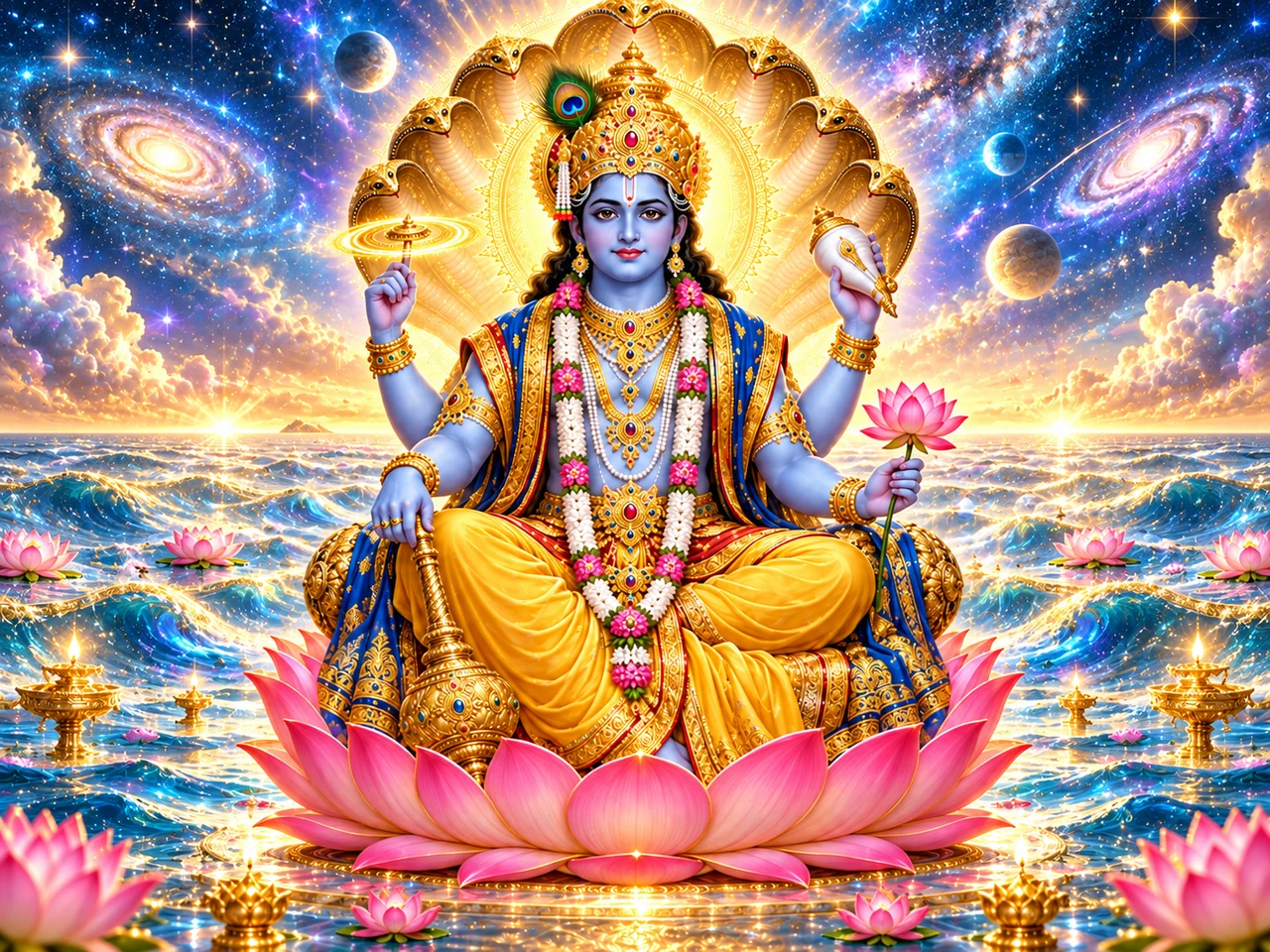
The Narayana KavachaNārāyaṇa Kavacha is not an isolated modern composition. It is the protective teaching embedded in Śrīmad-Bhāgavatam 6.8, a full chapter of 42 numbered verses. Parīkṣit first asks about Indra's victory; Śuka narrates how Viśvarūpa explained the protective tradition to Indra. Verses 4–11 report the traditional liturgical setting, 12–34 are the principal petitions to Hari and his forms, and 35–42 conclude the teaching and related narrative. 1 2
Textual scope and shared source. This edition carries the whole chapter to avoid misleading readers about where the prayer begins and ends. If ShivGoraksh later publishes a Bhāgavata scripture reader, the original Sanskrit should be unified behind a single source record rather than maintained as divergent devotion and scripture copies. The aṣṭākṣarī at 6.8.6 is related to Om Namo Narayanaya and the twelve-syllable mantra at 6.8.7 to Om Namo Bhagavate Vasudevaya. 1 6
Source confidence. The draft transcribes a 42-verse digital presentation and compares key loci against another online source. It has not been collated verse by verse against a dated historical printing. Difficult compounds and the manuscript evidence remain unresolved; no translation from a modern copyrighted site is reproduced. This is not a production-ready canonical master. 1 2 5
Interpretive and practice caution. This is a historical-religious text, not a guarantee of safety in combat, illness or danger. Mythic weapon imagery is not a call for violence. Rites named in the original (including nyāsa and mantra placement) are described for context only; the article does not instruct readers how to perform them.
Themes and devotional significance
What a kavacha protects in this poetic language
Kavaca literally means armour. Here it is built from forms and names of Narayana rather than from a physical substance. The verse sequence draws ordinary fears—water, roads, forests, darkness, distraction, illness and conflict—into a language of dependence on the divine. The imagery offers a sense of belonging and responsibility; it is not empirical evidence that hazards disappear. literally means armour. Here it is built from forms and names of Nārāyaṇa rather than from a physical substance. The verse sequence draws ordinary fears—water, roads, forests, darkness, distraction, illness and conflict—into a language of dependence on the divine. The imagery offers a sense of belonging and responsibility; it is not empirical evidence that hazards disappear. 1
The many forms and the hours of a day
Verses 13–19 move through Matsya, Vāmana, Trivikrama, Nṛsiṃha, Varāha, Rama, Kapila and other manifestations. Verses 20–22 map divine names onto the passing day. Vaiṣṇava commentators can differ on the roles of individual names and manifestations, so these notes remain descriptive rather than doctrinally absolute. Verses 13–19 move through Matsya, Vāmana, Trivikrama, Nṛsiṃha, Varāha, Rāma, Kapila and other manifestations. Verses 20–22 map divine names onto the passing day. Vaiṣṇava commentators can differ on the roles of individual names and manifestations, so these notes remain descriptive rather than doctrinally absolute. 1 4
Why the weapons and concluding promises matter
Verses 23–26 directly address divine weapons through fierce mythic imperatives. The statements of victory, safety and healing later in the chapter belong to a traditional phalaśruti and narrative conclusion. They are meaningful evidence of religious imagination, not guaranteed results in health or security. 1
Textual variants and editorial decisions
- 6.8.10: the source wording oṃ viṣṇave nama iti is not silently replaced with a standalone oṃ viṣṇave namaḥ. 1
- 6.8.12 and 6.8.15: dense weapon compounds and the referent of RamaRāma need independent print/commentarial checking. 1 2
- 6.8.24, 6.8.27, 6.8.29 and 6.8.34: editorial normalisation of script and sandhi remains provisional. Verse 40 has an additional pāda and must not be truncated. 1 3
- Speaker headings belong to verses 1, 3, 4 and 41; they are editorial metadata, not extra numbered stanzas. 1
Frequently asked questions
Where does Narayana Kavacha come from?Where does Nārāyaṇa Kavacha come from? The sixth skandha, eighth chapter of the Śrīmad-Bhāgavatam; this chapter contains 42 numbered verses. 1
Are all 42 verses a prayer? No. They contain a question, a reported liturgical frame, the central protective prayer, promises and a closing narrative. Verses 12–34 form the prayer's main petitioning sequence. 1
Is the eight-syllable mantra the whole kavacha? No. Oṃ namo nārāyaṇāya is quoted in 6.8.6 and has its own shorter devotional record. 1
Does the chapter promise guaranteed freedom from sickness and harm? It contains devotional promises; these are not medical or safety guarantees. Does this page teach nyāsa? No. It reports what the source says without giving operational initiation- or ritual-specific instructions.




Additional passage commentary
Verse 1 — Bhāgavata 6.8.1
Meaning: King Parīkṣit recalls how thousand-eyed Indra, protected by a sacred armour, overcame an opposing army and gained dominion over the three worlds. Explanation: The words 'sahasrākṣa' and the three-world sovereignty identify Indra in a Purāṇic narrative; this is not an independent military history.
Verse 2 — Bhāgavata 6.8.2
Meaning: He asks the sage to explain the protective teaching associated with Narayana and Indra’s victory in battle. He asks the sage to explain the protective teaching associated with Nārāyaṇa and Indra’s victory in battle. Explanation: The question sets the subject: a named kavaca embedded in a larger scriptural conversation, rather than an anonymously transmitted free-standing hymn.
Verse 3 — Bhāgavata 6.8.3
Meaning: Śuka introduces Viśvarūpa, son of Tvaṣṭṛ and Indra’s priest, as the speaker who first explained the Narayana armour. Śuka introduces Viśvarūpa, son of Tvaṣṭṛ and Indra’s priest, as the speaker who first explained the Nārāyaṇa armour. Explanation: Śuka is the frame narrator, whereas Viśvarūpa is the teacher in the inner dialogue. Preserve that distinction when linking scripture nodes.
Verse 4 — Bhāgavata 6.8.4
Meaning: Viśvarūpa describes customary purifications and mantra placement upon the limbs and hands before this protective recitation. Explanation: This is a report of a traditional rite, not an invitation to perform ācamana or nyāsa from an unsupervised guide. Details can be lineage-sensitive.
Verse 5 — Bhāgavata 6.8.5
Meaning: The passage calls the teaching Narayana-centred armour and names the feet, knees, thighs, abdomen, heart and chest as parts of the traditional liturgy. The passage calls the teaching Nārāyaṇa-centred armour and names the feet, knees, thighs, abdomen, heart and chest as parts of the traditional liturgy. Explanation: These named body locations form part of the source's descriptive ritual language. The page intentionally does not turn them into operational steps.
Verse 6 — Bhāgavata 6.8.6
Meaning: It continues with the mouth and head and explicitly names the eight-syllable formula 'Oṃ namo Nārāyaṇāya', along with a reversed order in ritual usage. Explanation: Aṣṭākṣarī means eight syllables. The eight-syllable prayer is Om Namo Narayanaya; it is distinct from the twelve-syllable prayer.
Verse 7 — Bhāgavata 6.8.7
Meaning: It refers to a second, twelve-syllable formula and its customary assignment to the finger and thumb joints. Explanation: The twelve-syllable formula is associated with Om Namo Bhagavate Vasudevaya. This chapter names its structure without repeating the full wording here.
Verse 8 — Bhāgavata 6.8.8
Meaning: The text describes the syllables of the Vishnu formula in association with the heart, head, brow and hair crest. The text describes the syllables of the Viṣṇu formula in association with the heart, head, brow and hair crest. Explanation: The letters are syllabic elements of the phrase viṣṇave namaḥ, not ordinary standalone words with independently fixed translations.
Verse 9 — Bhāgavata 6.8.9
Meaning: It associates further syllables with the eyes, bodily joints and protective symbolism, portraying the adept as a bearer of the mantra. Explanation: The image of becoming 'mantra-formed' is a traditional devotional transformation of identity; no medical or supernatural result is guaranteed.
Verse 10 — Bhāgavata 6.8.10
Meaning: The mantra concludes in a direction-protection expression, and the text names the formula 'Oṃ viṣṇave namaḥ'. Explanation: The transmitted source includes 'phaṭ' terminology. It remains a quoted text, not a recommendation for directional ritual practice.
Verse 11 — Bhāgavata 6.8.11
Meaning: The meditator is asked, within the story’s rite, to contemplate the supreme being endowed with six powers, knowledge, brilliance and austerity. Explanation: The theological language of six powers varies across Vaiṣṇava schools. No single school’s list is silently imposed on the passage.
Verse 12 — Bhāgavata 6.8.12
Meaning: The prayer invokes eight-armed Hari on Garuḍa, equipped with conch, discus, shield, sword, mace, arrows, bow and noose, to protect the supplicant. Explanation: This starts the petition proper after the preliminary verses. The eight arms and eight attributes join devotional iconography with martial protection imagery.
Verse 13 — Bhāgavata 6.8.13
Meaning: Matsya is invoked amid water, Vāmana upon land and Trivikrama across the sky and the vastness of the universe. Explanation: Different avatāras address different environments; the mapping is poetic rather than a promise of physical safety in water or flight.
Verse 14 — Bhāgavata 6.8.14
Meaning: Nṛsiṃha is invoked in forests, dangerous passes and battle, his awesome laughter reverberating throughout the directions. Explanation: This is a deliberately fearsome Purāṇic description; its line about miscarriage is part of the mythic image, not a wish or a medical claim.
Verse 15 — Bhāgavata 6.8.15
Meaning: Varāha, who raised Earth upon his tusk, is called upon during travel; Rama with Lakṣmaṇa is asked to guard the devotee in remote places. Varāha, who raised Earth upon his tusk, is called upon during travel; Rāma with Lakṣmaṇa is asked to guard the devotee in remote places. Explanation: Some expositions distinguish Paraśurāma at 'adri-kūṭa' and Rāmacandra with Lakṣmaṇa in exile; keep the ambiguity visible when translating 'Rama'. Some expositions distinguish Paraśurāma at 'adri-kūṭa' and Rāmacandra with Lakṣmaṇa in exile; keep the ambiguity visible when translating 'Rāma'.
Verse 16 — Bhāgavata 6.8.16
Meaning: Narayana, Nara, Dattātreya and Kapila are invoked against error, heedlessness, disconnection from yoga and bondage to action. Nārāyaṇa, Nara, Dattātreya and Kapila are invoked against error, heedlessness, disconnection from yoga and bondage to action. Explanation: The list shifts from geographic hazards to interior ethical and spiritual dangers: pride, distraction and attachment to action.
Verse 17 — Bhāgavata 6.8.17
Meaning: Sanatkumāra, Hayagrīva, Nārada and Kūrma are named as guardians against desire, irreverence, failures in worship and fearful destinies. Explanation: 'Hayagrīva' literally evokes the horse-headed form. Worship and moral care are praised; the text should not become a manual for prescribed rites.
Verse 18 — Bhāgavata 6.8.18
Meaning: Dhanvantari, Ṛṣabha, Yajña, Balarāma and the serpent lord are invoked amid harmful habits, turmoil, social dangers and anger. Explanation: 'Dhanvantari' is associated with healing; the verse makes a devotional request and does not replace medical treatment or professional advice.
Verse 19 — Bhāgavata 6.8.19
Meaning: Vyāsa, Buddha and Kalki are invoked against ignorance, misleading conduct and the moral decay symbolised by the age of Kali. Explanation: The name 'Buddha' appears as an avatāra in this particular Purāṇic list; Buddhist traditions need not accept this theological classification.
Verse 20 — Bhāgavata 6.8.20
Meaning: Keśava, Govinda, Narayana and Vishnu are invoked for protection across morning and midday, with distinctive attributes of each form. Keśava, Govinda, Nārāyaṇa and Viṣṇu are invoked for protection across morning and midday, with distinctive attributes of each form. Explanation: The ordered sequence of daytime names is a devotional schedule described by scripture, not a verified timetable or compulsory practice.
Verse 21 — Bhāgavata 6.8.21
Meaning: Madhusūdana, Mādhava, Hṛṣīkeśa and Padmanābha are invoked as the day moves through afternoon, evening and night. Explanation: The verse crosses the sunset and midnight periods, portraying divine remembrance as continuous as time passes.
Verse 22 — Bhāgavata 6.8.22
Meaning: The prayer continues with forms including Janārdana, Dāmodara and Viśveśvara at dawn and the transitions of night and day. Explanation: The closing part of the time-circle employs several names for Vishnu. Varying divisions of time exist across recitation traditions. The closing part of the time-circle employs several names for Viṣṇu. Varying divisions of time exist across recitation traditions.
Verse 23 — Bhāgavata 6.8.23
Meaning: The Lord's revolving discus is addressed in fierce imagery, compared to a fire consuming dry grass, to dispel the enemy host. Explanation: The double imperative intensifies the poetry. These expressions are mythic combat imagery, not guidance for violence against real persons.
Verse 24 — Bhāgavata 6.8.24
Meaning: The mace is invoked in martial, thunderbolt-like imagery against terrifying hostile beings and obstructive forces. Explanation: The reduplicated verbs heighten the urgent tone. Names for spirits and beings reflect the poem’s religious worldview.
Verse 25 — Bhāgavata 6.8.25
Meaning: The divine conch is asked to drive away threatening spirits and hostile glances with its mighty sound. Explanation: Dare/śaṅkha is the conch; its terrifying sound functions here as an image of divine presence overcoming fear.
Verse 26 — Bhāgavata 6.8.26
Meaning: The sword and shield are praised in images of cutting through hostile forces and concealing the sight of malicious aggressors. Explanation: The poetic commands refer to divine weapons within the kavaca. They must not be interpreted as directions to harm anyone.
Verse 27 — Bhāgavata 6.8.27
Meaning: The speaker names fears associated with heavenly portents, other people, serpents, dangerous animals and wrongdoing. Explanation: Terms for portents and harmful beings belong to the traditional cosmology. Do not portray astrology or supernatural danger as scientifically established.
Verse 28 — Bhāgavata 6.8.28
Meaning: May such obstructions, the text prays, vanish through praise and remembrance of the Lord's names and forms. Explanation: 'Nāma-rūpa-anukīrtana' links deliverance to recalling divine names and forms, a central devotional theme.
Verse 29 — Bhāgavata 6.8.29
Meaning: Garuḍa, understood through the language of sacred metre and praise, and Viṣvaksena are invoked for help in distress. Explanation: The imagery joins Garuḍa with Vedic metres and praise. Textual compounds deserve specialist attention in the historical-print collation.
Verse 30 — Bhāgavata 6.8.30
Meaning: The Lord's names, forms, vehicles, weapons and attendants are invoked to safeguard intellect, senses, mind and life-breath. Explanation: This prayer expands protection beyond the body to inner faculties, giving the kavaca a reflective and psychological dimension.
Verse 31 — Bhāgavata 6.8.31
Meaning: The verse grounds its appeal in the theological claim that all that is manifest and unmanifest depends upon the divine reality. Explanation: The claim about sat/asat connects the request for safety to a comprehensive Vaiṣṇava account of ultimate reality.
Verse 32 — Bhāgavata 6.8.32
Meaning: Divine ornaments, weapons and marks are described as manifestations of the Lord's own power, not independent competing deities. Explanation: The line resists treating the Lord's emblems as unrelated divine powers; philosophical interpretations remain tradition-dependent.
Verse 33 — Bhāgavata 6.8.33
Meaning: The all-knowing, all-pervading Hari is petitioned to protect everyone through all his forms in every place and time. Explanation: 'Sarvagāḥ' means all-pervading. The protection sought is theological reassurance, not certainty that harm will never occur.
Verse 34 — Bhāgavata 6.8.34
Meaning: Nṛsiṃha is invoked above, below, within, without and in every direction, his splendour dispersing cosmic fear. Explanation: The closing prayer returns to Nṛsiṃha to envelop all directions, including inward and outward experience.
Verse 35 — Bhāgavata 6.8.35
Meaning: Viśvarūpa tells Indra that this Narayana-centred armour has been explained and predicts victory over opposing forces. Viśvarūpa tells Indra that this Nārāyaṇa-centred armour has been explained and predicts victory over opposing forces. Explanation: Here Viśvarūpa ends his speech to 'Maghavan' (Indra). The change in voice determines where the inner kavaca instruction stops.
Verse 36 — Bhāgavata 6.8.36
Meaning: The traditional account attributes the easing of fear even in others to one who carries this protective knowledge. Explanation: Its promised effect belongs to the phalaśruti and is presented as a devotional belief, not experimentally established causation.
Verse 37 — Bhāgavata 6.8.37
Meaning: It promises fearlessness from rulers, thieves, spirits and illness to one who holds the sacred knowledge. Explanation: The health and safety claims are stated as part of the Purāṇic text, not as guarantees; seek real-world support when needed.
Verse 38 — Bhāgavata 6.8.38
Meaning: An illustrative story begins: a Brāhmaṇa named Kauśika is said to have left his body through yogic absorption in a desert. Explanation: Kauśika’s death and yogic departure are narrative motifs; the site does not endorse extreme practices or self-harm.
Verse 39 — Bhāgavata 6.8.39
Meaning: The Gandharva leader Citraratha, traveling with his companions, passes above the place where Kauśika's remains lay. Explanation: The continuation identifies Citraratha and the location of the remains, setting up a mythic account about respect for ascetics.
Verse 40 — Bhāgavata 6.8.40
Meaning: The story says Citraratha falls from the sky and, following counsel from sages, moves the remains to the Saraswati and returns home. The story says Citraratha falls from the sky and, following counsel from sages, moves the remains to the Sarasvatī and returns home. Explanation: This is a religious narrative, not evidence for literal aviation; there is no instruction here to perform funerary acts.
Verse 41 — Bhāgavata 6.8.41
Meaning: Śuka adds a phalaśruti: those who hear or honour this account are praised in the text as receiving freedom from fear. Explanation: The phrase about removing fear is a traditional promised fruit of devotion, not a substitute for practical protection.
Verse 42 — Bhāgavata 6.8.42
Meaning: The chapter closes by saying Indra received the teaching from Viśvarūpa and won the battle with the asuras. Explanation: The conclusion reconnects the kavaca to the initial question: Parīkṣit asked about Indra and now receives a complete account.