



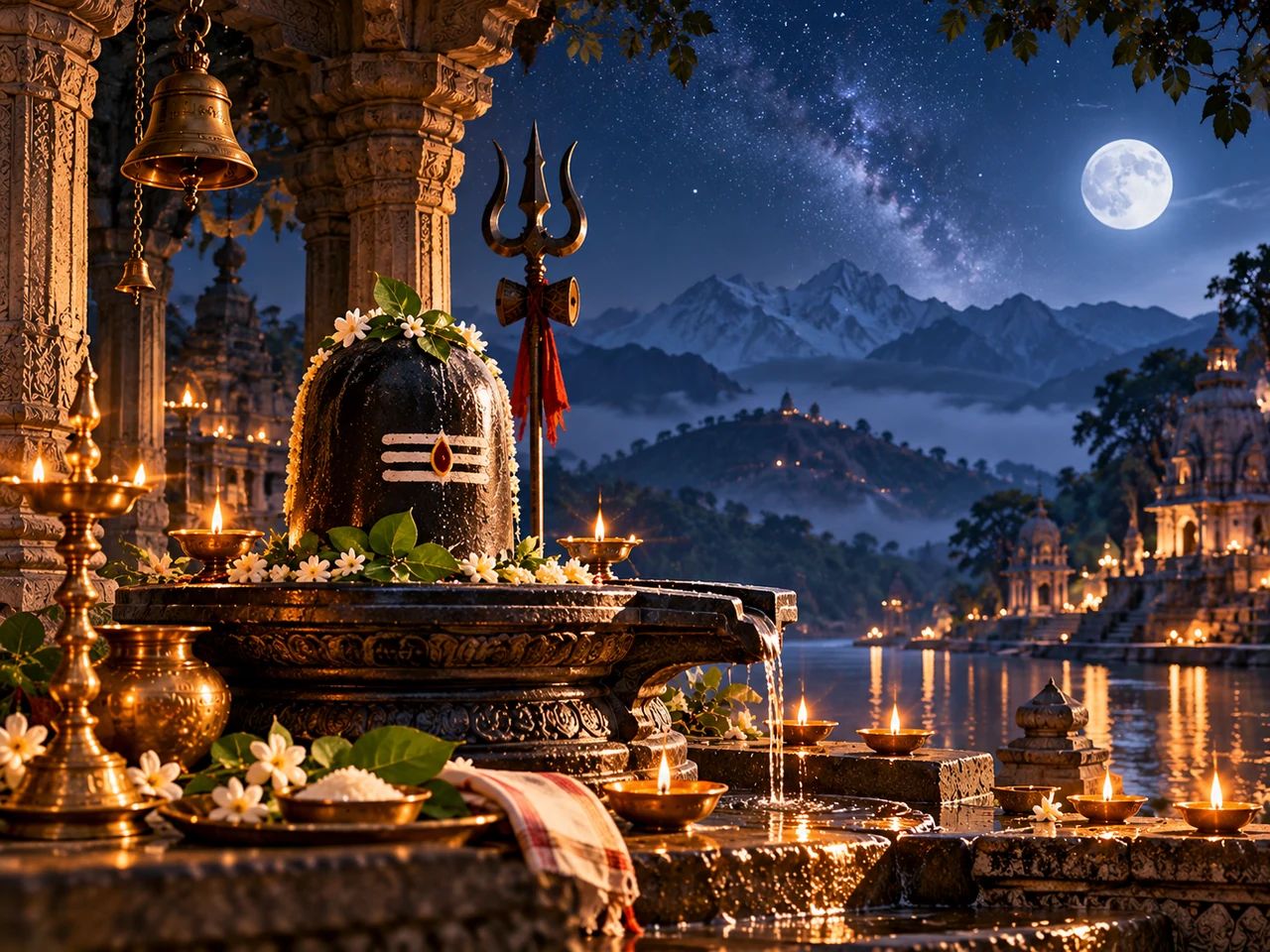
An annual night of prayer, reflection and devotion that gives silence a place beside celebration.
Mahashivratri at a glance
| Question | Answer |
|---|---|
| What is it? | An annual Hindu observance dedicated especially to Shiva. |
| What does the name mean? | Mahā means great; ShivratriŚivarātri is the night of Shiva. |
| When is it observed? | Around the dark-fortnight (Krishna PakṣaKṛṣṇa Pakṣa) fourteenth lunar day (Caturdaśī) of the late-winter month called Phalguna in many North Indian Purnimanta calendars and Magha in many Amanta calendars. Exact local dates require an approved calendar rule. |
| What distinguishes it? | Night-long remembrance, temple worship and, in many communities, a voluntary fast and vigil (jāgaraṇa). |
| Who observes it? | Shiva devotees and many wider Hindu communities, with distinctive household, temple and regional traditions. |
| Related occasion | Masik Shivratri is a separate monthly occurrence, not another name for this single annual festival. |
A night unlike an ordinary festival day
On many Hindu festive days, the bright hours fill with processions, family visits and shared meals. Mahashivratri draws attention to the hours when the world becomes quieter. Temple lamps continue to burn; bells mark successive periods of worship; people sing Shiva's names, sit in meditation or listen to narratives. Not everyone stays awake all night, and no single style of participation represents every tradition. But the question behind the observance is widely recognizable: what happens when attention turns away from daily noise and toward the sacred?
For devotees, this is a night associated with Shiva—ascetic and householder, silent yogi and cosmic dancer, the deity known as Mahadev, Shankar, Shambhu and Bholenath. Its significance is larger than one story. Shaiva traditions, Puranic accounts and local customs have attached several meanings to the night; the best way to understand it is to hear each on its own terms. 1, 5, 7
Names, meanings and related observances
Mahāśivarātri, Maha Shivaratri, Mahashivratri and Mahashivratri Vrat are common spelling or devotional variants. In some contexts the shorter Shivratri refers to this annual festival; elsewhere it can mean the recurring monthly observance. The context matters. Rātri means night, an apt reminder that the observance cannot always be selected by checking the lunar day at morning sunrise. 8
The word vrat (Sanskrit vrata) refers to a religious observance or commitment; fasting is one possible element, not the entire definition of devotion. A linga is a revered emblem of Shiva, and abhisheka means a ritual bathing or anointing of a deity or sacred image. These words appear often in descriptions of the festival, but their local forms vary. 1, 2
Textual foundations and historical development
The Shiva PurāṇaŚiva Purāṇa gives Shivratri exceptional importance. In its Vidyeśvara-saṃhitā, chapter 9, Shiva praises the observance while Brahma and Vishnu stand before him. The chapter connects the day with devotion, self-restraint and worship of Shiva in an embodied image or linga. Its devotional promises are claims made by the text, not independently measurable outcomes. 1
A different sequence in the Koṭirudra-saṃhitā, chapters 38–40, treats the vow and explains its importance through the story of a hunter whose conduct changes through a night of unintentional worship. Together, these passages document a substantial Puranic tradition of Shivratri devotion. Their presence in a received text does not, by itself, date the first historical observance of the festival or establish an unchanged all-India ritual. 2, 3
Evidence of regional history is equally important. The Indira Gandhi National Centre for the Arts (IGNCA) documents Kashmiri Shivratri, or Herath, with reference to Nīlamatapurāṇa festival material, domestic rites and a multi-day local cycle. The quoted ancient passage still needs comparison with a named Sanskrit edition before its precise wording can be reproduced on ShivGoraksh. What the study clearly shows is that community tradition has its own history beyond a generic festival description. 5
1. The endless column of light
A well-known Shiva PurāṇaŚiva Purāṇa cycle begins with a dispute between Brahma and Vishnu. Shiva manifests as an immeasurable column of fire, revealing how inadequate pride can be before the unbounded divine. After the deities offer reverence, Shiva extols a day called Shivratri. This imagery makes the linga, for many worshippers, a sign of reality that exceeds any one visible form. 1
There is an important textual distinction. The same Vidyeśvara-saṃhitā chapter 9 separately says that the manifestation as a column of fire occurred under the Ārdrā star in Mārgaśīrṣa. It would therefore be misleading to assert that this cited passage straightforwardly dates the fiery manifestation itself to the annual late-winter Mahashivratri. Later devotional associations may connect the column of light with the festival, but those associations must be labelled as interpretations. 1
2. The marriage of Shiva and Parvati
In popular storytelling Mahashivratri is often celebrated as the wedding night of Shiva and Parvati. Their union joins a deity who seems to stand outside ordinary society with a goddess whose resolve, discernment and devotion bring him into relationship with the world. It can be understood as a meeting of contemplative stillness and dynamic Shakti. 4, 7
The Shiva PurāṇaŚiva Purāṇa, Rudra-saṃhitā, Parvati-khaṇḍaPārvatī-khaṇḍa, does narrate their marriage in detail. However, a text's description of a marriage and a community's celebration of Mahashivratri as the marriage night are different kinds of evidence. No universally binding historical wedding date follows from this narrative, and not every Shaiva community makes the wedding its central interpretation. 4
3. The hunter, the bilva tree and a change of heart
Another story unfolds far from a splendid temple. The hunter Gurudruha waits for prey in a tree on Shivratri, unaware that a linga stands below. While he keeps watch, water and bilva leaves repeatedly fall onto it. Deer ask him to let them return to care for their young and promise to come back. Their honesty unsettles the hunter; by dawn he chooses compassion instead of killing. The text describes Shiva's grace and the hunter's transformation. 3
The story is not an instruction to hunt or to copy its accidental rite. It illustrates the possibility that a person who has lived carelessly can become capable of restraint, truthfulness and mercy. The Shiva PurāṇaŚiva Purāṇa version is a devotional narrative, not a report about a recoverable historical hunter. 3
4. The cosmic dance and the dark night
Some devotional explanations associate this night with Shiva's cosmic dance, often called tāṇḍava, in which creation, change and dissolution are imagined as aspects of cosmic rhythm. This is a meaningful Shaiva interpretation, especially where Nataraja imagery is prominent, rather than a single universally established account of the festival's origin. Chidambaram's Nataraja tradition gives dance a particularly powerful religious language. 5, 10
These narratives should not be fused into one purportedly documented event. Each offers a different point of entry: humility before the infinite, the partnership of Shiva and Shakti, compassion through moral change, and awareness of life's movement.
When does Mahashivratri occur?
Mahashivratri is associated with Krishna Paksha Chaturdashi, the fourteenth lunar day of the waning fortnight near the new moon. It is not a full-moon festival, and “fourteenth” does not mean the fourteenth day of a Gregorian month. A tithi depends on the changing angular separation of Sun and Moon and can begin or end between successive sunrises. 8, 11
For many North Indian Purnimanta calendars the festival's fortnight is named Phalguna Krishna Paksha; in many western and southern Amanta calendars the same fortnight is called Magha Krishna Paksha. The different month names are not evidence that the festival automatically occupies two different nights. Nevertheless, geography, actual lunar intervals and observance-selection conventions can also affect the finally selected local civil date. 11
Nighttime is central. Certain calendar traditions examine whether Chaturdashi prevails in a qualifying midnight/ardharatri or nishita interval rather than applying a universal sunrise-only shortcut. The published festival-rule digest used here reports different historical prescriptions, including disagreement over consecutive qualifying nights. That disagreement is a reason for a tested, named rule profile—not for the article writer to choose a date. 8
Where is the next Mahashivratri date? The ShivGoraksh Calendar will eventually display the selected observance for a supported city, year and approved convention. Date/timing not yet verified for this city/year is the correct state until that service has reviewed occurrence data. No fixed Gregorian date or auspicious time is asserted in this article.
Prayer, linga worship and abhisheka
In many Shiva temples, devotees offer prayers at a Shiva linga. Water, flowers and bilva leaves are familiar offerings, and some traditions also use milk or other customary substances in abhisheka. Worship arrangements depend on the temple, household resources and local practice. The ritual significance of bilva is supported by the hunter episode, but that story does not establish one obligatory procedure for every worshipper. 3, 7
Families may light lamps, sing aarti, listen to Shiva stories or visit a temple for darshan. Some temples hold special periods of worship throughout the night. The term prahara denotes a division of day or night; descriptions of four night-watches of worship need not imply one standardized schedule at every location. Public participation, voluntary prayer and learning are distinct from lineage-specific ritual initiation. 2, 7
Fasting and the vigil
Some worshippers observe a strict fast; others avoid certain foods, take fruit or milk, or follow a family-specific meal pattern. Others participate without fasting. Such variation should not be treated as a measure of moral worth. The Shiva PurāṇaŚiva Purāṇa describes fasting and self-restraint in its own normative religious setting; it is not medical guidance or a universal obligation. People for whom food or hydration restrictions would be unsafe should not be pressured to fast. 1, 2
Jāgaraṇa means remaining awake in devotional attention. It can involve singing, recitation, meditation or quiet contemplation. Some observe for part of the night rather than all of it. Religious claims about exceptional cosmic energies or guaranteed bodily effects should be understood as faith-based teachings where taught, not as scientifically confirmed medical or astronomical outcomes. 7
Sequence, from preparation to the following day
Household and temple customs differ, but an illustrative pattern is preparation and prayer during the day, evening worship, one or more periods of worship or reflection at night, and the ending of the observance on the following day according to the family's or institution's tradition. Fasting completion and associated timing, if applicable, belong to an approved location-specific calendar rule or a qualified local guide—not to this evergreen article. 2, 8
North and central India
At many northern and central Indian Shiva shrines the festival is associated with darshan, special worship, devotional singing and congregations of devotees. Public processions and representations of the Shiva–Parvati wedding occur in some communities, but one procession style cannot describe every town. Official Indian tourism coverage emphasizes both temple worship and night-long participation without supplying evidence for a single universal ritual. 7, 9
Kashmir: Herath
Among Kashmiri Pandit communities, Herath has distinctive family and ritual traditions. IGNCA describes a cycle involving household preparations, family observances and worship that extends beyond a single night. The same research records the importance of Shiva and the philosophical setting of Kashmiri Shaivism. Herath should not be reduced to a generic temple queue or assumed to mirror every custom elsewhere. 5
Tamil Shaiva contexts
South Indian Shaiva temples can emphasize special abhisheka, scriptural recitation and music; Chidambaram is especially associated with Shiva as Nataraja, whose dance is central to the temple's identity. This provides an important regional lens for understanding the symbolic importance of Shiva's dance, without asserting that all Tamil Shaiva observances look identical or that any one scheduled event runs every year unchanged. 10
Nepal: Pashupatinath
At Kathmandu's Pashupatinath, Shivaratri is a major occasion of pilgrimage. Nepal Tourism Board records the arrival of devotees and ascetics seeking darshan at the temple beside the Bagmati. The Pashupati Area Development Trust also identifies its Shivaratri gathering as a major annual event. Access restrictions and temple schedules should be checked separately and must not be inferred from the festival article. 6, 9
Symbols that help explain the occasion
The linga is Shiva's sacred emblem, understood in Shaiva traditions in ways that can encompass presence, transcendence and the relationship between manifest and unmanifest reality. Calling it merely an everyday object misses its devotional and philosophical range. Bilva leaves signify an established form of offering. Water and other bathing substances are elements of worship, not proof of a medical mechanism. Lamps make night prayer visible, while ash may remind worshippers of impermanence and the ascetic path. Shiva's crescent moon, trident and Nandi are associated with his wider iconography; not all must appear in a particular Mahashivratri setting. 1, 3, 10
Food, prasad and household hospitality
A family may prepare fruit, sweets or simple foods suitable to its own fasting custom; a temple may distribute prasad after worship. Regional households also have their own customary festive meals. The chosen food is not a test of whether the festival has been celebrated “correctly.” The timing of ending a formal fast, where relevant, is not supplied here because it may depend on a verified observance profile. Hospitality and sharing food can be meaningful even for those not fasting. 5, 7
Spiritual meanings: Shiva, Shakti and the Nath perspective
For some devotees Shiva represents the quiet witness beneath restless activity. The night suggests a pause in habit: noticing anger before it becomes injury, loosening pride, and attending to a deeper form of stillness. The hunter story makes this ethical aspect vivid. In Shiva–Shakti interpretations, the marriage story can express the inseparability of awareness and power. These are philosophical readings, not mandatory creeds for all Hindus. 1, 3, 4
ShivGoraksh also includes Nath teachings and the lives of Matsyendranath and Gorakhnath. Their traditions can help readers understand why yogic discipline, attention and guru guidance matter in some Shaiva environments. Yet Mahashivratri is not exclusively a Nath festival, and specific advanced practices or mantras must not be inferred from this broad educational overview.
Public worship, private disciplines and responsible limits
Public, descriptive material on temple visits, shared song, commonly recognized offerings and voluntary reflection is educationally appropriate (PUBLIC). Details of fasting or the observance sequence are tradition-specific; they change by household, temple, region and religious authority. Lineage-bound tantric initiations, secret mantras, esoteric visualizations and advanced yogic methods, where relevant, are initiation-dependent or UNKNOWN_REVIEW_REQUIRED until reviewed. This article does not provide such procedures.
Scriptures, songs and related festivals
The primary narrative references used here are the Shiva PurāṇaŚiva Purāṇa: Vidyeśvara-saṃhitā chapter 9; Rudra-saṃhitā, Parvati-khaṇḍaPārvatī-khaṇḍa, chapter 48; and Koṭirudra-saṃhitā chapters 38–40. Their function in this article is to document particular narratives and devotional prescriptions, not to establish a single historical origin. 1, 2, 3, 4
Communities may recite Shiva's names, Shri RudramŚrī Rudram, Shiva stotras or locally beloved bhajans. A full-text recitation, exact mantra wording or passage-specific quotation requires a verified edition and appropriate rights clearance; none is invented here.
1. Is Mahashivratri Shiva's birthday?
It is primarily described as a night of Shiva devotion; different communities relate it to Shiva's manifestation, marriage or cosmic dance. Calling it simply a universally agreed historical birthday erases those distinctions. 1, 4, 5
2. Is Mahashivratri the same as Masik Shivratri?
No. Masik Shivratri recurs monthly near Krishna Chaturdashi, while Mahashivratri is the specially observed annual occasion. Their calendar records should be separate. 8
3. Why do some calendars say Magha and others Phalguna?
The same dark fortnight has different month labels in Amanta and Purnimanta reckoning. Always check the calendar convention before concluding that two sources contradict one another. 11
4. Why may the festival's civil date differ between calendar sources?
A tithi can cross sunrise and midnight, while a religious rule may require its presence in a particular night interval. Local astronomy, timezone and competing selection conventions also matter. The date must be reviewed for a defined city and rule profile. 8
5. Must everyone fast without food or water?
No universal fasting regime can be inferred from the festival's name or a single Puranic passage. Participation varies; safety and individual circumstances matter. 1, 7
6. Is staying awake all night compulsory?
A vigil is a prominent custom, but observance varies. Some families or devotees pray for part of the night, attend worship or reflect at home. 7
7. Why are bilva leaves offered to Shiva?
They belong to established Shiva worship, and the Shivratri hunter narrative features leaves falling upon a linga. Their devotional use does not mean every household has one compulsory offering list. 3
8. Was Shiva and Parvati's wedding definitely on this date?
Many devotees celebrate the night through their marriage story. The Shiva PurāṇaŚiva Purāṇa narrates their wedding, but that does not establish a historically dated event or one universal festival explanation. 4
9. What is Herath?
Herath is a Kashmiri Shivratri tradition especially associated with Kashmiri Pandit households, including observances spread over several days. 5
10. Is the fiery column episode proof of Mahashivratri's historical origin?
No. The Vidyeśvara-saṃhitā explicitly distinguishes Shivratri's praise from a statement locating the fiery-column manifestation under Ārdrā in Mārgaśīrṣa. Its narrative has religious importance but is not a dated historical record. 1
11. Where can I see the next local festival date?
Use a verified ShivGoraksh Calendar occurrence for your selected supported location when one becomes available. Until then, the correct status is date/timing not yet verified; this article does not provide a calculated date.
Glossary
Abhisheka: ceremonial bathing/anointing in worship. Bilva: leaf associated with offerings to Shiva. Chaturdashi: fourteenth lunar tithi. Darshan: seeing and being in the sacred presence of a deity or shrine. Jagaran: devotional night vigil. Krishna Paksha: waning lunar fortnight. Linga: revered emblem of Shiva. Nishita/Ardharatri: midnight-related interval terms, with exact computational definitions requiring an approved rule profile. Prasad: food or other offering received in a sacred context. Vrata: religious observance or vowed discipline.