



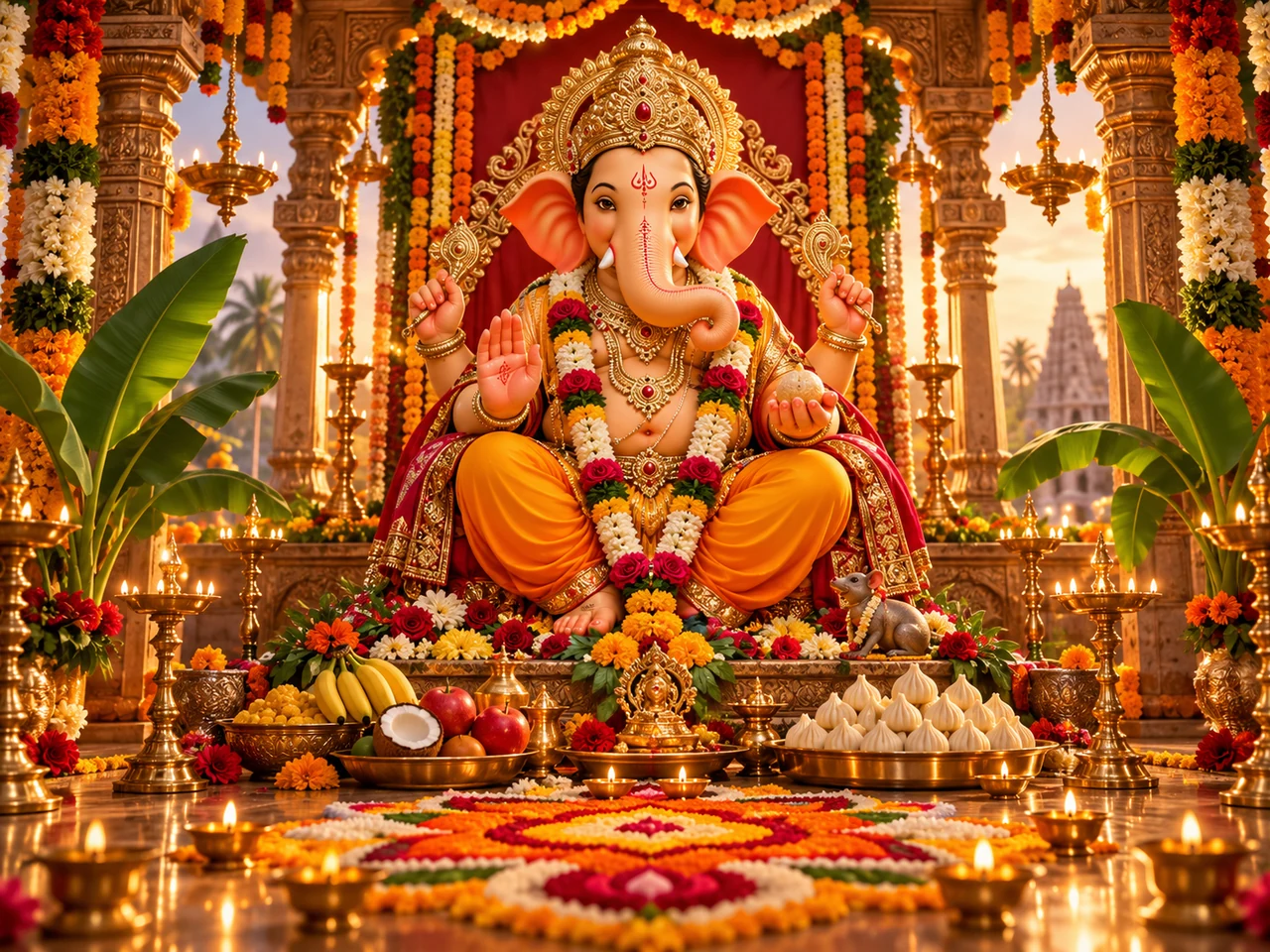
A neighbourhood workshop shapes a small clay Ganesha. At home, a family prepares a simple place for worship. Elsewhere, volunteers put the final touches on a shared mandap, or festival pavilion. When Ganesh Chaturthi arrives, these different scenes become parts of one celebration: welcoming Shri Ganesha, affectionately called Ganapati Bappa, with prayer, hospitality, music, food and companionship. Some households observe the day quietly; some communities celebrate over several days. Neither style describes every family's practice. 4, 5
Ganesh Chaturthi, also called Vinayaka Chaturthi, Ganeshotsav, Vinayaka Chavithi/Chavithi or Vinayagar Chaturthi in relevant regions, is an annual Hindu festival honouring Ganesha. Devotees celebrate him as the source of discernment and auspicious beginnings, and as Vighnaharta—the remover of obstacles. The festival commemorates his divine appearance in devotional tradition; its stories should not be confused with independently dated historical events. 1, 3, 4
At a glance
| Question | General answer |
|---|---|
| Whom does it honour? | Lord Ganesha, the elephant-headed deity associated with wisdom, beginnings and the overcoming of obstacles. |
| When? | Traditionally Bhadrapada Shukla Chaturthi, the fourth lunar tithi in the bright fortnight; the locally observed civil date requires reviewed Panchang rules. |
| Does the celebration last ten days? | Some large public festivities culminate near Anant Chaturdashi; household stays vary, including one-and-a-half-day and shorter or longer local patterns. |
| Main practices | Welcoming a murti, puja and aarti, offerings and shared meals, community events, farewell worship and, where customary, immersion (visarjan). |
| Important distinction | The annual Ganesh Chaturthi is not the same record as the monthly Vinayaka Chaturthi or Sankashti Chaturthi observances. |
The Shiva Purana narrative, Maharashtra's public-festival tradition and a contemporary ritual almanac each answer different questions. A story explains a devotional meaning; a history documents social change; a Panchang convention determines a particular local observance. They should not be substituted for one another. 1, 5, 6, 11
Why is Ganesh Chaturthi celebrated?
To welcome Ganesha is, for many devotees, to begin with thoughtful attention. He is remembered before study, journeys, ceremonies and new undertakings. Prayers express the hope that confusion will give way to clarity and that obstacles will be met with steadiness. This is a religious and ethical interpretation, not a promise of measurable outcomes. The Shiva Purana's account of his honouring as leader of the ganas and first among those worshipped provides one textual framework for that devotion. 3
The occasion has a social dimension too. Neighbours work together, children learn devotional songs and crafts, artisans prepare murtis, and families exchange food. Public celebrations may also support performances, learning activities and community service. The festival's welcoming, collective character is especially visible in Maharashtra, although practice is geographically diverse. 4, 5
For devotees who regard Ganesha as Shiva and Parvati's son, the celebration also illuminates a Shiva–Shakti household: the Goddess's agency, a child's loyalty, conflict, restoration and reconciliation. This connection suits ShivGoraksh's wider Shiva–Shakti learning context, without turning the festival into a specifically Nath observance. 1, 2
The story of Ganesha's birth: narrative and interpretation
The Shiva Purana, Rudra-samhita, Kumara-khanda, chapters 13–18 preserves a well-known account. Parvati creates a boy of her own and sets him to guard her doorway. The boy faithfully refuses entry to Shiva, whom he does not recognize. Conflict follows; after the boy loses his head, Parvati demands his restoration and appropriate honour. In this telling he is brought back to life with an elephant's head and is acknowledged as a foremost object of worship. The details of creation, conflict and revival are parts of the text's sacred narrative, not an archaeological report. 1, 2, 3
Importantly, the same work explicitly acknowledges multiple birth accounts associated with different kalpas (cosmic cycles). Readers should therefore resist claims that only one literal version exists throughout Hindu literature. Even the vrata instructions at the end of its eighteenth chapter have their own textual setting and should not be silently equated with the modern annual Bhadrapada Shukla Chaturthi date rule. 1, 3
The story invites several careful readings. Parvati's creation and fierce defence of the child place her power at the centre. The child's determination suggests duty, yet the conflict also encourages reflection on the limits of knowing only part of a situation. His return and appointment express reconciliation and restored relationship. These are interpretive lessons, not exclusive or compulsory explanations. 1, 2, 3
What do the names and features signify?
Ganapati and Ganesha convey leadership of the ganas, Shiva's attendants, in the familiar devotional explanation. Vinayaka is another widely used name, especially in southern regions. His elephant head is popularly read as intelligence and perceptiveness; his large ears suggest attentive listening, and the small mouse associated with him is interpreted in various communities as a reminder that even restless impulses may be directed thoughtfully. These symbolic readings differ across teachers and are not a single compulsory scriptural code. 3, 4
Ganesha may appear with one tusk, a rounded belly, ritual objects and sweets in devotional art. Such images invite reflection, but an artwork cannot establish the calendar date, prove a specific Purana variant or certify the correctness of a ritual. 1, 4
When is Ganesh Chaturthi?
The annual festival is traditionally associated with Shukla Paksha Chaturthi of Bhadrapada, the fourth lunar tithi during the waxing half of the month. Tithi measures the angular relationship of Moon and Sun; it is not simply the fourth midnight-to-midnight civil day. This is why a page can explain the yearly lunar principle without safely printing one universal Gregorian date. 4, 11
Many almanac traditions give importance to Madhyahna, the local midday portion, for Ganesha worship. But the exact civil day to select when Chaturthi crosses local midday, begins between sunrises or spans more than one candidate day requires an explicit, reviewed rule profile. Latitude, longitude, time zone, sunrise, sunset, tithi boundaries, month convention and edge-case decisions matter. A bare statement that Chaturthi exists at sunrise is not a universally adequate day-selector. 11
Amanta and Purnimanta naming systems must be handled deliberately rather than presumed identical; the relevant annual month label and treatment of exceptional lunar months belong to the calendar-review process. The local calendar module, once independently validated, should display the selected city and rule profile. Until then the accurate message is: “Date/timing not yet verified for this city/year.” 11
Some families also keep monthly Chaturthi observances, including Vinayaka Chaturthi on a bright-half fourth tithi and Sankashti Chaturthi on a dark-half fourth tithi. Those are recurring practices, not twelve occurrences of the annual Ganeshotsav. Their fasting and moon-related conventions must not be imported into this festival without review. 11
From a home welcome to Ganapati Visarjan
The festival is best understood as a sequence of hospitality, not a compulsory standardized script. Family custom, region, temple affiliation and the length of a murti's stay all shape the observance. 4, 8
1. Preparing a place for worship
A clean place is set aside, with flowers, lamps and other simple decorations. Some families bring a newly made clay murti; others worship an existing household form, picture, or permanent temple deity. Craftspeople and families may prepare for days beforehand. Public organizers prepare gathering spaces and take on shared responsibilities. Choosing a huge idol or elaborate decoration is not a universal religious requirement. 4, 8
2. Welcoming and worship
In homes using a temporary festival murti, its arrival may be accompanied by an avahana (invitation), followed by offerings, aarti, hymns and family prayer. Devotees often offer durva grass, flowers, fruit and sweets; precise lists and the formal shodashopachara sequence differ across practice manuals and lineages. This article describes commonly visible forms of worship—it does not replace an authorized family or temple procedure. 3, 4
3. Days of togetherness
During the period that the murti is kept, worship and offerings may recur daily. In public mandals, devotional singing, music, talks, theatre, craft displays and charitable initiatives may take place. Homes may host relatives and share prasad. Do not assume that one exact count of days applies to every village, city, household or temple. 4, 5
4. Uttar-puja and visarjan
At the conclusion, devotees offer farewell worship, often called uttar-puja, before the murti is immersed where the custom calls for it. Larger public celebrations frequently culminate on Anant Chaturdashi, while homes may say farewell earlier. The farewell expresses gratitude for the visit and the idea that a temporary form returns to the elements; devotion is not thought to disappear with the material murti. Goa Tourism specifically describes a household farewell followed by procession and immersion. 4, 8
Visarjan is not a demand to pollute a river. Environmental responsibility can be part of devotional hospitality. The Central Pollution Control Board's idol-immersion guidance supports natural clay, less toxic colour choices, segregated materials and suitable designated immersion arrangements. Local civic rules and facilities should be followed; an artificial tank or managed at-home method may be appropriate where permitted and safely handled. This is environmental guidance rather than an invented religious mandate. 12
Maharashtra: household devotion and public Ganeshotsav
Maharashtra is strongly associated with decorated home murtis and neighbourhood sarvajanik Ganeshotsav mandals. Pune and Mumbai's public gatherings may include aarti, devotional music, street processions, creative displays and large volunteer efforts. Ukadiche modak, steamed rice-flour dumplings with coconut and jaggery, are a familiar offering; household menus naturally vary. 4
The modern public history deserves precision. Ganesha worship and collective celebrations predated Bal Gangadhar Tilak. From the 1890s, Tilak helped promote and broaden the public form, giving it a stronger civic and nationalist dimension under colonial rule. Scholarship by Raminder Kaur challenges the simplified assertion that he single-handedly invented the public festival: other community leaders and earlier initiatives matter. This is historical development, different from the Purana narratives of Ganesha's appearance. 5, 6
Goa: Chovoth, family homecoming and matoli
Goa's Chovoth/Chavath has a distinctive household character. Families may return to ancestral homes; a decorated matoli/matov canopy with seasonal fruit, leaves, vegetables and other natural produce forms part of the setting. Offerings include modak and local sweets such as nevri. The festival joins devotion with regional farming, food and family ties. The pattern should not be reduced to a miniature version of Mumbai's public mandals. 8, 13
Karnataka: Gowri–Ganesha Habba
Karnataka's Gowri Habba is associated with worship of Goddess Gowri (Parvati), commonly on the day preceding Ganesh Chaturthi; the linked occasion is often called Gowri Ganesha Habba. Karnataka Tourism records household Goddess worship and the exchange of bagina, gifts of customary items. The relationship underlines the importance of Ganesha's mother without suggesting that every Karnataka household uses identical procedures. 7
Andhra Pradesh: Vinayaka Chavithi
Vinayaka Chavithi is observed in homes and temples in Telugu-speaking regions. Reports from Tirumala Tirupati Devasthanams about Shri Kapileswara Swamy Temple at TirupatiSri Kapileswara Swamy Temple at Tirupati document Ganesha worship through abhishekam, archana and a temple procession on the mouse vehicle (mushika vahana). A documented temple event illustrates one institutional practice, not a timetable for all locations or years. 9
Telangana: Hyderabad's community mandals
Hyderabad offers a conspicuous public-festival setting, including Khairatabad Ganapati and community installations. Telangana government reporting documents the Khairatabad celebration and civic preparations for immersion. Those event reports establish that the practice occurs there; their crowd figures and annually announced programmes should not be copied into an evergreen festival article. 10
Across other Indian regions and diaspora communities, temples and families also celebrate Vinayaka or Ganesh Chaturthi in locally meaningful ways. Without a verified named-source example, it is better to acknowledge this breadth than invent uniform observances. 4
Food and prasad: the language of offering
The most familiar sweet is modak—especially coconut-and-jaggery-filled steamed modak in Maharashtra. Fruit, coconut and other sweets are also shared. Goan households may prepare nevri beside modak. Such foods bring cooking, affection and hospitality into the festival; they are not requirements for every devotee. 4, 8
Some devotees observe a voluntary fast or choose simpler foods. Others eat their customary vegetarian festival meal and participate fully. Customs differ, and nothing in a general article can establish that everyone must fast. People with dietary or medical needs can participate through prayer or service without treating a restrictive fast as obligatory. Formal vrat procedures are tradition-dependent and require competent guidance. 11
The moon-sighting story: how to read it
Certain traditions advise not looking at the Moon during a specified Ganesh Chaturthi interval. An almanac explanation relates this to a devotional tale involving a false accusation against Krishna and the Syamantaka jewel. The claim that looking at the Moon brings misfortune is a religious belief, not a demonstrated physical consequence. Its relevant interval, if a site ever displays one, would need an independently approved rule using local time and actual lunar data; it should not appear as a fabricated warning or an all-India clock time. 11
This story is also a useful lesson in careful attribution: not every Hindu family follows the custom, and the moon-sighting question does not determine the central purpose of welcoming Ganesha. 11
What can the festival teach?
Ganesh Chaturthi offers several complementary ways to reflect. Beginnings can be approached with humility rather than haste. Wisdom can mean listening before speaking, and judging a situation with more than one perspective. Community can mean sharing work, making space for neighbours and caring for public places. Farewell can teach that forms and celebrations change while meaningful relationships endure.
For Shiva–Shakti readers, the account of Parvati and Shiva offers a family-centred reflection on agency, loyalty and reconciliation. For families centred on Ganesha himself, the same festival may express direct, primary devotion to Ganapati. Both should be described respectfully; the celebration is not a claim that a particular Shaiva, Shakta, Smarta or Ganapatya interpretation is universally binding. 1, 3
Common confusions
Is it always a ten-day festival? No. A prominent public cycle may end at Anant Chaturdashi, but home murti stays vary. Did Tilak create Ganesh worship? No. He helped popularize an enlarged modern public celebration that developed from older traditions, and the historical credit is shared and disputed. Does the Shiva Purana establish the exact contemporary Bhadrapada Shukla date rule? Not by itself: its narrative and vrata passages must be read in context, including the different lunar reference in chapter 18. Does every family immerse a new idol? No—some worship a permanent image or temple deity. 3, 4, 6, 11