



Pradosha Vrat (प्रदोष व्रत), Pradosh and Pradosham are names used for a recurring Shaiva observance linked with Trayodashi, the thirteenth lunar Tithi. It is generally encountered twice in a lunar month: once in the waxing half and once in the waning half.Pradoṣa Vrat (प्रदोष व्रत), Pradosh and Pradosham are names used for a recurring Shaiva observance linked with Trayodashi, the thirteenth lunar Tithi. It is generally encountered twice in a lunar month: once in the waxing half and once in the waning half.
At a glance
| Question | In brief |
|---|---|
| What is observed? | Shiva worship associated with the evening pradoshapradoṣa period |
| How often? | Generally twice in each lunar month, subject to calendrical selection |
| Lunar connection | Shukla and Krishna Paksha Trayodashi |
| Main devotional figures | Shiva; commonly Parvati and Nandi in temple settings |
| Common names | Pradosha Vrat, Pradosh Vrat, Pradosham, Pradosha PujaPradosha Vrat, Pradosh Vrat, Pradosham, Pradoṣa Pūjā |
| Where? | Home and Shiva-temple traditions, including distinctive South Indian practices |
This is not an annual festival and not merely another name for the whole Trayodashi Tithi. Trayodashi is a lunar-calendar interval. Pradosha is an evening period; Pradosha Vrat is a devotional observance connected to their appropriate concurrence. 1, 4
An evening with a different rhythm
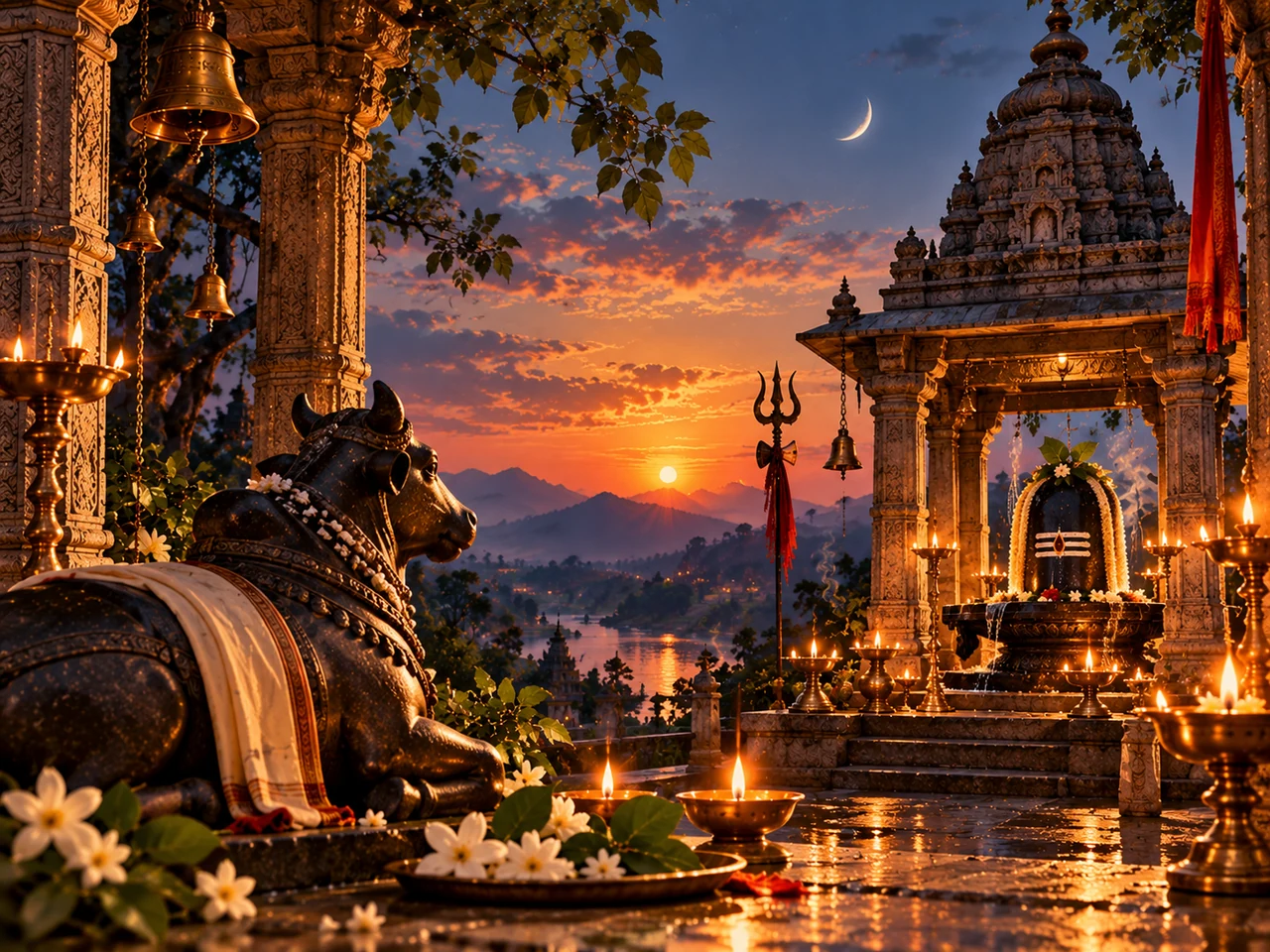
A Shiva temple can look different as daylight fades. Some worshippers come for the evening darshan; lamps brighten the shrine, the sound of bells gathers attention, and devotees may stand before Nandi, the bull who faces Shiva. Elsewhere a household may mark the occasion quietly with prayer. The thread connecting these practices is an intentional pause at the threshold of night—not an identical ceremony performed by every family. 4, 5, 6
The name pradoshapradoṣa has an evening or early-night sense in Sanskrit usage; in this observance it is closely associated with the period around sunset. The vow (vrata) belongs to Shiva devotion. Traditional texts praise prayer and disciplined remembrance at this time, while different communities interpret the duty, intensity and timing of a fast differently. 1, 2
Trayodashi, Pradosha and Pradosha Vrat are three different things
A Tithi describes a phase relationship between the Sun and Moon; it does not begin automatically at midnight or sunrise. Each lunar paksha contains numbered Tithis, and Trayodashi is the thirteenth. The waxing fortnight is Shukla Paksha, moving toward the full moon; the waning fortnight is Krishna Paksha, moving toward the new moon. 4, 7
Pradosha Kala is an evening interval in a chosen calendrical or ritual convention. Pradosha Vrat is the worship or vow associated with the relevant Trayodashi and that evening. Thus a date labelled 'Trayodashi' on a general calendar need not automatically be the date chosen for Pradosha worship. If the Tithi begins or ends near sunset, selection becomes especially sensitive to the actual interval and the accepted rule profile. 4
Some published almanacs explicitly select the day on which Trayodashi overlaps their Pradosha window and warn that the resulting observance date may differ even between cities in the same state. That is a documented almanac convention, not a universally approved rule for ShivGoraksh. 4
Why Pradosha matters in Shaiva tradition
The Skanda Purāṇa, in the Brahmottara-khaṇḍa of its Brahma-khaṇḍa, contains a chapter specifically praising worship of Shiva at Pradosha. In the account, the sage Sūta tells listeners that Shiva is celebrated by divine beings and pictured dancing upon Kailasa in the evening. The passage commends worship, praise and remembrance and describes their benefits in the devotional language of a , in the Brahmottara-khaṇḍa of its Brahma-khaṇḍa, contains a chapter specifically praising worship of Shiva at Pradoṣa. In the account, the sage Sūta tells listeners that Shiva is celebrated by divine beings and pictured dancing upon Kailasa in the evening. The passage commends worship, praise and remembrance and describes their benefits in the devotional language of a mahatmyamāhātmya, a text that magnifies the spiritual significance of a practice. 1
Such promises are claims within a religious tradition; they are not medical, financial or scientific guarantees. A modern reader may also see a readily understandable theme: a recurring moment for humility, recollection and a deliberate change of pace after the work of the day.
This practice is strongly Shaiva, but that does not require reducing other Hindu traditions to it. A household may follow several observances in one month, such as Ekadashi, Pradosha and Shivratri, for different devotional reasons.
Shiva's dance at twilight
The first narrative is a scene rather than a birth story. The Skanda Purāṇa presents Shiva dancing at Pradosha, with the gods gathered in praise. Later lines picture a divine musical assembly. In devotional reading the dance expresses creative and transformative power, while the assembled deities emphasize the importance the text grants this period. It should not be advertised as an eyewitness account of an earthly event. 1
King Satyaratha and the two children
A second, extended narrative concerns Satyaratha, a ruler of Vidarbha, who dies in battle. His pregnant queen escapes but is later taken by a crocodile, leaving a newborn child. A widowed woman named Uma shelters the infant and raises him with her own son. Sage Shandilya later discloses the royal child's past and narrates an earlier-life episode in which the king abruptly left Pradosha worship, turned toward violent anger and neglected its completion. The story explains subsequent misfortune within its own framework of karma and devotion, then turns toward Shiva worship as a path of renewed discipline. 1
The point is not that a parent's missed ceremony can be used to blame a real family for misfortune. The text is a traditional moral narrative involving interruption, pride, care for an abandoned child and return to devotion. It contains social assumptions belonging to its literary setting, not a universal prescription for present-day conduct.
The disciplined observance taught by Shandilya
The following chapter describes Shandilya teaching the woman about the observance. Its longer ritual exposition contains fasting, preliminary preparation, prayer and offerings, alongside technical practices that are not interchangeable with a brief public home prayer. These details belong to a particular textual ritual framework. They are not a single mandatory checklist for all devotees and are not reproduced here as an initiation or procedural manual. 2, 3
The ocean-churning association
Some living temple communities connect Pradosham with Shiva's protective act in the samudra-manthana story, when he holds the dangerous poison and becomes known as Nilakantha. This is a devotional association cited by a contemporary temple, not evidence that the text of the Pradosha chapter narrates that episode or fixes the event at a particular historical date. It supplies a moving ethical image: compassion that absorbs danger for the sake of others. 5
When is Pradosha Vrat observed?
In a general lunar month, there is one Shukla Trayodashi and one Krishna Trayodashi. A devotional calendar therefore normally anticipates two Pradosha observances per month. However, 'twice monthly' does not mean two predetermined Gregorian dates. The relevant evening depends on the moving Tithi boundary, the city's sunset, the ritual interval used by the calendar authority and its decision rules. 4
There is also a language difference across regions. North Indian calendars commonly describe lunar months with a Purnimanta naming system, while many other calendars use Amanta. These systems do not change the underlying Tithi's existence, but a named Krishna Paksha Trayodashi may be placed under different lunar-month labels. Readers should check the named calendar profile, not assume one printed month name is universal. 7
Where Trayodashi touches two adjacent evenings, begins late, or ends near sunset, different rule authorities may require tie-breaks. A Tithi absent at sunrise can still be relevant to the evening; conversely one present at sunrise may not cover that evening. ShivGoraksh's future occurrence module must resolve such cases through separately reviewed astronomical inputs and named tradition rules. It must not silently pick one date based on a sunrise-only shortcut.
City- and year-specific date status: Not yet verified here. The website's reviewed Calendar occurrence, once available, should supply the actual local date, evening window, time zone, selection profile and verification status. Until then, the truthful result is 'Date/timing not yet verified for this city/year.'
Why do some Pradoshas have weekday names?
An observance occurring on Monday may be called Soma Pradosh; Tuesday yields Bhauma Pradosh, and Saturday Shani Pradosh. Names such as Ravi, Budha, Guru and Shukra Pradosh can also identify the remaining weekdays in almanac listings. These are weekday qualifiers of a recurring observance, not seven different festivals or proof of seven fixed ritual outcomes. 4
Local devotional publications sometimes attach different petitions or hoped-for benefits to these combinations. Those associations should be described, when sourced, as particular faith traditions rather than guaranteed cures, wealth results or astrological mechanisms. Weekday naming itself depends on which local civil or sunrise-related day is ultimately selected; the unresolved profile must be recorded by a Calendar reviewer.
How worship is observed
A visitor to a Shiva temple may see an evening assembly, abhisheka (ritual bathing of the deity), flower and bilva offerings, lamp worship, chanting and shared darshan. The Hindu Temple Society of New Mexico records these as elements of its own Pradosham celebration. That supports the description of one current community practice; it does not establish that all temples follow one schedule or every item is obligatory. 5
South Indian Pradosham practice often gives Nandi particular attention. Shiva and Parvati may be depicted in relation to the bull; the Metropolitan Museum of Art documents historical imagery showing this connection, though a work of art cannot itself prove how an individual temple conducts a rite. Temple descriptions may include special worship of Nandi, the Shiva linga and, in some traditions, a procession. Such arrangements require local temple confirmation. 6, 8
In homes, an observance may be as modest as a clean space, a lamp where safe, remembrance of Shiva, familiar public hymns and a reflective moment. Others visit a temple or undertake a vow taught in their household. There is no basis for insisting that elaborate priestly worship, a particular count of circumambulations or a special esoteric practice is compulsory for every reader.
Fasting, food and the question of obligation
Vrata can mean a religious vow extending beyond food restriction. Some devotees refrain from food for part of the day; others take fruit, milk or a simple vegetarian meal according to family practice. The underlying textual chapter includes fasting, but real observance varies by lineage, capacity and circumstance. The exact timing of taking food again is tradition-dependent and is not supplied as an unreviewed universal instruction. 2
Pradosha is not primarily a harvest-food festival with one signature dish. Fruits, sweets and simple offerings may become naivedya or prasada when prepared and received within a worship tradition. Their form differs from home to home. No person, particularly someone for whom food restriction would be unsafe, should interpret an educational article as a demand to fast; participation in prayer is distinct from dietary austerity.
Symbols: Nandi, lamp, linga and bilva
The Shiva linga is a central focus of worship in many temples. Nandi, often shown facing the sanctuary, evokes service, patient attention and steadfast devotion in a widely used symbolic reading. Historical sculpture and painting attest to Nandi's association with Shiva; they do not establish a single fixed symbolic explanation for all schools. 6
A lamp marks the change from day to night and can invite an inward pause. Bilva leaves, flowers, water and ash belong to different Shaiva devotional settings; their use depends on local custom, shrine rules and available materials. The Trishula and crescent moon identify Shiva in broader iconography but are not calendar measurements. No drawing of a moon in festival artwork should be treated as a determination of the actual lunar phase of the observance.
Regional diversity and living practice
The term Pradosham is familiar in Tamil-speaking Shaiva temple contexts, where the worship of Shiva and Nandi can be especially visible. In North Indian usage, Pradosh Vrat is a common name in almanacs and household conversations. In the diaspora, temples may hold an evening gathering that follows local volunteer capacity and posted event arrangements; the Hindu Temple Society of New Mexico is a documented example. 4, 5
These are illustrations of different settings, not claims about every household in Tamil Nadu, every North Indian town or every temple overseas. A visitor should consult the relevant temple's own information for attendance rules. This article is not a source for present-day opening hours or travel plans.
Relationship with Shivratri, Ekadashi and other observances
Pradosha and Masik Shivratri are not synonyms: Pradosha is associated with Trayodashi evening, while monthly Shivratri is generally linked with Krishna Paksha Chaturdashi and its own night-based observance. Mahashivratri is an annual major observance rather than one of the two usual monthly Pradoshas. 4
Ekadashi is associated with the eleventh Tithi and has distinct Vaishnava and other rules, including fasting completion (parana) on an appropriate later day. When an Ekadashi schedule and Pradosha are close, one should not invent an all-purpose combined fasting rule; the appropriate authorities and individual circumstances matter. Dhanteras may fall on Krishna Trayodashi in its own festive context, but that does not turn all Pradosha observances into Dhanteras.
For ShivGoraksh's learning library, the most relevant connections are Shiva (Shiva), Shankar (Shankar), Parvati (Parvati) and, where Nandi or Shaiva ideas require context, the broader Shiva–Shakti entry.
Reflections for contemporary readers
The appeal of Pradosha is partly its recurrence. A major festival may come once a year; the next Pradosha arrives after only another fortnight. In a devotional reading, that rhythm suggests that concentration and care do not have to await a grand occasion. A reader without a prescribed ritual may still understand the practical meaning of the story: pause before acting in anger, recognize obligations to others, and renew attention when routine becomes hurried.
This is an interpretation, not a substitute for the varied Shaiva theologies that understand Shiva's grace, bhakti and cosmic dance in more specific ways. The full ritual disciplines of initiated traditions require qualified guidance and separate review; this page remains an educational overview.
Common misconceptions
- 'Trayodashi and Pradosha are identical.' They are related but different: a lunar Tithi, an evening period and a religious observance should be identified separately.
- 'It is once a year.' Generally it recurs twice per lunar month.
- 'Every city must use the same Gregorian date.' Evening sunset and rule-profile differences can matter.
- 'All families must fast in the same way.' Vows and dietary practice vary.
- 'Pradosha is Masik Shivratri.' The usual associated Tithis and temporal emphasis differ.
- 'The Puranic narrative is a documented incident.' It is traditional religious literature, valuable without being demonstrable modern history.