



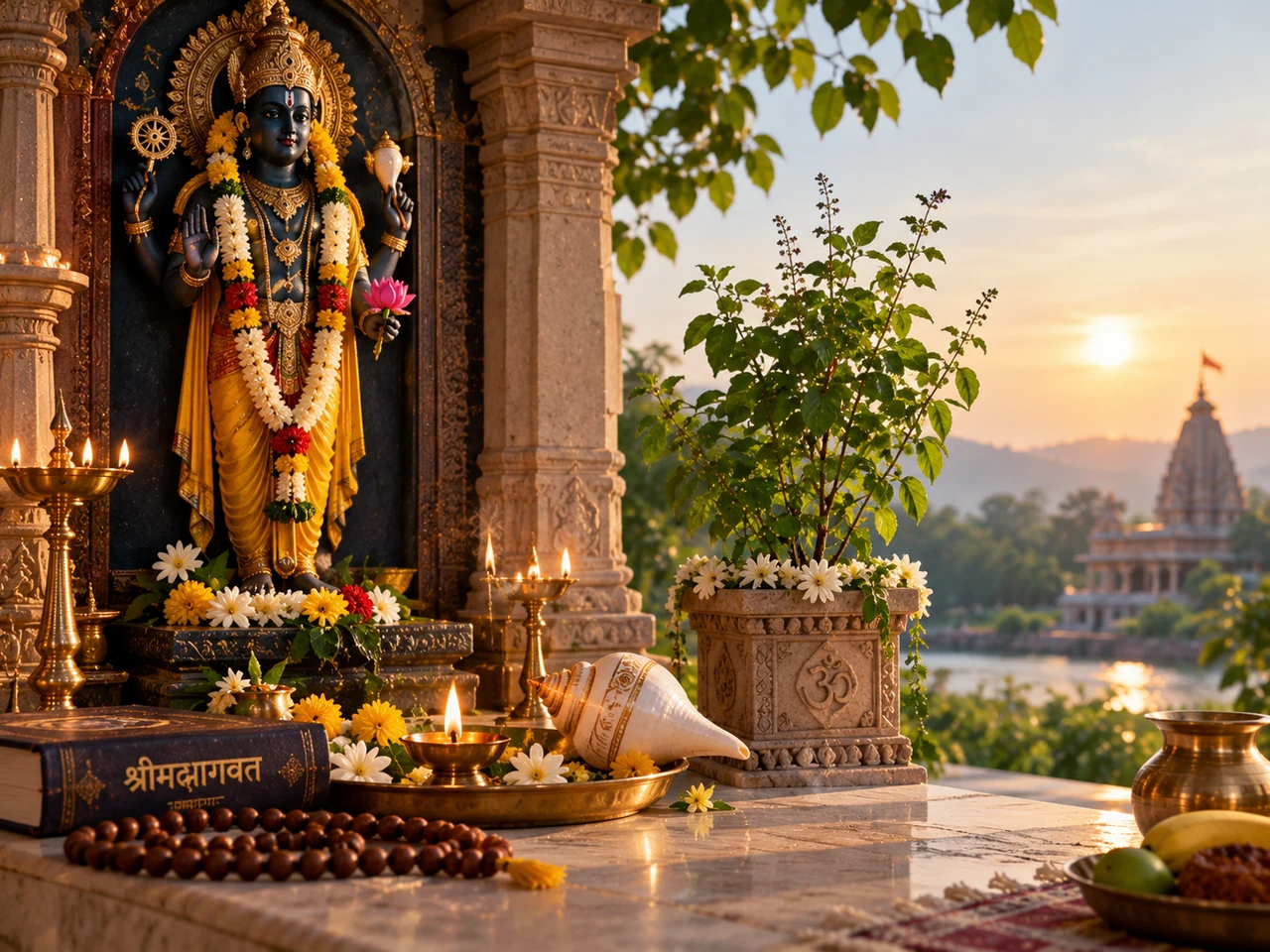
The Hindu calendar holds a recurring invitation to change one's ordinary rhythm. On Ekadashi, many worshippers simplify their meals, set aside additional time for prayer, remember Vishnu or Krishna, and attend more carefully to their actions. For one family the centre of the day is a quiet lamp and a few verses; for another it is singing the names of Hari; for a Vaishnava community it may be a carefully observed fast followed by a timed Parana on Dvadashi. The shared word does not conceal the very real diversity of practice. 1, 2, 3
Ekadashi is the eleventh lunar tithi in either half of a Hindu lunar month. It occurs in both the waxing fortnight (Shukla Paksha) and the waning fortnight (Krishna Paksha), so the underlying observance normally recurs approximately twice per lunar month, not once per year. An intercalary lunar month (Adhika Masa) brings its own Ekadashi observances. A tithi is not a fixed 24-hour civil day: its boundaries move, which is why the appropriate fast date is not safely obtained simply by spotting “Ekadashi” on a generic date grid. 2, 4, 5, 11, 12
What does Ekadashi mean?
EkadashiEkādaśī comes from the Sanskrit idea of “eleventh.” The name refers to the eleventh tithi, rather than to the eleventh calendar date. One arrives during the Moon's waxing half and another during its waning half. The Sanskrit paksha means “fortnight” or “side” of the lunar month; Shukla denotes the brighter, waxing side and Krishna its darker, waning side. 2
In many devotional traditions the tithi is particularly dear to Vishnu, also invoked as Narayana, Hari, Madhava and Krishna. The Narada Purana explicitly praises the Ekadashi vow as pleasing to Vishnu and speaks of observing it in both lunar fortnights. That textual description is a genuine source for this recurring subject. It should not be confused with a claim that every household across India has always performed an identical fasting ritual. 1, 2
A common explanation associates the day with restraint of the senses and redirecting attention toward what matters. This is a devotional interpretation, not a scientific assertion that an eleventh lunar day causes unusual mental or bodily effects. Prayer, considerate conduct and generosity remain meaningful even for someone who does not undertake a food fast.
The scriptural foundations: the Narada Purana
In Narada Purana, Purva-bhaga, Prathama-pada, Chapter 23, the vow is explained as a discipline of devotion to Vishnu. Verses 3–4 identify the observance and explicitly discuss the eleventh day in each fortnight. The chapter proceeds through preparation on Dashami, Vishnu worship and restraint on Ekadashi, and the observance's completion in connection with Dvadashi. It also describes devotional singing and keeping vigil. 1, 2
The chapter includes ancient religious prescriptions, praise, warnings and promises of spiritual merit. Those belong to the text's religious worldview. This article is not presenting punishments or supernatural rewards as measurable historical or scientific outcomes; nor does it turn a strict textual ideal into a demand on every reader. There are differences between a textual vrata description, an initiated community's discipline, and a household's practical observance.
The same chapter narrates Bhadrashila and Galava. Bhadrashila is portrayed as inclined toward worship of Narayana, and the narrative links his devotion to the perceived transformative value of Ekadashi. It is a Puranic didactic story about remembrance and ethical redirection, not a datable biography or the established historical beginning of the festival. 2
King Ambarisha and the meaning of Parana
Another valuable textual anchor occurs in the Bhagavata Purana, Book 9, Chapter 4. Verse 29 describes King Ambarisha and his queen undertaking an extended vow associated with Ekadashi and Dvadashi. Later, as Ambarisha is ready to complete the fast, the sage Durvasa arrives. The king faces a dilemma between honouring a guest and preserving the appropriate period for ending his vow. The narrative says he takes water while still waiting to welcome his guest. 3
The lesson is not that water has a universal technical effect in every form of fasting. The text shows why the end of the observance matters, and why Parana—the ceremonial or rule-governed breaking of a fast—is not a casual afterthought. The chapter's Vaishnava transmission and translation interpret this account devotionally; ShivGoraksh does not treat the commentator's sectarian theological ranking as an obligation for all Hindu traditions. 3
These two sources complement one another: the Narada Purana lays out an Ekadashi discipline, while the Bhagavata Purana dramatizes the tension between devotion, ritual timing and hospitality. Neither passage, alone, supplies a fully validated city-specific contemporary calculation for every Smarta and Vaishnava calendar.
When is Ekadashi observed?
Ekadashi concerns Shukla Ekadashi and Krishna Ekadashi in the lunar month. The tithi can begin or end between sunrises and may overlap more than one local civil date. A calculation needs verified solar and lunar positions, locally determined sunrise and, for particular traditions, Arunodaya, the pre-sunrise period used in some Vaishnava rules. 4, 5
A further distinction matters: the day labelled “Ekadashi Tithi” and the day selected for “Ekadashi fasting” are not necessarily identical. Some almanacs display two neighbouring fast dates when Smarta and Vaishnava rules diverge. That is a named convention difference, not evidence that the lunar calendar has malfunctioned. The calendar should always display whose rule has been used. 4, 5
A related complication is the Purnimanta versus Amanta way of naming lunar months. The actual tithi cycle is not changed by a naming convention, but a Krishna Paksha Ekadashi may carry a different month label in North Indian and many southern calendars. The names of specific Ekadashis and their associations must be matched to the selected tradition, not attached to the wrong month by guesswork.
For city- and year-specific dates, a future reviewed ShivGoraksh Calendar module should supply the local civil date, named tradition profile, the relevant lunar tithi details, and any validated fasting/Parana window. Until that material is available, the correct notice is: “Date/timing not yet verified for this city/year.” This article intentionally does not publish a Gregorian date or a fasting clock-time.
Smarta, Vaishnava and Gaudiya calendars are not interchangeable
Different Hindu traditions have worked out detailed fasting-selection principles. Smarta Ekadashi is one commonly used household convention. Vaishnava Ekadashi follows stricter tithi-purity conditions in several lineages, so its fast may be assigned to the following civil day. The labels are helpful, but neither describes every adherent identically. Some sources further distinguish the rules of the Gaudiya Vaishnava / ISKCON Gaurabda calendar. 4, 5
Terms such as Dashami-viddha Ekadashi concern whether the eleventh tithi has an overlap with the tenth at a relevant decision period. Arunodaya matters in some Vaishnava calculations; simply reading which tithi prevails at sunrise does not resolve every case. The rules of individual Dharmashastra digests and Vaishnava lineages should be examined and versioned by calendar specialists before any software claims a final answer. 4, 5
A Mahadvadashi is an important exception in particular Vaishnava systems: a fast associated ordinarily with Ekadashi may instead be observed on Dvadashi under specified combinations. ISKCON-oriented references describe named Mahadvadashi classes. Their precise predicates cannot safely be reduced to “always choose the later day,” because there are multiple exceptional cases and a distinct calendar tradition involved. 5
A useful digital calendar would let readers deliberately choose an approved Smarta, Vaishnava, or more specific denominational profile, explain its decision in plain language, and mark unsupported profiles as unverified instead of silently borrowing another tradition's date.
How Ekadashi is observed at home
There is no universal checklist. A modest household observance may begin by cleaning a worship space, lighting a lamp safely, offering flowers or water before a representation of Vishnu or Krishna, and reading or listening to sacred texts. Others recite divine names, sing bhajans, contemplate the Bhagavad Gita, offer service, or dedicate extra time to acts of kindness. Some families read an Ekadashi-specific vrata-katha appropriate to that month's named Ekadashi. 2, 3
In many traditions, Dashami, the tenth tithi, is considered a day of preparation. Ekadashi is then devoted to worship and restraint, and Dvadashi, the twelfth, is associated with completion and Parana. That three-stage framework helps explain the sequence without requiring all practitioners to follow a single rigorously timed ritual at home. 2
Formal sankalpa wording, particular mantras, temple-specific seva, initiation-dependent worship and community vows should be learned from appropriate practitioners. Public reading material should not claim to substitute for a lineage's religious instruction. A simple expression of gratitude or devotion does not require inventing a Sanskrit formula.
Fasting foods and customary variations
Many Ekadashi traditions emphasize avoiding grains and pulses; other households use fruit, milk or permitted preparations according to inherited practice. Some undertake a partial fast, some one simplified meal, and some a strict fast. Nirjala describes a particularly severe form observed in certain contexts; it is not the standard required of all Hindus. 2, 5
An article cannot safely issue an individualized food or fluid restriction. Children, pregnant people, older adults and people with health conditions may need very different practices or no food fast at all. Describing customary observances is not a medical instruction, and devotion need not be measured by how much discomfort somebody tolerates. The purpose of the reader-facing article is understanding, not imposing a regimen.
Nor is “Ekadashi food” identical throughout India. Common examples of permitted ingredients depend on region, family and sampradaya; even ingredients sold commercially as fasting foods may not conform to every rule. Before a family borrows a ritual menu from a different community, it should distinguish local food custom from a universal scriptural requirement.
Why Dvadashi Parana needs its own explanation
Parana means concluding the fast. Many devotional calendars place it on Dvadashi, typically after a relevant local sunrise, subject to rule-dependent exceptions. Some Vaishnava methods also refer to Hari Vasara, the initial portion of Dvadashi, as a restricted interval for Parana. A correct window requires more than adding a fixed number of hours to sunrise. 3, 4, 5
These are calendar requirements, not times provided here. What should the calendar do if Dvadashi ends around sunrise? If an exceptional Mahadvadashi shifts the fast? If local sunrise differs in two cities? If a selected lineage uses a different understanding of the relevant interval? Each situation demands verified rules and tests. 4, 5
It is therefore possible for one city to show an Ekadashi fast date and a separately calculated next-day Parana window, while another city or profile displays a different assignment. A date without its relevant rule, place and confidence status is incomplete information.
Important named Ekadashis: examples, not a universal list
Over the year, recurring Ekadashis acquire names and distinctive devotional associations. Nirjala Ekadashi is remembered for an especially rigorous fasting ideal and is sometimes linked in popular Vaishnava storytelling to Bhima; this does not make waterless fasting obligatory. Devshayani or Ashadhi Ekadashi is associated in many Vaishnava settings with Vishnu's symbolic rest and the beginning of Chaturmas traditions. Prabodhini, Devuthani or Kartiki Ekadashi celebrates his symbolic awakening in a number of communities. These are interpretive religious narratives, not astronomical sleep/wake events. 4, 6
Mokshada Ekadashi is associated in some traditions with Gita Jayanti; Vaikuntha Ekadashi receives distinct attention in major South Indian Vishnu temples. These annual named occasions are specific Ekadashis within the repeating monthly cycle, not synonyms for every Ekadashi. 4, 10
During an Adhika Masa, additional named Ekadashis appear, including Padmini and Parama in the referenced Vaishnava almanac tradition. Therefore the statement “Ekadashi means exactly twenty-four fasts in every possible year” is inaccurate without qualification. The calendar must handle the inserted lunar month and its named occurrences rather than silently dropping them. 11, 12
Maharashtra: Ashadhi Wari and Pandharpur
At Pandharpur, devotees of Vitthal or Vithoba gather with special intensity around Ashadhi and Kartiki Ekadashi. Maharashtra Tourism describes the Wari pilgrimage, in which pilgrims known as Warkaris walk with palanquins associated with Sant Dnyaneshwar and Sant Tukaram, singing abhangas and remembering Vitthal. This is more than an account of private fasting: it shows Ekadashi as shared devotional movement, song, service and the long memory of a regional saint tradition. 6, 7
The journey is not the general format of every monthly Ekadashi in Maharashtra. The Wari is linked to particular annual occasions; an individual household's twice-monthly practice can look quite different. Both aspects deserve distinct calendar labels and editorial treatment.
Kerala: Guruvayur EkadashiKerala: Guruvayur Ekadasi
At the Krishna temple of Guruvayur, the annual Guruvayur EkadashiGuruvayur Ekadasi is a significant devotional event. Kerala Tourism notes special temple ceremonies and associated musical offerings. The state's festival calendar also explicitly cautions that local temple customs may affect festival-date listings. That caveat is especially relevant when software attempts to assign the temple's festival date using only a pan-Indian standard. 8, 9
The temple festival should remain a separate named regional observance connected to, but not identical with, the general two-times-per-month Ekadashi cycle.
Tamil Nadu and Andhra Pradesh: Vaikuntha Ekadashi
Vaikuntha Ekadashi is associated with Vishnu temples in southern traditions. Tirumala Tirupati Devasthanams documents special Vaikuntha Dwara Darshan and Dvadashi-linked worship at the Tirumala temple in its festival announcements. This gives direct evidence for a temple's celebration; it does not establish an unchanging number of days, a permanent darshan schedule or a calendar rule for all Vishnu temples. 10
Other communities celebrate at Srirangam and beyond, each with its own temple administration and observance pattern. Details for those institutions should be sourced and reviewed separately, rather than inferred from Tirumala's programme.
North India and household Vaishnava traditions
In North Indian homes, many devotees associate monthly Ekadashi with Vishnu worship, the recitation of names such as Om Namo Bhagavate Vasudevaya, the reading of devotional literature and occasional visits to temples. Named events such as Devuthani Ekadashi can also enter wider seasonal family celebrations. Community practices vary widely by geography and lineage; no single list of foods, mantras or processions describes all of them. 2, 4
Gaudiya Vaishnava temples and ISKCON communities follow their own documented Ekadashi and Parana calendars, including Mahadvadashi exceptions. These should be treated as named traditions rather than quietly overriding Smarta household calendars. 5
Ekadashi and Shiva–Shakti: respectful boundaries
ShivGoraksh centres Shiva, Shakti and the Nath heritage, but Ekadashi's dominant vrata literature is especially associated with Vishnu. The correct approach is to teach this clearly. Hindu families may honour Shiva and Vishnu in the same household, and some Puranic passages praise devotion across divine names, but those connections do not authorize calling Ekadashi a Shiva fast or inventing a Nath-specific obligation. 1, 2
This is also why Pradosha Vrat and Masik Shivratri require separate articles. Pradosha centres the Trayodashi and its relevant twilight worship, while Masik Shivratri belongs to Krishna Chaturdashi and night worship. Ekadashi precedes those tithis in the waning fortnight, but sharing a lunar cycle does not make their rituals interchangeable.
A good knowledge site helps readers compare practices without placing one tradition above another. The discipline of Ekadashi can be understood through devotion, mindful self-restraint and generosity without a false claim that every Hindu temple observes it in precisely the same way.
1. Is Ekadashi monthly or yearly?
It is a recurring twice-monthly lunar tithi—one in Shukla Paksha and one in Krishna Paksha. Named annual Ekadashis are particular instances within that cycle. Adhika Masa can add further occurrences. 2, 11
2. Does Ekadashi always fall on the eleventh Gregorian date?
No. “Eleventh” refers to a lunar tithi, not the eleventh day of a civil month. The date depends on the Moon–Sun relationship, local calendar conversion and the chosen tradition's fast-day rules. 4
3. Is Ekadashi dedicated to Vishnu or Shiva?
The central Ekadashi-vrata sources considered here connect it especially with Vishnu/Narayana. Shiva-related Pradosha Vrat and Masik Shivratri are different observances. 1, 2
4. Why do Smarta and Vaishnava Ekadashi dates sometimes differ?
They can apply different rules for tithi purity, pre-sunrise conditions and exceptions. The correct answer needs a named, reviewed calendar profile, not a universal one-line shortcut. 4, 5
5. What is Ekadashi Parana?
It is the act of ending an Ekadashi fast, generally associated with Dvadashi in many traditions. Its appropriate interval depends on the adopted rule, locality and exceptional cases. 3, 5
6. Is it compulsory to fast without food or water?
No universal food or water restriction should be imposed on every reader. Customs range from devotional worship without a food fast to simplified meals and stricter vows. Nirjala is a particularly demanding named practice, not a requirement for everyone. 2, 5
7. Are grains avoided on Ekadashi?
Many Vaishnava practices avoid grains and pulses, but ingredients and degrees of restriction vary by family and lineage. The descriptions here are cultural information, not personal dietary directions. 5
8. What is Mahadvadashi?
In certain Vaishnava calculations, a fasting observance can be assigned to a specially qualified Dvadashi rather than ordinary Ekadashi. Which exceptional case applies requires a reviewed tradition-specific rule. 5
9. Why is Ashadhi Ekadashi important in Maharashtra?
It is a principal occasion for devotion to Vitthal at Pandharpur and for the Wari, with pilgrim processions linked to saints such as Dnyaneshwar and Tukaram. 6, 7
10. Is Vaikuntha Ekadashi the same as every Ekadashi?
No. It is a particular named Ekadashi with distinctive observances at Vishnu temples, including those administered by Tirumala Tirupati Devasthanams. 10
11. Can there be more than twenty-four Ekadashis in a year?
Yes. An Adhika Masa introduces additional lunar fortnights and related Ekadashi observances. Names such as Padmini and Parama appear in some almanac traditions. 11, 12
12. Where can I find the exact fasting and Parana time for my city?
Use a specialist-verified local Panchang or an approved future calendar module displaying location, tradition profile and calculation status. No city-specific date or clock-time is verified in this evergreen article. 4, 5
Related observances and further learning
To understand the lunar rhythm, compare Purnima and Amavasya, the opposite ends of the waxing and waning halves. For distinct Shiva-oriented observances, see Pradosha Vrat and Masik Shivratri. To explore the deity-centred devotional setting, read about Vishnu and Lakshmi when their Learn articles are available. Named Ekadashis, including Ashadhi and Vaikuntha, need their own verified annual profiles before showing city-specific occurrence data.