



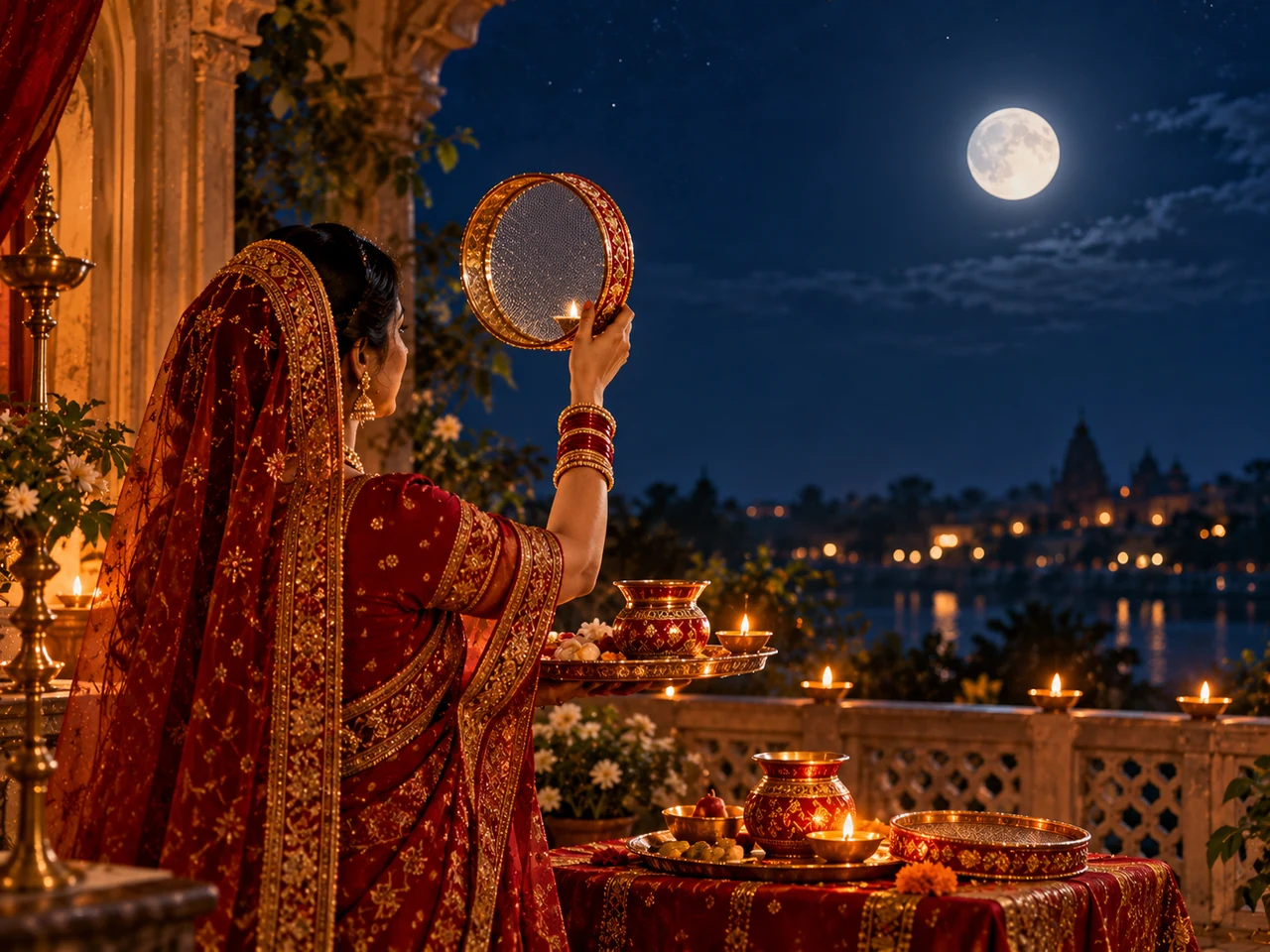
On a Karva Chauth evening in a North Indian neighbourhood, women may gather with decorated plates, small water vessels and a story learned from their mothers or elders. Later, families look towards the sky for the moon. To an outsider, the festival might appear to be only about fasting for a husband; to many participants, it also carries memories of family, friendship, the companionship of other women, and a cherished meeting of household custom and worship. Its meaning cannot be reduced to one scene from a film or one identical practice across India. 3 6 7
Karva Chauth (करवा चौथ), also called Karwa Chauth or Karaka Chaturthi, is an annual lunar observance especially associated with North India. Traditionally, many married Hindu women undertake a vrata—a religious vow or observance—while praying for their husband's wellbeing and a blessed married life. Households may honour Gauri or Parvati, Ganesha, Shiva and the Moon in different combinations. Some contemporary couples participate reciprocally, and some women choose a different or non-fasting form of devotion. These are different personal and community practices, not an obligation for every woman. 1 3 4
Karva Chauth at a glance
| Aspect | Explanation |
|---|---|
| Name | Karva Chauth, Karwa Chauth, Karak/Karaka Chaturthi (करवा चौथ / करक चतुर्थी) |
| Kind | Annual lunar vrata, observed especially in married-life traditions |
| Traditional lunar marker | Kartika Krishna Paksha Chaturthi in the North Indian Purnimanta naming convention; Ashvina Krishna Chaturthi in the Amanta convention |
| Main emphasis | Prayer for marital wellbeing, Gauri/Ganesha devotion, the evening gathering and honouring the Moon |
| Characteristic objects | Karva or earthen water pot, puja plate, lamp, festive clothing and, in many households, a sieve |
| Key timing | Local moonrise (chandrodaya); evening worship and day selection need a reviewed local Panchang |
| Main regions | Punjab, Haryana, Delhi, Himachal Pradesh, Rajasthan, Uttar Pradesh and North Indian communities elsewhere |
The approved ShivGoraksh Calendar must determine a location-specific observance date and moonrise; this evergreen article does not supply an unreviewed date or time. 3 4
What does the name mean?
A karva (also written karwa or Sanskrit karaka) is a vessel or pot, often understood in the festival as a clay water pot used for ritual offerings. Chauth is the vernacular form of Chaturthi, the fourth lunar tithi in a fortnight. The pot is therefore not a decorative afterthought: in many households it holds water or forms part of a gift and offering. Some families use an earthen pot, others a metal vessel or a different household arrangement. The term Karak Chaturthi appears in calendar traditions and is useful when comparing Sanskrit discussions with regional Hindi and Punjabi practice. 1 2 3 4
Although the festival is closely associated with marriage, the word vrata does not mean fasting alone. It can embrace intention, devotion, listening to a narrative, an offering, generosity and an altered rhythm of the day. What is emphasised varies with community, household and personal circumstances.
What do the scriptures actually say?
A particularly helpful textual witness is the Narada Purana, Purva-bhaga, fourth part, Chapter 113, verses 43–50. The passage describes a Karaka Vrata on Kartika's dark-fortnight Chaturthi. It speaks of a woman worshipping Ganesha, making offerings involving vessels, giving respectfully to others, offering arghya at moonrise and taking food afterwards. The text praises the vrata's connection with saubhagya—the wellbeing or auspiciousness of married life. These are religious claims within the text, not scientifically measurable guarantees. 1 2
This distinction is important: the passage focuses on Ganesha and does not explicitly describe every modern feature commonly pictured as Karva Chauth. It does not by itself establish a universally obligatory Sargi, a sieve-viewing custom, a red sari, or an evening circle with a representation of Gauri. Those familiar practices are real living traditions, but they need evidence appropriate to household and community life rather than an invented quotation from the Purana. The translator's notes also distinguish Karaka Vrata from other vows kept near the same lunar date. 2 3 6
Neither the accessible Purana passage nor a popular legend establishes an exact historical year in which Karva Chauth began. Regional participation, change over generations and the intertwining of domestic custom with devotional literature are better documented than a single founding event. 6 7
Veeravati and the false moon
One widespread vrat katha tells of Veeravati, the cherished sister of seven brothers. In the story, she keeps a difficult fast, and her brothers, worried by her exhaustion, arrange a deceptive light that resembles the rising moon. Veeravati breaks the fast before the true moonrise. The story then describes misfortune, sorrow and renewed devotion, eventually leading to the restoration of her husband. Details vary: Veeravati is a queen in some retellings and a Brahmin's daughter in others; the identity of the divine helper and the sequence of events also change. 3 5 7
The narrative makes moonrise and integrity central to the vow. Yet it should be understood as a traditional devotional story, not a documented medical or historical account. Nor should its harsh narrative consequences be used to frighten someone who cannot safely fast. Its importance is also literary and social: the story is recited collectively, remembered, questioned and retold. 5 7
Karva, the crocodile and Yama
Another popular story concerns a woman named Karva, whose husband is attacked by a crocodile. Her steadfastness is said to compel an intervention by Yama, the deity associated with death and moral order. The tale celebrates courage and loyalty, but a secure primary textual locator for the version commonly circulated today has not been established in this edition. It is labelled a regional/popular legend, not presented as a proven quotation from the Mahabharata or a specified Purana. 8
Draupadi and the Savitri comparison
Some popular tellings connect Karva Chauth to Draupadi receiving advice about a vow during difficulties faced by the Pandavas. Another familiar comparison is to Savitri and Satyavan, whose determination forms a well-known narrative of marital devotion. These connections appear in festival storytelling, but this edition has not verified that the current Karva Chauth rite is prescribed in an inspected Mahabharata passage. Savitri's story is also celebrated in other vrata contexts: sharing a theme does not make different festivals identical. 3 8
When is Karva Chauth observed?
Karva Chauth is associated with the fourth tithi of the waning Moon (Krishna Paksha Chaturthi). In calendars where a lunar month ends at full moon (Purnimanta, customary in much of North India), the month is called Kartika. In calendars where the month ends at new moon (Amanta), the corresponding period is typically called Ashvina. That apparent disagreement in month names does not, by itself, indicate two different festivals. 1 2 4
A tithi is determined by the angular relationship between the Sun and Moon, not by a fixed midnight-to-midnight date. The fourth tithi can begin or end at unusual local clock times, sometimes touching two civil dates. Moonrise matters because in widespread fasting customs the fast is concluded after an offering to the Moon. A calendar must therefore distinguish (1) selecting the festival's civil day, (2) selecting the appropriate evening worship interval, and (3) showing the local astronomical moonrise. These are related but not interchangeable decisions. 4
If clouds hide the Moon, family approaches vary; no single replacement sighting or ritual should be prescribed here as universally authorised. If ShivGoraksh has no specialist-approved profile for a location, its calendar should display a clear limitation rather than inventing a time.
Before sunrise: Sargi and the beginning of the vow
In many Punjabi and other North Indian families, Sargi is a pre-dawn meal associated with the festival. It may be prepared or gifted by a mother-in-law, although who provides it differs from one family to another. Fruits, milk preparations, sweets, feni, nuts and a customary family meal may be included. Some receive a Baya—a gift of food, clothing or other festive items—from maternal relatives. These arrangements reflect family ties and customs, not a uniform requirement proven by one ancient text. 3
Some women traditionally keep a nirjala fast, without food or water until moonrise. Others observe a modified fast or devotional prayers without fasting. Describing a nirjala fast is not a health recommendation, and spiritual worth should not be equated with enduring dehydration or illness. Each person can take medical and personal circumstances seriously without public judgement.
Afternoon or early evening: gathering, Gauri and the story
A key social moment in many communities is the gathering of women with decorated puja thalis. Lamps, sweets, rice, water vessels and other items may be arranged. In some Punjabi practices the plates circulate in a group while participants sing, exchange blessings and hear a Karva Chauth katha. Gauri or Gaura Mata, understood in many families as Parvati, may be honoured. Other households emphasise Ganesha, and some include Shiva and the wider Shiva family. The Narada Purana's Karaka passage is especially Ganesha-focused, while the modern Gauri-centred grouping is documented as living practice. 1 2 3 6
This shared gathering matters even when the individual fast is private. Studies of Karva Chauth show how women make neighbourhood relationships, share religious knowledge and develop forms of mutual support through the observance. A festival can thus be about marital affection and also about friendship among women. 6 7
At moonrise: Arghya and a family meal
In a widely recognised custom, a woman looks towards the Moon, sometimes through a sieve, makes an offering of water (arghya), and then concludes the fast with water or food received in the company of her spouse or family. The sieve and the sequence of looking at the Moon and spouse are not universal requirements in every household. The moonrise to consult is local, not a time copied from another city. 3 4
Afterwards, family members may share a celebratory dinner. The day is often remembered as much for conversations, gifts and mutual appreciation as for the moment the fast ends.
Regional traditions: more than one way to celebrate
Punjab and Chandigarh: Pre-dawn Sargi, Baya, colourful plates, group singing and narrated katha are especially visible. In some families the relationship between mothers-in-law and daughters-in-law is foregrounded; in others, women form their own circles of friends and neighbours. 3 6
Haryana and Delhi: Neighbourhood gatherings, Gauri-Ganesha devotion, festive attire and moonrise observance are familiar to many families. Yet urban households do not all follow the same sequence, and participation may range from strict fasting to prayer, gifts or shared meals. Government tourism material identifies these areas within the festival's North Indian heartland. 3
Uttar Pradesh: Celebrations can involve feni, regional sweets, fara, offerings with decorated pots, mehendi and evening storytelling. Accounts of local practice also describe designs or representations made with rice paste. These are examples, not an all-state checklist. 3
Rajasthan and Himachal Pradesh: The festival is recognised in household married-life traditions, but details of the karva, songs, kinship gifts and devotional focus can differ by locality. Where an exact village ritual has not been independently documented, it is better to preserve this variety than invent a named custom. 3
Elsewhere and among the diaspora: North Indian families may keep the observance while living in other parts of India or abroad. In a different time zone, sunset and moonrise are not portable from the family's ancestral town. Calendars and rituals need to be understood in their actual local setting. 4
Symbols and food: what the objects convey
The karva is associated with water, hospitality, offering and the very name of the observance. The Moon marks the awaited completion of the fast and evokes the regular rhythms of the lunar calendar. A diya expresses light and reverence; mehendi, bangles and festive clothing may express joy and married-life identity in particular social settings. Not everyone uses every object, and a missing ornament does not define the sincerity of a person's devotion. 1 3
Food is significant at both ends of the day. In some Punjabi households, Sargi includes fruits, nuts and sweet or milk-based foods, while the evening table may feature sabut dal, puris, rice and festive sweets. In Uttar Pradesh, feni and fara are among reported preparations. Since cooking and fasting customs differ widely, these dishes are examples of regional culture rather than required offerings. 3
A Shiva–Shakti perspective without forcing one theology
When families honour Gauri or Parvati, they may see in her a symbol of steadfastness, compassion and companionship. When Ganesha is invoked, the observance may highlight auspicious beginnings and the removal of obstacles. Shiva appears within the wider family devotion, while the Moon is offered water at the end of the fast. This layered worship suits a website that teaches Shiva–Shakti traditions, but Karva Chauth should not be redefined as exclusively Shaiva, Nath or Shakta. The primary-text account and different household understandings deserve their own place. 1 2 3
A thoughtful modern reading can also ask what reciprocal care looks like. Some couples now observe together; others express affection through service, conversation or simply respecting one another's choices. The importance of a festival can survive without insisting that every relationship, gender role or capacity for fasting be identical. 3 6
Common misunderstandings
“Karva Chauth is mentioned exactly as celebrated today in one scripture.” No. The Narada Purana describes an important Karaka Vrata, but features such as Sargi and the sieve belong to documented living traditions, not to those specific verses. 1 2 3
“A new-moon or full-moon date should be used.” No. This is associated with Krishna Chaturthi, the fourth tithi of the waning fortnight. The local Moon is neither a full moon nor the invisible new moon. 4
“The Purnimanta and Amanta calendar names make two separate Karva Chauth festivals.” Usually they are different month labels for the corresponding lunar period. Still, city selection and other boundary cases must be independently reviewed. 2 4
“All married women must keep a waterless fast.” A strict fast is an important custom for many, not a universally binding condition of Hindu identity or affection. Some households make adjustments; some people do not fast. Neither a story nor a website article should be used to pressure medically vulnerable people.
“Karva Chauth and Sankashti Chaturthi are identical.” They can coincide on the lunar calendar, and Ganesha connects them, but they are different observance identities, with different customary emphases. Similarly, Karva Chauth is not the same event as the later festival sequence of Dhanteras, Diwali or Bhai Dooj. 2 4
1. Why is Karva Chauth celebrated?
Traditionally many married Hindu women observe it to pray for their husband's wellbeing, shared prosperity and marital auspiciousness. Its social meanings also include friendship, family visits and transmitting traditions between generations. 3 6
2. What is the difference between Karva Chauth and Karaka Chaturthi?
They are closely related names: karaka/karva refers to a vessel and chauth/chaturthi to the fourth lunar tithi. Sanskrit textual descriptions and regional celebrations need not be identical in every detail. 1 2
3. Is Karva Chauth on Kartika or Ashvina Krishna Chaturthi?
Both names can describe the relevant lunar period. Kartika is typical in the North Indian Purnimanta convention; Ashvina in Amanta calendars. Calendar publication needs a reviewed regional convention. 2 4
4. Which deity is worshipped on Karva Chauth?
Ganesha is central in the inspected Narada Purana passage. Many families also worship Gauri/Parvati, Shiva and the Moon, with regional differences. 1 3
5. What is Sargi?
A customary meal taken before sunrise in many North Indian families; it is often associated with gifts or care from the husband's family, but arrangements vary. 3
6. What is Baya?
A family gift—sometimes containing clothing, sweets, fruit and festive items—shared in certain traditions around the observance. The giver and contents are not identical everywhere. 3
7. Why is the Moon seen through a sieve?
It is a widely recognised family custom at the moonrise ceremony. It is not explicitly required by the inspected Narada Purana Karaka passage and should not be projected onto all communities. 2 3
8. What is the story of Veeravati?
A traditional account in which Veeravati mistakes a false light for the Moon, ends her fast early, faces sorrow and later restores her family through devotion. Versions differ; it is not a factual account of what fasting can medically cause. 3 5
9. Must everyone observe a nirjala fast?
No. A waterless fast is practiced by many families, but observance is personal and tradition-dependent. Health, safety and individual circumstances should never be ignored.
10. Can unmarried people or husbands participate?
In some households unmarried women or husbands participate, and some couples observe together. These are contemporary or family-specific choices, not a rule applicable to all Hindu communities. 3
11. Is Karva Chauth the same as Sankashti Chaturthi?
No. Both relate to a Krishna Paksha Chaturthi and may coincide, but Sankashti is a recurring Ganesha-associated vrata, while Karva Chauth is a distinctive annual domestic and marital observance. 2 4
12. Where should I check the moonrise time and observance date?
Use a reviewed local Panchang that accounts for your location and the relevant festival-day rule. Moonrise in another city is not a reliable substitute. ShivGoraksh will display dates only after its Calendar team validates them. 4