



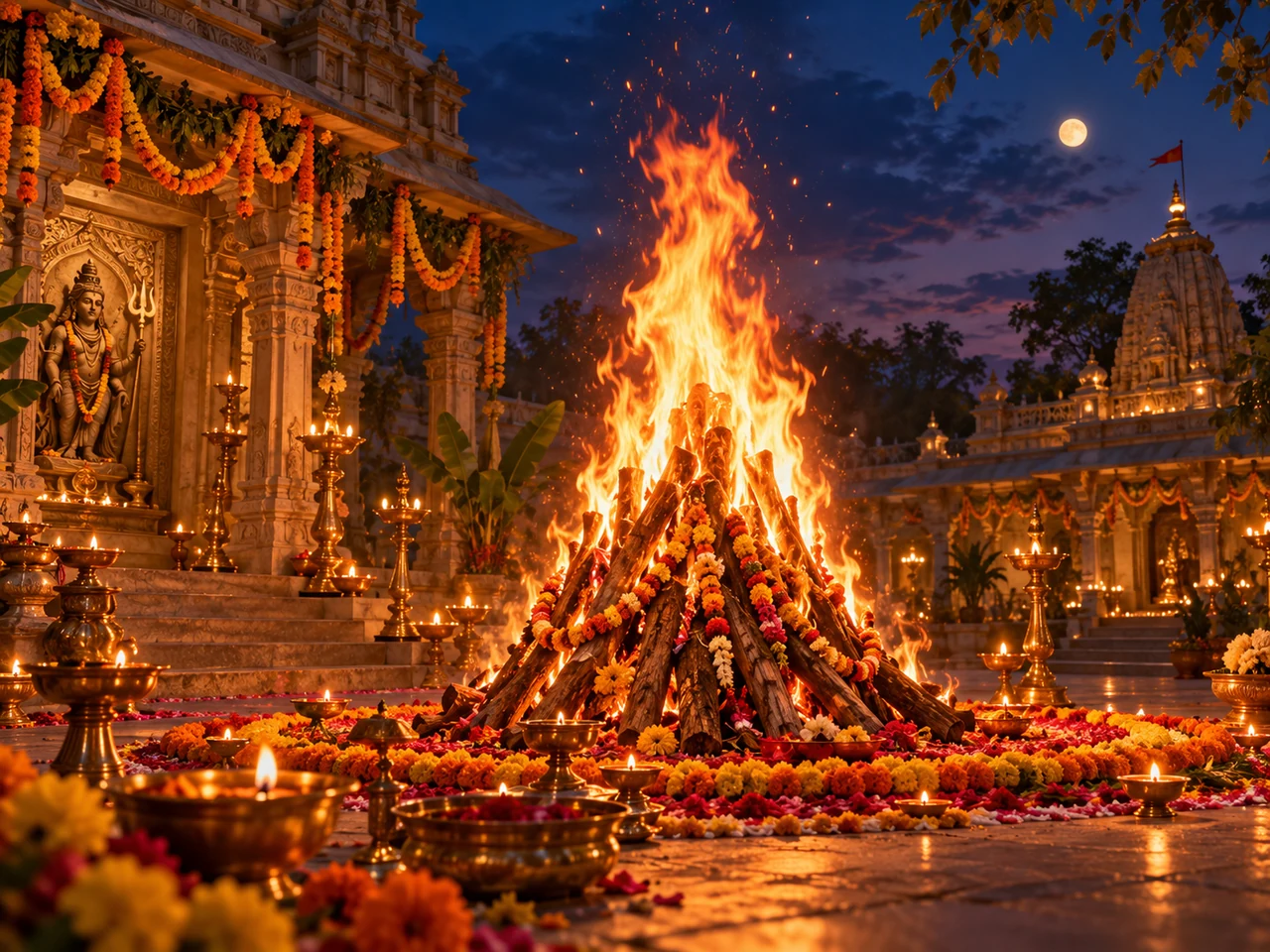
An evening fire gathers an entire neighbourhood. An elder recounts the courage of a child; a family offers a little grain; people pause before the colour and laughter of the following day. Holika Dahan (होलिका दहन) is this quieter, reflective face of the Holi season. In many northern and western Indian communities, a ceremonial bonfire recalls the story of Prahlada, whose devotion endured an attempt on his life. It is a gathering around a symbol—not an invitation to demonstrate supernatural immunity to fire. 3, 4
Although people often use Holi to mean the whole celebration, Holika Dahan deserves its own explanation. The fire rite is generally associated with the evening of Phalguna Purnima, while Rangwali Holi, the playful exchange of colours, ordinarily follows. The religious meaning, regional forms and selection of the correct local evening are all more nuanced than a fixed date in a calendar. 3, 5
At a glance
| Question | Short answer |
|---|---|
| What is it? | A community or household-linked ritual bonfire that forms part of the Holi festival cycle. |
| Other names | Chhoti Holi, Holika Deepak, Holika Dahan; some communities speak of Holi ka dahan or Holi jalana. |
| Hindu calendar association | Phalguna Purnima and an appropriate evening period; full date and timing need a location-specific reviewed rule. |
| Principal associated figures | Prahlada, Hiranyakashipu, Holika of the widely told festival legend, and Vishnu/Narasimha in the wider Prahlada narrative. |
| Central emphasis | Devotion under pressure, the end of arrogance, community renewal and the beginning of the Holi celebration. |
| Related observance | Holi/Dhulandi, covered independently under Holi: Meaning, Stories, Colours and Traditions. |
What do the names mean?
Dahan simply means burning; Holika is the figure whose downfall the bonfire memorializes in the best-known account. Chhoti Holi, literally “little Holi,” is an everyday name for the preceding observance, not a statement that its meaning is smaller. Holika Deepak appears in modern Panchang descriptions. Some regions call the shared seasonal festivities by entirely different local names, such as Shimga in the Konkan; that wider regional festival cannot be reduced to the bonfire alone. 5, 7
These labels have overlapping uses, not strict universal definitions. A family may say “Holi” when referring to the bonfire and use “Dhulandi” for the next day. Another may regard several preceding and following days as part of one larger cycle. It is more accurate to ask which rite is meant than to presume that every use of the word “Holi” describes the same activity. 3, 7
The story: Prahlada, Holika and Hiranyakashipu
The popular festival account begins with Hiranyakashipu, a powerful king who wanted unquestioned obedience. His young son Prahlada remained devoted to Lord Vishnu despite his father's hostility. In commonly narrated versions, Hiranyakashipu called upon his sister Holika to take Prahlada into a fire. Holika believed she would be protected by a special boon or covering; instead, the child survived and Holika perished. The burning of Holika thus became an image of harm failing in the face of steadfast devotion. Details about a protective garment, how the boon applied, and the participants' words differ across retellings; they should not be advertised as one verbatim scriptural passage. 3, 4, 10
The moral is not that flames are harmless to sincere believers. In devotional interpretation, Prahlada's protection expresses divine grace, while the story's human lesson challenges cruelty and pride. Today's community bonfire is symbolic. No one should imitate the dangerous ordeal of the narrative. 3, 11
Where does the Bhagavata Purana fit? Its Seventh Skandha contains an influential Prahlada cycle. Chapter 7.5, particularly verses 43–44, describes failed attempts to harm Prahlada, including exposure to fire, and his attachment to Vishnu. Chapter 7.8 then describes Narasimha emerging to end Hiranyakashipu's tyranny. These inspected sections establish the broader Prahlada–Hiranyakashipu–Narasimha narrative; they do not, by themselves, establish the entire familiar episode of Holika seated on a pyre with a protective cloth. Treating the devotional festival retelling and these particular cited verses as identical would be misleading. 1, 2
Narasimha's appearance is an important part of Prahlada's story, but Holika Dahan is not simply Narasimha Jayanti under another name. A festival connection is not proof that every episode in a religious life story occurred on the same calendrical day. Here, the remembrance of fire and Prahlada's faith governs the popular observance, while the theological story is considerably larger. 2, 3
Why the fire matters
The bonfire can be understood on more than one level. In the Prahlada tradition, its most familiar meaning is the defeat of arrogance and the survival of devotion. The king demands conformity, while the child refuses to abandon his conscience. The story is remembered because a person seemingly without power has an inner resource that force cannot purchase. The use of fire is especially striking: something visibly destructive becomes, in the story, the sign that destructive intent does not prevail. 1, 3
There is also a communal meaning. Families gather at a public place, meet neighbours, pray or stand silently, and mark a seasonal transition. In some agrarian communities newly available grain appears among the offerings. Such actions link the ritual with gratitude and the movement from winter toward spring, although the weather and agricultural calendar are not uniform across India. The rite combines religious memory with a way of marking belonging and renewal. 4, 5, 7
Finally, an ethical interpretation invites self-reflection: What would one like to leave behind—resentment, humiliation, stubbornness or hostility? These are interpretations of the symbolism, not promises that a fire literally removes wrongdoing, bad luck, illness or hardship. Neither fire nor its ashes should be described as scientifically demonstrated cures. 4
When is Holika Dahan observed?
Holika Dahan is associated with the full-moon Tithi (Purnima) of Phalguna and an evening worship interval usually discussed in relation to Pradosha Kala, the period around and after sunset. A Tithi is defined by the changing angular relationship between the Sun and Moon, not by a midnight-to-midnight civil clock. Therefore its start and end can occur at any hour. 5, 6
This is why a generic sentence such as “Holika Dahan is performed whenever Purnima falls at sunrise” is inadequate. An evening rite needs an evening-oriented selection rule; the beginning and end of Purnima, local sunset and the relevant evening interval may create different candidate days. Some years or places also present a conflict involving Bhadra, a traditionally restricted interval identified with the Vishti Karana. Panchang authorities describe a preference for a Purnima-associated Pradosha after Bhadra has ended, while published exceptional-case choices—including Bhadra Puccha, Mukha and post-midnight alternatives—are not uniform. 5, 6
The difference is substantive, not just a display issue. Even publicly available Panchang examples for different cities can select different civil evenings under different profiles or exceptions. ShivGoraksh must not resolve that disagreement from a convenient website snippet. Its eventual Calendar module needs a named, specialist-reviewed convention, geographical coordinates, local time zone and an auditable rule trace. Until an occurrence is validated, the truthful display is: “Date/timing not yet verified for this city/year.” 6
Do not confuse Pradosha Kala, a daily evening interval, with the separately named Pradosha Vrat observed around certain Trayodashi periods. Nor should the calendar team automatically copy every local bonfire date onto Rangwali Holi, whose linked occurrence must have its own checked relationship. These distinctions matter particularly when a lunar Tithi spans sunset boundaries. 5, 6
What people commonly do
Preparations vary by village, housing community, town, household and temple. At a shared site, people may assemble a stack of permitted natural fuel, perform a brief customary worship, remember Prahlada, and kindle a managed ceremonial fire. Some place a symbolic representation of Holika; elsewhere the bonfire itself is the visible sign. Families might offer grain, coconut, flowers or other materials according to local practice, rather than follow one standardized national list. Songs, greetings and community gatherings often accompany the occasion. 3, 5, 7
Some participants walk around the fire in a customary parikrama, pray for household well-being or share offerings afterward. These are descriptions of practices that occur in some communities, not a required universal sequence or an authorized substitute for a family's tradition. Mantras, materials, priestly procedures and the number of circumambulations may differ. No unverified rite or auspicious minute is prescribed here. 3, 5
Other devotees observe the night primarily through prayer, a narration of Prahlada's life, reflection or temple visits. One does not have to light a personal fire to understand the festival. If a building or neighbourhood does not permit open flames, a supervised community event or a non-fire devotional observance is a meaningful alternative. Community rites should follow local regulations and remain accessible to people who do not participate in all parts of the festival. 3, 11
The offerings and the harvest connection
In some northern and western farming regions, ears of wheat, barley or other seasonal grains are offered or symbolically roasted, recalling the importance of harvest and renewal. Drik Panchang describes roasting green cereals at the bonfire, while Maharashtra Tourism documents grains and coconut in Konkan Shimga gatherings. These accounts support regional examples, not a rule that every Hindu household must make the same offering. 5, 7
Prasad and celebratory food also depend on family and locality. The gujiya and other sweets associated with the wider Holi season belong principally to the family and social food culture of the festival; Holika Dahan does not have a single obligatory menu. Simple shared food, a small grain offering, or no food offering at all may each occur. Avoid presenting particular regional foods as religiously mandatory or attributing universal spiritual effects to eating them. 4, 7
Delhi, western Uttar Pradesh and much of North India
Delhi Tourism records the bonfire on the eve of Holi and links it to the Prahlada–Holika legend. In many northern communities the fire is an unmistakable public event, and the next day is devoted to colours and visits. Yet neighbourhood celebrations, household prayers and the vocabulary used for the following day vary widely. The North Indian emphasis described here should not be projected onto all of India. 3
Braj: the fire within a much longer Holi season
Braj, the region culturally associated with Radha and Krishna, has a wider Holi cycle encompassing different villages and temple communities. The Uttar Pradesh Braj Teerth Vikas Parishad has explicitly included Holika Dahan at Phalain village in its event listings, among other locally distinct celebrations. Phalain therefore offers a concrete example of the fire observance's place within Braj's season, but a past published programme is not a perpetual timetable or proof of a permanent ritual detail. 8
A page about Holika Dahan should briefly introduce Braj's larger celebration without repeating an entire account of Lathmar Holi, the play of colours, temple flowers or other activities better treated in the main Holi article. The bonfire's relationship to Braj's Krishna-centred festivities is a relationship within the seasonal festival, not proof that every local episode has the same origin story. 8, 4
Maharashtra's Konkan: Shimga
Maharashtra's Department of Tourism describes Shimga as the Konkan's multiday Holi celebration, bringing together community bonfire practices, folk performance, agricultural gratitude and later colour observances. In some places the fire gathering includes coconut or grains and local songs; these belong to a larger community festival rather than a one-night festival that is identical everywhere. The timing of regional colour activities may differ from the simple North Indian “fire tonight, colours tomorrow” outline. 7
Rajasthan and neighbouring communities
In north-western India, community fires, household visits, seasonal grains and the next-day Dhulandi form a recognisable pattern, though details depend on locality. It is useful to distinguish the bonfire vigil from Rajasthan's tourist-oriented Dhulandi colour programmes, which are events on another stage of the festival. A cultural label or state-level programme is not a substitute for a local religious timing authority. 4, 5
South Indian Kama Dahanam: a related but different story
Some Hindu communities in the south observe Kama Dahanam / Kamadahana, centred on Shiva burning the god of desire, Kamadeva, through the fire of his third eye. This is a different mythic narrative from the Prahlada–Holika account, even where a seasonal fire rite or festival period overlaps. A Vaishnava devotional source describes this Shaiva interpretation particularly for parts of Tamil Nadu and Karnataka. It would be wrong to state that every South Indian Hindu celebrates Holika Dahan under this name or that the two rites are textually interchangeable. Their calendars and specific local practices require separate verification. 10
This connection belongs naturally on ShivGoraksh: it illuminates how a shared season may invite both Vishnu-oriented remembrance of Prahlada and Shiva-oriented reflection on desire. It is not grounds to recast Holika Dahan as an originally Nath or universally Shaiva festival, and no Nath-lineage-specific fire rite has been verified for this article. 1, 10
A safe, respectful and environmentally aware observance
Fire is both the festival's dramatic symbol and a genuine physical hazard. Public bonfires require appropriate permissions and local fire-safety arrangements. Use an authorized space away from electrical lines and structures, keep children at a safe distance, do not leave flames unattended and follow local officials' directions. Avoid burning plastic, painted or treated waste, and other toxic materials. A smaller managed fire—or attending a properly supervised one—can preserve the symbolism without unnecessary smoke or danger. General fire-prevention advice from the Delhi Fire Service supports this cautious approach; it does not endorse a particular ritual method. 11
It is also wise to protect people with respiratory sensitivities and to avoid harming trees or neighbourhood animals. These are contemporary civic responsibilities, not claims about ancient rituals. No one's devotion should be judged by the size of a bonfire. The hero of the festival story is a child protected from violence, so the most fitting public remembrance of the story should never expose real people to avoidable harm. 11
Holika Dahan, Holi, Narasimha and related observances
The Holi topic (Holi: Meaning, Stories, Colours and Traditions) is the parent seasonal festival: colour play, Krishna-related festivities, music and social customs belong there in full. The Holika Dahan topic (Holika Dahan: The Sacred Fire Before Holi) is specifically the evening fire rite, its distinctive Prahlada story and its complicated Purnima/Pradosha/Bhadra timing. A person searching “Holi date” may need the whole festival calendar, while someone asking “when should Holika be burnt?” needs a separately verified local ritual interval. Conflating those answers is a calendar error. 5, 6
The name Narasimha belongs in the supporting theological context, because the Bhagavata Purana explicitly relates that form of Vishnu to Prahlada. However, a separate Narasimha Jayanti observance must not be generated or date-linked without an approved catalogue entry and an independently checked selection rule. 2
The public narrative is appropriate for general readers (PUBLIC). Detailed procedures of a particular temple, lineage or officiant remain tradition-specific and need separate review; there is no justification here for inventing initiation-only mantras or presenting physical fire rituals as something children should perform. This page describes what communities do rather than issuing a universal command. 3, 11
1. What is the difference between Holika Dahan and Holi?
Holika Dahan is the ritual bonfire associated with Prahlada and the evening preceding colour celebrations in many communities. The broader Holi festival includes several days and forms of activity; Rangwali Holi or Dhulandi commonly follows the bonfire. 3, 5
2. Is Holika Dahan always held on a fixed Gregorian date?
No. It follows a lunar Tithi and an evening-selection tradition. The exact civil date and time depend on the year, location, named rule profile and exceptional cases such as Bhadra. An unverified city-specific date should not be displayed as settled. 5, 6
3. What is Phalguna Purnima?
It is the full-moon Tithi associated with the lunar month of Phalguna. The Tithi is an astronomical interval; it does not necessarily run from civil midnight to civil midnight, which is why the selected fire evening requires careful calculation. 5
4. What is Pradosha Kala in this context?
It is the evening period around and after local sunset used in many Holika Dahan timing discussions. It is not synonymous with the separately observed Trayodashi-based Pradosha Vrat. 5, 6
5. What is Bhadra, and why do almanacs mention it?
Here Bhadra refers to the traditionally restricted Vishti Karana interval. Panchang guides consider it when selecting a bonfire window. Detailed exceptions differ, so the public page should not invent a simplified universal prescription. 6
6. Does the Bhagavata Purana tell the entire Holika-and-cloth story?
The inspected passages in Skandha 7 describe Prahlada, attempts on his life including exposure to fire, and Narasimha. They do not establish every detail of the popular Holika-on-the-pyre story; those details are better labelled as festival retellings unless another exact textual witness is verified. 1, 2, 3
7. Why is Prahlada remembered?
He represents unwavering Vishnu devotion despite threats from his father. In devotional readings this conveys faith and divine protection; in an ethical reading it honours conscience under pressure. 1
8. Is Holika Dahan a celebration of burning a person?
No. The bonfire is a symbolic remembrance of a traditional story about the failure of cruelty. It must never be read as permission to threaten, harm or subject anyone to fire. 3, 11
9. Are wheat or barley offerings compulsory?
No universal requirement is established here. Seasonal grains are documented in some communities, while coconut and other offerings appear in regional descriptions. Families follow their own appropriate traditions and local rules. 5, 7
10. Is Kama Dahanam the same as Holika Dahan?
Not exactly. Where observed, Kama Dahanam invokes Shiva and Kamadeva, whereas the familiar Holika Dahan account invokes Prahlada and Holika. They can be associated with a similar season but retain distinct narratives and local practices. 10
11. Must every home light its own bonfire?
No. Many people attend a community rite, offer prayers at home, hear Prahlada's story or take part in the wider Holi celebration. Where open fires are unsafe or prohibited, follow local rules and choose a non-fire alternative. 3, 11
12. Where can I find the exact time for my city?
Use a calendar record that identifies your supported city, time zone and reviewed Holika Dahan rule. Until such a record is independently approved for the relevant year and location, ShivGoraksh should say “Date/timing not yet verified for this city/year,” rather than supplying a guessed muhurta. 6