



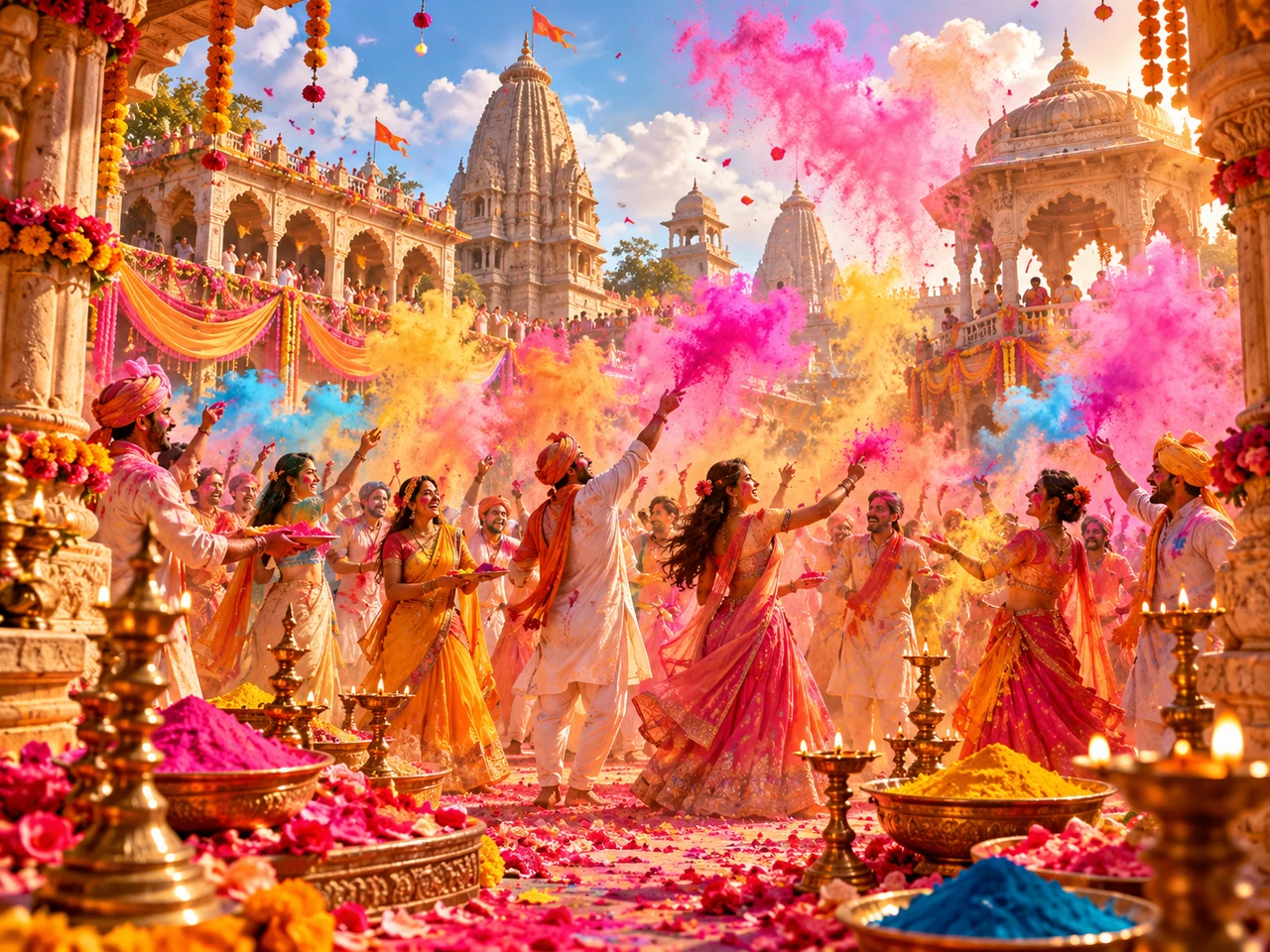
Holi (होली) is a festival of spring, colour, shared meals and renewed relationships. Many people know it through laughter and clouds of gulal (coloured powder), yet that lively scene is only one part of a much larger occasion. The preceding evening's bonfire, Holika Dahan, evokes the survival of the devotee Prahlada; in the Braj region, Holi is especially associated with Krishna, Radha and the playful poetry of devotion. Elsewhere, the season brings different dances, processions and community gatherings. Holi is an annual lunar-seasonal festival, not a fixed Gregorian-date holiday. 2, 3
At a glance
| Question | Answer |
|---|---|
| What is celebrated? | Spring, festive friendship, devotion, hope and—in some interpretations—the defeat of cruelty and arrogance. |
| When? | Around Phalguna Purnima, near the transition from winter to spring; Holika Dahan and the day of colours are distinct observances. |
| Other names | Rangwali Holi, Dhulandi, Dhulendi, Dhuleti, Phag or Phagua, according to region and context. |
| Who is associated? | Prahlada and Vishnu/Narasimha in the bonfire narratives; Radha and Krishna in Braj devotion; Shiva and Kamadeva in a different regional story. |
| Where? | Across different parts of India, Nepal and Hindu diaspora communities, with markedly different forms. |
The names above are not universally interchangeable: Dhuleti commonly refers specifically to Gujarat's colour-playing day; Dol Jatra, Yaoshang and Hola Mohalla each deserve description in their own terms. 3, 4, 5, 10
Why Holi matters
Some festivals call people together through solemn prayer; Holi often does so through play. People meet neighbours, visit relatives, sing, serve sweets and ask forgiveness after disagreements. Its best-known symbols—bright colours, spring blossoms, the bonfire and shared food—invite interpretations of renewal and release. These are meaningful social ideals, not a claim that hierarchies or conflicts literally disappear for everyone on the festival day. 2, 6
Holi is not exclusively about a single deity. In households focused on Vishnu, Prahlada's steadfast bhakti (devotion) may be central. In Braj, Krishna's springtime play embodies affection and a devotee's longing for the divine. Other communities emphasize the season, agricultural rhythms or village togetherness. Different strands coexist without requiring a single invented origin. 1, 3, 4
Names, language and historical background
Holi is the common festival name. Phag and Phagua evoke the Phalguna season and its singing traditions. Rangwali Holi emphasizes the play with colour, whereas Holika Dahan means the burning associated with Holika, and is the name of a related but separately scheduled observance. Chhoti Holi is another common name for that preceding evening in parts of North India. Gujarat's Dhuleti usually means its colour festival. 3, 7, 11
Holi has accumulated stories and local practices over a long period; historians cannot responsibly assign every current custom to one founding event. Accounts in modern reference reporting place its festive development across centuries, but such summaries do not establish exact dates for the birth of particular rites. Older literary mentions sometimes attributed to Harsha's Ratnavali need edition- and passage-level examination before being used as proof of an identical modern Holi. This article therefore does not claim that a named ancient Sanskrit passage directly describes every present-day practice. 2
Prahlada, Hiranyakashipu and the bonfire
The boy Prahlada remains devoted to Vishnu even though his powerful father, Hiranyakashipu, demands obedience and seeks to harm him. The Bhagavata Purana, seventh skandha, chapters 5–8, develops Prahlada's courage, his teaching that divine power pervades existence, and the appearance of Narasimha from a pillar. The story culminates in the defeat of the tyrant. It belongs to sacred narrative, not to a recoverable modern-style biography. 1
In the widely told Holika episode, the king's sister Holika is confident that fire cannot harm her. She enters a blaze with Prahlada, intending his death; he survives while she perishes. Versions explain Holika's protection and its failure differently, including a protective garment in some tellings. Importantly, the directly inspected Bhagavata Purana chapter on Narasimha is not a textual proof of every detail about Holika. The Holika-in-fire account is attested here through separately identified devotional and modern accounts; its precise Sanskrit textual genealogy needs additional review. 11, 2
To many devotees, the fire dramatizes the burning away of hostility, conceit or cruelty. But the symbolism should not erase the more specific theological point: Prahlada worships Vishnu, and the legend concerns protection, faith and the misuse of power.
Radha, Krishna and the colours of Braj
In devotional songs and living celebrations around Mathura, Vrindavan, Barsana and Nandgaon, Krishna and Radha are remembered through colour, teasing songs, dancing and playful exchanges. Some popular tellings connect Krishna's darker complexion and Radha's appearance with the playful application of colour. This is a devotional storytelling layer, not evidence that an identifiable historical gathering first established Holi. Braj's rasiya songs and temple observances make the narrative feel present through music and participation. 4, 9
Braj's celebrations unfold over several occasions rather than being limited to one morning. Government festival listings identify Lathmar Holi in Barsana and Nandgaon, colour events in Mathura–Vrindavan temples and Dauji ka Huranga in Baldeo. The calendar sequence changes by year, and some associated events fall before or after the main colour day. No past programme is a valid timetable for a future year. 4, 9
Shiva and Kamadeva: another springtime interpretation
A distinct tradition connects the season with Kamadeva, whose arrow disturbs Shiva's meditation. Shiva's third-eye fire burns Kama, while later narrative traditions reflect on desire, grief and the restoration of love. Some South Indian observances remember this as Kama Dahanam. This is not simply the same story as Prahlada and Holika with different characters. Its timing and local significance warrant their own tradition-specific verification. 2
Spring, harvest and community
Beyond named divine stories, households understand Holi as the changing of seasons and, in some localities, as a time near agricultural celebrations. Music, village gatherings, visits and food also belong to the festival's lived history. It would be misleading to insist that every region follows one harvest custom or one rule about which colours symbolize particular virtues. 3, 6, 12
When is Holi celebrated?
The familiar North Indian festival sequence is associated with Phalguna Purnima (the full-moon Tithi) and the following colour-playing day. A Tithi is a lunar angular interval; it does not begin or end at midnight like a civil date. Holika Dahan commonly depends on Purnima's relationship with the local evening Pradosha interval and on considerations involving Bhadra (associated here with Vishti Karana). Different almanacs describe intricate exceptions and choices. A simple rule such as “Purnima at sunrise” is therefore insufficient to schedule the bonfire. 7
Colour-playing often follows the bonfire, but a site's calendar must separately verify the occurrence for the chosen city and named tradition profile. Amanta and Purnimanta systems name lunar months differently around the dark fortnight; that difference must be explained, not used to guess a civil date. If two sources disagree over Holika Dahan, neither the article nor the image can decide the tie. The reviewed Calendar/Panchang engine must return the occurrence, local times, evidence and an explanatory trace. Until then, the correct display is “Date/timing not yet verified for this city/year.”
The preceding evening: Holika Dahan
In communities that hold the rite, people gather near a prepared bonfire, offer prayers or symbolic seasonal produce according to local custom, and remember Prahlada's survival. People may circle the fire or exchange greetings. The separate Holika Dahan: The Sacred Fire Before Holi article is intended to cover the symbolism, customary variations and technical observance-date considerations in depth. This overview does not provide a universal time or procedure for lighting a fire. 2, 7
The following celebration: Rangwali Holi
Families and friends exchange coloured powder or water, share greetings, sing, visit one another and eat together. Some begin with a respectful application of gulal to a loved one's forehead; others attend temple singing or a public neighbourhood event. Music may range from Braj phag and rasiya to contemporary popular songs. Commercial colour events are one modern form, not the whole tradition. 3, 6
Participation should be voluntary. A festival associated with joy is better served by asking consent before applying colour, providing options for people who prefer to watch, protecting eyes and skin from unknown substances, respecting animals and using water thoughtfully. These are ordinary community-safety principles, not claims about a religiously compulsory technique.
Braj: temple singing, Lathmar Holi and Huranga
Braj's devotional landscape links places to episodes of Krishna's lila (divine play). Barsana and Nandgaon are associated with a staged stick-and-shield performance called Lathmar Holi. Temple singers offer samaj gayan and rasiya, while other nearby celebrations include processions and Dauji ka Huranga. The forms are part of local living tradition, not a pattern that every family elsewhere must imitate. 4, 9
West Bengal and Odisha: Dol and springtime worship
The Holi season in Bengal is closely linked with Dol Jatra/Dol Purnima and springtime celebrations; Shantiniketan's Basanta Utsav is particularly associated with singing, flowers and cultural performance. In Odisha, Dola Jatra has processional and Vaishnava devotional expressions; tourism records document related local Dola Melana gatherings. Those processions should not be folded into an invented universal Holi sequence. 3, 8
Manipur: Yaoshang
Manipur Tourism describes Yaoshang as a five-day festival beginning around Phalguna Purnima, with Thabal Chongba dancing. Official descriptions also note community activities and sports. Calling it simply “North Indian Holi in Manipur” misses its local identity and social setting. 5
Gujarat and Maharashtra: Dhuleti and regional customs
In Gujarat, Dhuleti is a well-established name for the day of colour following the bonfire; Gujarat Tourism also records seasonal and community-linked fairs around Holi, including gatherings of Rathva communities at Kavant. Practices vary within the state. Maharashtra has Holi celebrations too, with distinct regional songs, food and colour-day usage that should not be collapsed into Gujarat's vocabulary. 12, 13
Punjab: why Hola Mohalla is not just another name for Holi
Hola Mohalla is a Sikh observance strongly associated with Anandpur Sahib, martial displays, community service and Sikh historical remembrance. Its proximity to Holi on the calendar does not make it a Hindu Krishna-colour rite or a synonym for Holika Dahan. Information about its meaning should be grounded in Sikh institutional accounts. 10
Nepal and the diaspora
Holi is observed in Nepal and in South Asian communities abroad, with local calendars, public events and household patterns. Some diaspora celebrations occur on convenient weekends rather than the ritual date; a social event's advertised date must not replace the calendar occurrence. Such variation reflects the difference between religious observance and community programming. 2
Flowers, colours, songs and symbols
Gulal can suggest play, human connection and beauty; some devotional interpretations associate particular colours with Krishna or spring renewal. The symbolism of any one shade is not fixed for every family. Floral colours, including materials associated with palash, appear in accounts of older colour-making traditions. Present-day products differ considerably, which is why “natural” and “harmless” should not be used interchangeably without evidence. 6
The bonfire has its own narrative context: it recalls Prahlada's protection and, in other local interpretations, transformation or spring renewal. Musical traditions also matter. A Braj Holi without its singing, or a Shantiniketan spring celebration without its music, would be a poor description of what participants value. 3, 4
Food and hospitality
In many North Indian homes, gujiya—a stuffed festive sweet—and a spiced milk drink such as thandai are associated with Holi. Families also prepare savoury snacks and locally preferred sweets, but menus vary significantly by region, budget and household. Seasonal hospitality helps turn a public occasion into a personal one: a neighbour's plate of sweets can matter just as much as an impressive street celebration. 2
Intoxicating preparations sometimes appear in reporting on the festival. They are neither a universal custom nor necessary to its observance, and this educational article gives no instructions for making or consuming them.
Devotional and philosophical perspectives
Prahlada's story asks what commitment remains when a powerful authority demands that conscience be surrendered. Krishna-centred Holi explores the joy of relationship, trust and loving remembrance. The Kama–Shiva story can lead some communities to reflect on whether desire is destructive, creative or transformed through insight. These teachings are tradition-dependent interpretations, not an attempt to make the entire festival a Vaishnava or Shaiva obligation. 1, 2, 4
For ShivGoraksh readers, useful links include Vishnu and his Narasimha manifestation, the Shiva/Shankar pages, and the wider lesson that religious traditions need not tell one identical story to inhabit the same festival season. No Nath lineage ceremony is claimed as universal for Holi without specific evidence.
Public practice, private worship and respectful boundaries
Publicly described practices include gathering, singing, visiting temples, preparing festive food, offering greetings and playing with colour. Some households have particular prayers or offerings; individual customs may depend on family, temple or lineage. The precise timing of Holika Dahan, any restricted worship and claims of assured spiritual results require appropriate human review. Nobody should be pressured to fast, join a bonfire or submit to unwanted colour. 7
Related observances and reading
- Holika Dahan — Holika Dahan: The Sacred Fire Before Holi: related evening observance with its own date requirements and article.
- Purnima — Purnima: The Monthly Full-Moon Observance: recurring full-moon Tithi, not interchangeable with Holi itself.
- Hindu Calendar & Panchang — Hindu Calendar and Panchang: A Complete Beginner’s Guide: Tithi and local convention basics.
- Vishnu — Vishnu: the devotional background of Prahlada and Narasimha.
- Shiva — Shiva; Shankar — Shankar: relevant to the distinct Kamadeva tradition.
Is Holi a one-day or a two-day festival?
A widespread pattern has Holika Dahan on a preceding evening and colours on the following day, but Braj and other regional celebrations can span many days. The two subjects have distinct religious and calendar concerns. 3, 4
Is Holi always on the same Gregorian date?
No. It is associated with the Hindu lunisolar calendar, and local observance selection must be verified for the year, city and convention. This article deliberately does not publish a next-date estimate. 7
Is Holi the same as Holika Dahan?
No. Holika Dahan refers to the bonfire observance; Holi is a broader festival and, in everyday speech, often the following day of colours. See Holika Dahan: The Sacred Fire Before Holi for the distinct ritual subject.
Why is Prahlada connected to Holi?
His continued devotion to Vishnu despite persecution became a key model of protection and faith. The bonfire tells this message through the later Holika narrative; the Bhagavata Purana text directly checked here tells the Prahlada–Narasimha episode, not every Holika detail. 1, 11
Why are Radha and Krishna associated with Holi?
In Braj devotional culture, spring colours, songs and playful exchanges evoke their loving lila. This is an especially influential regional and Vaishnava interpretation, not the only explanation of Holi. 4
What is the difference between Lathmar Holi and ordinary colour-playing?
Lathmar Holi is a localized, staged stick-and-shield celebration associated especially with Barsana and Nandgaon. It is not a requirement for Hindus celebrating Holi elsewhere. 4
Is Holi celebrated throughout South India in the same way?
No. Observance and public visibility vary, and some communities connect the season to Kamadeva and Shiva. It would be inaccurate to treat a single northern pattern as universal. 2
Are Dol Jatra, Yaoshang and Hola Mohalla just other names for Holi?
No. They are distinct observances and community traditions, even though their calendars or seasonal context may overlap with Holi. Yaoshang is especially associated with Manipur; Hola Mohalla belongs to Sikh tradition. 5, 10
Must everyone play with colour or attend a bonfire?
No. Practices differ by region, ability, preference and family. Voluntary participation and respectful boundaries are compatible with the festival's social meaning.
What do Holi's colours symbolize?
People connect them with joy, spring and devotion, while particular colour associations vary. A single fixed chart of “correct” spiritual meanings is not supported for every region. 6
What foods are associated with Holi?
Gujiya, thandai and various regional sweets and snacks are common examples, especially in parts of North India. No single festival menu is universal. 2
Can a calendar app calculate Holika Dahan from Purnima at sunrise alone?
No. It needs reviewed rules for local evening overlap, Bhadra and boundary cases. Holika Dahan: The Sacred Fire Before Holi has separate rule requirements; this page contains no approved date algorithm. 7
Key terms
Phalguna: Hindu lunar month named differently in some regional conventions. Purnima: full-moon lunar Tithi. Pradosha: evening interval relevant to certain observances. Bhadra: calendar condition associated here with Vishti Karana. Gulal: coloured powder. Bhakti: devotional commitment. Lila: divine play in devotional traditions. Braj: cultural and sacred region associated with Krishna.