



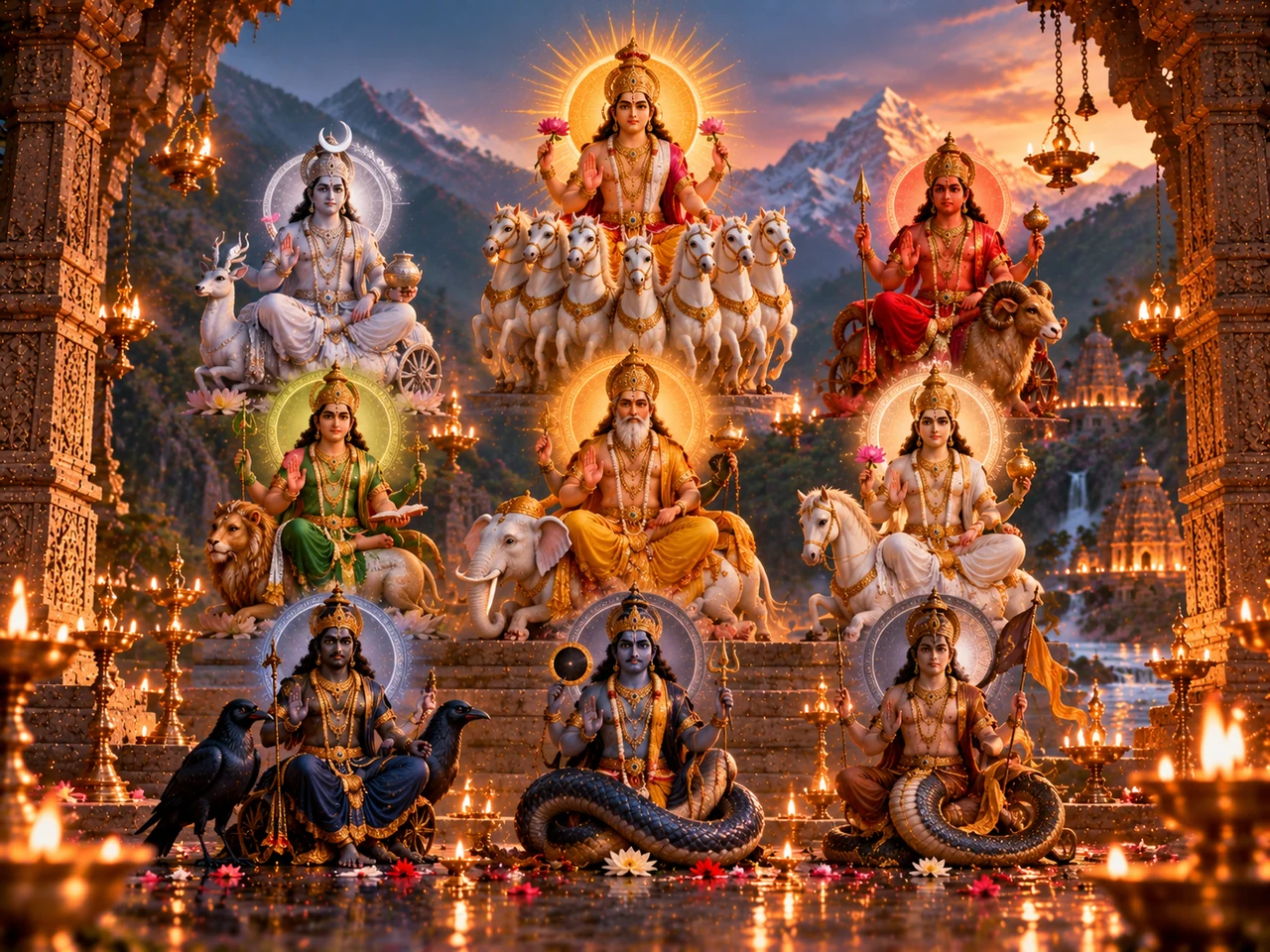
A visitor entering an old Indian temple may look up and discover nine small figures in a row above the doorway. Some carry flowers or vessels; one may be only a head, another may have a serpent-like body. This is not a miniature picture of the modern Solar System. The figures belong to the Navagraha, a traditional group through which Hindu communities have imagined the changing sky, the passage of time, and the relationship between celestial order and human life. A surviving seventh-century temple lintel in the Los Angeles County Museum of Art shows how long this visual grouping has been part of Indian sacred architecture. 5
Navagraha study has two complementary tasks. We can understand what a religious or Jyotisha tradition teaches without pretending that every teaching is a scientific finding; and we can appreciate the extraordinary history of observing the heavens without describing an eclipse as a literal attack by a demon. This article introduces all nine figures as one connected subject, then tells their stories individually. 7 · 11
What does Navagraha mean?
Nava means nine. Graha has a wider Sanskrit semantic history than the English word planet: it can suggest grasping or seizing, and in astronomical and astrological usage names a celestial influence or point of significance. The traditional nine are Surya (Sun), Chandra (Moon), Mangala (Mars), Budha (Mercury), Brihaspati (Jupiter), Shukra (Venus), Shani (Saturn), Rahu (the ascending or north lunar node), and Ketu (the descending or south lunar node). This is a religious-astral classification, not the modern astronomical category “planet.” 7 · 14
The Sun is a star, the Moon is Earth's natural satellite, and Rahu and Ketu are calculated points where the Moon's tilted orbital plane crosses the ecliptic. The other five names correspond to planets observable without a telescope. This explains why an ancient ninefold set does not include Earth, Uranus or Neptune: it was formed for a different purpose from modern planetary taxonomy. It does not establish that these bodies determine a person's health, character, marriage or fortune. 11 · 13
From Vedic sky poetry to temple sculpture
The oldest Vedic literature contains reverent invocations of celestial deities, but one must not project the fully developed nine-deity iconographic set backward onto every Vedic hymn. The RigvedaṚgveda, for example, addresses Surya in hymn 1.50; its moving picture of rays, days and seven steeds belongs to early sacred poetry. The later Navagraha group emerged through the histories of astronomy, calendrical knowledge, astrology, temple ritual and visual art. These strands overlap without being identical. 1 · 5
Museum evidence offers firmer dates than a universal tale about the group's single “invention.” LACMA catalogues an Uttar Pradesh lintel, stylistically dated to about 600–625 CE, as one of the earliest surviving complete nine-graha representations. A Cleveland Museum of Art relief from the 700s arranges the nine figures near a temple entrance. A separate Worcester Art Museum panel is dated 550–575 CE, but only eight planetary figures survive and Ketu is missing. These dates concern particular objects, not the beginning of belief in every named deity. 5 · 6 · 8
The same celestial figures did not remain confined to one region or one religious school. A Japanese Buddhist handscroll dated 1125, now at the Metropolitan Museum of Art, portrays the Nine Luminaries in an esoteric ritual setting shaped by Indian, Chinese and Japanese transmissions. Its existence is evidence for cultural travel, not proof that Hindu and Buddhist rites were interchangeable. 14
1. Surya — light, day and the visible sky
Surya (Sūrya; सूर्य) is the solar deity: radiant, life-sustaining and among the most prominent figures of Vedic religious poetry. In Rigveda 1.50Ṛgveda 1.50, the rising sun illuminates the world; the hymn also imagines a chariot drawn by seven steeds. Later artists frequently show Surya standing straight, holding two lotuses, and sometimes wearing high boots—features that can help identify him in a carved Navagraha row. The Cleveland Museum specifically notes his boots and fully open lotus flowers. 1 · 6
Sun worship ranges beyond the nine-graha grouping. The thirteenth-century Konark Sun Temple in Odisha, described by India's Ministry of Culture, gives monumental architectural form to a solar chariot. In everyday devotion, Surya may stand for illumination, regularity and gratitude for the conditions of life. These are religious and literary meanings; they do not make sunlight safe to stare at or cure illness through worship. Do not look directly at the Sun, including during an eclipse, without appropriate certified eye protection. 15
2. Chandra — the Moon and the rhythm of months
Chandra (चन्द्र), also called Soma in many later lunar contexts, is linked with moonlight, phases, plants, nourishment and the reckoning of time. It is important not to flatten every occurrence of Soma in early Vedic literature into a simple synonym for the physical Moon: the term has a complex history involving ritual and divine imagery. In a Navagraha relief, Chandra may appear as a human figure rather than as the crescent-moon symbol familiar from Shiva's hair. The LACMA lintel identifies Chandra among the six figures following Surya. 5
Lunar movement matters to many Indian calendars and festivals, though practices differ between regions. As a devotional symbol, changing lunar phases can suggest that change is part of an ordered cycle. In astronomy the Moon's phases arise from changing viewing geometry as it orbits Earth, not because a deity gains and loses substance. One person may see a moonlit night as prayerful, another as a subject for astronomical observation, and many as both.
3. Mangala — Mars and the language of courage
Mangala (मंगल) is traditionally identified with Mars and is also called Bhauma or Kuja in various Sanskrit traditions. Names, kinship stories, weapons, animals and preferred colours are not uniform in regional worship or iconographic handbooks. Rather than declaring that every Mangala image must have one number of arms or one vehicle, it is safer to identify him through the context of a properly documented graha group. Historical reliefs often show several middle grahas with similar human bodies and modest differences. 5 · 6
Modern Jyotisha manuals often associate Mangala with initiative, energy or conflict. Those are interpretive associations within astrology, not measurements establishing that the planet Mars causes human temperament or marital difficulties. A constructive cultural reading asks how qualities such as courage can be balanced by restraint, instead of labelling someone harmful because of a horoscope. No one should be pressured into costly rites or denied a relationship because of an unverified prediction.
4. Budha — Mercury, intelligence and a complicated birth story
Budha (बुध) is associated with Mercury and, in many later interpretive traditions, with discernment, language and quick understanding. Budha is not Buddha, the historical teacher central to Buddhism; the similar English spellings refer to different names and traditions. The planetary Budha appears within a family narrative in the Bhāgavata Purāṇa, book 9, chapter 14. The Moon-god Soma takes Tara, who is married to Brihaspati; after conflict and her return, she identifies Soma as the father of the child who receives the name Budha. 3
This is a Purāṇic story, not the biological origin of the physical planet Mercury. The narrative also involves Tara's abduction and an argument over her pregnancy; it should not be romanticized as an uncomplicated love story. Readers may interpret Budha's name and later intellectual symbolism in various ways, but the ancient account and a modern moral response are different levels of discussion.
5. Brihaspati — Jupiter and the responsibility of teaching
Brihaspati (Bṛhaspati; बृहस्पति), the graha associated with Jupiter, is widely portrayed in Hindu literature as the guru of the devas. In Bhāgavata Purāṇa 6.7, Indra fails to honour him, and the ensuing narrative portrays the consequences of arrogance toward a teacher. That is an identifiable scriptural story, not a chart reading. 4
Brihaspati therefore offers a striking contrast to a purely mechanical idea of “good luck.” The story's focus is attention, humility and responsibility. Devotional interpretations commonly associate him with counsel and learning, while Jyotisha adds other correspondences that vary by lineage. A sculptor working in a nine-graha frieze may give him a vessel or an ascetic appearance; modern posters often use different iconographic conventions. Neither should be claimed as his one universal portrait.
6. Shukra — Venus and the wisdom of a rival teacher
Shukra (Śukra; शुक्र), linked to Venus, is also prominent as Shukracharya, the spiritual teacher of the asuras in several Purāṇic narratives. In Bhāgavata Purāṇa 6.7, the text contrasts devas seeking guidance after offending Brihaspati with asuras acting under Shukracharya's instruction. The label asura changes meaning across periods and contexts; turning every related figure into a flat caricature erases the moral complexity of the stories. 4
Later astrological traditions associate Shukra with beauty, pleasure, relationship and artistic refinement. These are culturally meaningful categories but not established causal effects of the physical planet Venus on personal decisions. The Walters Art Museum documents a fragment where a frog is identified as the vehicle of Shukra—a useful reminder that historical art can differ from the popular vehicle descriptions that circulate online. 7
7. Shani — Saturn, limitation and endurance
Shani (Śani; शनि), linked to Saturn, is sometimes feared because Jyotisha traditions associate him with delays, discipline, hardship and the passage of time. Yet devotional Shani is not merely a cosmic punisher. Stories about difficult periods can also prompt reflection on patience, ethical action and solidarity with others. A sensitive presentation avoids suggesting that a person's suffering is proof of deserved divine punishment. 7
Shani's iconography varies. The Walters fragment depicts him carrying a club, with a buffalo below as his mount; other regional images show birds or different vehicles. The Cleveland relief depicts Saturn in an unusual one-legged pose and records a mythic explanation supplied by the museum. We should not generalize either work into a fixed rule for every Shani shrine. Saturn's actual orbital motion belongs to astronomy; a prediction about a life crisis based on his supposed influence belongs to astrology. 6 · 7
8. Rahu — eclipses, the severed head and the ascending node
Rahu (Rāhu; राहु) is represented in many early images as a disembodied head, sometimes with large eyes and grasping hands. LACMA's terracotta Rahu figure dated roughly 500–550 CE shows this striking iconography. In Bhāgavata Purāṇa 8.9.24–26, Rahu disguises himself while the nectar of immortality is distributed. Surya and Chandra recognize him; Hari cuts off his head, and the head remains alive. This version says his body falls lifeless. 9 · 2
Some later or separate tellings connect Rahu's body or tail with Ketu; it would be inaccurate to claim that the cited Bhāgavata verses themselves state this as the identity of Ketu. The astronomical Rahu is the ascending node of the Moon's orbit, a calculated point rather than a material celestial body. The eclipse story is religious narrative; orbital alignment is the physical explanation. The two should be discussed as different kinds of accounts, not forced into a single literal history. 7 · 11
9. Ketu — the descending node and changing imagery
Ketu (केतु) is the counterpart of Rahu in the familiar ninefold system: the descending lunar node. Religious imagery is notably variable. A Cleveland Museum carving shows a serpent-tailed figure; LACMA identifies a half-serpentine figure of Ketu in its early complete lintel and notes that the figure may appear feminine. Museum descriptions also connect Ketu with comets in some historical imagery. A modern artist's dramatic serpent-head or tail is therefore one possible artistic language, not a timeless mandatory form. 6 · 5
In some contemporary Jyotisha explanations Ketu symbolizes severance, detachment or spiritual inquiry. These readings belong to specific interpretive systems, not to modern physical astronomy. Because there is no planet-sized object at the descending node, talk of Ketu's gravity influencing a person's fate is not scientifically grounded. In temple sculpture, however, Ketu remains a meaningful member of a ninefold sacred composition—an example of how a mathematical point can acquire a richly human symbolic identity.
The sky of Surya and the calendar of Chandra
The rising Sun and changing Moon are the most immediate celestial rhythms in ordinary life. Vedic poetry celebrates Surya's visibility; lunar cycles continue to shape many ritual calendars. These are not interchangeable experiences: a solar day, a lunar phase and an astrological reading operate with different definitions. The Navagraha bring those different rhythms into a shared visual language, even though the technical calculations and theological interpretations must still be distinguished. 1
Tara, Soma and the naming of Budha
The story in Bhāgavata Purāṇa 9.14 crosses several graha identities at once: Soma/Chandra, Brihaspati, Shukra and the newborn Budha appear within one account of dispute, intervention and lineage. This reveals why the nine are more than isolated symbols on a chart. In Purāṇic literature they can be characters with relationships and moral tensions. Its treatment of Tara also reminds us to read old narratives critically and respectfully rather than copying their judgments unexamined. 3
Rahu's attempted theft of nectar
The most recognizable eclipse narrative begins not in a laboratory but at the distribution of amṛta, the nectar of immortality. Rahu's disguise succeeds only briefly. The two luminaries identify him, Hari intervenes, and the head's survival expresses a continuing rivalry. People have long used stories to give shape to startling sky events. We can appreciate this one as a narrative without teaching children that a hungry head literally causes eclipses. 2
Iconography: how to read a Navagraha panel
The safest way to identify a graha in historical art is to examine the whole panel, its order, region, date, and accompanying museum or inscriptional evidence. Surya's lotus flowers and boots, Rahu's exceptional head and Ketu's serpentine form can be useful clues. Other figures may look quite similar. Number of arms, colour, animal mounts and weapons change across objects and traditions. Even the survival of a panel affects identification: the Worcester example lacks Ketu. 5 · 6 · 8
Historically, Navagraha rows could serve a protective architectural function at temple entrances. That does not mean every temple requires a nine-figure shrine or that the group has exactly the same rank in Shaiva, Vaishnava and other communities. Placement near a doorway, a sculpture in a museum and an actively worshipped shrine are three different settings with different interpretive limits. 7 · 16
Jyotisha, mathematics and the limits of prediction
Jyotisha is a broad historical field whose practices have included calendrical calculation and astral interpretation. It is misleading to say everything called Jyotisha is identical to a modern horoscope, just as it is misleading to equate religious grahas with astronomical planets. Indian observers developed approaches to time-reckoning and celestial motion; the history of those calculations deserves careful study on its own terms. But a mathematically calculated position does not verify an astrological claim about career, illness, marriage or character.
Solar and lunar eclipses occur when the Earth, Moon and Sun align near one of the Moon's orbital nodes. NASA's eclipse materials explain the inclined lunar orbit and the two intersections with the ecliptic. That physical mechanism can be tested and used to predict eclipse times. Claims that a birth chart determines individual destiny lack reliable scientific validation, and should never replace medical care, sound financial decisions or consent in relationships. 11 · 12 · 13
Devotion, worship and cultural practice
Some temples display the Navagraha together; households and communities may also honour Surya, Shani or another graha individually. The nine-deity idea also appears in navaratna jewellery traditions, documented by the Metropolitan Museum; a gemstone association is evidence of material culture, not proof that purchasing a stone changes destiny. 10 People visit shrines, offer prayers or undertake observances for many reasons: inherited custom, gratitude, concern about difficulties, or a desire to reflect on time and responsibility. The public fact that such worship exists does not establish that a particular formula, donation, gemstone or costly ceremony guarantees an outcome. Requirements differ by temple and lineage; restricted mantras or initiations are outside this introductory guide.
The association of different weekdays with grahas is widely familiar in later practice, but local customs and ritual instructions vary. Sun temples at Konark and Modhera illustrate the independent importance of Surya devotion; neither should automatically be described as simply a Navagraha temple. The Navagraha also appear in historic Buddhist material outside India, demonstrating the group's mobility across cultures. 15 · 17 · 14
One should be particularly cautious about fear-based services promising to remove “planetary defects,” cure disease or save a marriage for a price. Supporting a temple voluntarily is different from being told that a crisis is inevitable without a purchase. For this educational article, public cultural description is appropriate; individualized horoscope interpretations, prescribed remedies and initiation-dependent rituals are not being provided.
Questions readers often ask
Are the Navagraha nine astronomical planets? No. The list includes the Sun and Moon, five naked-eye planets, and two lunar nodes. It is a traditional sacred-astral grouping. 7
Are Rahu and Ketu real? Their astronomical referents—the two nodes of the Moon's orbit—are mathematically real positions, not physical planets or giant invisible creatures. Their personal identities belong to religious narratives. 11
Does a graha's position decide someone's future? Astrology offers interpretive traditions, but precise personal-fate claims have not been reliably established through science. A horoscope should not decide health care, marriage consent or financial risk. 13
Why do two temples show different vehicles or colours? Iconographic conventions have changed across time and region. A labelled historical object is stronger evidence for its own form than an internet chart claiming universal rules. 5 · 7
Is Navagraha worship exclusively Shaiva? No. Graha figures appear in varied Hindu settings and also travelled into other religious art traditions; specific temple practices should be described locally, not generalized. 16 · 14
Key terms
- Navagraha: the traditional group of nine celestial deities or influences.
- Graha: a term with meanings including grasping, and a technical role in astral traditions; not exactly “planet” in modern astronomy.
- Jyotisha: historically diverse practices involving celestial time-reckoning and astral interpretation.
- Ecliptic: the apparent annual path of the Sun against the sky, used as a reference plane in astronomy.
- Lunar node: one of two intersections of the Moon's orbital plane with the ecliptic.
- Rahu / Ketu: in the nine-graha scheme, respectively the ascending and descending nodes; also personified in sacred narrative.
- Amṛta: the nectar of immortality in Hindu mythic literature.
- Temple lintel: horizontal architectural element over a doorway; sometimes carved with Navagraha figures.
- Purāṇa: a family of Sanskrit religious-literary works containing diverse narratives and teachings, rather than one uniform book.