



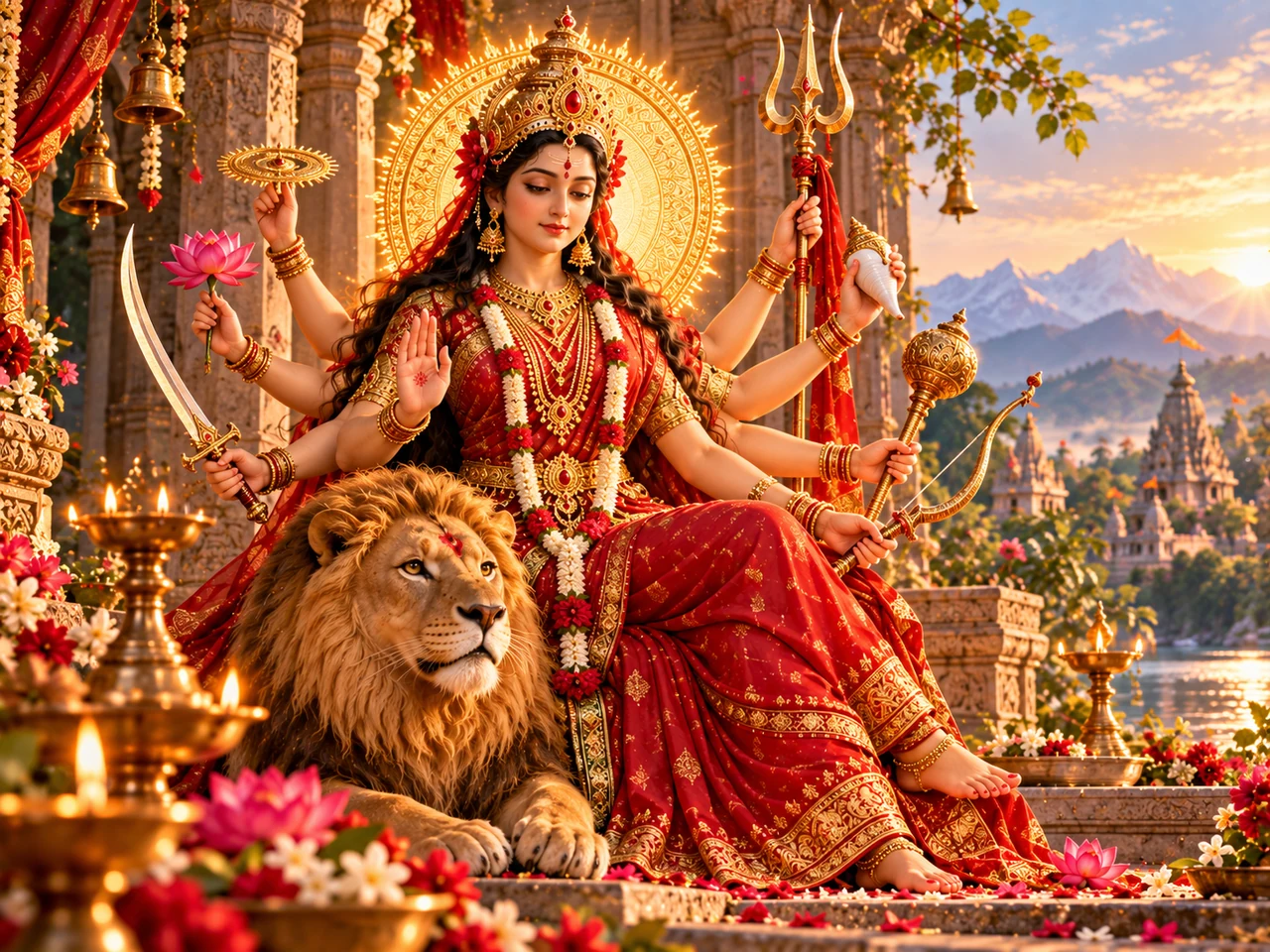
Editorial edition note. This article first gives the entire selected original Sanskrit mantra in Roman IAST, not an English translation. The controlling documented living-practice witness is the Devipuram Dasarā Brahmotsavaṃ 2022 manual, PDF p. 132 (zero-indexed scan page 131), under “Durgā Mantras.” The same short string appears on a dedicated Drik Panchang mantra page. This is not a claim that the mantra originates in the 2022 manual or is an independently verified verse of the Devi Mahatmyam (Durga Saptashati). The modern source has been inspected, but the earliest textual attestation and rights clearance remain unresolved. 1 2
Original mantra
Concise meaning: Oṃ. With the seed syllable duṃ, I offer reverential salutations to Goddess Durga. , I offer reverential salutations to Goddess Durgā. Expanded meaning: The mantra begins with oṃ, a sacred opening sound widely used in Hindu prayer. It then employs duṃ, the seed syllable associated with Durga in the selected Shakta devotional transmission. The ending , the seed syllable associated with Durgā in the selected Śākta devotional transmission. The ending durgayai namaḥdurgāyai namaḥ means “reverential salutations to Durgā.” Its grammatical shape is a salutation, not a sentence requesting a particular event, a promise of health, or a declaration that danger will disappear. The bija is not an ordinary dictionary word; its significance is liturgical and lineage-dependent. means “reverential salutations to Durgā.” Its grammatical shape is a salutation, not a sentence requesting a particular event, a promise of health, or a declaration that danger will disappear. The bīja is not an ordinary dictionary word; its significance is liturgical and lineage-dependent. 1 2
The formula is short, but readers can take it as a reminder of courage, compassionate protection, discernment and a willingness to face difficulty. This is ShivGoraksh's interpretive reflection, not a literal translation of the bija and not a statement of guaranteed effects. In Shakta traditions, Durga is honoured as a form of the Goddess whose imagery combines maternal care with the ability to confront destructive forces. That religious imagery should be understood in the context of the tradition, not reinterpreted as clinical or physical certainty., not a literal translation of the bīja and not a statement of guaranteed effects. In Śākta traditions, Durgā is honoured as a form of the Goddess whose imagery combines maternal care with the ability to confront destructive forces. That religious imagery should be understood in the context of the tradition, not reinterpreted as clinical or physical certainty.
Word-by-word and grammatical understanding
| Original | Form | Faithful explanation |
|---|---|---|
| oṃ (ॐ) | Sacred syllable, commonly called praṇava | The auspicious invocation; not a word with one fixed English equivalent. |
| duṃ (दुं) | Durga-associated Durgā-associated bijabīja in this mantra | A seed syllable used in a Shakta liturgical context; A seed syllable used in a Śākta liturgical context; do not invent a lexical English translation. |
| durgayaidurgāyai (दुर्गायै) | Feminine dative singular of DurgaDurgā | “To Durgā”; marks the addressee of the salutation. |
| namaḥ (नमः) | Indeclinable salutation | “Homage,” “respectful bow,” or “reverential salutations.” |
The most literal natural English rendering is “Oṃ, duṃ: salutations to Durgā.” The sound-value, symbolism and ritual understanding of duṃ cannot be reduced to a simple equivalent like “protection,” “shield,” or “victory.” Likewise, namaḥ does not mean “grant a wish.” 1 2
Why durgayaidurgāyai rather than durgadurgā? The everyday dictionary form of the name is DurgaDurgā. In a Sanskrit salutation, the dative names the one to whom reverence is offered: durgayaidurgāyai. This is a grammatical case change, not another goddess or a different mantra. Roman spellings such as “Durgaye,” “Durgayai,” and “Durgayei” often try to represent the same Sanskrit ending without IAST diacritics. They should not automatically be treated as independently collated textual variants. Sanskrit grammatical analysis is distinct from the folk etymologies sometimes attached to the Goddess's name.
What does duṃ mean? Duṃ is a bija-mantrabīja-mantra, a sacred seed syllable. Its ritual significance depends on the Shakta community and teaching tradition; it should , a sacred seed syllable. Its ritual significance depends on the Śākta community and teaching tradition; it should not be translated as a normal noun or treated as a syllable whose pronunciation automatically produces a measurable result. In the selected source, it is written दुं, corresponding to duṃ with a short u and nasal sign. Modern plain-Roman “dum” can conceal the length of the vowel and the nasal ending. The version दूं (long ū) must not be substituted without a verified witness; neither should the different bija ) must not be substituted without a verified witness; neither should the different bīja hrīṃ be inserted into the canonical line. 1 3
Is the mantra taken from the Devi Mahatmyam (Durga Saptashati) / Durga Saptashati? Is the mantra taken from the Devi Mahatmyam (Durga Saptashati) / Durgā Saptaśatī? No verified chapter-and-verse attribution has been established for this exact four-part mantra. The Devi Mahatmyam (Durga Saptashati) contains major praises of the Goddess and is central to many Durga traditions; its public verse collections do not, by themselves, establish this short contains major praises of the Goddess and is central to many Durgā traditions; its public verse collections do not, by themselves, establish this short oṃ duṃ durgayai namaḥoṃ duṃ durgāyai namaḥ formula as a numbered verse of the thirteen-chapter core. This reading has been documented instead through living-devotional textual witnesses. A source describing the formula as part of “Saptaśatī worship tradition” is a contextual claim, not an edition-specific verse locator. Do not create a fake “Devi Mahatmyam (Durga Saptashati) 11.x” citation. 1 2 3
This distinction matters for ShivGoraksh: the related reading and the related reading are linked to identifiable Devi Mahatmyam (Durga Saptashati) chapter verses; the related reading is a separate mantra work, not another excerpt to be mapped onto the Chapter 11 scripture nodes. The source provenance is appropriately classified as modern documented Shakta recitation / earlier textual origin unknownmodern documented Śākta recitation / earlier textual origin unknown.
Where is this exact wording attested?
- Devipuram, Dasarā Brahmotsavaṃ (2022): The page headed “Durgā Mantras” prints ॐ दुं दुर्गायै नमः (compactly spaced in the PDF) with Roman oṁ duṃ durgayai namaḥ and explicitly labels it “Mantra for the Uninitiated Devotees.” The same page lists a different Navārṇa/ Chamunda formula for initiated devotees. The line was confirmed directly in the rendered PDF page; this is the selected controlling and explicitly labels it “Mantra for the Uninitiated Devotees.” The same page lists a different Navārṇa/ Cāmuṇḍā formula for initiated devotees. The line was confirmed directly in the rendered PDF page; this is the selected controlling living-practice witness, not proof of ancient composition or permission to redistribute the contemporary PDF. 1
- Drik Panchang, “Durga Beeja Mantra”: Displays ॐ दुं दुर्गायै नमः।, supporting the short formula. The site's devotional claims of effectiveness remain religious claims, not scientific evidence. 2
- Sarva Panchang, “Durga Mantras”: Lists the same short mantra under “Durga Beeja Mantra” and a longer distinct formula with an added hrīṃ under “Durga Ashtakshara Mantra.” This corroborates the need not to merge variants. 3
- Learn Sanskrit, short-mantra reader: Also displays the same expression as a single-line devotional text. Its own editorial claims about two older edition checks do not provide sufficient published edition locators for independent historical collation here. It is supplementary confirmation only. 4
There is no verified author, composition century, ancient manuscript folio, or precise Tantra passage established for this exact selected wording. Do not assign one in public copy. 5
Is initiation required? The answer varies by tradition and intended practice. A significant detail is that Devipuram's 2022 manual itself places this short mantra under “Mantra for the Uninitiated Devotees”, while distinguishing a different mantra intended for initiated devotees. That is a source-grounded statement about Devipuram's practice classification, not a universal rule. Other Shakta, tantric, guru-disciple and household traditions may approach bija-syllables differently. , not a universal rule. Other Śākta, tantric, guru-disciple and household traditions may approach bīja-syllables differently. 1
This ShivGoraksh work teaches the words, their grammar and documented devotional context only. It does not prescribe a count of repetitions, nyāsa, yantra, homa, breath retention, bija activation, mantrādhikāra, deekṣā or specialized procedures. Practice customs differ between traditions. The cited Devipuram guidance addresses uninitiated devotees in its own context; reading this page does not confer initiation or authority for specialized applications. prescribe a count of repetitions, nyāsa, yantra, homa, breath retention, bīja activation, mantrādhikāra, deekṣā or specialized procedures. Practice customs differ between traditions. The cited Devipuram guidance addresses uninitiated devotees in its own context; reading this page does not confer initiation or authority for specialized applications.
Durga as a devotional subjectDurgā as a devotional subject
Durga is revered across Shakta and many broader Hindu devotional settings. In hymns and narrative traditions she is remembered as the Divine Mother who withstands destructive forces, shelters devotees and restores moral and cosmic order. Such ideas may inspire ethical courage and care for others. This modern interpretation must remain separate from a translation: only Durgā is revered across Śākta and many broader Hindu devotional settings. In hymns and narrative traditions she is remembered as the Divine Mother who withstands destructive forces, shelters devotees and restores moral and cosmic order. Such ideas may inspire ethical courage and care for others. This modern interpretation must remain separate from a translation: only durgayaidurgāyai explicitly names the Goddess in this brief formula. The full mythology, festivals and theology are not secretly embedded as additional words inside duṃ.
Shiva–Shakti frameworks sometimes explain Durga through wider notions of Shakti, while specific Shakta lineages give the Goddess independent supreme Śiva–Śakti frameworks sometimes explain Durgā through wider notions of Śakti, while specific Śākta lineages give the Goddess independent supreme
Textual forms and editorial distinctions
- Selected original:
ॐ दुं दुर्गायै नमः— oṃ duṃ durgayai namaḥoṃ duṃ durgāyai namaḥ. The terminal||shown above is reader punctuation, not an added original word. 1 2 - Unaccented Sanskrit: No Vedic svara accents are claimed. This is not presented as a Ṛgvedic or Taittirīya recitation verse.
- Roman spelling: oṃ / oṁ are transliteration conventions; “Om Dum Durgayai Namah” is a non-diacritic search spelling.
- Syllable notation: The seed is
दुं/ duṃ. Writing dūṃ with a long vowel describes a materially different spelling, not an editorial correction of this source. 1 - Added hrīṃ:
ॐ ह्रीं दुं दुर्गायै नमःis a different expanded formula listed separately in another catalogue. It is not part of the related reading's chosen source line. 3 - Navarna mantra:Navārṇa mantra:
ॐ ऐं ह्रीं क्लीं चामुण्डायै विच्चेis associated with Chamunda and should is associated with Cāmuṇḍā and should not be treated as a variant spelling or extension of this exact formula. The Devipuram manual presents a similar Navarna line separately. be treated as a variant spelling or extension of this exact formula. The Devipuram manual presents a similar Navārṇa line separately. 1 3 - Case ending: durgayaidurgāyai is not the nominative durgadurgā and cannot be replaced with it in the selected text.
- Unverified alternate: Other modern resources may write durgai or remove oṃ. They cannot be silently incorporated without a specific witness and editorial decision. 5
- Source identity: Modern recitation attestation is not the same as independent ancient textual sourcing. An unverified manuscript attribution is explicitly not accepted here.
- Rights: The mantra is a very short traditional Sanskrit formula, but the Devipuram PDF, modern editions, page layout and supplied explanations have separate modern rights. The commentary here is newly authored; publication still awaits review. 1 5
Frequently asked questions
What is the complete Durga bija mantra in this work?What is the complete Durgā bīja mantra in this work? The complete selected mantra is oṃ duṃ durgayai namaḥoṃ duṃ durgāyai namaḥ. The work intentionally contains one standalone formula, not a larger hymnal passage. What does “Om Dum Durgayai Namah” mean? “Oṃ, duṃ; salutations to Durgā.” The syllable duṃ is a liturgical seed, not an ordinary lexical word meaning “protect me.”
Is this the Navarna mantra?Is this the Navārṇa mantra? No. Navārṇa/Cāmuṇḍā formulas use different syllables and words and are treated as separate textual units. 1
Why do some sources show “Durgayei”? Non-diacritic Latin transliterations vary. Here durgayaidurgāyai represents the original दुर्गायै form precisely; any genuinely different Devanagari form needs its own textual evidence. Can anyone chant it? Devipuram labels this particular line for uninitiated devotees, but practice conventions vary. ShivGoraksh provides reading and understanding, not universal initiation advice, ritual instructions or guaranteed effects. 1