Text, Meaning & Explanation
देवि प्रपन्नार्तिहरे प्रसीद प्रसीद मातर्जगतोऽखिलस्य । प्रसीद विश्वेश्वरि पाहि विश्वं त्वमीश्वरी देवि चराचरस्य
Roman Transliterationdevi prapannaartihare praseeda praseeda maatarjagato’khilasya | praseeda vishveshvari paahi vishvam tvameeshvaree devi charaacharasyadevi prapannārtihare prasīda prasīda mātarjagato’khilasya | prasīda viśveśvari pāhi viśvaṃ tvamīśvarī devi carācarasya
Meaning
O Goddess, remover of the distress of those who seek refuge, be gracious! O Mother of the whole world, be gracious. O sovereign of the universe, protect the world: you rule all that moves and does not move.
Explanation
The prayer begins with vulnerability rather than triumph. Its repeated appeal for grace extends protection beyond the gods to the whole moving and unmoving world. The claim about divine sovereignty is devotional theology within the hymn.
आधारभूता जगतस्त्वमेका महीस्वरूपेण यतः स्थितासि । अपां स्वरूपस्थितया त्वयैतदाप्यायते कृत्स्नमलङ्घ्यवीर्ये
Roman Transliterationaadhaarabhootaa jagatastvamekaa maheesvaroopena yatah sthitaasi | apaam svaroopasthitayaa tvayaitadaapyaayate kritsnamalanghyaveeryeādhārabhūtā jagatastvamekā mahīsvarūpeṇa yataḥ sthitāsi | apāṃ svarūpasthitayā tvayaitadāpyāyate kṛtsnamalaṅghyavīrye
Meaning
You alone support the world, abiding as the earth. Present also in the form of water, you nourish all of it, O one whose power cannot be overcome.
Explanation
Earth and water express two basic forms of sustenance: a place to live and the nourishment life requires. The verse is praise of the Goddess through the elements, not a technical description of physical processes. The compound at the water image needs careful Sanskrit collation.
त्वं वैष्णवीशक्तिरनन्तवीर्या विश्वस्य बीजं परमासि माया । सम्मोहितं देवि समस्तमेतत् त्वं वै प्रसन्ना भुवि मुक्तिहेतुः
Roman Transliterationtvam vaishnaveeshaktiranantaveeryaa vishvasya beejam paramaasi maayaa | sammohitam devi samastametat tvam vai prasannaa bhuvi muktihetuhtvaṃ vaiṣṇavīśaktiranantavīryā viśvasya bījaṃ paramāsi māyā | sammohitaṃ devi samastametat tvaṃ vai prasannā bhuvi muktihetuḥ
Meaning
You are the immeasurably powerful Vaiṣṇavī energy, the ultimate seed of the cosmos and its great Māyā. Though the world is caught in that power of appearance, when you are gracious you become the cause of liberation.
Explanation
The hymn deliberately places concealment and release together. Māyā here belongs to the theological vocabulary of divine power; its exact philosophical meaning can vary by tradition. The verse does not reduce the Goddess to mere illusion.
विद्याः समस्तास्तव देवि भेदाः स्त्रियः समस्ताः सकला जगत्सु । त्वयैकया पूरितमम्बयैतत् का ते स्तुतिः स्तव्यपरापरोक्तिः
Roman Transliterationvidyaah samastaastava devi bhedaah striyah samastaah sakalaa jagatsu | tvayaikayaa pooritamambayaitat kaa te stutih stavyaparaaparoktihvidyāḥ samastāstava devi bhedāḥ striyaḥ samastāḥ sakalā jagatsu | tvayaikayā pūritamambayaitat kā te stutiḥ stavyaparāparoktiḥ
Meaning
All branches of knowledge are forms of you, O Goddess, and all women in the worlds are manifestations of you. You alone fill this whole universe, O Mother; how could any words adequately praise one who transcends every object of praise?
Explanation
This is one of the chapter's broadest affirmations of the sacred feminine and of knowledge as a divine expression. Its rhetorical question admits that language cannot encompass its subject. It should be presented as the hymn's theological vision, not as a replacement for women's individual identities.
सर्वभूता यदा देवी भुक्तिमुक्तिप्रदायिनी । त्वं स्तुता स्तुतये का वा भवन्तु परमोक्तयः
Roman Transliterationsarvabhootaa yadaa devee bhuktimuktipradaayinee | tvam stutaa stutaye kaa vaa bhavantu paramoktayahsarvabhūtā yadā devī bhuktimuktipradāyinī | tvaṃ stutā stutaye kā vā bhavantu paramoktayaḥ
Meaning
When you yourself are the Goddess present in all beings and the giver of both enjoyment and liberation, what superior words could remain with which to praise you?
Explanation
The verse extends the previous question: a power believed to embrace ordinary life and spiritual freedom exceeds conventional praise. Bhukti and mukti mark different human aspirations, not identical rewards or automatic guarantees.
सर्वस्य बुद्धिरूपेण जनस्य हृदि संस्थिते । स्वर्गापवर्गदे देवि नारायणि नमोऽस्तु ते
Roman Transliterationsarvasya buddhiroopena janasya hridi samsthite | svargaapavargade devi naaraayani namo’stu tesarvasya buddhirūpeṇa janasya hṛdi saṃsthite | svargāpavargade devi nārāyaṇi namo’stu te
Meaning
Abiding as understanding in every person's heart, giver of heaven and liberation, O Goddess Narayani, reverence to you.Abiding as understanding in every person's heart, giver of heaven and liberation, O Goddess Narayani, reverence to you.Abiding as understanding in every person's heart, giver of heaven and liberation, O Goddess Nārāyaṇī, reverence to you.
Explanation
Here the hymn locates the sacred not only outside a person but in the capacity to discern and understand. The repeated refrain 'Narayani, reverence to you' will structure much of the hymn and may be displayed consistently without diminishing the individual verses.Here the hymn locates the sacred not only outside a person but in the capacity to discern and understand. The repeated refrain 'Narayani, reverence to you' will structure much of the hymn and may be displayed consistently without diminishing the individual verses.Here the hymn locates the sacred not only outside a person but in the capacity to discern and understand. The repeated refrain 'Nārāyaṇī, reverence to you' will structure much of the hymn and may be displayed consistently without diminishing the individual verses.
कलाकाष्ठादिरूपेण परिणामप्रदायिनि । विश्वस्योपरतौ शक्ते नारायणि नमोऽस्तु ते
Roman Transliterationkalaakaashthaadiroopena parinaamapradaayini | vishvasyoparatau shakte naaraayani namo’stu tekalākāṣṭhādirūpeṇa pariṇāmapradāyini | viśvasyoparatau śakte nārāyaṇi namo’stu te
Meaning
Taking the forms of divisions of time, from kalā and kāṣṭhā onward, you bring transformation, and you have power over the world's cessation. O Narayani, reverence to you.Taking the forms of divisions of time, from kalā and kāṣṭhā onward, you bring transformation, and you have power over the world's cessation. O Narayani, reverence to you.Taking the forms of divisions of time, from kalā and kāṣṭhā onward, you bring transformation, and you have power over the world's cessation. O Nārāyaṇī, reverence to you.
Explanation
The names are traditional measures of time. Rather than calculating their length, the hymn invokes time and change as aspects of cosmic order under the Goddess. The expression for cessation needs to retain its cosmic sense, not be narrowed to an individual's death.
सर्वमङ्गलमाङ्गल्ये शिवे सर्वार्थसाधिके । शरण्ये त्र्यम्बके गौरि नारायणि नमोऽस्तु ते
Roman Transliterationsarvamangalamaangalye shive sarvaarthasaadhike | sharanye tryambake gauri naaraayani namo’stu tesarvamaṅgalamāṅgalye śive sarvārthasādhike | śaraṇye tryambake gauri nārāyaṇi namo’stu te
Meaning
Auspiciousness within all that is auspicious, beneficent one who fulfils every worthy aim, refuge of all, three-eyed Gaurī: O Narayani, reverence to you.Auspiciousness within all that is auspicious, beneficent one who fulfils every worthy aim, refuge of all, three-eyed Gaurī: O Narayani, reverence to you.Auspiciousness within all that is auspicious, beneficent one who fulfils every worthy aim, refuge of all, three-eyed Gaurī: O Nārāyaṇī, reverence to you.
Explanation
This much-loved verse gathers several divine epithets into a brief prayer. 'Three-eyed' recalls Shiva-associated iconography, while the broader address remains directed to the Goddess. The claim to fulfil every aim is devotional praise, not a promise of particular worldly outcomes.This much-loved verse gathers several divine epithets into a brief prayer. 'Three-eyed' recalls Shiva-associated iconography, while the broader address remains directed to the Goddess. The claim to fulfil every aim is devotional praise, not a promise of particular worldly outcomes.This much-loved verse gathers several divine epithets into a brief prayer. 'Three-eyed' recalls Śiva-associated iconography, while the broader address remains directed to the Goddess. The claim to fulfil every aim is devotional praise, not a promise of particular worldly outcomes.
सृष्टिस्थितिविनाशानां शक्तिभूते सनातनि । गुणाश्रये गुणमये नारायणि नमोऽस्तु ते
Roman Transliterationsrishtisthitivinaashaanaam shaktibhoote sanaatani | gunaashraye gunamaye naaraayani namo’stu tesṛṣṭisthitivināśānāṃ śaktibhūte sanātani | guṇāśraye guṇamaye nārāyaṇi namo’stu te
Meaning
Eternal one, power behind creation, preservation, and dissolution, foundation and embodiment of the qualities of nature: O Narayani, reverence to you.Eternal one, power behind creation, preservation, and dissolution, foundation and embodiment of the qualities of nature: O Narayani, reverence to you.Eternal one, power behind creation, preservation, and dissolution, foundation and embodiment of the qualities of nature: O Nārāyaṇī, reverence to you.
Explanation
The verse ties the three cosmic functions to a single divine power. 'Guṇa' evokes the qualities of nature found in Sāṃkhya-influenced vocabulary; the verse praises the Goddess as their ground and expression, without spelling out a complete philosophical system.
शरणागतदीनार्तपरित्राणपरायणे । सर्वस्यार्तिहरे देवि नारायणि नमोऽस्तु ते
Roman Transliterationsharanaagatadeenaartaparitraanaparaayane | sarvasyaartihare devi naaraayani namo’stu teśaraṇāgatadīnārtaparitrāṇaparāyaṇe | sarvasyārtihare devi nārāyaṇi namo’stu te
Meaning
Ever devoted to rescuing those who are helpless, suffering, and have sought refuge, remover of the distress of all, O Goddess Narayani, reverence to you.Ever devoted to rescuing those who are helpless, suffering, and have sought refuge, remover of the distress of all, O Goddess Narayani, reverence to you.Ever devoted to rescuing those who are helpless, suffering, and have sought refuge, remover of the distress of all, O Goddess Nārāyaṇī, reverence to you.
Explanation
The hymn returns from cosmic language to the immediate experience of distress. Its emphasis is on refuge and compassion; it should never be presented as a reason to avoid practical help, medicine, or protection when those are needed.
हंसयुक्तविमानस्थे ब्रह्माणीरूपधारिणि । कौशाम्भःक्षरिके देवि नारायणि नमोऽस्तु ते
Roman Transliterationhamsayuktavimaanasthe brahmaaneeroopadhaarini | kaushaambhahksharike devi naaraayani namo’stu tehaṃsayuktavimānasthe brahmāṇīrūpadhāriṇi | kauśāmbhaḥkṣarike devi nārāyaṇi namo’stu te
Meaning
Riding an aerial vehicle drawn by swans, assuming the form of Brāhmāṇī and sprinkling sanctified water, O Narayani, reverence to you.Riding an aerial vehicle drawn by swans, assuming the form of Brāhmāṇī and sprinkling sanctified water, O Narayani, reverence to you.Riding an aerial vehicle drawn by swans, assuming the form of Brāhmāṇī and sprinkling sanctified water, O Nārāyaṇī, reverence to you.
Explanation
Brāhmāṇī is one of the Mothers introduced in the battles. Her vehicle and water-sprinkling distinguish her iconography from the other manifestations. The precise compound naming the sprinkled water should be confirmed against the historical print before use in a public recitation text.
त्रिशूलचन्द्राहिधरे महावृषभवाहिनि । माहेश्वरीस्वरूपेण नारायणि नमोऽस्तुते
Roman Transliterationtrishoolachandraahidhare mahaavrishabhavaahini | maaheshvareesvaroopena naaraayani namo’stutetriśūlacandrāhidhare mahāvṛṣabhavāhini | māheśvarīsvarūpeṇa nārāyaṇi namo’stute
Meaning
Bearing trident, crescent moon, and serpent, riding the great bull, you appear as Māheśvarī. O Narayani, reverence to you.Bearing trident, crescent moon, and serpent, riding the great bull, you appear as Māheśvarī. O Narayani, reverence to you.Bearing trident, crescent moon, and serpent, riding the great bull, you appear as Māheśvarī. O Nārāyaṇī, reverence to you.
Explanation
Māheśvarī embodies the recognisable symbols of Shiva in the sequence of divine Mothers. The hymn treats this as a manifestation of the Goddess's power; it is not necessary to collapse all named forms into one undifferentiated image.Māheśvarī embodies the recognisable symbols of Shiva in the sequence of divine Mothers. The hymn treats this as a manifestation of the Goddess's power; it is not necessary to collapse all named forms into one undifferentiated image.Māheśvarī embodies the recognisable symbols of Śiva in the sequence of divine Mothers. The hymn treats this as a manifestation of the Goddess's power; it is not necessary to collapse all named forms into one undifferentiated image.
मयूरकुक्कुटवृते महाशक्तिधरेऽनघे । कौमारीरूपसंस्थाने नारायणि नमोऽस्तु ते
Roman Transliterationmayoorakukkutavrite mahaashaktidhare’naghe | kaumaareeroopasamsthaane naaraayani namo’stu temayūrakukkuṭavṛte mahāśaktidhare’naghe | kaumārīrūpasaṃsthāne nārāyaṇi namo’stu te
Meaning
Surrounded by peacock and cock, bearing the great spear and free from stain, present in the form of Kaumārī, O Narayani, reverence to you.Surrounded by peacock and cock, bearing the great spear and free from stain, present in the form of Kaumārī, O Narayani, reverence to you.Surrounded by peacock and cock, bearing the great spear and free from stain, present in the form of Kaumārī, O Nārāyaṇī, reverence to you.
Explanation
Kaumārī is associated with Kumāra/Skanda, hence the bird emblems and the spear-like weapon called shakti. Here 'shakti' refers specifically to an armament; the glossary should distinguish that use from the more general idea of divine energy.Kaumārī is associated with Kumāra/Skanda, hence the bird emblems and the spear-like weapon called shakti. Here 'shakti' refers specifically to an armament; the glossary should distinguish that use from the more general idea of divine energy.Kaumārī is associated with Kumāra/Skanda, hence the bird emblems and the spear-like weapon called śakti. Here 'śakti' refers specifically to an armament; the glossary should distinguish that use from the more general idea of divine energy.
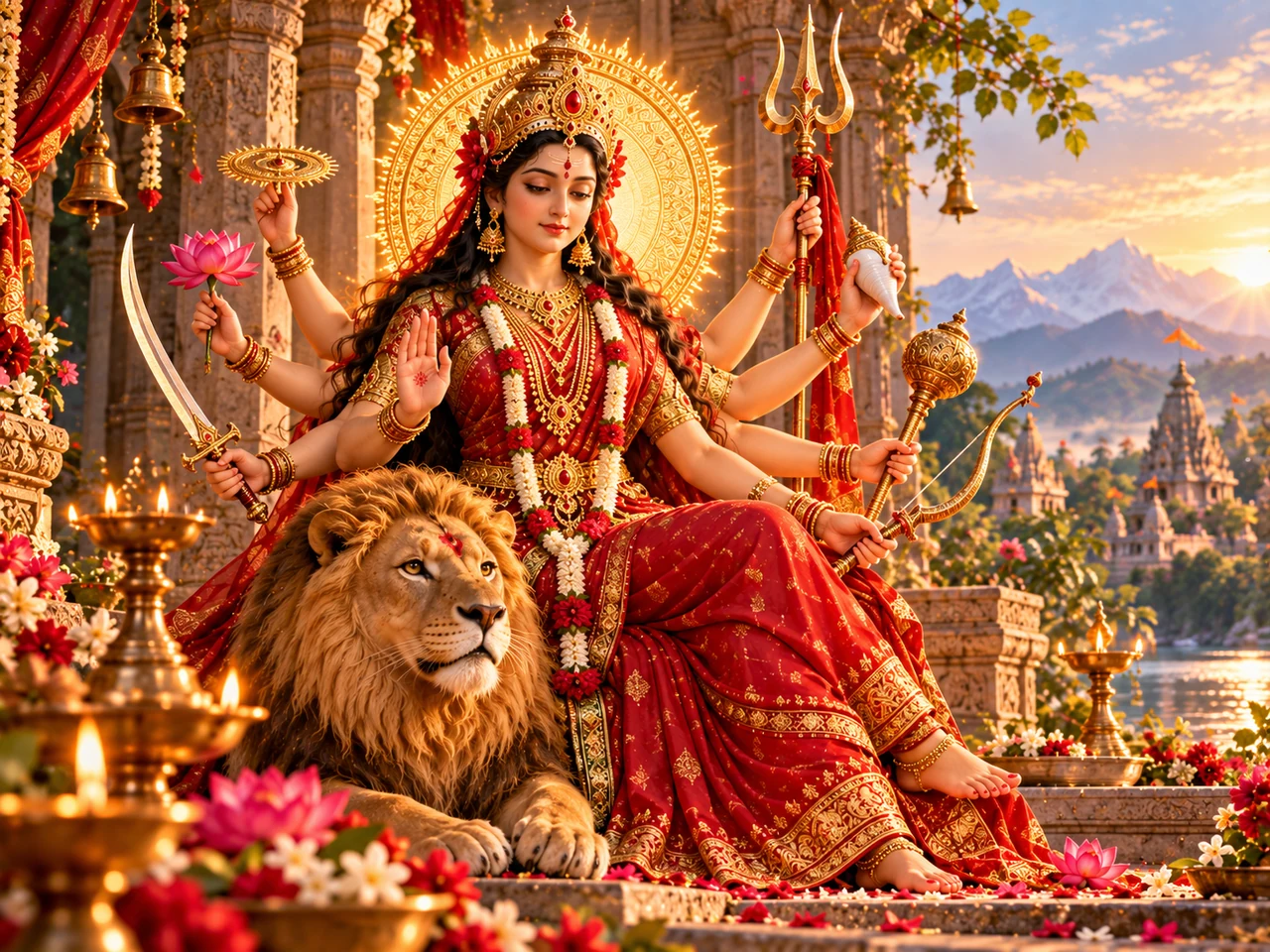
शङ्खचक्रगदाशार्ङ्गगृहीतपरमायुधे । प्रसीद वैष्णवीरूपे नारायणि नमोऽस्तु ते
Roman Transliterationshankhachakragadaashaarngagriheetaparamaayudhe | praseeda vaishnaveeroope naaraayani namo’stu teśaṅkhacakragadāśārṅgagṛhītaparamāyudhe | prasīda vaiṣṇavīrūpe nārāyaṇi namo’stu te
Meaning
You grasp the conch, discus, mace, and Śārṅga bow as supreme weapons. Be gracious in your Vaiṣṇavī form; O Narayani, reverence to you.You grasp the conch, discus, mace, and Śārṅga bow as supreme weapons. Be gracious in your Vaiṣṇavī form; O Narayani, reverence to you.You grasp the conch, discus, mace, and Śārṅga bow as supreme weapons. Be gracious in your Vaiṣṇavī form; O Nārāyaṇī, reverence to you.
Explanation
The divine Mother's Vaiṣṇavī form carries recognisable symbols of Vishnu. Listing the weapons makes this verse iconographically specific, rather than a generic praise of victory. The refrain links this particular form to the Goddess praised throughout.The divine Mother's Vaiṣṇavī form carries recognisable symbols of Vishnu. Listing the weapons makes this verse iconographically specific, rather than a generic praise of victory. The refrain links this particular form to the Goddess praised throughout.The divine Mother's Vaiṣṇavī form carries recognisable symbols of Viṣṇu. Listing the weapons makes this verse iconographically specific, rather than a generic praise of victory. The refrain links this particular form to the Goddess praised throughout.
गृहीतोग्रमहाचक्रे दंष्ट्रोद्धृतवसुन्धरे । वराहरूपिणि शिवे नारायणि नमोऽस्तु ते
Roman Transliterationgriheetogramahaachakre damshtroddhritavasundhare | varaaharoopini shive naaraayani namo’stu tegṛhītogramahācakre daṃṣṭroddhṛtavasundhare | varāharūpiṇi śive nārāyaṇi namo’stu te
Meaning
Taking up the mighty and fearsome discus, you raised the earth with your tusks in the boar form. O beneficent Narayani, reverence to you.Taking up the mighty and fearsome discus, you raised the earth with your tusks in the boar form. O beneficent Narayani, reverence to you.Taking up the mighty and fearsome discus, you raised the earth with your tusks in the boar form. O beneficent Nārāyaṇī, reverence to you.
Explanation
This praises Vārāhī through the Varāha rescue motif. The lifted earth is a mythic image of restoration; the hymn adapts it to the divine Mother's identity without changing the battle's underlying story.
नृसिंहरूपेणोग्रेण हन्तुं दैत्यान्कृतोद्यमे । त्रैलोक्यत्राणसहिते नारायणि नमोऽस्तु ते
Roman Transliterationnrisimharoopenogrena hantum daityaankritodyame | trailokyatraanasahite naaraayani namo’stu tenṛsiṃharūpeṇogreṇa hantuṃ daityānkṛtodyame | trailokyatrāṇasahite nārāyaṇi namo’stu te
Meaning
In the terrifying man-lion form, intent on destroying the asuras and protecting the three worlds, O Narayani, reverence to you.In the terrifying man-lion form, intent on destroying the asuras and protecting the three worlds, O Narayani, reverence to you.In the terrifying man-lion form, intent on destroying the asuras and protecting the three worlds, O Nārāyaṇī, reverence to you.
Explanation
The Narasiṃhī form recalls the man-lion motif of intervention against oppressive powers. The verse combines fierceness toward the threatening force with protection of the worlds; both sides are integral to the devotional image.
किरीटिनि महावज्रे सहस्रनयनोज्ज्वले । वृत्रप्राणहरे चैन्द्रि नारायणि नमोऽस्तु ते
Roman Transliterationkireetini mahaavajre sahasranayanojjvale | vritrapraanahare chaindri naaraayani namo’stu tekirīṭini mahāvajre sahasranayanojjvale | vṛtraprāṇahare caindri nārāyaṇi namo’stu te
Meaning
Crowned, bearing the mighty thunderbolt, shining with a thousand eyes, and destroyer of Vṛtra's life in the form of Aindrī, O Narayani, reverence to you.Crowned, bearing the mighty thunderbolt, shining with a thousand eyes, and destroyer of Vṛtra's life in the form of Aindrī, O Narayani, reverence to you.Crowned, bearing the mighty thunderbolt, shining with a thousand eyes, and destroyer of Vṛtra's life in the form of Aindrī, O Nārāyaṇī, reverence to you.
Explanation
Aindrī bears the signs of Indra: the thunderbolt and the thousand eyes. Vṛtra is evoked as a remembered adversary from divine mythology. Her identity should not be confused with the narrator Indra simply because the names are related.
शिवदूतीस्वरूपेण हतदैत्यमहाबले । घोररूपे महारावे नारायणि नमोऽस्तु ते
Roman Transliterationshivadooteesvaroopena hatadaityamahaabale | ghoraroope mahaaraave naaraayani namo’stu teśivadūtīsvarūpeṇa hatadaityamahābale | ghorarūpe mahārāve nārāyaṇi namo’stu te
Meaning
In the form of Śivadūtī, who destroys the great power of the asuras, fearsome in appearance and possessed of a terrible cry, O Narayani, reverence to you.In the form of Śivadūtī, who destroys the great power of the asuras, fearsome in appearance and possessed of a terrible cry, O Narayani, reverence to you.In the form of Śivadūtī, who destroys the great power of the asuras, fearsome in appearance and possessed of a terrible cry, O Nārāyaṇī, reverence to you.
Explanation
Śivadūtī was introduced during the confrontation with Shumbha's forces. Her name refers to the Goddess's command to Shiva as envoy, not merely to a messenger acting independently. The verse preserves that narrative identity amid the sequence of Mothers.Śivadūtī was introduced during the confrontation with Shumbha's forces. Her name refers to the Goddess's command to Shiva as envoy, not merely to a messenger acting independently. The verse preserves that narrative identity amid the sequence of Mothers.Śivadūtī was introduced during the confrontation with Śumbha's forces. Her name refers to the Goddess's command to Śiva as envoy, not merely to a messenger acting independently. The verse preserves that narrative identity amid the sequence of Mothers.
दंष्ट्राकरालवदने शिरोमालाविभूषणे । चामुण्डे मुण्डमथने नारायणि नमोऽस्तु ते
Roman Transliterationdamshtraakaraalavadane shiromaalaavibhooshane | chaamunde mundamathane naaraayani namo’stu tedaṃṣṭrākarālavadane śiromālāvibhūṣaṇe | cāmuṇḍe muṇḍamathane nārāyaṇi namo’stu te
Meaning
O Chamunda, terrible with projecting teeth, adorned with a garland of heads, crusher of Munda: O Narayani, reverence to you.O Chamunda, terrible with projecting teeth, adorned with a garland of heads, crusher of Munda: O Narayani, reverence to you.O Cāmuṇḍā, terrible with projecting teeth, adorned with a garland of heads, crusher of Muṇḍa: O Nārāyaṇī, reverence to you.
Explanation
The epithets deliberately retain fierce iconography. Chapter 7 provides the origin of the name Chamunda through the defeat of Chanda and Munda. Readers should be told that the imagery belongs to the sacred narrative, not a literal recommendation for violence.The epithets deliberately retain fierce iconography. Chapter 7 provides the origin of the name Chamunda through the defeat of Chanda and Munda. Readers should be told that the imagery belongs to the sacred narrative, not a literal recommendation for violence.The epithets deliberately retain fierce iconography. Chapter 7 provides the origin of the name Cāmuṇḍā through the defeat of Caṇḍa and Muṇḍa. Readers should be told that the imagery belongs to the sacred narrative, not a literal recommendation for violence.
लक्ष्मि लज्जे महाविद्ये श्रद्धे पुष्टि स्वधे ध्रुवे । महारात्रि महामाये नारायणि नमोऽस्तु ते
Roman Transliterationlakshmi lajje mahaavidye shraddhe pushti svadhe dhruve | mahaaraatri mahaamaaye naaraayani namo’stu telakṣmi lajje mahāvidye śraddhe puṣṭi svadhe dhruve | mahārātri mahāmāye nārāyaṇi namo’stu te
Meaning
O Lakshmi, modesty, great knowledge, faith, nourishment, the ancestral offering, constancy, great Night and great Māyā: O Narayani, reverence to you.O Lakshmi, modesty, great knowledge, faith, nourishment, the ancestral offering, constancy, great Night and great Māyā: O Narayani, reverence to you.O Lakṣmī, modesty, great knowledge, faith, nourishment, the ancestral offering, constancy, great Night and great Māyā: O Nārāyaṇī, reverence to you.
Explanation
The hymn now moves from battle forms to the powers present in religious and moral life. 'Svadhā' carries a specific association with offerings to ancestors; 'Mahārātri' and 'Mahāmāyā' are theological epithets. They should not all be rendered by a single generic English word.
मेधे सरस्वति वरे भूति बाभ्रवि तामसि । नियते त्वं प्रसीदेशे नारायणि नमोऽस्तुते
Roman Transliterationmedhe sarasvati vare bhooti baabhravi taamasi | niyate tvam praseedeshe naaraayani namo’stutemedhe sarasvati vare bhūti bābhravi tāmasi | niyate tvaṃ prasīdeśe nārāyaṇi namo’stute
Meaning
O wisdom, Saraswati, bestower of boons, prosperity, Bābhravī, darkness, and cosmic order, supreme Lady: be gracious; O Narayani, reverence to you.O wisdom, Saraswati, bestower of boons, prosperity, Bābhravī, darkness, and cosmic order, supreme Lady: be gracious; O Narayani, reverence to you.O wisdom, Sarasvatī, bestower of boons, prosperity, Bābhravī, darkness, and cosmic order, supreme Lady: be gracious; O Nārāyaṇī, reverence to you.
Explanation
This dense list joins insight, learning, abundance, and aspects associated with darkness or necessity. 'Bābhravī' and 'tāmasī' merit careful philological and theological notes: the hymn praises a range of powers, not a simple division into good and evil.
सर्वस्वरूपे सर्वेशे सर्वशक्तिसमन्विते । भयेभ्यस्त्राहि नो देवि दुर्गे देवि नमोऽस्तु ते
Roman Transliterationsarvasvaroope sarveshe sarvashaktisamanvite | bhayebhyastraahi no devi durge devi namo’stu tesarvasvarūpe sarveśe sarvaśaktisamanvite | bhayebhyastrāhi no devi durge devi namo’stu te
Meaning
You are every form, sovereign of all, endowed with every power. Save us from fears, O Goddess Durga; reverence to you.You are every form, sovereign of all, endowed with every power. Save us from fears, O Goddess Durga; reverence to you.You are every form, sovereign of all, endowed with every power. Save us from fears, O Goddess Durgā; reverence to you.
Explanation
After the catalogue of individual manifestations, the gods address the unifying deity directly. The request is protection from fear. The phrase 'all forms' is a theological summation rather than a claim that the preceding forms lack distinct stories.
एतत्ते वदनं सौम्यं लोचनत्रयभूषितम्। पातु नः सर्वभूतेभ्यः कात्यायनि नमोऽस्तु ते
Roman Transliterationetatte vadanam saumyam lochanatrayabhooshitam| paatu nah sarvabhootebhyah kaatyaayani namo’stu teetatte vadanaṃ saumyaṃ locanatrayabhūṣitam| pātu naḥ sarvabhūtebhyaḥ kātyāyani namo’stu te
Meaning
May your gentle face, adorned with three eyes, protect us from all beings; O Katyayani, reverence to you.May your gentle face, adorned with three eyes, protect us from all beings; O Katyayani, reverence to you.May your gentle face, adorned with three eyes, protect us from all beings; O Kātyāyanī, reverence to you.
Explanation
The hymn balances fierce images with a tender protective face. 'From all beings' belongs to the verse's broad protective request; it need not imply that every being is inherently hostile.
ज्वालाकरालमत्युग्रमशेषासुरसूदनम्। त्रिशूलं पातु नो भीतेर्भद्रकालि नमोऽस्तु ते
Roman Transliterationjvaalaakaraalamatyugramasheshaasurasoodanam| trishoolam paatu no bheeterbhadrakaali namo’stu tejvālākarālamatyugramaśeṣāsurasūdanam| triśūlaṃ pātu no bhīterbhadrakāli namo’stu te
Meaning
May your trident—blazing, terrifying and destroyer of every asura—protect us from fear. O Bhadrakālī, reverence to you.
Explanation
The weapon is invoked not for aggression by worshippers, but as a symbol of the Goddess's protective power in the myth. The pairing of 'bhadra' with a fierce form is a deliberate combination of auspiciousness and severity.
हिनस्ति दैत्यतेजांसि स्वनेनापूर्य या जगत्। सा घण्टा पातु नो देवि पापेभ्यो नः सुतानिव
Roman Transliterationhinasti daityatejaamsi svanenaapoorya yaa jagat| saa ghantaa paatu no devi paapebhyo nah sutaanivahinasti daityatejāṃsi svanenāpūrya yā jagat| sā ghaṇṭā pātu no devi pāpebhyo naḥ sutāniva
Meaning
May that bell whose sound fills the world and shatters the asuras' strength protect us from wrongs, O Goddess, as a mother protects her children.
Explanation
A battle instrument becomes a protective devotional symbol. The comparison to children makes the maternal dimension explicit even in a martial setting. 'Pāpa' should be translated with attention to context rather than silently recast as a modern medical or legal category.
असुरासृग्वसापङ्कचर्चितस्ते करोज्ज्वलः । शुभाय खड्गो भवतु चण्डिके त्वां नता वयम्
Roman Transliterationasuraasrigvasaapankacharchitaste karojjvalah | shubhaaya khadgo bhavatu chandike tvaam nataa vayamasurāsṛgvasāpaṅkacarcitaste karojjvalaḥ | śubhāya khaḍgo bhavatu caṇḍike tvāṃ natā vayam
Meaning
May your sword, shining in your hand and marked with the blood and fat of the asuras, bring us good fortune, O Chandika. We bow to you.May your sword, shining in your hand and marked with the blood and fat of the asuras, bring us good fortune, O Chandika. We bow to you.May your sword, shining in your hand and marked with the blood and fat of the asuras, bring us good fortune, O Caṇḍikā. We bow to you.
Explanation
The verse is deliberately graphic and belongs to the immediate aftermath of battle. Its request for auspiciousness places terrifying imagery in a protective devotional frame. A responsible explanation preserves both aspects without erasing the violence of the mythic scene.
रोगानशेषानपहंसि तुष्टा रुष्टा तु कामान्सकलानभीष्टान्। त्वामाश्रितानां न विपन्नराणां त्वामाश्रिता ह्याश्रयतां प्रयान्ति
Roman Transliterationrogaanasheshaanapahamsi tushtaa rushtaa tu kaamaansakalaanabheeshtaan| tvaamaashritaanaam na vipannaraanaam tvaamaashritaa hyaashrayataam prayaantirogānaśeṣānapahaṃsi tuṣṭā ruṣṭā tu kāmānsakalānabhīṣṭān| tvāmāśritānāṃ na vipannarāṇāṃ tvāmāśritā hyāśrayatāṃ prayānti
Meaning
When pleased, you remove every disease; when angered, you frustrate desired aims. Those who take refuge in you do not fall into ruin; sheltered by you, they become a refuge for others.
Explanation
These are the gods' devotional claims about the Goddess's grace and displeasure, not clinical predictions. The final image is especially important: receiving protection should enlarge one's capacity to care for others. The wording about illness must not discourage professional medical care.
एतत्कृतं यत्कदनं त्वयाद्य धर्मद्विषां देवि महासुराणाम्। रूपैरनेकैर्बहुधात्ममूर्तिं कृत्वाम्बिके तत्प्रकरोति कान्या
Roman Transliterationetatkritam yatkadanam tvayaadya dharmadvishaam devi mahaasuraanaam| roopairanekairbahudhaatmamoortim kritvaambike tatprakaroti kaanyaaetatkṛtaṃ yatkadanaṃ tvayādya dharmadviṣāṃ devi mahāsurāṇām| rūpairanekairbahudhātmamūrtiṃ kṛtvāmbike tatprakaroti kānyā
Meaning
O Mother, which other being could perform today the destruction you have brought upon these great asuras who oppose dharma, manifesting yourself in so many forms?
Explanation
The verse recalls the coordinated manifestations seen in the battle and asks a rhetorical question about their source. 'Dharma-opposing' is the text's designation of the mythic enemies, not a licence to identify living communities as asuras.
विद्यासु शास्त्रेषु विवेकदीपेष्वाद्येषु वाक्येषु च का त्वदन्या । ममत्वगर्तेऽतिमहान्धकारे विभ्रामयत्येतदतीव विश्वम्
Roman Transliterationvidyaasu shaastreshu vivekadeepeshvaadyeshu vaakyeshu cha kaa tvadanyaa | mamatvagarte’timahaandhakaare vibhraamayatyetadateeva vishvamvidyāsu śāstreṣu vivekadīpeṣvādyeṣu vākyeṣu ca kā tvadanyā | mamatvagarte’timahāndhakāre vibhrāmayatyetadatīva viśvam
Meaning
Who but you moves this universe through the deep darkness of possessiveness, even while dwelling in the branches of knowledge, scriptures, ancient sayings, and lamps of discernment?
Explanation
This deliberately paradoxical verse sets wisdom beside bewilderment and asks how the same divine power can be related to both. 'Mamatva' is possessive identification, and the 'pit' of darkness is an image for its grip. The syntax and its theological tension require careful review instead of simplifying it to 'education is bad'.
रक्षांसि यत्रोग्रविषाश्च नागा यत्रारयो दस्युबलानि यत्र । दावानलो यत्र तथाब्धिमध्ये तत्र स्थिता त्वं परिपासि विश्वम्
Roman Transliterationrakshaamsi yatrogravishaashcha naagaa yatraarayo dasyubalaani yatra | daavaanalo yatra tathaabdhimadhye tatra sthitaa tvam paripaasi vishvamrakṣāṃsi yatrograviṣāśca nāgā yatrārayo dasyubalāni yatra | dāvānalo yatra tathābdhimadhye tatra sthitā tvaṃ paripāsi viśvam
Meaning
Where fearsome beings, venomous serpents, enemies, bands of robbers, forest fires, or the middle of the ocean threaten, you are present to protect the world.
Explanation
The catalogue ranges across threats from nature and from human violence. Its geographic and elemental imagery makes the gods' protective prayer concrete. It remains a hymn of trust, not a statement that every danger will always be miraculously removed.
विश्वेश्वरि त्वं परिपासि विश्वं विश्वात्मिका धारयसीह विश्वम्। विश्वेशवन्द्या भवती भवन्ति विश्वाश्रया ये त्वयि भक्तिनम्राः
Roman Transliterationvishveshvari tvam paripaasi vishvam vishvaatmikaa dhaarayaseeha vishvam| vishveshavandyaa bhavatee bhavanti vishvaashrayaa ye tvayi bhaktinamraahviśveśvari tvaṃ paripāsi viśvaṃ viśvātmikā dhārayasīha viśvam| viśveśavandyā bhavatī bhavanti viśvāśrayā ye tvayi bhaktinamrāḥ
Meaning
Sovereign of the universe, you protect the universe; as its inner self you support it. You are worthy of the reverence of the world's rulers, and those who bow to you in devotion become a shelter for the world.
Explanation
The cosmic and ethical dimensions meet here. Devotion is pictured as changing the devotee into someone upon whom others can rely. The final clause merits careful grammar review so that 'world-support' is not mistaken for literal universal control by an individual.
देवि प्रसीद परिपालय नोऽरिभीतेर्नित्यं यथासुरवधादधुनैव सद्यः । पापानि सर्वजगतां प्रशमं नयाशु उत्पातपाकजनितांश्च महोपसर्गान्
Roman Transliterationdevi praseeda paripaalaya no’ribheeternityam yathaasuravadhaadadhunaiva sadyah | paapaani sarvajagataam prashamam nayaashu utpaatapaakajanitaamshcha mahopasargaandevi prasīda paripālaya no’ribhīternityaṃ yathāsuravadhādadhunaiva sadyaḥ | pāpāni sarvajagatāṃ praśamaṃ nayāśu utpātapākajanitāṃśca mahopasargān
Meaning
O Goddess, be gracious and protect us always from fear of enemies, as you have just protected us through the destruction of the asuras. Quickly bring peace to the sins of the world and the grave calamities arising from ominous disturbances.
Explanation
The gods transform a single historic victory in the story into a recurring plea for peace. The long verse should retain its prayerful syntax: protect us, calm wrongdoing, and still calamity. Its compounds around calamities warrant a fresh scan comparison.
प्रणतानां प्रसीद त्वं देवि विश्वार्तिहारिणि । त्रैलोक्यवासिनामीड्ये लोकानां वरदा भव
Roman Transliterationpranataanaam praseeda tvam devi vishvaartihaarini | trailokyavaasinaameedye lokaanaam varadaa bhavapraṇatānāṃ prasīda tvaṃ devi viśvārtihāriṇi | trailokyavāsināmīḍye lokānāṃ varadā bhava
Meaning
O Goddess who removes the world's suffering, be gracious to those who bow before you. Worthy of praise by dwellers of the three worlds, grant blessings to the worlds.
Explanation
This brief plea concludes the major hymn. Its scope is universal rather than limited to the gods who have survived the battle. The ensuing dialogue shifts from praise to the Goddess's own response.
Context & Usage
Edition and reuse notice: This is the provisional ShivGoraksh Devi Mahatmyam (Durga Saptashati) Chapter 11 source layer, verses 11.3–11.35. The complete selected reading is presented for educational study, not as an independently verified 1917 transcription. The 33 verses share the selected Chapter 11 source reading; independent critical certification is not claimed. The next verse, 11.36, is not part of the hymn.
Reading guide: one hymn, three movements
11.3–7 — Ground of life and liberation. The gods praise the Goddess as compassionate refuge and the sustaining power associated with earth, water, māyā and knowledge. The movement from worldly enjoyment (bhukti) to liberation (mukti) is deliberately expansive, not a promise of a particular result. 11.8–23 — Narayani and the divine Mothers.11.8–23 — Nārāyaṇī and the divine Mothers. The refrain links wisdom, time, refuge and the differentiated Mātṛkā forms: Brāhmāṇī, Māheśvarī, Kaumārī, Vaiṣṇavī, Vārāhī, Nārasiṃhī, Aindrī, Śivadūtī and Chamunda. The poem recognises distinctive images rather than claiming every tradition tells an identical story. The refrain links wisdom, time, refuge and the differentiated Mātṛkā forms: Brāhmāṇī, Māheśvarī, Kaumārī, Vaiṣṇavī, Vārāhī, Nārasiṃhī, Aindrī, Śivadūtī and Cāmuṇḍā. The poem recognises distinctive images rather than claiming every tradition tells an identical story. 11.24–35 — Protection and mercy. The hymn turns toward the Mother’s protection, the sword, bell and trident, then asks for relief from danger and distress. Its language belongs to a Purāṇic religious context; it must not substitute for practical help, safety or medical care.
Context and relationship to the parent Scripture
The previous chapter narrates Shumbha’s defeat; the gods approach Katyayani at 11.2. The hymn begins with The previous chapter narrates Śumbha’s defeat; the gods approach Kātyāyanī at 11.2. The hymn begins with “devi prapannārtihare prasīda” (11.3) and ends “lokānāṃ varadā bhava” (11.35). 11.36 begins the Goddess’s response and lies outside this excerpt. This Devotion listing should ultimately reuse one approved Chapter 11 canonical verse record per verse, not import a competing edition into the site. The scripture database’s real verse IDs remain unverified. 1 4 5
Textual variants, attribution and editorial caution
- Verse 11.7: The inherited draft reads bhuktimuktipradāyinī; a separate Gita-Press-based modern presentation shows svargamuktipradāyinī. This is documented as a variant, not resolved by a guess. 1 4 6
- Verse 11.13: The compound kauśāmbhaḥkṣarike and the precise source wording require an independent Sanskrit/print check. 1 2
- Verse 11.23: The earlier ShivGoraksh research explicitly marks it as a historical/comparator discrepancy locus. It is not print-verified. 1 2 3
- Other collation watch-points: 11.14, 11.25, 11.29 and 11.34; see the source list before editorial amendment. Avoid presenting spaces, sandhi segmentation or punctuation as separate manuscripts without evidence.
- Authorship: This is an embedded Devi Mahatmyam (Durga Saptashati)/Mārkaṇḍeya Purāṇa passage, not a historically documented standalone poem by a named modern devotional author. Narrative speakers and later hymn titles are not author signatures.
Reader questions
Sources, Credits & Licensing
Founder-authorized educational edition. Independent textual and specialist review remains incomplete; this reading does not confer initiation or ritual authorization.
Inherited traditional wording; selected witness cited below. Romanization, meanings and explanations prepared for ShivGoraksh. No modern source translation, page layout or recording reproduced.
Original Roman reading
The Roman reading recorded with this edition, retaining its spelling and word forms before the Easy Roman display conversion.
- 3
devi prapannārtihare prasīda prasīda mātarjagato’khilasya | prasīda viśveśvari pāhi viśvaṃ tvamīśvarī devi carācarasya
- 4
ādhārabhūtā jagatastvamekā mahīsvarūpeṇa yataḥ sthitāsi | apāṃ svarūpasthitayā tvayaitadāpyāyate kṛtsnamalaṅghyavīrye
- 5
tvaṃ vaiṣṇavīśaktiranantavīryā viśvasya bījaṃ paramāsi māyā | sammohitaṃ devi samastametat tvaṃ vai prasannā bhuvi muktihetuḥ
- 6
vidyāḥ samastāstava devi bhedāḥ striyaḥ samastāḥ sakalā jagatsu | tvayaikayā pūritamambayaitat kā te stutiḥ stavyaparāparoktiḥ
- 7
sarvabhūtā yadā devī bhuktimuktipradāyinī | tvaṃ stutā stutaye kā vā bhavantu paramoktayaḥ
- 8
sarvasya buddhirūpeṇa janasya hṛdi saṃsthite | svargāpavargade devi nārāyaṇi namo’stu te
- 9
kalākāṣṭhādirūpeṇa pariṇāmapradāyini | viśvasyoparatau śakte nārāyaṇi namo’stu te
- 10
sarvamaṅgalamāṅgalye śive sarvārthasādhike | śaraṇye tryambake gauri nārāyaṇi namo’stu te
- 11
sṛṣṭisthitivināśānāṃ śaktibhūte sanātani | guṇāśraye guṇamaye nārāyaṇi namo’stu te
- 12
śaraṇāgatadīnārtaparitrāṇaparāyaṇe | sarvasyārtihare devi nārāyaṇi namo’stu te
- 13
haṃsayuktavimānasthe brahmāṇīrūpadhāriṇi | kauśāmbhaḥkṣarike devi nārāyaṇi namo’stu te
- 14
triśūlacandrāhidhare mahāvṛṣabhavāhini | māheśvarīsvarūpeṇa nārāyaṇi namo’stute
- 15
mayūrakukkuṭavṛte mahāśaktidhare’naghe | kaumārīrūpasaṃsthāne nārāyaṇi namo’stu te
- 16
śaṅkhacakragadāśārṅgagṛhītaparamāyudhe | prasīda vaiṣṇavīrūpe nārāyaṇi namo’stu te
- 17
gṛhītogramahācakre daṃṣṭroddhṛtavasundhare | varāharūpiṇi śive nārāyaṇi namo’stu te
- 18
nṛsiṃharūpeṇogreṇa hantuṃ daityānkṛtodyame | trailokyatrāṇasahite nārāyaṇi namo’stu te
- 19
kirīṭini mahāvajre sahasranayanojjvale | vṛtraprāṇahare caindri nārāyaṇi namo’stu te
- 20
śivadūtīsvarūpeṇa hatadaityamahābale | ghorarūpe mahārāve nārāyaṇi namo’stu te
- 21
daṃṣṭrākarālavadane śiromālāvibhūṣaṇe | cāmuṇḍe muṇḍamathane nārāyaṇi namo’stu te
- 22
lakṣmi lajje mahāvidye śraddhe puṣṭi svadhe dhruve | mahārātri mahāmāye nārāyaṇi namo’stu te
- 23
medhe sarasvati vare bhūti bābhravi tāmasi | niyate tvaṃ prasīdeśe nārāyaṇi namo’stute
- 24
sarvasvarūpe sarveśe sarvaśaktisamanvite | bhayebhyastrāhi no devi durge devi namo’stu te
- 25
etatte vadanaṃ saumyaṃ locanatrayabhūṣitam| pātu naḥ sarvabhūtebhyaḥ kātyāyani namo’stu te
- 26
jvālākarālamatyugramaśeṣāsurasūdanam| triśūlaṃ pātu no bhīterbhadrakāli namo’stu te
- 27
hinasti daityatejāṃsi svanenāpūrya yā jagat| sā ghaṇṭā pātu no devi pāpebhyo naḥ sutāniva
- 28
asurāsṛgvasāpaṅkacarcitaste karojjvalaḥ | śubhāya khaḍgo bhavatu caṇḍike tvāṃ natā vayam
- 29
rogānaśeṣānapahaṃsi tuṣṭā ruṣṭā tu kāmānsakalānabhīṣṭān| tvāmāśritānāṃ na vipannarāṇāṃ tvāmāśritā hyāśrayatāṃ prayānti
- 30
etatkṛtaṃ yatkadanaṃ tvayādya dharmadviṣāṃ devi mahāsurāṇām| rūpairanekairbahudhātmamūrtiṃ kṛtvāmbike tatprakaroti kānyā
- 31
vidyāsu śāstreṣu vivekadīpeṣvādyeṣu vākyeṣu ca kā tvadanyā | mamatvagarte’timahāndhakāre vibhrāmayatyetadatīva viśvam
- 32
rakṣāṃsi yatrograviṣāśca nāgā yatrārayo dasyubalāni yatra | dāvānalo yatra tathābdhimadhye tatra sthitā tvaṃ paripāsi viśvam
- 33
viśveśvari tvaṃ paripāsi viśvaṃ viśvātmikā dhārayasīha viśvam| viśveśavandyā bhavatī bhavanti viśvāśrayā ye tvayi bhaktinamrāḥ
- 34
devi prasīda paripālaya no’ribhīternityaṃ yathāsuravadhādadhunaiva sadyaḥ | pāpāni sarvajagatāṃ praśamaṃ nayāśu utpātapākajanitāṃśca mahopasargān
- 35
praṇatānāṃ prasīda tvaṃ devi viśvārtihāriṇi | trailokyavāsināmīḍye lokānāṃ varadā bhava
Source notes
1 ShivGoraksh complete Chapter 11 internal trilingual first-pass draft (user Library), 11.3–35; not approved for publication.
2 Paṇśīkar (ed.), Durgā Saptashatī, Nirṇaya Sāgara Press, Bombay 1917; provisional historical anchor, not directly re-collated for this edition.
3 ShivGoraksh comparative source notes, including rights and recitational-count qualifications.
4 Sanskrit Documents, “Nārāyaṇī Stuti,” comparative digital reading only; redistribution rights unverified.
5 Devi Mahatmyam (Durga Saptashati) Digital Temple, Chapter 11 interpretations, for hymn boundaries and literary context only.
6 Astrojay Chapter 11, comparative modern recitation reading only.
- Comparative sources and edition notes for this reading
- Durgā Saptashatī / Devi Mahatmyam (Durga Saptashati), ed. Vāsudeva Lakṣmaṇa Śāstrī Paṇśīkar · Open source
- Comparative sources and edition notes for this reading
- Nārāyaṇīstutiḥ अथवा Nārāyaṇīsūktam — Chapter 11 · Open source
- Chapter 11 – Interpretations · Open source
- Devi Mahatmyam (Durga Saptashati) Chapter 11 Sanskrit display · Open source




Additional passage commentary
The following English meanings and explanations are the project’s own first-pass editorial layers, aligned to the provisional parent Chapter 11 manuscript. They are not a separately cleared translation.
Verse 11.3
Meaning: O Goddess, remover of the distress of those who seek refuge, be gracious! O Mother of the whole world, be gracious. O sovereign of the universe, protect the world: you rule all that moves and does not move. Explanation: The prayer begins with vulnerability rather than triumph. Its repeated appeal for grace extends protection beyond the gods to the whole moving and unmoving world. The claim about divine sovereignty is devotional theology within the hymn.
Verse 11.4
Meaning: You alone support the world, abiding as the earth. Present also in the form of water, you nourish all of it, O one whose power cannot be overcome. Explanation: Earth and water express two basic forms of sustenance: a place to live and the nourishment life requires. The verse is praise of the Goddess through the elements, not a technical description of physical processes. The compound at the water image needs careful Sanskrit collation.
Verse 11.5
Meaning: You are the immeasurably powerful Vaiṣṇavī energy, the ultimate seed of the cosmos and its great Māyā. Though the world is caught in that power of appearance, when you are gracious you become the cause of liberation. Explanation: The hymn deliberately places concealment and release together. Māyā here belongs to the theological vocabulary of divine power; its exact philosophical meaning can vary by tradition. The verse does not reduce the Goddess to mere illusion.
Verse 11.6
Meaning: All branches of knowledge are forms of you, O Goddess, and all women in the worlds are manifestations of you. You alone fill this whole universe, O Mother; how could any words adequately praise one who transcends every object of praise? Explanation: This is one of the chapter's broadest affirmations of the sacred feminine and of knowledge as a divine expression. Its rhetorical question admits that language cannot encompass its subject. It should be presented as the hymn's theological vision, not as a replacement for women's individual identities.
Verse 11.7
Meaning: When you yourself are the Goddess present in all beings and the giver of both enjoyment and liberation, what superior words could remain with which to praise you? Explanation: The verse extends the previous question: a power believed to embrace ordinary life and spiritual freedom exceeds conventional praise. Bhukti and mukti mark different human aspirations, not identical rewards or automatic guarantees.
Verse 11.8
Meaning: Abiding as understanding in every person's heart, giver of heaven and liberation, O Goddess Narayani, reverence to you. Abiding as understanding in every person's heart, giver of heaven and liberation, O Goddess Nārāyaṇī, reverence to you. Explanation: Here the hymn locates the sacred not only outside a person but in the capacity to discern and understand. The repeated refrain 'Narayani, reverence to you' will structure much of the hymn and may be displayed consistently without diminishing the individual verses. Here the hymn locates the sacred not only outside a person but in the capacity to discern and understand. The repeated refrain 'Nārāyaṇī, reverence to you' will structure much of the hymn and may be displayed consistently without diminishing the individual verses.
Verse 11.9
Meaning: Taking the forms of divisions of time, from kalā and kāṣṭhā onward, you bring transformation, and you have power over the world's cessation. O Narayani, reverence to you. Taking the forms of divisions of time, from kalā and kāṣṭhā onward, you bring transformation, and you have power over the world's cessation. O Nārāyaṇī, reverence to you. Explanation: The names are traditional measures of time. Rather than calculating their length, the hymn invokes time and change as aspects of cosmic order under the Goddess. The expression for cessation needs to retain its cosmic sense, not be narrowed to an individual's death.
Verse 11.10
Meaning: Auspiciousness within all that is auspicious, beneficent one who fulfils every worthy aim, refuge of all, three-eyed Gaurī: O Narayani, reverence to you. Auspiciousness within all that is auspicious, beneficent one who fulfils every worthy aim, refuge of all, three-eyed Gaurī: O Nārāyaṇī, reverence to you. Explanation: This much-loved verse gathers several divine epithets into a brief prayer. 'Three-eyed' recalls Shiva-associated iconography, while the broader address remains directed to the Goddess. The claim to fulfil every aim is devotional praise, not a promise of particular worldly outcomes. This much-loved verse gathers several divine epithets into a brief prayer. 'Three-eyed' recalls Śiva-associated iconography, while the broader address remains directed to the Goddess. The claim to fulfil every aim is devotional praise, not a promise of particular worldly outcomes.
Verse 11.11
Meaning: Eternal one, power behind creation, preservation, and dissolution, foundation and embodiment of the qualities of nature: O Narayani, reverence to you. Eternal one, power behind creation, preservation, and dissolution, foundation and embodiment of the qualities of nature: O Nārāyaṇī, reverence to you. Explanation: The verse ties the three cosmic functions to a single divine power. 'Guṇa' evokes the qualities of nature found in Sāṃkhya-influenced vocabulary; the verse praises the Goddess as their ground and expression, without spelling out a complete philosophical system.
Verse 11.12
Meaning: Ever devoted to rescuing those who are helpless, suffering, and have sought refuge, remover of the distress of all, O Goddess Narayani, reverence to you. Ever devoted to rescuing those who are helpless, suffering, and have sought refuge, remover of the distress of all, O Goddess Nārāyaṇī, reverence to you. Explanation: The hymn returns from cosmic language to the immediate experience of distress. Its emphasis is on refuge and compassion; it should never be presented as a reason to avoid practical help, medicine, or protection when those are needed.
Verse 11.13
Meaning: Riding an aerial vehicle drawn by swans, assuming the form of Brāhmāṇī and sprinkling sanctified water, O Narayani, reverence to you. Riding an aerial vehicle drawn by swans, assuming the form of Brāhmāṇī and sprinkling sanctified water, O Nārāyaṇī, reverence to you. Explanation: Brāhmāṇī is one of the Mothers introduced in the battles. Her vehicle and water-sprinkling distinguish her iconography from the other manifestations. The precise compound naming the sprinkled water should be confirmed against the historical print before use in a public recitation text.
Verse 11.14
Meaning: Bearing trident, crescent moon, and serpent, riding the great bull, you appear as Māheśvarī. O Narayani, reverence to you. Bearing trident, crescent moon, and serpent, riding the great bull, you appear as Māheśvarī. O Nārāyaṇī, reverence to you. Explanation: Māheśvarī embodies the recognisable symbols of Shiva in the sequence of divine Mothers. The hymn treats this as a manifestation of the Goddess's power; it is not necessary to collapse all named forms into one undifferentiated image. Māheśvarī embodies the recognisable symbols of Śiva in the sequence of divine Mothers. The hymn treats this as a manifestation of the Goddess's power; it is not necessary to collapse all named forms into one undifferentiated image.
Verse 11.15
Meaning: Surrounded by peacock and cock, bearing the great spear and free from stain, present in the form of Kaumārī, O Narayani, reverence to you. Surrounded by peacock and cock, bearing the great spear and free from stain, present in the form of Kaumārī, O Nārāyaṇī, reverence to you. Explanation: Kaumārī is associated with Kumāra/Skanda, hence the bird emblems and the spear-like weapon called shakti. Here 'shakti' refers specifically to an armament; the glossary should distinguish that use from the more general idea of divine energy. Kaumārī is associated with Kumāra/Skanda, hence the bird emblems and the spear-like weapon called śakti. Here 'śakti' refers specifically to an armament; the glossary should distinguish that use from the more general idea of divine energy.
Verse 11.16
Meaning: You grasp the conch, discus, mace, and Śārṅga bow as supreme weapons. Be gracious in your Vaiṣṇavī form; O Narayani, reverence to you. You grasp the conch, discus, mace, and Śārṅga bow as supreme weapons. Be gracious in your Vaiṣṇavī form; O Nārāyaṇī, reverence to you. Explanation: The divine Mother's Vaiṣṇavī form carries recognisable symbols of Vishnu. Listing the weapons makes this verse iconographically specific, rather than a generic praise of victory. The refrain links this particular form to the Goddess praised throughout. The divine Mother's Vaiṣṇavī form carries recognisable symbols of Viṣṇu. Listing the weapons makes this verse iconographically specific, rather than a generic praise of victory. The refrain links this particular form to the Goddess praised throughout.
Verse 11.17
Meaning: Taking up the mighty and fearsome discus, you raised the earth with your tusks in the boar form. O beneficent Narayani, reverence to you. Taking up the mighty and fearsome discus, you raised the earth with your tusks in the boar form. O beneficent Nārāyaṇī, reverence to you. Explanation: This praises Vārāhī through the Varāha rescue motif. The lifted earth is a mythic image of restoration; the hymn adapts it to the divine Mother's identity without changing the battle's underlying story.
Verse 11.18
Meaning: In the terrifying man-lion form, intent on destroying the asuras and protecting the three worlds, O Narayani, reverence to you. In the terrifying man-lion form, intent on destroying the asuras and protecting the three worlds, O Nārāyaṇī, reverence to you. Explanation: The Narasiṃhī form recalls the man-lion motif of intervention against oppressive powers. The verse combines fierceness toward the threatening force with protection of the worlds; both sides are integral to the devotional image.
Verse 11.19
Meaning: Crowned, bearing the mighty thunderbolt, shining with a thousand eyes, and destroyer of Vṛtra's life in the form of Aindrī, O Narayani, reverence to you. Crowned, bearing the mighty thunderbolt, shining with a thousand eyes, and destroyer of Vṛtra's life in the form of Aindrī, O Nārāyaṇī, reverence to you. Explanation: Aindrī bears the signs of Indra: the thunderbolt and the thousand eyes. Vṛtra is evoked as a remembered adversary from divine mythology. Her identity should not be confused with the narrator Indra simply because the names are related.
Verse 11.20
Meaning: In the form of Śivadūtī, who destroys the great power of the asuras, fearsome in appearance and possessed of a terrible cry, O Narayani, reverence to you. In the form of Śivadūtī, who destroys the great power of the asuras, fearsome in appearance and possessed of a terrible cry, O Nārāyaṇī, reverence to you. Explanation: Śivadūtī was introduced during the confrontation with Shumbha's forces. Her name refers to the Goddess's command to Shiva as envoy, not merely to a messenger acting independently. The verse preserves that narrative identity amid the sequence of Mothers. Śivadūtī was introduced during the confrontation with Śumbha's forces. Her name refers to the Goddess's command to Śiva as envoy, not merely to a messenger acting independently. The verse preserves that narrative identity amid the sequence of Mothers.
Verse 11.21
Meaning: O Chamunda, terrible with projecting teeth, adorned with a garland of heads, crusher of Munda: O Narayani, reverence to you. O Cāmuṇḍā, terrible with projecting teeth, adorned with a garland of heads, crusher of Muṇḍa: O Nārāyaṇī, reverence to you. Explanation: The epithets deliberately retain fierce iconography. Chapter 7 provides the origin of the name Chamunda through the defeat of Chanda and Munda. Readers should be told that the imagery belongs to the sacred narrative, not a literal recommendation for violence. The epithets deliberately retain fierce iconography. Chapter 7 provides the origin of the name Cāmuṇḍā through the defeat of Caṇḍa and Muṇḍa. Readers should be told that the imagery belongs to the sacred narrative, not a literal recommendation for violence.
Verse 11.22
Meaning: O Lakshmi, modesty, great knowledge, faith, nourishment, the ancestral offering, constancy, great Night and great Māyā: O Narayani, reverence to you. O Lakṣmī, modesty, great knowledge, faith, nourishment, the ancestral offering, constancy, great Night and great Māyā: O Nārāyaṇī, reverence to you. Explanation: The hymn now moves from battle forms to the powers present in religious and moral life. 'Svadhā' carries a specific association with offerings to ancestors; 'Mahārātri' and 'Mahāmāyā' are theological epithets. They should not all be rendered by a single generic English word.
Verse 11.23
Meaning: O wisdom, Saraswati, bestower of boons, prosperity, Bābhravī, darkness, and cosmic order, supreme Lady: be gracious; O Narayani, reverence to you. O wisdom, Sarasvatī, bestower of boons, prosperity, Bābhravī, darkness, and cosmic order, supreme Lady: be gracious; O Nārāyaṇī, reverence to you. Explanation: This dense list joins insight, learning, abundance, and aspects associated with darkness or necessity. 'Bābhravī' and 'tāmasī' merit careful philological and theological notes: the hymn praises a range of powers, not a simple division into good and evil.
Verse 11.24
Meaning: You are every form, sovereign of all, endowed with every power. Save us from fears, O Goddess Durga; reverence to you. You are every form, sovereign of all, endowed with every power. Save us from fears, O Goddess Durgā; reverence to you. Explanation: After the catalogue of individual manifestations, the gods address the unifying deity directly. The request is protection from fear. The phrase 'all forms' is a theological summation rather than a claim that the preceding forms lack distinct stories.
Verse 11.25
Meaning: May your gentle face, adorned with three eyes, protect us from all beings; O Katyayani, reverence to you. May your gentle face, adorned with three eyes, protect us from all beings; O Kātyāyanī, reverence to you. Explanation: The hymn balances fierce images with a tender protective face. 'From all beings' belongs to the verse's broad protective request; it need not imply that every being is inherently hostile.
Verse 11.26
Meaning: May your trident—blazing, terrifying and destroyer of every asura—protect us from fear. O Bhadrakālī, reverence to you. Explanation: The weapon is invoked not for aggression by worshippers, but as a symbol of the Goddess's protective power in the myth. The pairing of 'bhadra' with a fierce form is a deliberate combination of auspiciousness and severity.
Verse 11.27
Meaning: May that bell whose sound fills the world and shatters the asuras' strength protect us from wrongs, O Goddess, as a mother protects her children. Explanation: A battle instrument becomes a protective devotional symbol. The comparison to children makes the maternal dimension explicit even in a martial setting. 'Pāpa' should be translated with attention to context rather than silently recast as a modern medical or legal category.
Verse 11.28
Meaning: May your sword, shining in your hand and marked with the blood and fat of the asuras, bring us good fortune, O Chandika. We bow to you. May your sword, shining in your hand and marked with the blood and fat of the asuras, bring us good fortune, O Caṇḍikā. We bow to you. Explanation: The verse is deliberately graphic and belongs to the immediate aftermath of battle. Its request for auspiciousness places terrifying imagery in a protective devotional frame. A responsible explanation preserves both aspects without erasing the violence of the mythic scene.
Verse 11.29
Meaning: When pleased, you remove every disease; when angered, you frustrate desired aims. Those who take refuge in you do not fall into ruin; sheltered by you, they become a refuge for others. Explanation: These are the gods' devotional claims about the Goddess's grace and displeasure, not clinical predictions. The final image is especially important: receiving protection should enlarge one's capacity to care for others. The wording about illness must not discourage professional medical care.
Verse 11.30
Meaning: O Mother, which other being could perform today the destruction you have brought upon these great asuras who oppose dharma, manifesting yourself in so many forms? Explanation: The verse recalls the coordinated manifestations seen in the battle and asks a rhetorical question about their source. 'Dharma-opposing' is the text's designation of the mythic enemies, not a licence to identify living communities as asuras.
Verse 11.31
Meaning: Who but you moves this universe through the deep darkness of possessiveness, even while dwelling in the branches of knowledge, scriptures, ancient sayings, and lamps of discernment? Explanation: This deliberately paradoxical verse sets wisdom beside bewilderment and asks how the same divine power can be related to both. 'Mamatva' is possessive identification, and the 'pit' of darkness is an image for its grip. The syntax and its theological tension require careful review instead of simplifying it to 'education is bad'.
Verse 11.32
Meaning: Where fearsome beings, venomous serpents, enemies, bands of robbers, forest fires, or the middle of the ocean threaten, you are present to protect the world. Explanation: The catalogue ranges across threats from nature and from human violence. Its geographic and elemental imagery makes the gods' protective prayer concrete. It remains a hymn of trust, not a statement that every danger will always be miraculously removed.
Verse 11.33
Meaning: Sovereign of the universe, you protect the universe; as its inner self you support it. You are worthy of the reverence of the world's rulers, and those who bow to you in devotion become a shelter for the world. Explanation: The cosmic and ethical dimensions meet here. Devotion is pictured as changing the devotee into someone upon whom others can rely. The final clause merits careful grammar review so that 'world-support' is not mistaken for literal universal control by an individual.
Verse 11.34
Meaning: O Goddess, be gracious and protect us always from fear of enemies, as you have just protected us through the destruction of the asuras. Quickly bring peace to the sins of the world and the grave calamities arising from ominous disturbances. Explanation: The gods transform a single historic victory in the story into a recurring plea for peace. The long verse should retain its prayerful syntax: protect us, calm wrongdoing, and still calamity. Its compounds around calamities warrant a fresh scan comparison.
Verse 11.35
Meaning: O Goddess who removes the world's suffering, be gracious to those who bow before you. Worthy of praise by dwellers of the three worlds, grant blessings to the worlds. Explanation: This brief plea concludes the major hymn. Its scope is universal rather than limited to the gods who have survived the battle. The ensuing dialogue shifts from praise to the Goddess's own response.