



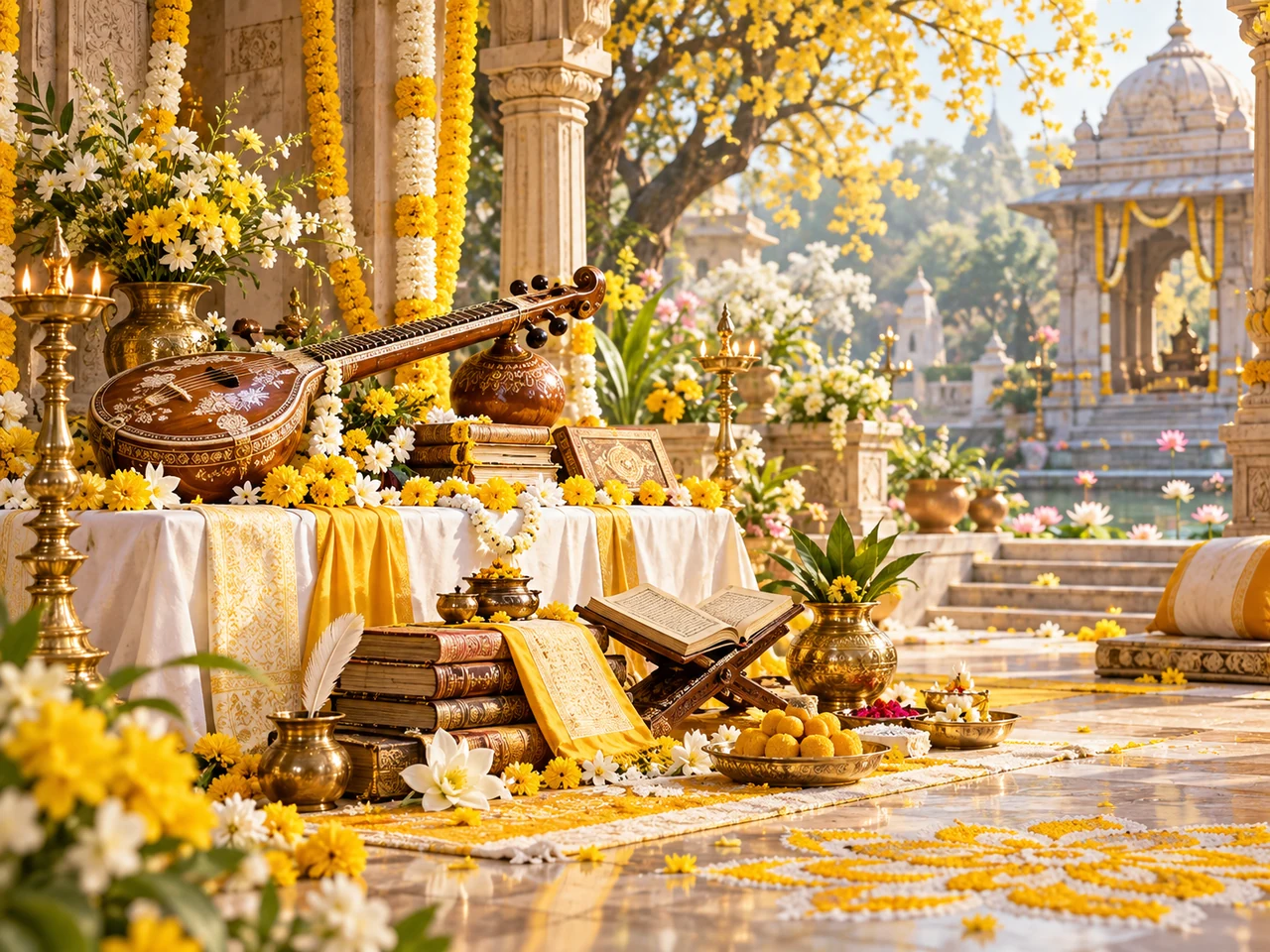
A book placed beside a flower, a child tracing a first letter, a musician setting a veena carefully near an altar, and fields bright with mustard blossoms: each offers a glimpse of Vasant Panchami (also Basant Panchami, Shri Panchami or Saraswati Puja). For many Hindu families the festival is devoted to Goddess Saraswati, associated with knowledge, speech, music, learning and the arts. Elsewhere it is equally a celebration of the season, poetry and community. The festival's name brings spring into the imagination, but its customs are not identical everywhere. 1, 3, 5
Vasant Panchami invites a question beyond examination success: How do we treat the gift of learning? Children, teachers, artists and lifelong students can recognise themselves in its answer. Reverence for knowledge is expressed not merely by seeking information, but by speaking responsibly, practising with patience and sharing what one knows.
When is Vasant Panchami celebrated?
The widely recognised Hindu calendar association is Magha Shukla Panchami: the fifth Tithi of the waxing lunar fortnight in the month of Magha. Shukla Paksha means the fortnight during which the visible Moon generally waxes. A Tithi is determined by the angular relationship of the Sun and Moon, and need not begin or end at midnight. Thus the observance cannot be calculated by adding five ordinary days to a fixed Gregorian date. In common civil-calendar terms it often lies in late winter, but that approximation is not a date rule. 1, 2
For Saraswati Puja, one published North Indian almanac convention emphasises the Purvahna period—the earlier part of the day—and the presence or overlap of Panchami during that period. The local Panchami interval, local sunrise and the convention used to choose the festival civil day matter. Some calendar choices can select a day whose sunrise Tithi is not Panchami. This is why a blanket 'Panchami at sunrise' algorithm is inadequate for selecting this observance.
Who is Goddess Saraswati?
Saraswati is widely honoured as the source or guardian of eloquence, discerning understanding, music, language, literature and the creative disciplines. Her image often includes a veena, a book or manuscript, a rosary, a lotus, and a hamsa (often interpreted as a swan). These are not a single mandatory iconographic checklist: artwork varies across eras and schools. The Metropolitan Museum of Art documents late nineteenth-century representations from Bengal and western India, describing the veena and book as signs of music and learning and showing differences in bird imagery. 3, 4
Her story cannot be reduced to one timeless 'birth biography'. The Rigveda, hymn 6.61, addresses Saraswati with striking language of flowing waters, strength, protection and inspired thought. That hymn does , addresses Sarasvati with striking language of flowing waters, strength, protection and inspired thought. That hymn does not state that Vasant Panchami marks her birthday. In later Hindu theology and devotional art, Saraswati is prominently the goddess of vidya (learning) and vak (speech). Some devotional calendars call the festival Saraswati Jayanti and tell appearance-day stories; these should be identified as devotional traditions, not retroactively presented as statements of the Rigveda or as proven historical events. 6, 3, 1
The festival's affectionate title Shri Panchami is also found in regional usage. 'Saraswati Puja' may refer to the worship on this day, but it is not the only annual occasion for Saraswati worship. In a number of South Indian traditions, Saraswati is prominently honoured during Sharad Navratri and the Ayudha Puja–Vijayadashami season; those observances must not be silently assigned this Magha date. 1
Why are knowledge, speech and music at the heart of the festival?
Devotees understand Saraswati worship as a request for clarity, insight, disciplined study and expressive skill. In a classroom the form may be a small puja before an image; at home a family may assemble books and writing materials; in a music school a student may honour their instrument. Such actions express a wider ideal: knowledge becomes meaningful through attention, good judgement and practice. These are interpretations of devotional symbolism, not measurable guarantees of grades or talent. 1, 3
The veena evokes harmony and concentration; the manuscript calls attention to learning; the hamsa is often interpreted in devotional explanation as the power to discern; white garments evoke simplicity or purity. No object requires exactly one philosophical reading, and not every regional image contains every attribute. The goddess may also be discussed as a form of divine Shakti; that is a theological connection, not evidence that all Vasant Panchami practice belongs to a single Shaiva or Nath ritual lineage. 3, 4
A practical, inclusive way of appreciating the day is to thank those who teach, practise a skill without distraction, read thoughtfully, or help another learner. Those activities complement worship where a household observes it; they are not substitutes imposed upon families with different practices.
How is Saraswati Puja observed at home and in educational institutions?
In many worshipping households, the day begins with cleaning and arranging a simple place for Saraswati's image, respectful offerings of flowers, fruit or sweets, and family prayers. Books, notebooks, writing tools and musical instruments may be placed nearby as symbols of learning. At schools and colleges, students and teachers may gather for puja, music, readings or cultural programmes. A child may be gently introduced to the alphabet in a Vidyarambha/Aksharabhyasa ceremony; in Bengali-speaking settings this is often called hate khori ('holding chalk'). The exact form depends on family, teacher and place. 1, 5
Worshippers may offer flowers and share prasad, while other families mark the occasion by study, yellow clothing or community gatherings. There is no universal requirement that everyone must perform a lengthy ritual, make a particular offering, remain silent, or postpone all reading. Customs about setting books aside during worship differ. Nor should a family's ability to buy elaborate decorations be treated as a measure of devotion. 1
A publicly accessible article can explain these customs, but should not invent initiation-specific mantras, promise results, prescribe an inflexible sixteen-step worship sequence, or replace the direction of a family's priest or teacher. Common devotional songs, Saraswati Vandana and Aarti are associated with worship; exact texts and lineage attributions should appear only in separately verified devotional-work pages. 1
Fasting: Some families maintain a voluntary food observance or choose simpler meals. Many others do not fast at all. Vasant Panchami is not an occasion on which one universal fast and Parana rule can be presumed. Children and anyone who should not abstain from food need not be pressured into fasting; follow household practice and appropriate personal health guidance.
Why is yellow associated with Vasant Panchami?
In much of North India, fields of blooming mustard and the colour of marigolds help explain the appeal of yellow or basanti garments and flowers. The hue is often read as a sign of freshness, warmth, growth and auspicious beginnings. Yellow is prominent in Bihar's own public description of the festival, where seasonal crops, yellow foods and Saraswati devotion appear side by side. 5
Yet yellow is not a rule about the goddess's only proper colour. Saraswati is very frequently shown wearing white in painting and sculpture, including historical museum objects; many devotees use white flowers or garments. A festival that celebrates yellow seasonal landscapes can still place a white-robed goddess at the centre of worship. This is one of the clearest examples of festival colour and deity iconography serving different purposes. 3, 4, 1
Foods and offerings vary by home and region. Sweet saffron-coloured or turmeric-tinted rice, seasonal fruits, sweets, milk-based offerings and khichuri appear in some communities. Bengali Saraswati Puja traditions may include kul (jujube), fruit offerings and a shared meal of khichuri with vegetables. These examples are regional customs, not a single religiously required menu. 1, 5
North India: Saraswati, education and the spring landscape
In Bihar, the occasion is strongly associated with Saraswati worship, study, cultural gatherings and yellow clothing and food. The Bihar government's festival description connects the worship of knowledge with the season's mustard blossoms. In neighbouring regions, families may visit temples, offer flowers or gather in schools. It is more precise to say many communities observe Saraswati Puja than to suggest that every North Indian village follows identical rituals. 5
In parts of Punjab and Haryana, Basant Panchami also signifies the welcome of warmer days through yellow clothes, folk culture and, in some localities, kite flying. These activities should not be mistaken for the dominant custom across every locality; regional differences in worship and celebration are real. Published almanac summaries describe this cultural variation, but modern local events need separate verification rather than permanent claims about a specific fair or schedule. 1
West Bengal: students, neighbourhood puja and hate khori
In West Bengal, the name Saraswati Puja or Sree Panchami is especially familiar. Students and families gather around Saraswati images; books, pens, paintbrushes and instruments may be dedicated symbolically to learning. Yellow or pale traditional clothing, pushpanjali (flower offerings), school celebrations, neighbourhood pandals and, in some communities, immersion of temporary images are features of the occasion. Families differ on the day and form of immersion, and on the first-writing ceremony called hate khori. A West Bengal school council's holiday nomenclature identifies the day as 'Saraswati Puja (Sree Panchami)', corroborating local naming without proving one uniform puja sequence. 1, 8
Assam and the eastern educational setting
Assam also provides a vivid example of the association between Saraswati Puja and learning. Government records describe Saraswati Puja events in educational institutions, including a documented celebration at a college. This supports a connection to campus worship, not a claim that all Assamese households observe the same puja, processions or offerings. Eastern and northeastern practices are plural and should remain locally named. 9
Braj: Krishna devotion and the first colours of Holi
In Mathura–Vrindavan and the Braj region, Vasant Panchami can also carry a Krishna-bhakti character: deities dressed in spring colours, sung verses and the symbolic beginning of a longer Holi season. The Shri Banke Bihari Temple's own explanatory page says symbolic Holi colours begin on Basant Panchami, even while its annual festival calendar names a later date for the onset of the period of colourful Holi celebrations. These statements describe distinct levels of observance, not a reason to merge the Vasant Panchami, Rangbhari Ekadashi and Holi calendar records. 10, 11
Nepal: prayers for learning around Swayambhu
In Kathmandu, the Nepal Tourism Board describes devotees and students visiting a Manjushree/Saraswati shrine in the Swayambhu area on Basanta Panchami; some parents introduce young children to writing there. This is an identifiable local pilgrimage practice, not proof that every Nepalese worshipper follows the same rite or that a Nepal-specific observance date will always equal that of an Indian city. 7
South Indian worship: related, not necessarily the same observance
Devotion to Saraswati is not confined to Magha. In parts of southern India, Saraswati Puja and the placing of learning tools are especially associated with Sharad Navratri, Ayudha Puja and Vijayadashami. The season, local names and ritual sequence differ; a site should therefore link these topics without treating them as calendar duplicates. A visitor searching for 'Saraswati Puja date' may be referring to two different seasonal observances. 1
What is the relationship between Vasant Panchami and spring?
The word vasanta evokes spring, song, renewal and the brightness of mustard fields. In literature and popular imagination the day welcomes a new mood after the depth of winter. But the festival name is not an astronomical certification that spring begins on that Gregorian date. Traditional Indian seasonal systems and present-day weather vary across regions. Likewise, Vasant Panchami is a lunar Panchami observance, not a solar ingress or the March equinox. 1, 5
The same principle helps separate related celebrations: the first symbolic gulal at a Braj temple does not turn Vasant Panchami into Holika Dahan; and the worship of Saraswati in autumn does not relocate Magha Panchami. Calendar labels must tell the truth about which tradition, season and event they describe. 10, 11
A day for students, artists and thoughtful speech
The greatest charm of this festival is that its subject—learning—never belongs to one age group. A child beginning the alphabet and an experienced singer returning to practice can both approach Saraswati with humility. A writer can consider the responsibility of words; a teacher can renew their commitment to make knowledge accessible. The religious understanding is that knowledge is a blessing; the ethical implication is that it should not become a cause for arrogance.
For ShivGoraksh readers, this also opens a gentle connection to Shakti, the divine power invoked in many Hindu traditions, without trying to remake the festival as principally Nath or Shaiva. Devotional emphasis and practice belong to their communities. The closest existing Learn topic is Saraswati (Saraswati); the broader theological conversation may reference Shakti (Shakti), while the Braj strand connects to the already documented Holi (Holi: Meaning, Stories, Colours and Traditions) and Holika Dahan (Holika Dahan: The Sacred Fire Before Holi).