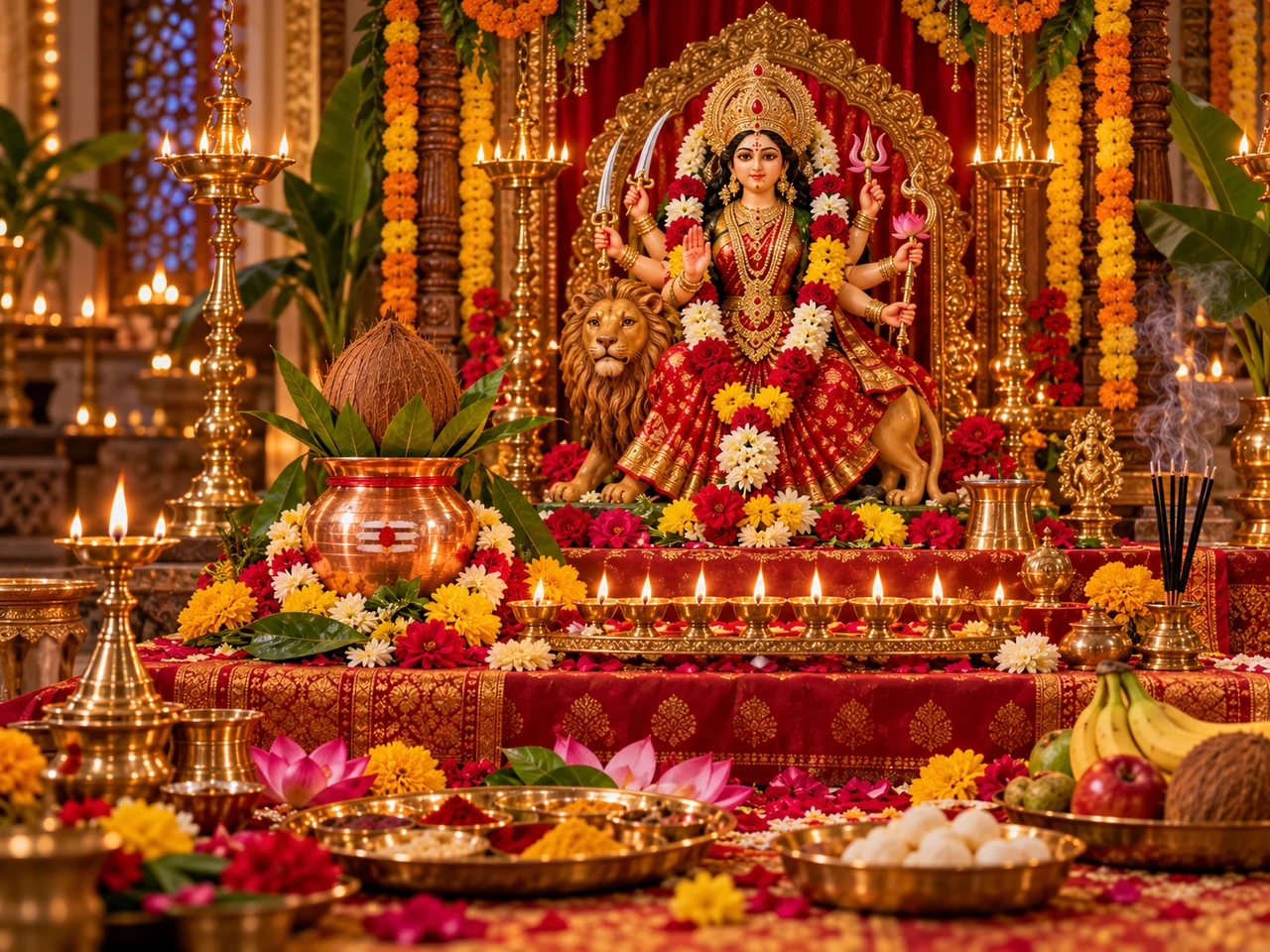
Household Worship: Steps & Context
Step 1
Prepare the household worship space
Choose a clean, stable surface and a Durga image or suitable household murti; wash hands, arrange clean small vessels and offerings. Do not handle or bathe delicate images. This is a safety and hospitality action, not an excuse to invent a Sanskrit purification formula.
Step 2 · Optional
Optional Ganesha remembrance
As a separate preparatory prayer, remember Ganesha; this is optional in the selected household approach and not asserted to occur in every Shakta lineage.
Original Text
वक्रतुण्ड महाकाय सूर्यकोटिसमप्रभ ।
निर्विघ्नं कुरु मे देव सर्वकार्येषु सर्वदा ॥
Roman Transliteration
vakratunda mahaakaaya sooryakotisamaprabha |
nirvighnam kuru me deva sarvakaaryeshu sarvadaa ||vakratuṇḍa mahākāya sūryakoṭisamaprabha |
nirvighnaṃ kuru me deva sarvakāryeṣu sarvadā ||
Meaning
O curved-trunked, great-bodied Lord, radiant like millions of suns, make all my undertakings free of impediments, always.
Related reading & sourceStep 3 · Optional
Optional Guru remembrance
Remember teachers and lineage respectfully without claiming a specific initiation.
Original Text
गुरुर्ब्रह्मा गुरुर्विष्णुर्गुरुर्देवो महेश्वरः ।
गुरुः साक्षात् परं ब्रह्म तस्मै श्रीगुरवे नमः ॥
Roman Transliteration
gururbrahmaa gururvishnurgururdevo maheshvarah |
guruh saakshaat param brahma tasmai shreegurave namah ||gururbrahmā gururviṣṇurgururdevo maheśvaraḥ |
guruḥ sākṣāt paraṃ brahma tasmai śrīgurave namaḥ ||
Meaning
The teacher is likened to Brahma, Vishnu and Maheshvara, and directly to the supreme Brahman; I honor that revered guru.
Related reading & sourceStep 4
Express a truthful personal intention
In ordinary language state your wish to worship with care and goodwill. A formal Sanskrit sankalpa containing lineage, place, year, nakshatra and tithi is excluded because the exact variables have not been verified.
Context 5 · Optional
Ghatasthapana in context
Ghatasthapana is a distinct opening observance with its own materials and tradition-specific sequence. See the separate Kalash guide for its symbolism; this passage does not supply a ritual timing or a complete installation procedure.
Step 6
Dhyana: contemplate compassionate Devi
Recite the following prayer as an independently sourced Devi hymn; do not mistake it for a formal installation mantra.
Original Text
सर्वमङ्गलमाङ्गल्ये शिवे सर्वार्थसाधिके ।
शरण्ये त्र्यम्बके गौरि नारायणि नमोऽस्तु ते ॥
Roman Transliteration
sarvamangalamaangalye shive sarvaarthasaadhike |
sharanye tryambake gauri naaraayani namo’stu te ||sarvamaṅgalamāṅgalye śive sarvārthasādhike |
śaraṇye tryambake gauri nārāyaṇi namo’stu te ||
Meaning
O the most auspicious among all that is auspicious, benevolent one who accomplishes worthy aims, refuge-giving three-eyed Gauri and Narayani, salutations to you.
Related reading & sourceStep 7
Respectful invitation / āvāhana
If using the published Durga-puja pattern, invite the Goddess symbolically to accept your worship; an already-installed temple murti should not be treated as newly consecrated.
Original Text
आगच्छ वरदे देवि दैत्यदर्पनिषूदिनि ।
पूजां गृहाण सुमुखि नमस्ते शङ्करप्रिये ॥
Roman Transliteration
aagachchha varade devi daityadarpanishoodini |
poojaam grihaana sumukhi namaste shankarapriye ||āgaccha varade devi daityadarpaniṣūdini |
pūjāṃ gṛhāṇa sumukhi namaste śaṅkarapriye ||
Meaning
Come, gracious Goddess who overcomes the arrogance of hostile forces. Kindly accept this worship; salutations to you, beloved of Shankara.
Related reading & sourceStep 8 · Optional
Day 1: Shailaputri invocation
Where your observance follows this Navratri sequence, read the prayer to Shailaputri; recite this named salutation, then the distinct published prārthanā. Do not recite all nine as though one form must govern every day, and do not infer a civil date from this number. Steadiness, grounding and the mountain-daughter image.
Original Text
ॐ देवी शैलपुत्र्यै नमः॥
Roman Transliteration
oṃ devee shailaputryai namah||oṃ devī śailaputryai namaḥ
Meaning
Salutations to Goddess Shailaputri, the form remembered in this day-wise tradition.
Related reading & sourceOriginal Text
वन्दे वाञ्छितलाभाय चन्द्रार्धकृतशेखराम्।
वृषारूढां शूलधरां शैलपुत्रीं यशस्विनीम्॥
Roman Transliteration
vande vaanchhitalaabhaaya chandraardhakritashekharaam|
vrishaaroodhaam shooladharaam shailaputreem yashasvineem||vande vāñchitalābhāya candrārdhakṛtaśekharām |
vṛṣārūḍhāṃ śūladharāṃ śailaputrīṃ yaśasvinīm ||
Meaning
I bow to glorious Śailaputrī, crowned with a crescent, mounted on a bull, carrying a trident, invoked with hope for worthy aims.
Related reading & sourceStep 9 · Optional
Day 2: Brahmacharini invocation
Where your observance follows this Navratri sequence, read the prayer to Brahmacharini; recite this named salutation, then the distinct published prārthanā. Do not recite all nine as though one form must govern every day, and do not infer a civil date from this number. Discipline, patient study and ascetic devotion.
Original Text
ॐ देवी ब्रह्मचारिण्यै नमः॥
Roman Transliteration
oṃ devee brahmachaarinyai namah||oṃ devī brahmacāriṇyai namaḥ
Meaning
Salutations to Goddess Brahmacharini, the form remembered in this day-wise tradition.
Related reading & sourceOriginal Text
दधाना कर पद्माभ्यामक्षमाला कमण्डलू।
देवी प्रसीदतु मयि ब्रह्मचारिण्यनुत्तमा॥
Roman Transliteration
dadhaanaa kara padmaabhyaamakshamaalaa kamandaloo|
devee praseedatu mayi brahmachaarinyanuttamaa||dadhānā kara padmābhyām akṣamālā kamaṇḍalū |
devī prasīdatu mayi brahmacāriṇyanuttamā ||
Meaning
May the incomparable Brahmacāriṇī, holding a rosary and water-pot in her two lotus-like hands, be gracious to me.
Related reading & sourceStep 10 · Optional
Day 3: Chandraghanta invocation
Where your observance follows this Navratri sequence, read the prayer to Chandraghanta; recite this named salutation, then the distinct published prārthanā. Do not recite all nine as though one form must govern every day, and do not infer a civil date from this number. Courage joined to compassion; martial imagery is symbolic, not a call to violence.
Original Text
ॐ देवी चन्द्रघण्टायै नमः॥
Roman Transliteration
oṃ devee chandraghantaayai namah||oṃ devī candraghaṇṭāyai namaḥ
Meaning
Salutations to Goddess Chandraghanta, the form remembered in this day-wise tradition.
Related reading & sourceOriginal Text
पिण्डज प्रवरारूढा चण्डकोपास्त्रकैर्युता।
प्रसादं तनुते मह्यम् चन्द्रघण्टेति विश्रुता॥
Roman Transliteration
pindaja pravaraaroodhaa chandakopaastrakairyutaa|
prasaadam tanute mahyam chandraghanteti vishrutaa||piṇḍaja pravarārūḍhā caṇḍakopāstrakairyutā |
prasādaṃ tanute mahyam candraghaṇṭeti viśrutā ||
Meaning
May the Goddess known as Chandraghanta, described as mounted and equipped with powerful weapons, extend her grace to me. The compound piṇḍaja has differing interpretations.May the Goddess known as Candraghaṇṭā, described as mounted and equipped with powerful weapons, extend her grace to me. The compound piṇḍaja has differing interpretations.
Explanation
The meditation portrays the Goddess as mounted and bearing weapons. The compound pindaja has differing readings and interpretations; no single vehicle identification is assumed here.
Related reading & sourceStep 11 · Optional
Day 4: Kushmanda invocation
Where your observance follows this Navratri sequence, read the prayer to Kushmanda; recite this named salutation, then the distinct published prārthanā. Do not recite all nine as though one form must govern every day, and do not infer a civil date from this number. Creative radiance; imagery requiring lineage-context interpretation.
Original Text
ॐ देवी कूष्माण्डायै नमः॥
Roman Transliteration
oṃ devee kooshmaandaayai namah||oṃ devī kūṣmāṇḍāyai namaḥ
Meaning
Salutations to Goddess Kushmanda, the form remembered in this day-wise tradition.
Related reading & sourceOriginal Text
सुरासम्पूर्ण कलशं रुधिराप्लुतमेव च।
दधाना हस्तपद्माभ्यां कूष्माण्डा शुभदास्तु मे॥
Roman Transliteration
suraasampoorna kalasham rudhiraaplutameva cha|
dadhaanaa hastapadmaabhyaam kooshmaandaa shubhadaastu me||surāsampūrṇa kalaśaṃ rudhirāplutam eva ca |
dadhānā hastapadmābhyāṃ kūṣmāṇḍā śubhadāstu me ||
Meaning
May Kushmanda be auspicious to me; the published iconographic verse depicts her carrying a vessel and uses wine/blood imagery. It is description, not a household offering instruction.May Kūṣmāṇḍā be auspicious to me; the published iconographic verse depicts her carrying a vessel and uses wine/blood imagery. It is description, not a household offering instruction.
Related reading & sourceStep 12 · Optional
Day 5: Skandamata invocation
Where your observance follows this Navratri sequence, read the prayer to Skandamata; recite this named salutation, then the distinct published prārthanā. Do not recite all nine as though one form must govern every day, and do not infer a civil date from this number. Maternal care, protection, and Kartikeya/Skanda relationship.
Original Text
ॐ देवी स्कन्दमात्रे नमः॥
Roman Transliteration
oṃ devee skandamaatre namah||oṃ devī skandamātre namaḥ
Meaning
Salutations to Goddess Skandamata, the form remembered in this day-wise tradition.
Related reading & sourceThis edition uses the lotus-associated Skandamata reading.
Original Text
सिंहासनगता नित्यं पद्माश्रितकरद्वया।
शुभदास्तु सदा देवी स्कन्दमाता यशस्विनी॥
Roman Transliteration
simhaasanagataa nityam padmaashritakaradvayaa|
shubhadaastu sadaa devee skandamaataa yashasvinee||siṃhāsanagatā nityaṃ padmāśritakaradvayā|
śubhadāstu sadā devī skandamātā yaśasvinī||
Meaning
May the renowned Goddess Skandamata, ever seated on a lion throne with two lotus-bearing hands, bestow auspiciousness.
Explanation
The meditation brings together the lion seat and lotus-bearing hands of Skandamata. This reading follows the lotus-associated wording of the cited Navadurga edition; it is a devotional image, not a prescribed visualization technique.
Related reading & sourceStep 13 · Optional
Day 6: Katyayani invocation
Where your observance follows this Navratri sequence, read the prayer to Katyayani; recite this named salutation, then the distinct published prārthanā. Do not recite all nine as though one form must govern every day, and do not infer a civil date from this number. Resolve against injustice; traditions interpret the martial imagery diversely.
Original Text
ॐ देवी कात्यायन्यै नमः॥
Roman Transliteration
oṃ devee kaatyaayanyai namah||oṃ devī kātyāyanyai namaḥ
Meaning
Salutations to Goddess Katyayani, the form remembered in this day-wise tradition.
Related reading & sourceOriginal Text
चन्द्रहासोज्ज्वलकरा शार्दूलवरवाहना।
कात्यायनी शुभं दद्याद् देवी दानवघातिनी॥
Roman Transliteration
chandrahaasojjvalakaraa shaardoolavaravaahanaa|
kaatyaayanee shubham dadyaad devee daanavaghaatinee||candrahāsojjvalakarā śārdūlavaravāhanā |
kātyāyanī śubhaṃ dadyād devī dānavaghātinī ||
Meaning
May Katyayani, with shining sword and tiger mount, conqueror of demonic forces, grant auspiciousness.May Kātyāyanī, with shining sword and tiger mount, conqueror of demonic forces, grant auspiciousness.
Related reading & sourceStep 14 · Optional
Day 7: Kalaratri invocation
Where your observance follows this Navratri sequence, read the prayer to Kalaratri; recite this named salutation, then the distinct published prārthanā. Do not recite all nine as though one form must govern every day, and do not infer a civil date from this number. Darkness faced without denial; the iconography does not authorize occult procedures.
Original Text
ॐ देवी कालरात्र्यै नमः॥
Roman Transliteration
oṃ devee kaalaraatryai namah||oṃ devī kālarātryai namaḥ
Meaning
Salutations to Goddess Kalaratri, the form remembered in this day-wise tradition.
Related reading & sourceOriginal Text
एकवेणी जपाकर्णपूरा नग्ना खरास्थिता।
लम्बोष्ठी कर्णिकाकर्णी तैलाभ्यक्त शरीरिणी॥
वामपादोल्लसल्लोह लताकण्टकभूषणा।
वर्धन मूर्धध्वजा कृष्णा कालरात्रिर्भयङ्करी॥
Roman Transliteration
ekavenee japaakarnapooraa nagnaa kharaasthitaa|
lamboshthee karnikaakarnee tailaabhyakta shareerinee||
vaamapaadollasalloha lataakantakabhooshanaa|
vardhana moordhadhvajaa krishnaa kaalaraatrirbhayankaree||ekaveṇī japākarṇapūrā nagnā kharāsthitā |
lambōṣṭhī karṇikākarṇī tailābhyakta śarīriṇī ||
vāmapādollasalloha latākaṇṭakabhūṣaṇā |
vardhana mūrdhadhvajā kṛṣṇā kālarātrirbhayaṅkarī ||
Meaning
This descriptive prayer portrays the dark, fearsome Kalaratri with a single braid, distinctive ornaments, and an oil-anointed body; her fearsome form is revered as protective. Several compounds need collation.This descriptive prayer portrays the dark, fearsome Kālarātrī with a single braid, distinctive ornaments, and an oil-anointed body; her fearsome form is revered as protective. Several compounds need collation.
Explanation
The fierce imagery describes Kalaratri’s form. It is not a direction to imitate the imagery, apply substances to the body or undertake a special night practice.
Related reading & sourceStep 15 · Optional
Day 8: Mahagauri invocation
Where your observance follows this Navratri sequence, read the prayer to Mahagauri; recite this named salutation, then the distinct published prārthanā. Do not recite all nine as though one form must govern every day, and do not infer a civil date from this number. Purity as clarity and ethical renewal, not a judgement about complexion.
Original Text
ॐ देवी महागौर्यै नमः॥
Roman Transliteration
oṃ devee mahaagauryai namah||oṃ devī mahāgauryai namaḥ
Meaning
Salutations to Goddess Mahagauri, the form remembered in this day-wise tradition.
Related reading & sourceOriginal Text
श्वेते वृषेसमारूढा श्वेताम्बरधरा शुचिः।
महागौरी शुभं दद्यान्महादेव प्रमोददा॥
Roman Transliteration
shvete vrishesamaaroodhaa shvetaambaradharaa shuchih|
mahaagauree shubham dadyaanmahaadeva pramodadaa||śvete vṛṣesamārūḍhā śvetāmbaradharā śuciḥ |
mahāgaurī śubhaṃ dadyān mahādeva pramodadā ||
Meaning
May pure Mahagauri, wearing white and mounted on a white bull, bring auspiciousness and delight to Mahadeva.May pure Mahāgaurī, wearing white and mounted on a white bull, bring auspiciousness and delight to Mahādeva.
Related reading & sourceStep 16 · Optional
Day 9: Siddhidatri invocation
Where your observance follows this Navratri sequence, read the prayer to Siddhidatri; recite this named salutation, then the distinct published prārthanā. Do not recite all nine as though one form must govern every day, and do not infer a civil date from this number. Completion, gratitude, skill and disciplined insight; not a guarantee of supernatural powers.
Original Text
ॐ देवी सिद्धिदात्र्यै नमः॥
Roman Transliteration
oṃ devee siddhidaatryai namah||oṃ devī siddhidātryai namaḥ
Meaning
Salutations to Goddess Siddhidatri, the form remembered in this day-wise tradition.
Related reading & sourceOriginal Text
सिद्ध गन्धर्व यक्षाद्यैरसुरैरमरैरपि।
सेव्यमाना सदा भूयात् सिद्धिदा सिद्धिदायिनी॥
Roman Transliteration
siddha gandharva yakshaadyairasurairamarairapi|
sevyamaanaa sadaa bhooyaat siddhidaa siddhidaayinee||siddha gandharva yakṣādyair asurair amarair api |
sevyamānā sadā bhūyāt siddhidā siddhidāyinī ||
Meaning
May Siddhidatri, revered by siddhas, gandharvas, yakṣas, asuras and gods alike, ever be the giver of spiritual accomplishment.May Siddhidātrī, revered by siddhas, gandharvas, yakṣas, asuras and gods alike, ever be the giver of spiritual accomplishment.
Related reading & sourceStep 17 · Optional
Offer a symbolic seat
Place a clean flower or symbolic seat in front of the image, following the source’s hospitality motif. The selected full verse poetically describes a jeweled golden seat; explain the symbolism rather than pretending the household possesses that object.
Original Text
अनेकरत्नसंयुक्तं नानामणिगणान्वितम् ।
कार्तस्वरमयं दिव्यमासनं प्रतिगृह्यताम् ॥
Roman Transliteration
anekaratnasamyuktam naanaamaniganaanvitam |
kaartasvaramayam divyamaasanam pratigrihyataam ||anekaratnasaṃyuktaṃ nānāmaṇigaṇānvitam |
kārtasvaramayaṃ divyamāsanaṃ pratigṛhyatām ||
Meaning
Please accept a divine seat imagined as gold and covered in many gems.
Related reading & sourceStep 18 · Optional
Water symbolically for the feet
In a clean separate vessel offer a little water as a gesture of guest hospitality; do not pour it onto a paper image.
Original Text
गङ्गादिसर्वतीर्थेभ्यो मया प्रार्थनयाहृतम् ।
तोयमेतत्सुखस्पर्शं पाद्यार्थं प्रतिगृह्यताम् ॥
Roman Transliteration
gangaadisarvateerthebhyo mayaa praarthanayaahritam |
toyametatsukhasparsham paadyaartham pratigrihyataam ||gaṅgādisarvatīrthebhyo mayā prārthanayāhṛtam |
toyametatsukhasparśaṃ pādyārthaṃ pratigṛhyatām ||
Meaning
Accept this pleasant water, reverently envisioned as drawn from sacred bathing places, for your feet.
Related reading & sourceStep 19 · Optional
Arghya: honored scented-water offering
The prayer describes scented water with flowers and unbroken rice. It expresses hospitality; a simpler symbolic offering need not be described as the same full ritual action.
Original Text
गन्धपुष्पाक्षतैर्युक्तमर्घ्यं सम्पादितं मया ।
गृहाण त्वं महादेवि प्रसन्ना भव सर्वदा ॥
Roman Transliteration
gandhapushpaakshatairyuktamarghyam sampaaditam mayaa |
grihaana tvam mahaadevi prasannaa bhava sarvadaa ||gandhapuṣpākṣatairyuktamarghyaṃ sampāditaṃ mayā |
gṛhāṇa tvaṃ mahādevi prasannā bhava sarvadā ||
Meaning
O great Goddess, accept the respectful water offering prepared with fragrance, flowers and unbroken rice, and be gracious.
Related reading & sourceStep 20 · Optional
Water for ceremonial sipping (for deity)
Set a small vessel of clean water as a symbolic offering. This is water offered to Devi; do not confuse it with instructions requiring the reader to ingest water as part of purification.
Original Text
आचम्यतां त्वया देवि भक्तिं मे ह्यचलां कुरु ।
ईप्सितं मे वरं देहि परत्र च परां गतिम् ॥
Roman Transliteration
aachamyataam tvayaa devi bhaktim me hyachalaam kuru |
eepsitam me varam dehi paratra cha paraam gatim ||ācamyatāṃ tvayā devi bhaktiṃ me hyacalāṃ kuru |
īpsitaṃ me varaṃ dehi paratra ca parāṃ gatim ||
Meaning
O Goddess, please sip this water; grant me unwavering devotion, worthy blessings, and ultimate spiritual progress.
Related reading & sourceContext 21 · Optional
Bathing traditions
The cited bathing verse describes five nectars rather than water alone. This is a different practice from picture-based household devotion; no substitute bathing prayer is supplied.
Step 22 · Optional
Optional clean cloth offering
A symbolic fresh cloth may be placed adjacent to the image, not over burning lamps or delicate artwork; no gendered clothing claim should be universalized.
Original Text
वस्त्रं च सोमदैवत्यं लज्जायास्तु निवारणम् ।
मया निवेदितं भक्त्या गृहाण परमेश्वरि ॥
Roman Transliteration
vastram cha somadaivatyam lajjaayaastu nivaaranam |
mayaa niveditam bhaktyaa grihaana parameshvari ||vastraṃ ca somadaivatyaṃ lajjāyāstu nivāraṇam |
mayā niveditaṃ bhaktyā gṛhāṇa parameśvari ||
Meaning
O Supreme Goddess, kindly accept the garment I offer with devotion for modesty and honor.
Related reading & sourceStep 23 · Optional
Offer sandalwood / fragrant paste
Place safe sandal paste in a dish; apply only to a suitable, cleanable image or murti if appropriate and with permission. The selected verse is specifically about gandha, not a generic invocation.
Original Text
परमानन्दसौभाग्यं परिपूर्णं दिगन्तरे ।
गृहाण परमं गन्धं कृपया परमेश्वरि ॥
Roman Transliteration
paramaanandasaubhaagyam paripoornam digantare |
grihaana paramam gandham kripayaa parameshvari ||paramānandasaubhāgyaṃ paripūrṇaṃ digantare |
gṛhāṇa paramaṃ gandhaṃ kṛpayā parameśvari ||
Meaning
O Supreme Goddess, mercifully accept this excellent fragrance associated with auspicious joy.
Related reading & sourceStep 24 · Optional
Optional kumkum / roli
A small amount of suitable red offering powder may be used where it belongs to family custom; it is not compulsory in every Shakta tradition. Avoid unknown ingredients and do not apply it to another person without consent.
Original Text
कुङ्कुमं कान्तिदं दिव्यं कामिनीकामसम्भवम् ।
कुङ्कुमेनार्चिते देवि प्रसीद परमेश्वरि ॥
Roman Transliteration
kunkumam kaantidam divyam kaamineekaamasambhavam |
kunkumenaarchite devi praseeda parameshvari ||kuṅkumaṃ kāntidaṃ divyaṃ kāminīkāmasambhavam |
kuṅkumenārcite devi prasīda parameśvari ||
Meaning
Divine Goddess, be gracious when honored with radiant kumkum.
Related reading & sourceStep 25 · Optional
Offer flowers / puṣpa
Offer clean flowers in a dry dish. The printed flower verse names particular kinds, including jasmine and champak; do not assert that every listed species has been physically offered.
Original Text
मन्दारपारिजातादि-पाटलीकेतकानि च ।
जातीचम्पकपुष्पाणि गृहाणेमानि शोभने ॥
Roman Transliteration
mandaarapaarijaataadi-paataleeketakaani cha |
jaateechampakapushpaani grihaanemaani shobhane ||mandārapārijātādi-pāṭalīketakāni ca |
jātīcampakapuṣpāṇi gṛhāṇemāni śobhane ||
Meaning
O beautiful one, accept these flowers such as mandara, parijata, patali, ketaki, jasmine and champaka.
Related reading & sourceContext 26 · Optional
Optional incense with ventilation caution
The printed dhūpa verse specifies a multi-ingredient incense including guggal, sandalwood and agarwood; it does not precisely describe a generic stick. If only unknown-composition incense is available, omit the liturgical action; no universal need to produce smoke.
Original Text
दशाङ्गगुग्गुलं धूपं चन्दनागरुसंयुतम् ।
समर्पितं मया भक्त्या महादेवि प्रतिगृह्यताम् ॥
Roman Transliteration
dashaangaguggulam dhoopam chandanaagarusamyutam |
samarpitam mayaa bhaktyaa mahaadevi pratigrihyataam ||daśāṅgaguggulaṃ dhūpaṃ candanāgarusaṃyutam |
samarpitaṃ mayā bhaktyā mahādevi pratigṛhyatām ||
Meaning
O great Goddess, accept the incense presented with devotion, described as blended with guggulu, sandalwood and agaru.
Related reading & sourceContext 27 · Optional
Optional source-specific ghee lamp
The attested dīpa verse literally mentions a wick with ghee; if this is not the actual lamp, do not substitute an LED under the same literal offering claims. Never leave any open flame unattended.
Original Text
घृतवर्त्तिसमायुक्तं महातेजो महोज्ज्वलम् ।
दीपं दास्यामि देवेशि सुप्रीता भव सर्वदा ॥
Roman Transliteration
ghritavarttisamaayuktam mahaatejo mahojjvalam |
deepam daasyaami deveshi supreetaa bhava sarvadaa ||ghṛtavarttisamāyuktaṃ mahātejo mahojjvalam |
dīpaṃ dāsyāmi deveśi suprītā bhava sarvadā ||
Meaning
O ruler of the gods, I offer this bright lamp with a ghee-soaked wick; may you be gracious.
Related reading & sourceContext 28 · Optional
Food offering and its meaning
The source prayer describes a fourfold meal with six tastes. A simple fruit offering found in some household traditions is a separate devotional gesture; this guide does not assign that full-meal prayer to it.
Original Text
अन्नं चतुर्विधं स्वादु रसैः षड्भिः समन्वितम् ।
नैवेद्यं गृह्यतां देवि भक्तिं मे ह्यचलां कुरु ॥
Roman Transliteration
annam chaturvidham svaadu rasaih shadbhih samanvitam |
naivedyam grihyataam devi bhaktim me hyachalaam kuru ||annaṃ caturvidhaṃ svādu rasaiḥ ṣaḍbhiḥ samanvitam |
naivedyaṃ gṛhyatāṃ devi bhaktiṃ me hyacalāṃ kuru ||
Meaning
O Goddess, please accept a pleasing fourfold meal embracing the six tastes, and make my devotion firm.
Related reading & sourceContext 29 · Optional
Optional water after food offering
Water following a food offering expresses hospitality in the described tradition. This concluding gesture does not, by itself, make a selected offering into a complete ritual sequence.
Original Text
कामारिवल्लभे देवि कुर्वाचमनमम्बिके ।
निरन्तरमहं वन्दे चरणौ तव चण्डिके ॥
Roman Transliteration
kaamaarivallabhe devi kurvaachamanamambike |
nirantaramaham vande charanau tava chandike ||kāmārivallabhe devi kurvācamanamambike |
nirantaramahaṃ vande caraṇau tava caṇḍike ||
Meaning
O Ambika, consort of Shiva, please accept water for rinsing; I continually bow to your feet.
Related reading & sourceStep 30 · Optional
Public-facing theological stotra (not Navarna initiation)
Read the supplied Devi Mahatmyam (Durga Saptashati) verse as a text of reverence. Reciting all seven hundred units is not required; initiation-dependent Navarna applications remain outside this guide.
Original Text
नमो देव्यै महादेव्यै शिवायै सततं नमः ।
नमः प्रकृत्यै भद्रायै नियताः प्रणताः स्म ताम् ॥
Roman Transliteration
namo devyai mahaadevyai shivaayai satatam namah |
namah prakrityai bhadraayai niyataah pranataah sma taam ||namo devyai mahādevyai śivāyai satataṃ namaḥ |
namaḥ prakṛtyai bhadrāyai niyatāḥ praṇatāḥ sma tām ||
Meaning
Always salutations to the Goddess, the Great Goddess and the auspicious One; we bow with discipline to primordial Nature and the benevolent One.
Related reading & sourceContext 31 · Optional
Optional source-specific nīrājana / arati
The nirajana prayer explicitly concerns camphor. Its live-fire procedure is outside this guide. Ambe Tu Hai Jagdambe Kali is available separately as a devotional song, not as this offering formula.
Original Text
नीराजनं सुमाङ्गल्यं कर्पूरेण समन्वितम् ।
चन्द्रार्कवह्निसदृशं महादेवि नमोऽस्तु ते ॥
Roman Transliteration
neeraajanam sumaangalyam karpoorena samanvitam |
chandraarkavahnisadrisham mahaadevi namo’stu te ||nīrājanaṃ sumāṅgalyaṃ karpūreṇa samanvitam |
candrārkavahnisadṛśaṃ mahādevi namo’stu te ||
Meaning
O great Goddess, I offer reverence through this auspicious light-waving, with camphor, shining like moon, sun and fire.
Related reading & sourceStep 32
Namaskara and respectful closing
Bow quietly to the Goddess. The general circumambulation prayer expresses reverence without prescribing three circuits; adapt physical movement to your circumstances and mobility.
This edition uses the general circumambulation prayer.
Original Text
यानि कानि च पापानि जन्मान्तरकृतानि च ।
तानि तानि विनश्यन्तु प्रदक्षिणपदे पदे ॥
Roman Transliteration
yaani kaani cha paapaani janmaantarakritaani cha |
taani taani vinashyantu pradakshinapade pade ||yāni kāni ca pāpāni janmāntarakṛtāni ca |
tāni tāni vinaśyantu pradakṣiṇapade pade ||
Meaning
May the wrongs committed in this or previous lives fall away with each step of circumambulation.
Explanation
This general circumambulation prayer expresses an aspiration to turn away from wrongdoing. It does not prescribe three circuits or guarantee removal of the consequences of harmful actions; family customs and physical ability differ.
Related reading & sourceStep 33 · Optional
Ask forgiveness and reflect
Use the distinct source-specific forgiveness verse. Understand “offence” as humility and attentiveness, not fear of guaranteed supernatural punishment.
This edition uses the Goddess forgiveness prayer.
Original Text
आवाहनं न जानामि न जानामि विसर्जनम् ।
पूजां चैव न जानामि क्षम्यतां परमेश्वरि ॥
Roman Transliteration
aavaahanam na jaanaami na jaanaami visarjanam |
poojaam chaiva na jaanaami kshamyataam parameshvari ||āvāhanaṃ na jānāmi na jānāmi visarjanam |
pūjāṃ caiva na jānāmi kṣamyatāṃ parameśvari ||
Meaning
I do not know the invitation, the farewell or the proper worship; O supreme Goddess, please forgive me.
Explanation
This forgiveness prayer addresses the Goddess with humility. It acknowledges limited knowledge without replacing responsibility for care, kindness or safety.
Related reading & sourceStep 34
Share prasada and safe aftercare
If food was offered, distribute it hygienically. Handle flowers and other materials respectfully without polluting waterways, and ensure any lamp or incense has stopped safely. A formally installed Kalash has its own concluding custom.
Reused text credits & licences
Reading & sourceMIT License
Copyright (c) 2026 Ishank Gupta and contributors to hindu-devotional-texts
Permission is hereby granted, free of charge, to any person obtaining a copy
of this software and associated documentation files (the "Software"), to deal
in the Software without restriction, including without limitation the rights
to use, copy, modify, merge, publish, distribute, sublicense, and/or sell
copies of the Software, and to permit persons to whom the Software is
furnished to do so, subject to the following conditions:
The above copyright notice and this permission notice shall be included in all
copies or substantial portions of the Software.
THE SOFTWARE IS PROVIDED "AS IS", WITHOUT WARRANTY OF ANY KIND, EXPRESS OR
IMPLIED, INCLUDING BUT NOT LIMITED TO THE WARRANTIES OF MERCHANTABILITY,
FITNESS FOR A PARTICULAR PURPOSE AND NONINFRINGEMENT. IN NO EVENT SHALL THE
AUTHORS OR COPYRIGHT HOLDERS BE LIABLE FOR ANY CLAIM, DAMAGES OR OTHER
LIABILITY, WHETHER IN AN ACTION OF CONTRACT, TORT OR OTHERWISE, ARISING FROM,
OUT OF OR IN CONNECTION WITH THE SOFTWARE OR THE USE OR OTHER DEALINGS IN THE
SOFTWARE.
LicenceReading & sourceInherited traditional wording; selected witness cited below. Romanization, meanings and explanations prepared for ShivGoraksh. No modern source translation, page layout or recording reproduced.
The quoted passage is used for textual study, without conferring ritual authority.
Reading & sourceInherited traditional wording; selected witness cited below. Romanization, meanings and explanations prepared for ShivGoraksh. No modern source translation, page layout or recording reproduced.
The quoted passage is used for textual study, without conferring ritual authority.
Reading & sourceTraditional prayer; comparative witness: Puja Samuccaya, Nirnaya Sagar Press, Bombay, 1923, https://sanskritdocuments.org/~sanskrit/doc_trial/fortransfer/Shankara/pUjAsamucchaya.pdf. The 1923 printed edition is used for inherited text, not modern website commentary, translations or arrangement. Traditional offering verse; the selected wording is retained, including sandhi, spelling and devotional-address variants. Comparative witness is not claimed identical.
Reading & sourceMIT License
Copyright (c) 2026 Ishank Gupta and contributors to hindu-devotional-texts
Permission is hereby granted, free of charge, to any person obtaining a copy
of this software and associated documentation files (the "Software"), to deal
in the Software without restriction, including without limitation the rights
to use, copy, modify, merge, publish, distribute, sublicense, and/or sell
copies of the Software, and to permit persons to whom the Software is
furnished to do so, subject to the following conditions:
The above copyright notice and this permission notice shall be included in all
copies or substantial portions of the Software.
THE SOFTWARE IS PROVIDED "AS IS", WITHOUT WARRANTY OF ANY KIND, EXPRESS OR
IMPLIED, INCLUDING BUT NOT LIMITED TO THE WARRANTIES OF MERCHANTABILITY,
FITNESS FOR A PARTICULAR PURPOSE AND NONINFRINGEMENT. IN NO EVENT SHALL THE
AUTHORS OR COPYRIGHT HOLDERS BE LIABLE FOR ANY CLAIM, DAMAGES OR OTHER
LIABILITY, WHETHER IN AN ACTION OF CONTRACT, TORT OR OTHERWISE, ARISING FROM,
OUT OF OR IN CONNECTION WITH THE SOFTWARE OR THE USE OR OTHER DEALINGS IN THE
SOFTWARE.
LicenceReading & sourceInherited brief salutation or offering formula. Only the short traditional words are used; no modern translation or ritual compilation is reproduced. ShivGoraksh bilingual meanings and explanations are original educational writing.
Reading & sourceTraditional prayer; comparative witness: Puja Samuccaya, Nirnaya Sagar Press, Bombay, 1923, https://sanskritdocuments.org/~sanskrit/doc_trial/fortransfer/Shankara/pUjAsamucchaya.pdf. The 1923 printed edition is used for inherited text, not modern website commentary, translations or arrangement. Traditional offering verse; the selected wording is retained, including sandhi, spelling and devotional-address variants. Comparative witness is not claimed identical.
Reading & sourceTraditional prayer; comparative witness: Puja Samuccaya, Nirnaya Sagar Press, Bombay, 1923, https://sanskritdocuments.org/~sanskrit/doc_trial/fortransfer/Shankara/pUjAsamucchaya.pdf. The 1923 printed edition is used for inherited text, not modern website commentary, translations or arrangement. Traditional offering verse; the selected wording is retained, including sandhi, spelling and devotional-address variants. Comparative witness is not claimed identical.
Reading & sourceTraditional prayer; comparative witness: Puja Samuccaya, Nirnaya Sagar Press, Bombay, 1923, https://sanskritdocuments.org/~sanskrit/doc_trial/fortransfer/Shankara/pUjAsamucchaya.pdf. The 1923 printed edition is used for inherited text, not modern website commentary, translations or arrangement. Traditional offering verse; the selected wording is retained, including sandhi, spelling and devotional-address variants. Comparative witness is not claimed identical.
Reading & sourceTraditional prayer; comparative witness: Puja Samuccaya, Nirnaya Sagar Press, Bombay, 1923, https://sanskritdocuments.org/~sanskrit/doc_trial/fortransfer/Shankara/pUjAsamucchaya.pdf. The 1923 printed edition is used for inherited text, not modern website commentary, translations or arrangement. Traditional offering verse; the selected wording is retained, including sandhi, spelling and devotional-address variants. Comparative witness is not claimed identical.
Reading & sourceTraditional prayer; comparative witness: Puja Samuccaya, Nirnaya Sagar Press, Bombay, 1923, https://sanskritdocuments.org/~sanskrit/doc_trial/fortransfer/Shankara/pUjAsamucchaya.pdf. The 1923 printed edition is used for inherited text, not modern website commentary, translations or arrangement. Traditional offering verse; the selected wording is retained, including sandhi, spelling and devotional-address variants. Comparative witness is not claimed identical.
Reading & sourceTraditional prayer; comparative witness: Puja Samuccaya, Nirnaya Sagar Press, Bombay, 1923, https://sanskritdocuments.org/~sanskrit/doc_trial/fortransfer/Shankara/pUjAsamucchaya.pdf. The 1923 printed edition is used for inherited text, not modern website commentary, translations or arrangement. Traditional offering verse; the selected wording is retained, including sandhi, spelling and devotional-address variants. Comparative witness is not claimed identical.
Reading & sourceTraditional prayer; comparative witness: Puja Samuccaya, Nirnaya Sagar Press, Bombay, 1923, https://sanskritdocuments.org/~sanskrit/doc_trial/fortransfer/Shankara/pUjAsamucchaya.pdf. The 1923 printed edition is used for inherited text, not modern website commentary, translations or arrangement. Traditional offering verse; the selected wording is retained, including sandhi, spelling and devotional-address variants. Comparative witness is not claimed identical.
Reading & sourceTraditional prayer; comparative witness: Puja Samuccaya, Nirnaya Sagar Press, Bombay, 1923, https://sanskritdocuments.org/~sanskrit/doc_trial/fortransfer/Shankara/pUjAsamucchaya.pdf. The 1923 printed edition is used for inherited text, not modern website commentary, translations or arrangement. Traditional offering verse; the selected wording is retained, including sandhi, spelling and devotional-address variants. Comparative witness is not claimed identical.
Reading & sourceInherited Devi Mahatmyam Sanskrit; exact quoted words compared with the currently released Nirnaya Sagara historical-source educational edition. Original ShivGoraksh bilingual meanings. Source remains provisional, not independently certified.
Reading & sourcePuja Samuccaya, Nirnaya Sagar Press, Bombay, 1923. https://sanskritdocuments.org/~sanskrit/doc_trial/fortransfer/Shankara/pUjAsamucchaya.pdf. Inherited Sanskrit offering text, distinguished from modern translations, explanations and arrangements. The historical/institutional comparison is not a claim that every spelling or deity-address is identical. Selected traditional orthography and devotional-address variants are retained.
Reading & sourceMahidhara, Mantramahodadhi with Nauka, Khemraj Sanskrit reprint. https://archive.org/details/mantra-mahodadhi-with-tika-khemraj. Inherited Sanskrit offering text, distinguished from modern translations, explanations and arrangements. The historical/institutional comparison is not a claim that every spelling or deity-address is identical. Selected traditional orthography and devotional-address variants are retained.
Reading & sourcePuja Samuccaya, Nirnaya Sagar Press, Bombay, 1923. https://sanskritdocuments.org/~sanskrit/doc_trial/fortransfer/Shankara/pUjAsamucchaya.pdf. Inherited Sanskrit offering text, distinguished from modern translations, explanations and arrangements. The historical/institutional comparison is not a claim that every spelling or deity-address is identical. Selected traditional orthography and devotional-address variants are retained.
Reading & sourcePuja Samuccaya, Nirnaya Sagar Press, Bombay, 1923. https://sanskritdocuments.org/~sanskrit/doc_trial/fortransfer/Shankara/pUjAsamucchaya.pdf. Inherited Sanskrit offering text, distinguished from modern translations, explanations and arrangements. The historical/institutional comparison is not a claim that every spelling or deity-address is identical. Selected traditional orthography and devotional-address variants are retained.
Reading & sourcePuja Samuccaya, Nirnaya Sagar Press, Bombay, 1923. https://sanskritdocuments.org/~sanskrit/doc_trial/fortransfer/Shankara/pUjAsamucchaya.pdf. Inherited Sanskrit offering text, distinguished from modern translations, explanations and arrangements. The historical/institutional comparison is not a claim that every spelling or deity-address is identical. Selected traditional orthography and devotional-address variants are retained.
Reading & sourcehindu-devotional-texts 0.8.0, Ishank Gupta and contributors. https://www.npmjs.com/package/hindu-devotional-texts/v/0.8.0. Selected reading adapted or quoted under MIT. MIT License
Copyright (c) 2026 Ishank Gupta and contributors to hindu-devotional-texts
Permission is hereby granted, free of charge, to any person obtaining a copy
of this software and associated documentation files (the "Software"), to deal
in the Software without restriction, including without limitation the rights
to use, copy, modify, merge, publish, distribute, sublicense, and/or sell
copies of the Software, and to permit persons to whom the Software is
furnished to do so, subject to the following conditions:
The above copyright notice and this permission notice shall be included in all
copies or substantial portions of the Software.
THE SOFTWARE IS PROVIDED "AS IS", WITHOUT WARRANTY OF ANY KIND, EXPRESS OR
IMPLIED, INCLUDING BUT NOT LIMITED TO THE WARRANTIES OF MERCHANTABILITY,
FITNESS FOR A PARTICULAR PURPOSE AND NONINFRINGEMENT. IN NO EVENT SHALL THE
AUTHORS OR COPYRIGHT HOLDERS BE LIABLE FOR ANY CLAIM, DAMAGES OR OTHER
LIABILITY, WHETHER IN AN ACTION OF CONTRACT, TORT OR OTHERWISE, ARISING FROM,
OUT OF OR IN CONNECTION WITH THE SOFTWARE OR THE USE OR OTHER DEALINGS IN THE
SOFTWARE. This edition uses a separately attributed alternative; other devotional sequences use different prayers.
LicenceReading & sourceKshamaprarthana, Wikisource contributors. https://sa.wikisource.org/w/index.php?oldid=92517. Wikisource contributors, revision 92517; verse 2. CC BY-SA 4.0; attribution and ShareAlike apply to this reading and aligned meanings. This edition uses a separately attributed alternative; other devotional sequences use different prayers.
LicenceReading & sourcehindu-devotional-texts 0.8.0, Ishank Gupta and contributors. https://www.npmjs.com/package/hindu-devotional-texts/v/0.8.0. Selected reading adapted or quoted under MIT. MIT License
Copyright (c) 2026 Ishank Gupta and contributors to hindu-devotional-texts
Permission is hereby granted, free of charge, to any person obtaining a copy
of this software and associated documentation files (the "Software"), to deal
in the Software without restriction, including without limitation the rights
to use, copy, modify, merge, publish, distribute, sublicense, and/or sell
copies of the Software, and to permit persons to whom the Software is
furnished to do so, subject to the following conditions:
The above copyright notice and this permission notice shall be included in all
copies or substantial portions of the Software.
THE SOFTWARE IS PROVIDED "AS IS", WITHOUT WARRANTY OF ANY KIND, EXPRESS OR
IMPLIED, INCLUDING BUT NOT LIMITED TO THE WARRANTIES OF MERCHANTABILITY,
FITNESS FOR A PARTICULAR PURPOSE AND NONINFRINGEMENT. IN NO EVENT SHALL THE
AUTHORS OR COPYRIGHT HOLDERS BE LIABLE FOR ANY CLAIM, DAMAGES OR OTHER
LIABILITY, WHETHER IN AN ACTION OF CONTRACT, TORT OR OTHERWISE, ARISING FROM,
OUT OF OR IN CONNECTION WITH THE SOFTWARE OR THE USE OR OTHER DEALINGS IN THE
SOFTWARE. Selected traditional orthography and devotional-address variants are retained.
LicenceReading & sourcehindu-devotional-texts 0.8.0, Ishank Gupta and contributors. https://www.npmjs.com/package/hindu-devotional-texts/v/0.8.0. Selected reading adapted or quoted under MIT. MIT License
Copyright (c) 2026 Ishank Gupta and contributors to hindu-devotional-texts
Permission is hereby granted, free of charge, to any person obtaining a copy
of this software and associated documentation files (the "Software"), to deal
in the Software without restriction, including without limitation the rights
to use, copy, modify, merge, publish, distribute, sublicense, and/or sell
copies of the Software, and to permit persons to whom the Software is
furnished to do so, subject to the following conditions:
The above copyright notice and this permission notice shall be included in all
copies or substantial portions of the Software.
THE SOFTWARE IS PROVIDED "AS IS", WITHOUT WARRANTY OF ANY KIND, EXPRESS OR
IMPLIED, INCLUDING BUT NOT LIMITED TO THE WARRANTIES OF MERCHANTABILITY,
FITNESS FOR A PARTICULAR PURPOSE AND NONINFRINGEMENT. IN NO EVENT SHALL THE
AUTHORS OR COPYRIGHT HOLDERS BE LIABLE FOR ANY CLAIM, DAMAGES OR OTHER
LIABILITY, WHETHER IN AN ACTION OF CONTRACT, TORT OR OTHERWISE, ARISING FROM,
OUT OF OR IN CONNECTION WITH THE SOFTWARE OR THE USE OR OTHER DEALINGS IN THE
SOFTWARE. This edition uses a separately attributed alternative; other devotional sequences use different prayers.
LicenceReading & sourcehindu-devotional-texts 0.8.0, Ishank Gupta and contributors. https://www.npmjs.com/package/hindu-devotional-texts/v/0.8.0. Selected reading adapted or quoted under MIT. MIT License
Copyright (c) 2026 Ishank Gupta and contributors to hindu-devotional-texts
Permission is hereby granted, free of charge, to any person obtaining a copy
of this software and associated documentation files (the "Software"), to deal
in the Software without restriction, including without limitation the rights
to use, copy, modify, merge, publish, distribute, sublicense, and/or sell
copies of the Software, and to permit persons to whom the Software is
furnished to do so, subject to the following conditions:
The above copyright notice and this permission notice shall be included in all
copies or substantial portions of the Software.
THE SOFTWARE IS PROVIDED "AS IS", WITHOUT WARRANTY OF ANY KIND, EXPRESS OR
IMPLIED, INCLUDING BUT NOT LIMITED TO THE WARRANTIES OF MERCHANTABILITY,
FITNESS FOR A PARTICULAR PURPOSE AND NONINFRINGEMENT. IN NO EVENT SHALL THE
AUTHORS OR COPYRIGHT HOLDERS BE LIABLE FOR ANY CLAIM, DAMAGES OR OTHER
LIABILITY, WHETHER IN AN ACTION OF CONTRACT, TORT OR OTHERWISE, ARISING FROM,
OUT OF OR IN CONNECTION WITH THE SOFTWARE OR THE USE OR OTHER DEALINGS IN THE
SOFTWARE. Selected traditional orthography and devotional-address variants are retained.
Licence