



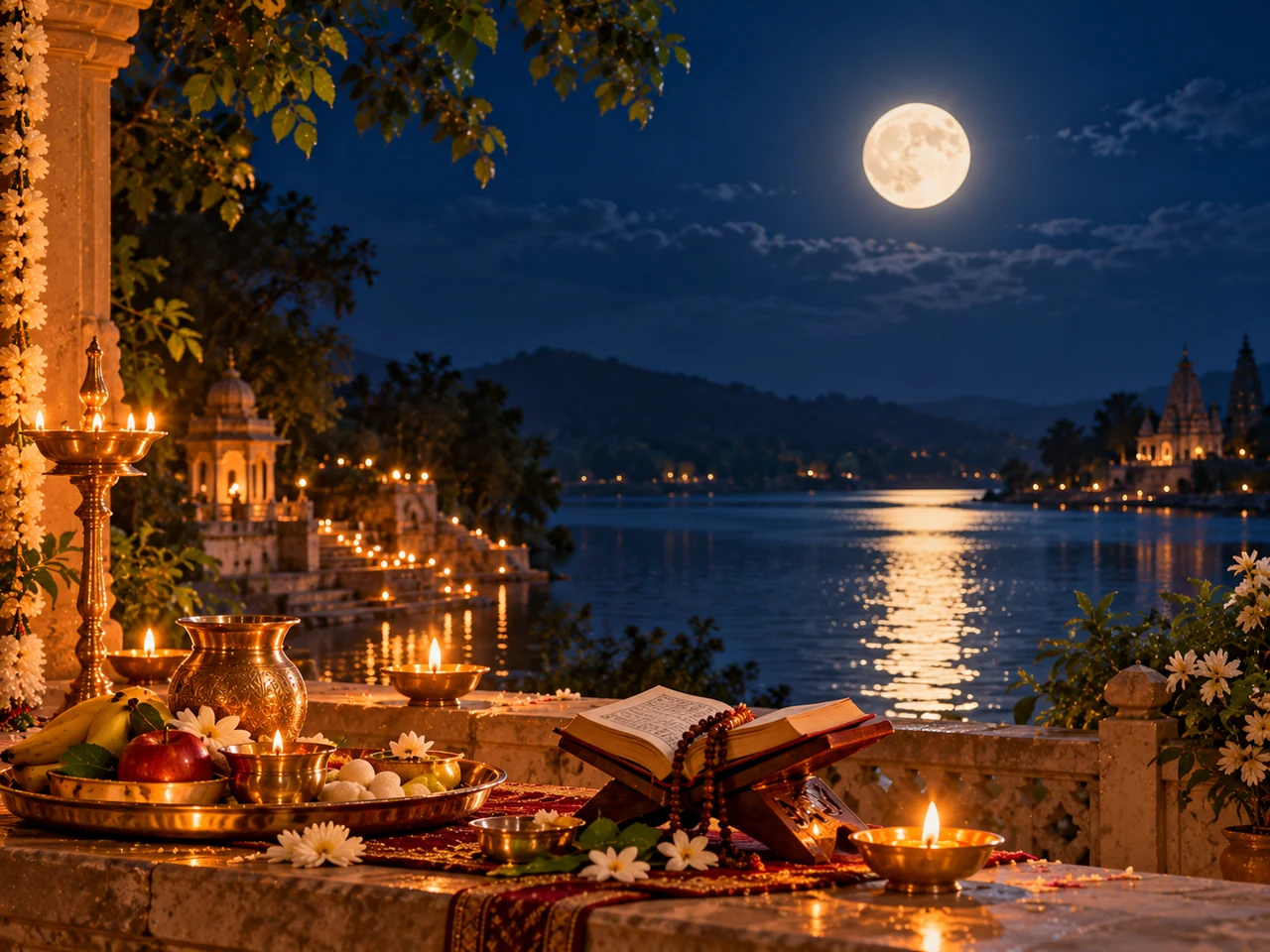
A full moon can turn an ordinary evening into a moment of attention. At one home, relatives gather to hear a Satyanarayana Katha; at another, a family lights a lamp and offers fruit. In a Tamil town, devotees may undertake a hill circumambulation. In a different month, the same lunar phase becomes Guru Purnima, a celebration of the teacher–disciple relationship. What connects these very different scenes is Purnima, the full-moon tithi in Hindu calendars—not a single compulsory ceremony shared by everyone. 2 3 5 6
Purnima is worth understanding in two ways: as a recurring element of the Panchang, the Hindu almanac, and as a setting for multiple devotional, familial, and regional observances. Its meaning changes with the month, community and specific vrata (religious observance). This guide explains those layers without pretending that one universal ritual or calendar date applies across India.
At a glance
| Question | Helpful answer |
|---|---|
| What is it? | The fifteenth and final tithi of Shukla Paksha, the bright or waxing lunar fortnight. |
| How often? | Once each lunar month; the count across a civil year can be affected by Adhika Masa, the intercalary lunar month. |
| Other names | Purnima (पूर्णिमा), Poonam / Punam (regional), Pournami / Paurnami (South Indian usage), full-moon Pūrṇimā (पूर्णिमा), Poonam / Punam (regional), Pournami / Paurnami (South Indian usage), full-moon tithi. |
| Deity | No single deity for every Purnima; Vishnu/Satyanarayana, Shiva, Devi, teachers and other focuses are found in specific traditions. |
| Common practices | Prayer, charity, family worship, katha listening, pilgrimage, and fasting in some homes. |
| Date rule | Determined by the relevant local lunar tithi and an observance-specific rule, not by a fixed Gregorian day. |
A key distinction runs through this page: Purnima as a lunar *tithi, Purnima Vrat (a chosen full-moon fast), Satyanarayana Puja, and a named full-moon festival** are related but not always interchangeable. 2 3
What does “Purnima” mean?
The Sanskrit word purnimapūrṇimā is associated with fullness or completeness. The Moon's illuminated face appears almost entirely round when viewed from Earth at full moon. Astronomically, the full-moon phase occurs when the Moon is approximately opposite the Sun as seen from Earth; its visible appearance can seem full for more than one night. NASA explains that this is part of the changing appearance of the sunlit Moon during its roughly 29½-day phase cycle. 1
The Hindu tithi is a different kind of measure: it is a division of the changing angular relationship between the Moon and the Sun, not a midnight-to-midnight civil date. Purnima is the last of the fifteen tithis in the waxing half of the lunar cycle. It can start in the middle of a daytime or night and end on the next civil day. A calendar may therefore show one civil day for a fast and another for a particular evening ceremony. This is why a pretty full moon in the sky cannot, by itself, settle a religious observance date. 2 3
When does Purnima occur?
A full-moon tithi returns approximately once each lunar month, often around the middle or end of a Gregorian month but never on a guaranteed numbered date. In the Amanta month-naming system a lunar month is reckoned from new moon to new moon; in the Purnimanta system it is reckoned from full moon to full moon. Importantly, the Shukla Paksha of a given lunation generally carries the same month name under both systems; the familiar naming disagreement typically affects the Krishna Paksha, not an ordinary Purnima. 4
The extra lunar month known as Adhika Masa helps reconcile lunar months with the solar year. Consequently, one should not hardcode “exactly twelve Purnimas every Gregorian year” into a calendar. The term Purnima is also used in many annual observance names: a monthly recurring entry must not accidentally generate all their distinct rites or assume they share its date-selection convention. 2 4
For an actual upcoming date, ShivGoraksh's Calendar will ultimately need an approved local astronomical calculation, a specified regional convention, and an observance rule reviewed by a Panchang specialist. This draft does not publish any such date or auspicious hour.
Why is the full moon considered significant?
The visible fullness of the Moon has often been understood by devotees as a reminder of completion, gratitude, illumination and renewal. Families may set aside Purnima for more attentive prayer, hospitality or acts of giving. These are devotional and cultural interpretations, not scientifically established effects of moonlight on health, destiny or wealth. 1 3
There is also no single authoritative story explaining the origin of every Purnima practice. The lunar cycle belongs to the basic calendar framework; stories belong to particular vows, deities and festivals. For example, a tradition that associates a particular full moon with Shiva does not prove that every monthly Purnima was originally a Shaiva festival. Likewise, observing Satyanarayana Puja on Purnima does not make the full-moon tithi exclusively Vaishnava.
How families observe an ordinary monthly Purnima
A household observance can be simple. Some people bathe, tidy a prayer space, light a lamp, offer water, flowers or fruit and spend time chanting or reading. Others gather for Vishnu worship and a Satyanarayana Katha, share a meal and give food or other support to people in need. Temple attendance or visiting relatives may be more important than a formal household rite. The form is chosen within a family's tradition, not supplied as an obligatory all-India checklist. 3
Satyanarayana Puja honours Vishnu in the form of Satyanarayana, commonly understood in devotional usage through the theme of truth. Purnima is a popular occasion for this puja, but it can also be undertaken on other suitable days. The katha and its ritual transmission have different locally printed and recited versions; without checking a particular manuscript or edition, this guide does not assign the entire modern five-part katha to one exact ancient Sanskrit chapter. 3
Purnima Vrat, in families that practise it, may involve simplified meals, selected foods, or a different routine of prayer and food-sharing. Some fast until a family-chosen observance point; others do not fast. Strict fasting—especially foregoing water—is not presented here as an instruction or as a condition for receiving spiritual benefits. Needs and personal circumstances matter, and observance is voluntary.
Food, offerings and hospitality
Fruit, sweets, milk-based offerings, homemade vegetarian food and prasada may be shared in some communities, with recipes varying by season. In Satyanarayana worship, many homes prepare sheera or suji halwa, sometimes with banana or other ingredients, but no one recipe describes all of India. On Sharad Purnima, some families make kheer or flavoured milk associated with a moonlit-night custom. These foods are culturally meaningful; claims that moonlight gives food medical properties should not be stated as scientific fact. 3 9
Each full moon can have a different identity
The word Purnima often acts as a calendar foundation, while the name before it tells the reader about the specific occasion. The following examples are not interchangeable rituals:
- Magha Purnima: In parts of North India, linked with sacred bathing, religious donations and winter pilgrimage traditions. This is a distinct observance, not the template for every full moon.
- Phalguna Purnima: Associated with Holika Dahan and the wider Holi sequence in many regions. An evening fire rite can have selection rules different from a generic Purnima fast.
- Chaitra Purnima: Connected in many North Indian traditions with Hanuman Janmotsav; other regions observe Hanuman's festival on different dates.
- Vaishakha Purnima: Recognised as Buddha Purnima / Vesak in Buddhist communities and associated with their own interpretations, ceremonies and calendars. It should not be reduced to a Hindu monthly-vrat variant.
- Jyeshtha Purnima: Connected with Vat Purnima in some Maharashtrian and other western-Indian communities, while Vat Savitri dates elsewhere may differ.
- Ashadha Purnima: Widely celebrated as Guru Purnima, honouring teachers and lineage. Buddhism also marks an Ashadha full-moon observance associated with the Buddha's first teaching. 5 10
- Shravana Purnima: Linked with Raksha Bandhan and, in some traditions, other rites such as Upakarma. Their date-selection requirements must be checked independently.
- Ashvina (Sharad) Purnima: Includes Kojagari Lakshmi Puja in parts of Bengal and neighbouring areas, and distinct seasonal moonlit-night customs elsewhere. 11
- Kartika Purnima: Associated with Tripurari Purnima, Shiva-related lamp offerings in some communities, and Odisha's Boita Bandana / Bali Jatra maritime remembrance. 7 8 12
The list is illustrative: it is not a claim that every community observes all nine, nor a ready-made date algorithm. A named annual occasion needs its own independently approved calendar profile and its own explanation.
North India: family prayer and special pilgrimage months
Across Uttar Pradesh, Bihar, Haryana, Delhi and neighbouring regions, some households mark ordinary Purnima with a katha, devotion to Vishnu, temple visits or giving. Particular full moons draw attention to specific places and seasons, such as Magha-related bathing practices or Guru Purnima gatherings. These are broad patterns rather than a claim that a state has one uniform puja. 2 3 5
Maharashtra and the western coast: Guru devotion and named vows
In Maharashtra, Guru Purnima provides an important setting for honoring religious and academic teachers, while Vat Purnima is distinctive for certain family communities. On Kartika Purnima, Goa also has a documented Tripurari Poornima celebration associated with Shiva's victory over Tripurasura; the festival in Sankhali features illuminated riverfront celebrations and model boats. It is an annual regional celebration, not a monthly Purnima prescription. 5 12
Tamil Nadu: Pournami and the Arunachala hill
In Tamil usage, the full moon is commonly called Pournami. Tiruvannamalai has a distinctive Girivalam tradition of circumambulating Arunachala, a hill revered in Shiva worship. The Tiruvannamalai district administration publicly documents arrangements relating to Chitra Pournami and its Girivalam path. This is a Shiva-oriented place-specific custom, not proof that all Purnimas everywhere require a pilgrimage. Large crowds and physical terrain also make practical planning important. 6
Odisha: Kartika Purnima and maritime memory
Odisha offers a vivid example of how a lunar date gathers a regional history. On Kartika Purnima, Boita Bandana commemorates maritime traditions through small decorated boats floated on water. Bali Jatra at Cuttack brings together the remembrance of seafaring trade and a public cultural fair. Odisha government sources explicitly describe the symbolism of toy boats and links to the historic trading community. The historical maritime contacts and the ceremonial remembrance should be distinguished: a story about a particular voyage on an exact sacred date requires additional documentary proof. 7 8
Bengal, Nepal and Buddhist contexts
Kojagari Lakshmi Puja gives Ashvina Purnima a particular focus on the goddess in many Bengali families. In Nepal, different communities may follow their own lunar calendar naming and full-moon customs. Buddhist communities give Vaishakha and Ashadha full moons distinctive importance; the Ashadha association with the first sermon is documented separately from Hindu Guru Purnima traditions. Avoiding a single flattened description makes these observances more meaningful, not less. 10 11
Symbolism: light, reflection and responsibility
A lamp offered at home or near water can signify attention and gratitude; a shared meal can mean care for relatives and guests; a pilgrimage can express discipline and belonging. In Shiva–Shakti and Nath settings, the monthly cycle may provide a personal reminder for inward reflection or honouring the guru. However, this is an interpretive connection, not a claim that Nath texts prescribe one universal monthly Purnima ritual. For the historically and devotionally distinct guru-centred full moon, see Guru Purnima (Guru Purnima: Meaning, Vyasa, Traditions and the Guru–Disciple Bond). 5
The moonlight itself should not be confused with a spiritual guarantee. Devotional literature may poetically link the Moon with peacefulness or fulfilment; the value of practice is expressed through sincerity, conduct and community, not a scientifically measurable supernatural effect.
Understanding dates without confusing different observances
Three questions should be asked whenever a page says “on Purnima”:
- Which event is being dated? The lunar tithi, an ordinary monthly vrat, an evening Satyanarayana Puja, or a named annual festival?
- Which day-selection convention applies? A rite keyed to sunrise, moonrise, evening, or midnight (Nishita) need not choose the same local civil date. In practice, published Purnima Vrat and Satyanarayana calendars sometimes use different dates. 2 3 11
- Which city and calendar profile apply? Sunrise, sunset, moonrise and local civil date depend on geographic location and time zone. The underlying tithi interval is astronomical, but its display and assignment to a locality's day are not simply copied from another city.
In an unusual case, Purnima tithi may touch two sunrises or not cover the principal ritual interval expected by a given community. Adhika Masa, lunar month labels, public holidays, an evening religious event and astronomical full-moon instants must be handled as separate data concepts. Until the Calendar team validates those cases, ShivGoraksh will not display a guessed fasting date or moonrise time.
Common misconceptions
“Purnima means one fixed date every month.” No. Lunar and Gregorian months are not aligned, and the religious observance needs the applicable date rule.
“Every Purnima must be celebrated as Satyanarayana Puja.” No. This is a widespread practice, not a universal rule. 3
“The precise astronomical full moon is the same as Purnima Vrat.” No. The former is an instant/phase; the latter is a religious date selection from a tithi interval and custom. 1 2
“Moonlight-charged food is proven medicine.” No. Kheer and moonlit gathering customs can be described respectfully without unsupported medical claims.
“All annual full-moon festivals share the monthly Purnima rule.” No. A festival with an evening, midnight, nakshatra or other dependency needs its own reviewed rule. 11 12