



At a glance
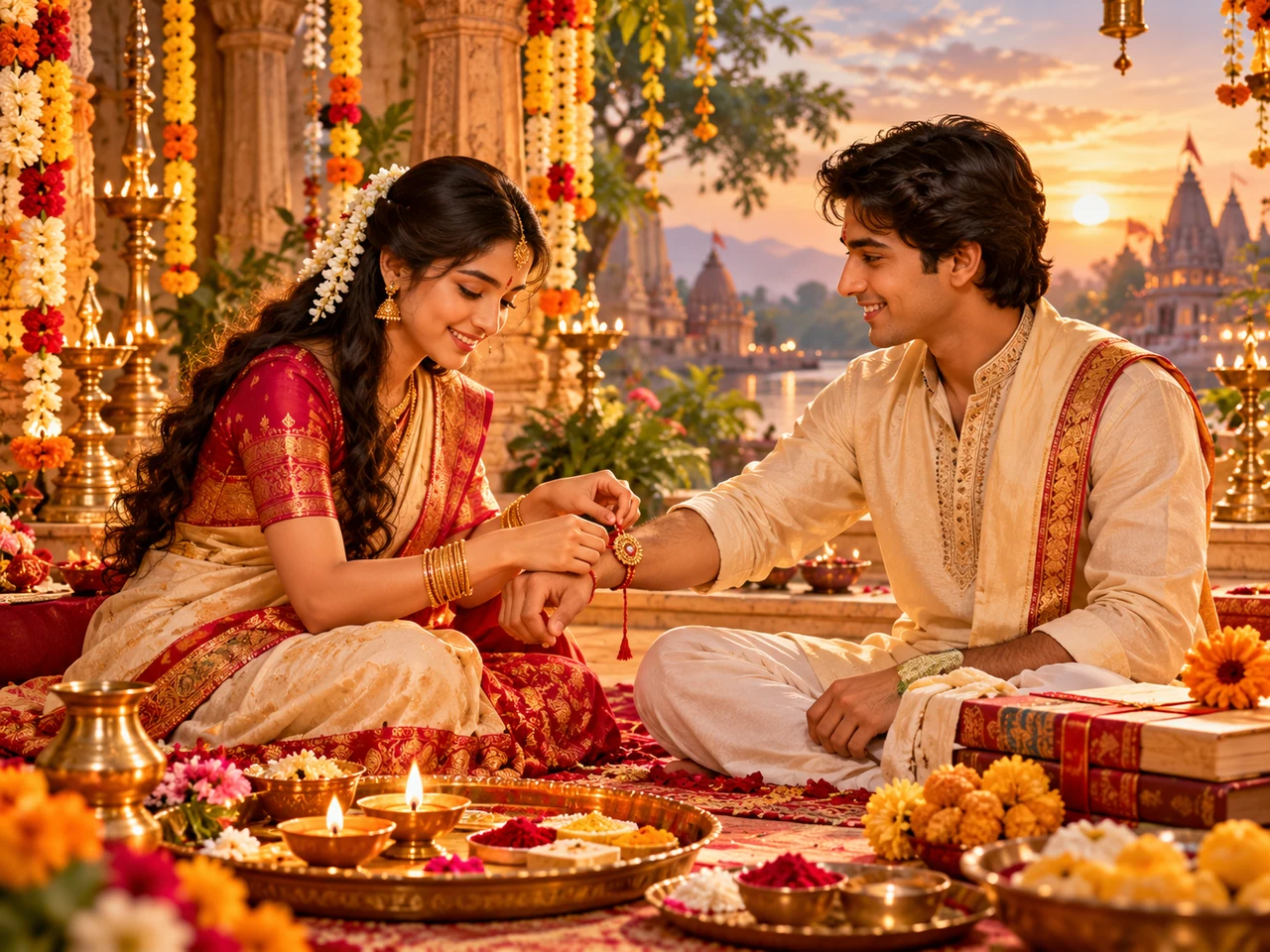
Raksha Bandhan (रक्षाबंधन), also called Rakhi, is an annual Hindu festival centred on a bond of protection and affection. It is particularly associated with sisters tying a rakhi around a brother's wrist, exchanging good wishes and renewing mutual responsibilities. It is associated with Shravana Purnima, the full-moon Tithi of the lunar month of Shravana. The precise observance date and customary time must be determined for a place and calendar convention; neither is fixed in this article. 1, 2
Its familiar family celebration is only one part of a larger history of protective threads, blessings and relationships. Some religious institutions tie a protective thread to devotees, while different communities observe other festivals on or near this full moon. Raksha Bandhan is especially visible in northern and western India, but contemporary participation extends beyond these regions and beyond biological siblings. 1, 3, 5
Why a small thread matters
A rakhi might be a few strands of coloured cotton or an elaborately crafted bracelet. Its material value is not the central point. A sister may bless her brother's long life and well-being; he may respond with appreciation, a gift, or a promise to stand beside her. For some families, these gestures are solemn and prayerful. For others they come with jokes, reunion photographs, a meal and an old childhood argument settled over sweets. Both forms can convey affection. 1, 4
The word rakṣā means protection and bandhana means binding or bond. The festival's most meaningful contemporary interpretation is mutual care, not an assumption that women are incapable of protecting themselves. A sister also supports, advises and protects her brother; siblings of any gender can honour one another. Family practices differ, and participating in the festival need not require the same gender roles or financial resources in every household. 3, 4
Names, meaning and historical layers
The names Raksha Bandhan, Rakshabandhan, Rakhi, Rakhi Purnima and Raksha Purnima appear in descriptions of the festival. In some communities a protective thread is called rakhri, rakhdi or raksha-sutra. Terminology varies with language, community and ritual purpose. A decorative rakhi tied by a sister is not necessarily identical in religious function to a consecrated protective thread tied by a priest. 1, 3
It is tempting to name a single ancient episode as the festival's birthday. The evidence does not justify that. Protective-thread customs, religious blessings, kinship obligations, seasonal rites and the modern family-oriented festival developed across different contexts. A traditional story can explain what a community values without proving exactly when or how today's ritual began. The broadly attested sibling custom should therefore be described alongside, rather than collapsed into, the varied scriptural and folk narratives. 1, 3, 5
The festival has also acquired public meanings. India's national institutions speak of trust, warmth and mutual responsibility beyond blood relationships. A documented political example is the use of rakhi as an emblem of solidarity during protests surrounding the 1905 partition of Bengal. That historical use does not establish the ancient origin of Raksha Bandhan; it shows how a known symbol could speak to a new social situation. 4, 1
Indra and Shachi: protection before a difficult battle
A narrative transmitted in Bhavishya Purana-associated Raksha Bandhan traditions tells of the gods' distress in conflict with their opponents. Shachi, also known as Indrani, prepares or ties a protective thread for Indra, with a prayer for his well-being. Some retellings bring Brihaspati into the act of blessing the thread. The striking feature is that the thread is tied by a wife to her husband, not by a sister to a brother. It expresses the older protective-rite dimension of the observance. 3, 8
This is a devotional account of blessing and divine protection, not an independently dated military event. The precise Purana passage and its readings across editions require textual collation before ShivGoraksh should quote a Sanskrit verse or assign a definitive verse number. Neither the account nor the English retelling proves that modern sibling Raksha Bandhan began with Indra. 3, 8
Lakshmi and King Bali: a new relationship created by trust
A widely told Vaishnava festival story begins when Vishnu remains in King Bali's realm after granting him divine protection. Lakshmi visits Bali, ties him a protective thread and accepts him as a brother. When Bali offers a gift, she asks that Vishnu return with her. In this telling, the thread creates kinship between people who were not previously brother and sister. 1, 3
This narrative connects Raksha Bandhan with generosity, promises and the ethical responsibility attached to a freely accepted relationship. It is one transmitted devotional version, not a passage assigned here to a particular verse of the Bhagavata Purana. The Vishnu–Bali narrative also occurs in wider Vaishnava literature in forms that do not necessarily include a rakhi ceremony. The article distinguishes those stories instead of quietly treating them as the same text. 1, 3
Krishna and Draupadi: gratitude and friendship in later storytelling
In a beloved popular telling, Krishna cuts his finger and Draupadi tears a strip from her garment to bandage it. Krishna remembers her care and later offers protection in her hour of need. The story is meaningful to many readers because it places immediate compassion ahead of elaborate ritual. 1, 5
It is often labelled simply as a Mahabharata episode. That attribution needs caution: this particular rakhi-like exchange has not been verified here against a defined critical Sanskrit Mahabharata passage. ShivGoraksh therefore presents it as a widespread later devotional retelling, not as a proven scene in the earliest recoverable text. The epic's Draupadi narratives are important, but popularity alone cannot authenticate a precise textual claim. 1
Royal rakhis and the limits of historical certainty
Another familiar anecdote says that Rani Karnavati of Mewar sent a rakhi to the Mughal emperor Humayun. The story circulates widely as an image of protection across political boundaries. But the contemporary documentation and details of the episode are disputed. It cannot responsibly be presented as a securely established historical origin of the festival. 5
A more securely documented modern use of the symbol concerns the anti-partition movement in Bengal in 1905. Rabindranath Tagore encouraged tying threads across communal lines as a sign of social solidarity. The episode is best understood as a public reinterpretation of a protective bond, not a claim that the ordinary Shravana family rite and the political ceremony occurred on the same religious date. 1, 5
When is Raksha Bandhan observed?
The central calendar association is Shravana Shukla Purnima. Tithi is a lunar-day measure based on the changing angular separation of the Sun and Moon; a Tithi may begin or end at any civil-clock time. Purnima refers to the full-moon Tithi, which is related to but not identical with the single astronomical instant of full Moon. Accordingly, an ordinary midnight-to-midnight date cannot substitute for a reviewed local Panchang decision. 7
In traditional naming, the northern Purnimanta month and the widely used Amanta month may be partitioned differently. The same Purnima-related observance can fall under a name familiar across regions even when descriptions of the preceding or following month differ. The site must preserve which convention has been used rather than infer it from a Gregorian date. 7
Many almanacs consider the Aparahna period and avoidance of Bhadra, associated with Vishti Karana, when suggesting a rakhi-tying window. Some traditions discuss Pradosha if an appropriate afternoon opportunity is unavailable. These are normative religious timing conventions, not astronomical facts about luck or harm. Sources differ on the handling of Bhadra subdivisions and exceptional cases. This article does not issue a universal ruling or compute any muhurta. 7
For a real occurrence, a specialist must review the location, timezone, Purnima start and end, sunrise, applicable daily segments, Bhadra interval, relevant regional profile, and tie-breaking decisions. The future ShivGoraksh calendar module should show an approved local result or say “Date/timing not yet verified for this city/year.” 7
How families celebrate: a description, not a compulsory script
In many North Indian homes, relatives plan a reunion in advance. Sisters may choose simple or decorated rakhis, and households prepare sweets or a festive meal. At the family gathering, a sister may place tilak on her brother's forehead, offer a blessing, tie the rakhi and share sweets. An aarti may be part of some households' practice; others mark the occasion quietly with words and a hug. Brothers often respond with a gift or a promise of support. These variations are described in institutional accounts of the living celebration. 1, 3
Some families also tie rakhis to cousins, sisters-in-law, younger siblings or cherished friends. In religious communities, a guru or priest may tie an auspicious thread to worshippers. Not all these acts have the same ceremony or meaning, and none should be made the one mandatory form of Raksha Bandhan. Where detailed puja, mantras or temple rites are desired, follow a qualified tradition or an independently reviewed practice guide instead of inventing ritual instructions from a general-interest article. 1, 3
What about fasting? Raksha Bandhan is not uniformly defined by a compulsory all-day fast. Some families follow other vows or local religious disciplines, but such practices vary. A person's food, health and ability to participate should not be judged by whether they fast. The ethical core—care, gratitude and meaningful presence—can be expressed without imposing a dietary rule. 1, 3
North India: households and extended family
Across much of Uttar Pradesh, Bihar, Rajasthan, Haryana, Punjab and Delhi, the sister–brother rakhi ceremony is especially visible. Families may travel to the maternal or parental home, reconnect across generations, and give children their first experience of the custom. Local usage, domestic preparations and gift conventions vary; a single ceremonial checklist cannot describe every community. The practice may cross religious and friendship boundaries in individual households. 1, 4
Gujarat and Swaminarayan practice
In Gujarat, families celebrate the sibling bond while some religious communities give emphasis to a protective thread tied to devotees. BAPS documents the rakhdi, kumkum marking, rice grains, blessings, gifts and the spiritual meaning of protection from inner adversity. This account establishes a particular Swaminarayan tradition, not a binding doctrine for all Hindus in Gujarat. 3
Maharashtra's Konkan coast: Narali Purnima
On the Konkan coast, Hindu fishing communities observe Narali Purnima near the same Shravana full moon. Families make offerings involving coconuts to honour the sea and seek safety for fishing livelihoods. The customary food narali bhat is coconut-flavoured rice. Rakhi may also be celebrated on the day, but offering a coconut to the sea and tying a rakhi to a sibling are distinct actions with different cultural purposes. 6
Nepal: Janai Purnima, Gunhi Punhi and protective threads
Nepal Tourism Board documents Janai Purnima as a day of sacred-thread renewal, priestly protection threads, pilgrimage and food traditions. It notes pilgrimages to Gosainkunda and practices at Kumbheshwar in Patan. Among Kathmandu Valley Newar communities, the name Gunhi Punhi and the preparation of sprouted-bean kwati are especially relevant. This is a richer set of religious practices than simply renaming a North Indian sister–brother celebration. 9
Other Purnima-linked observances
Odisha's Gamha Purnima is associated in Odia tradition with Balabhadra as well as rakhi observances; some communities mark agricultural or livestock ties. Some southern Vedic families observe forms of Upakarma or sacred-thread renewal near Shravana Purnima, with school-of-Veda and regional calendar differences. These are neighbouring observances, not universally interchangeable titles for Raksha Bandhan. The full calendar relationship of each is a separate future research and rule task. 10, 9
Food, gifts and the objects of the festival
Rakhis range from handmade cotton threads to beads and decorative motifs. Their appearance can express affection, but expensive materials are not a measure of sincerity. A small sweet, a letter, a shared photograph or a call across distances can carry equal emotional weight. Traditional tilak ingredients and flowers occur in many household settings, but there is no single compulsory national set. 1, 3
Mithai is central to many celebrations. Laddoo, barfi, kheer and regional homemade foods often appear on the table. In parts of Rajasthan, the monsoon-season sweet ghevar is popularly associated with family festivities; local household choices differ. On the Konkan coast coconut preparations belong to Narali Purnima; in Nepal kwati belongs particularly to Janai/Gunhi Punhi. These distinctions explain the culinary landscape better than publishing one supposed festival menu for the subcontinent. 1, 6, 9
Spiritual, philosophical and social significance
The protective thread invites a simple question: what does it mean to keep another person safe? In devotional settings, protection may be expressed through prayer and divine grace. Within the household it may mean listening without embarrassment, respecting choices, helping in difficult times, sharing work and remaining present. A bond gains meaning through conduct after the ceremony, not by an object alone. 3, 4
Within wider Hindu traditions, a protective thread can mark blessing, hospitality, or a relationship accepted across households. Vaishnava tellings of Lakshmi and Bali emphasise generosity and fidelity to an obligation. Indra and Shachi traditions emphasise blessing under threat. The modern ethical interpretation need not accept miraculous causation as a scientifically demonstrated outcome; it can still appreciate the stories' moral and devotional significance. 3, 8
For ShivGoraksh's Shiva–Shakti and Nath readership, the festival offers an opportunity to consider care and guru–disciple responsibility without inventing a special Nath Raksha Bandhan rite. Where a Nath community has a particular local practice, its documentation should be verified separately. The presence of sacred threads in several Hindu traditions does not make every protective-thread practice identical. 3, 9
Common misunderstandings
“Rakhi is only a promise by a man to guard a woman.” That is one prominent traditional arrangement, not the only meaningful one. Mutual assistance and respect describe the living relationship more completely. “Every Shravana Purnima observance is Raksha Bandhan.” No: Narali Purnima, Upakarma and Janai Purnima have distinctive aims and rites. “Every famous rakhi legend is a verified verse of an epic.” No: attribution, historical documentation and regional transmission must be checked separately. 1, 4, 6, 9
“Bhadra means the same ban at the same hour everywhere.” Timing depends on location and a named tradition's rules; the site must not claim universal local muhurta data without validation. “A costly gift makes a stronger bond.” That is a modern preference, not a spiritual requirement. “Rakhi brings guaranteed protection from illness or danger.” Such a guarantee is neither scientifically justified nor a responsible reading of a devotional blessing. 7, 4
Related reading and source notes
Within ShivGoraksh, related knowledge topics include the Hindu Calendar & Panchang overview (Hindu Calendar and Panchang: A Complete Beginner’s Guide) and Purnima (Purnima: The Monthly Full-Moon Observance). The Lakshmi (Lakshmi) and Vishnu (Vishnu) pages offer context for the Bali narrative; Krishna is discussed within Vishnu traditions, but has no invented standalone entity ID here.
Selected sources: Government of India's Incredible India Raksha Bandhan guide 1; University of Kansas cultural overview 2; BAPS tradition account 3; President of India address 4; Maharashtra Tourism/Narali Purnima 6; Drik Panchang's published selection conventions 7; Nepal Tourism Board's Janai Purnima account 9. The complete source scope, access limitations and reuse status are documented in the source and edition notes. This educational article does not provide an independently approved calendar date or ritual ruling.