



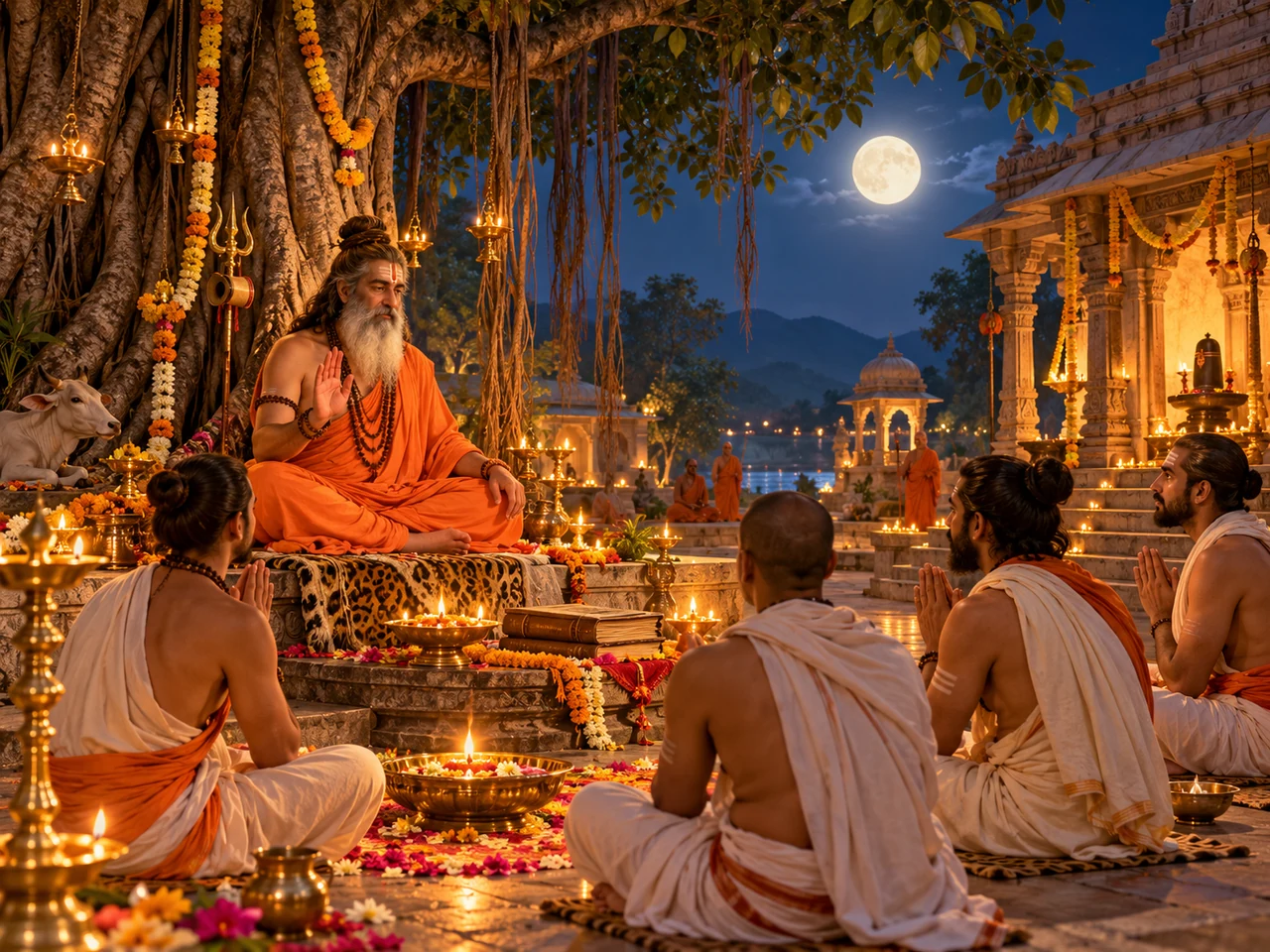
A teacher can give you an answer. A remarkable teacher may help you ask a better question. Guru Purnima, also called Vyasa Purnima, is an occasion to recognize that kind of guidance: the learning that passes between generations, the responsibility of a teacher, and the effort a student must make to understand. In Hindu communities, it is especially associated with the sage Vyasa and spiritual lineages; other Indian traditions observe the Ashadha full moon with distinct meanings of their own. 4 5 11
A visit to an ashram, a quiet expression of gratitude to a schoolteacher, a reading from a sacred text, or time set aside for self-study can all express different aspects of this day. None is a universal prescription. This guide explains what the occasion means, how it is celebrated, why the Nath guru–disciple tradition is particularly relevant to ShivGoraksh, and why its calendar date needs independent verification. 4 8
At a glance
- Names: Guru Purnima (गुरु पूर्णिमा), Guru Poornima, Vyasa Purnima, Vyas Purnima, Guru Pournima; the related rite is sometimes called Vyasa Puja.
- Type: Annual lunar observance, with a general focus on teachers, especially spiritual guides.
- Traditional timing: Ashadha Shukla Purnima, the full-moon Tithi of the Hindu lunar month Ashadha; the corresponding civil date changes from year to year and may be sensitive to location and convention. 4 6
- Associated figures and themes: Vyasa, the teacher–student relationship, guru-parampara (teaching lineage), scriptural learning, humility, questions, gratitude, and ethical responsibility.
- ShivGoraksh links: Matsyendranath, Gorakhnath, Shiva as Adiyogi in particular yogic traditions, the Bhagavad Gita, and the Hindu Calendar & Panchang overview.
What does “Guru Purnima” mean?
Purnima names the full-moon lunar day (tithi). Guru can mean a respected teacher, preceptor or spiritual guide. The much-loved explanation that gu means darkness and ru means its removal expresses a devotional interpretation of the guru's purpose; it should not be mistaken for an uncontested historical derivation of the Sanskrit word. A meaningful teacher is someone who brings clarity where a learner once had confusion. 5
People may use guru narrowly for an initiating spiritual master, or more broadly for a parent, music teacher, mentor, scholar or schoolteacher. Those meanings overlap, but they do not make every teaching relationship an initiatory bond. AcharyaĀcārya often emphasizes a teacher of conduct or a learned instructor; śiṣya is a disciple or student; paramparā is a succession through which teaching is preserved and reinterpreted. 2 8
The moon's fullness is an evocative image for the completion of learning, but that is a symbolic interpretation, not an astronomical proof of spiritual effects. The festival offers a chance to ask two questions together: Who helped me learn? And how am I using what I learned?
Vyasa Purnima: a traditional story of preserving knowledge
In Hindu devotional memory, Krishna Dvaipayana Vyasa is revered as the sage who arranged Vedic teaching, is associated with the Mahabharata, and transmitted wisdom through disciples. The Bhagavata Purana describes the division of Vedic learning and its distribution among pupils; this is a textual and theological account of transmission, not a modern archival record of a single person's work. 3
The image is powerful: knowledge is too valuable to remain the possession of one individual. It must be organized, communicated, remembered, questioned and handed on. The name Vyasa Purnima honours this role, and several modern religious communities associate the observance with Vyasa's birth. His precise historical date of birth, however, cannot be independently established. Calling Guru Purnima his birthday is therefore an expression of tradition, not a verified civil-calendar anniversary. 4 5
The Bhagavata Purana also tells of Narada advising Vyasa, presenting even the revered compiler as a learner who can benefit from another's insight. The episode makes room for a subtle point: the title guru does not imply that a teacher has no further learning to do. Different devotional schools interpret the purpose of Narada's counsel differently, particularly in relation to devotion to Vishnu or Krishna. 3
Older teachings about teachers: what the texts actually say
The Taittiriya Upanishad, in its Shiksha Valli closing instruction, places the acharya among those worthy of exceptional honour. It also asks the student to speak truth, practise dharma and continue study. Its concern is not merely ceremonial respect: learning should shape character and responsibility. The verified passage belongs to a general educational instruction, not to a text prescribing the modern festival of Guru Purnima. 2
The Bhagavad Gita 4.34 connects the pursuit of knowledge with respectful approach, sincere questioning and service to those who have insight. The combination matters. The learner is not told simply to remain silent. Humility without inquiry can become passivity; inquiry without care can become a contest of egos; service without discernment can lose its purpose. These observations are an accessible interpretation of the verse, not a quotation of a particular modern commentator. 1
Neither passage establishes the date of Guru Purnima. Both offer strong textual background for its central themes: knowledge is relational, and responsible learning calls for both respect and discernment.
The living meaning of guru and disciple
Guru Purnima is not only gratitude for information delivered. Traditional spiritual teaching often asks a disciple to practise, reflect and learn over time. A teacher may explain a text; a student must examine whether the teaching makes sense, how it relates to life, and whether the teacher's conduct deserves trust. That distinction between receiving instruction and doing the work of understanding is central to a mature teacher–student relationship.
There are many kinds of teaching in Hindu life. Some families honour parents as their earliest guides. Musicians and dancers remember artists who trained them. Students may thank classroom teachers. Monastic institutions acknowledge a formal succession of religious instructors. A personal spiritual guru may occupy a different place from any of these; respect for teachers does not automatically imply accepting initiation, surrendering judgement, or following one universal ritual. 4 5
In many communities, people offer flowers, listen to discourses (satsang), recite or study scriptures, and share food. Some observe a personal fast; many do not. Participation, offerings and diet depend on local custom, individual capacity and family or lineage practice. 4 5
Guru Purnima in the Nath Sampradaya
For ShivGoraksh, this is a particularly meaningful connection. Nath traditions commonly trace revered teachings through Adinath, frequently identified with Shiva, to Matsyendranath and Gorakhnath, with different branches remembering additional teachers and different succession lists. Such lineages express religious authority, continuity and shared identity; they should not be read as a universally fixed historical genealogy. 8
The guru–disciple bond matters deeply in accounts of yogic learning. Instruction can involve spoken explanations, patient demonstration, ethical discipline, correction and experience within a recognized lineage. Scholarship and tradition-specific accounts both note the importance of transmission, but they do not provide a single historically provable timeline for all Nath teachers. Nor do they imply that every public visitor participates in restricted training. 8 9
The celebrated relationship between Matsyendranath and Gorakhnath appears in many Nath narratives. In some tellings, Gorakhnath helps his teacher remember the path of practice; the story reverses ordinary expectations, suggesting that responsibility runs in both directions. These are lineage narratives with variations, not verified diaries of their lives. They work best as teachings about alertness, humility and fidelity to practice, not as precisely dated events.
On Guru Purnima, a Nath practitioner or admirer may honour teachers and the lineage, study accessible teachings, serve a community or contemplate the ethical meaning of discipleship. Formal diksha (initiation), lineage mantras, and specialized yogic procedures are tradition-dependent or initiation-bound matters. This article neither prescribes them nor substitutes for a qualified lineage teacher.
Shiva as Adiguru: one yogic interpretation
Some Shaiva and contemporary yogic communities connect this observance with Shiva as Adiyogi or Adiguru, the first yogi or archetypal teacher, and recall his instruction to the seven sages (Saptarishis). This is a respected tradition-specific sacred narrative, documented in the explanation given by the Isha Foundation. Claims that it happened a precise number of thousands of years ago should be understood as claims within that telling, not as archaeological dating. 7
This connection does not change the festival into an exclusively Shaiva event. Vyasa-oriented observances, Vaishnava guru traditions, Nath teaching lineages and other Hindu communities each bring different emphases. The shared theme is indebtedness to guidance; their specific theology need not be made identical.
When is Guru Purnima observed?
The conventional Hindu calendar anchor is Ashadha Shukla Purnima. A tithi is determined by the changing angular relationship of the Moon and Sun, not by a fixed number of hours in a civil day. The Purnima interval can begin or end between sunrises; a Tithi may touch two local dates or be absent at sunrise on a particular date. 6
Ashadha is a lunar month. In Amanta reckoning, the month ends at new moon; in Purnimanta reckoning, it ends at full moon. The difference can matter in explaining surrounding lunar months, and an actual occurrence still requires the appropriate named tradition profile and local ephemeris. People should therefore not assume that a single generic online date is authoritative for all towns, institutions and Hindu calendar conventions.
The ShivGoraksh calendar module, once independently implemented and reviewed, should supply the locally selected Gregorian date. The evergreen article should supply the rule's meaning, not pretend to perform the calculation. The attached calendar-rule-spec.json explicitly leaves sunrise or other selection precedence, ties, and boundary cases to specialist review; it is not a certified algorithm.
How families, teachers and ashrams observe the day
In some homes, Guru Purnima begins with a quiet remembrance of parents, teachers or a spiritual mentor. People may make a phone call, write a note of gratitude, bring a modest offering, read a page of scripture or resolve to practise something their teacher taught. There is no requirement that a family have an initiating guru to approach the day meaningfully.
Ashrams and temples may hold guru-puja, bhajan, kirtan, satsang, discourse, scripture reading and communal meals. In some lineages, the teacher's seat (vyasa-pitha) or the memory of earlier teachers is honoured. A ceremony may last a short gathering or be part of a longer local programme; the festival's lunar Tithi should not be confused with a specific institution's complete event schedule. 4 5
In traditions with formal initiation, rites may be reserved for recognized disciples and vary by lineage. Describing their existence does not authorize outsiders to improvise them from fragments found online. The public acts of thanks, study and hospitality remain separate from specialized procedures.
Regional and community examples
Maharashtra: Public-facing cultural descriptions treat the occasion as a day for spiritual and academic teachers, involving prayer and gratitude. The emphasis varies among households, temples and institutions. 4
Shirdi: The Shri Saibaba Sansthan identifies Guru Purnima as one of its principal festivals, with devotional programmes that include prayer, music and readings. The institution also preserves a tradition-specific account of early devotees worshipping Sai Baba as their guru. That account belongs to Shirdi's own community history and should not be generalized into an origin story for Guru Purnima everywhere. 10
Swaminarayan devotional communities: BAPS describes Guru Purnima or Vyas Purnima as a day for honouring Vyasa and the living guru-parampara, including celebrations within its mandirs. This documents one Vaishnava community's practice, not a standard for every Hindu family. 5
Nath lineages: Different Nath groups may honour their own guru succession through reverence, teaching and remembrance, but no single list or ceremony should be imposed on all twelve-panthi and other Nath communities. 8 9
Buddhist Ashadha Purnima: Buddhist communities remember the Buddha's first teaching at Sarnath and the turning of the wheel of Dharma, often under names such as Asalha Puja or Dhamma Chakra Day. It is important to acknowledge this shared seasonal full-moon context without describing Buddhist practice as merely a Hindu guru-puja variation. 11
These examples show diversity, not an exhaustive geographical inventory. Local observances should be represented with the community's own names and confirmed evidence.
The sequence of the observance, food and symbolism
The day can be observed simply: remembering a teacher, engaging in learning or reflection, joining a gathering if desired, and expressing thanks through respectful action. Institutions sometimes organize several days of programmes around it. Such schedules are community events, not proof of a second or third annual Guru Purnima Tithi. 10
Offerings of flowers, fruit, sweets or a simple meal occur in some homes and ashrams. There is no single pan-Indian mandatory Guru Purnima dish. Where devotees fast, its form differs and no one should infer that fasting is necessary for educational gratitude or spiritual worth. People with health or dietary constraints may participate without a fast.
The full moon is a recurring symbol of luminosity and completeness; a lamp may be used as a visual reminder that learning dispels confusion. A book can represent study; the teacher's seat can represent an inherited lineage. These are interpretive symbols. A painting of an ancient guru, even a familiar devotional portrait, is not historical proof of how a named teacher appeared.
Gratitude, questions and the ethics of teaching
The strongest celebration of a teacher may be to practise what is worth learning. Appreciation is richer when joined to honesty, compassion and discipline. The Taittiriya Upanishad combines honour for an instructor with truthfulness and ethical conduct; the Gita includes pariprashna, thoughtful questioning, as part of receiving knowledge. 1 2
A healthy learning relationship leaves room for clarification and for recognizing boundaries. A claim to spiritual authority does not excuse financial exploitation, coercion, abuse or suppression of ordinary safety. Not every instructor is qualified for every practice, and a reader should not equate respectful devotion with unconditional submission. This is an editorial ethical clarification, not a claim that one community's practice is uniquely correct.
For readers without an individual guru, Guru Purnima can still be a moment to honour books, good teachers, careful scholarship and the patient people whose work made understanding possible. Gratitude need not erase critical thought; it can make thoughtful learning more responsible.
Scriptures, prayers and traditions of remembrance
The Bhagavad Gita 4.34 provides a passage about learning through respectful approach, inquiry and service; it is relevant to the festival's meaning, not evidence for its calendar origin. The Taittiriya Upanishad, Shiksha Valli 1.11, teaches regard for the acharya and ethical living. The Bhagavata Purana 1.4–1.5 gives a devotional account of Vyasa's organization of learning and his encounter with Narada. 1 2 3
People also recite verses from a Guru Stotram, use prayers connected with a named lineage or study a guru's teachings. Versions and attributions of prayers differ; no unverified mantra or attribution is supplied here. A source-checked edition and a practice-specific review should precede any detailed liturgical reproduction.
Related observances and reading
Guru Purnima is a specific named Ashadha Purnima, not a synonym for every monthly Purnima. The Guru Purnima page remains distinct from temple-specific festivals and from the Buddhist Ashadha full-moon observance.
Related ShivGoraksh Learn topics are Matsyendranath (Matsyendranath), Gorakhnath (Gorakshnath) and Shiva (Shiva). The separate Shankar (Shankar) page may be connected when explaining names of Shiva, not because Shankar and Shiva are inherently unrelated deities. The prepared Bhagavad Gita project is a relevant scriptural source, but its public link must remain unresolved until the actual publication state is verified. No unfinished or presumed-live route is inserted here.
Glossary
- Ashadha: Hindu lunar month associated with this observance.
- Purnima: Full-moon Tithi, not necessarily identical to one civil midnight-to-midnight date.
- Guru: Teacher or spiritual guide, with meanings depending on context.
- Shishya: Learner or disciple.
- Parampara: Lineage of teaching and transmission.
- Vyasa Puja: Tradition-specific honouring of Vyasa or a guru lineage.
- Diksha: Formal spiritual initiation; its conditions differ between lineages.
- Satsang: Gathering for religious instruction, discussion or devotion.