



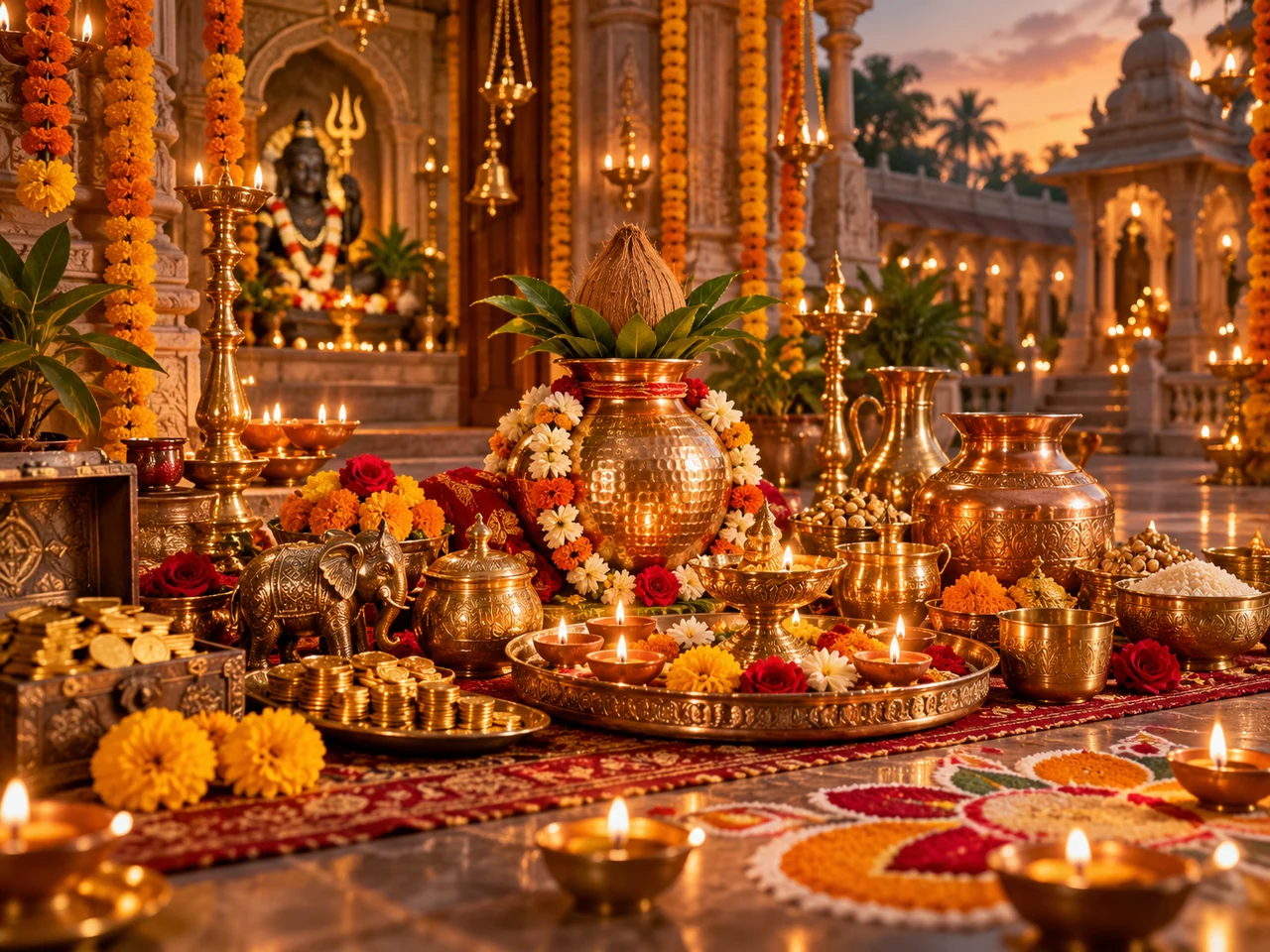
Dhanteras, or Dhantrayodashi (धनत्रयोदशी), is an annual Hindu observance of the dark fortnight’s thirteenth lunar day, closely associated with the Diwali festival cycle. It brings together prayers for prosperity, remembrance of Dhanvantari and health, and an evening lamp offered to Yama in many households. 1 2 3
A family sweeps its threshold, draws a small rangoli and places a lamp where visitors will see its glow. Elsewhere, a family selects a practical steel vessel; another worships Dhanvantari; a trader lights lamps near the account books. These are recognisable expressions of Dhanteras, but none alone defines it. Behind the popular advice to “buy something new” lies a fuller conversation about security, well-being, generosity and responsible use of resources.
At a glance
| Question | Short answer |
|---|---|
| What is celebrated? | Dhanteras or Dhantrayodashi, an annual component of the Diwali cycle. |
| When? | Krishna Paksha Trayodashi near Diwali; in many North Indian Purnimanta calendars it is Kartika Krishna Trayodashi, while the corresponding Amanta month is commonly called Ashvina. |
| Who is remembered? | Lakshmi, Kubera and Dhanvantari in different devotional settings; Yama through a lamp-offering custom. |
| What happens? | House cleaning, lamps, worship, symbolic purchases, sharing food, and in some communities Yama Deepam. |
| Is it the main Lakshmi Puja night? | No. The much more prominent Diwali Amavasya Lakshmi Puja is a distinct observance. |
| Where can I find the date? | In a reviewed, location-specific festival occurrence based on a named Panchang convention; this article intentionally gives no annual civil date or muhurta. |
Why the names Dhanteras and Dhantrayodashi matter
The familiar Hindi name combines dhan, wealth or resources, and teras, the vernacular form of “thirteenth.” The more formal Dhantrayodashi combines the idea of wealth with trayodashi, the thirteenth lunar Tithi. A Tithi is a lunar-phase interval, not a fixed twenty-four-hour civil date. The festival therefore moves in the Gregorian calendar and its preferred day may need more than a sunrise-only check. 2
The word dhan includes more than gold. In ordinary life resources also mean provisions, a secure household, the ability to help others and the tools of one’s livelihood. A new utensil may symbolize a useful home; a lamp may suggest attentiveness and protection. These are meaningful interpretations, not guaranteed material outcomes. The festival’s distinct themes are often described as prosperity (Lakshmi–Kubera), health (Dhanvantari), and protection or remembrance of mortality (Yama Deepam). Their exact prominence varies by family and tradition. 1 2
Dhanvantari and the ocean-churning story
In the Bhagavata Purana’s account of Samudra Manthana (the churning of the Ocean of Milk), gods and antigods seek the nectar of immortality. Lakshmi appears during the churning and chooses Vishnu. Later Dhanvantari appears carrying the vessel of nectar. Bhagavata Purana 8.8.34 explicitly identifies Dhanvantari with Vishnu and connects him with knowledge of medicine; verse 8.8.35 describes the vessel being seized. The text is a theological narrative, not an independently datable historical event. 4 5
This source establishes the Dhanvantari episode; it does not by itself demonstrate that the churning took place on the modern festival’s precise Trayodashi, nor that every contemporary element of Dhanteras appears in that chapter. Popular festival accounts connect the deity’s manifestation and Dhanvantari Jayanti with Dhantrayodashi. Keeping the scriptural episode and the later festival-date association distinct protects both the meaning of the story and the reliability of the article. 2 3 4
Dhanvantari is revered in several Vaishnava and Ayurvedic devotional settings as a divine physician and a bearer of knowledge of life and healing. Worship of Dhanvantari expresses hopes for well-being, relief from suffering and wise stewardship of the body. It should not be presented as a medical treatment or substitute for professional care. 5 7
The separate story of Lakshmi’s emergence
The same Bhagavata Purana chapter places the manifestation of Lakshmi within the ocean-churning narrative. In its theological setting she chooses Vishnu and becomes the emblem of divine fortune. Householders who honour Lakshmi on Dhanteras may understand prosperity as something that should support an ordered and hospitable life. Yet the better-known Lakshmi Puja associated with Diwali Amavasya follows a different Tithi. The shared deity does not make those two worship days interchangeable. 4 1 2
Yama Deepam: a lamp and the limits of life
In many communities a small oil or ghee lamp is placed outside the home during the evening and devoted to Yama, the deity associated with death and moral order. The custom is called Yama Deepam, Yama Deep Daan or Yamadeepdan. Worshippers traditionally pray for protection from untimely death and the welfare of family members. This is a faith-based purpose of the rite, not a proven way to prevent harm. 2 6
A popular household legend tells of a young prince threatened by a foretold death and of his resourceful bride, who lights lamps, places shining ornaments and keeps him awake so the danger passes. It is best described as a popular vrat-katha or oral festival narrative, not as a securely verified episode from the Bhagavata Purana. The story’s lesson centres on vigilance, companionship and courage. Precise details—such as a mandatory number of lamps, their arrangement, or a prescribed direction—vary, and should not be universalised. 6
A lamp is also a practical flame: families need stable holders, safe placement, distance from fabrics and children’s reach, and supervision. The devotional intention does not require a hazardous fire arrangement.
When is Dhanteras in the Hindu calendar?
Dhanteras is tied to Krishna Paksha Trayodashi, the thirteenth waning-moon Tithi near Diwali. North Indian Purnimanta usage commonly names the fortnight Kartika Krishna Paksha; in Amanta systems that same lunar fortnight is commonly placed under Ashvina. The event is not moved by a change in its underlying lunar phase: the calendar systems may apply different labels to the month. Even within a convention, a Tithi can begin or end at any clock time. 2 8
For a number of contemporary Panchang traditions, evening Pradosha matters for Lakshmi–Kubera worship and Yama Deepam. A selected muhurta may additionally consider a sthira lagna (a “fixed” ascendant), including Vrishabha in one published method. This is a tradition-specific almanac method rather than a universal rule authorised for every community. A trustworthy app must calculate the local Tithi interval and evening overlap, then apply a separately verified selection policy. 2
Two nearby sunrise dates, a Trayodashi beginning after sunset, or one that crosses an evening boundary can create different candidates. Neither copying a generic national date nor declaring that “Trayodashi at sunrise always wins” solves the problem. ShivGoraksh’s eventual calendar will need the selected locality, time zone, month convention, an approved worship-window rule, comparisons against independent references and a human-reviewed rationale. Until then, the correct display is “Date/timing not yet verified for this city/year.”
Important distinction: Dhanteras is not the same observance as Pradosha Vrat (Pradosha Vrat: Meaning, Trayodashi & Shiva Worship), even though both involve a Trayodashi and the evening period. Pradosha Vrat recurs twice monthly and is particularly associated with Shiva worship; Dhantrayodashi is the annual Diwali-related observance. 2
How homes and communities observe the festival
There is no single compulsory household script. Practices vary with family elders, regional custom, community and means. The following describes commonly documented forms of public devotion rather than an obligatory ritual sequence.
Preparing the home and inviting auspiciousness
Families often clean and tidy their homes, shopfronts and working spaces during the days before Diwali. Rangoli, flowers and lamps make the entrance welcoming. Some worshippers decorate a home shrine, place an image or icon of Lakshmi and Kubera, offer flowers and sweets, or sing a short hymn. Dhanvantari remembrance may be incorporated at home or in Ayurveda-related institutional worship. The simplicity or grandeur of an offering does not establish anyone’s devotion. 1 7
Lakshmi–Kubera worship
Lakshmi is associated with prosperity and auspiciousness; Kubera with guarded wealth. Household offerings may include flowers, incense, lamps, a small sweet or fruit. Traders may mark a fresh beginning for business and account keeping. These practices express the hope that earnings are honest, savings prudent and prosperity shared. They are not an assurance that a purchase or prayer will produce financial gain. 1 2
Dhanvantari remembrance and gratitude for health
Where Dhanvantari Puja or Jayanti is prominent, devotees honour the divine physician through prayer, garlands, lamps and reflection on healing knowledge. Ayurveda students, institutions and some healthcare professionals may remember this tradition. Respect for classical medical heritage is distinct from individual clinical recommendations. Herbs or home preparations named in customs should not be assumed medically effective simply because they appear in a festival story. 1 5 7
Buying a utensil, coin or useful object
In many North and West Indian markets the day is associated with purchasing gold, silver, metalware or other durable household objects. For some people, a small steel pot or kitchen utensil is enough to mark the occasion. Others buy nothing and instead clean their homes, light lamps, donate supplies or share food. The museum’s Diwali overview records the association between Dhanteras and metal purchases; it does not prescribe them as a requirement of worship. 1
The belief that a new purchase invites prosperity belongs to the festival’s auspicious symbolism. It is not a reliable investment forecast, a mandate to take on debt, or a reason to measure religious sincerity by expenditure. The generous and practical meanings of dhan deserve as much space as the commercial market does.
Hindi-speaking North India
Across many communities in Uttar Pradesh, Bihar, Rajasthan, Delhi and Haryana, Dhanteras is especially visible in the lighting of lamps, household preparations, worship of Lakshmi–Kubera and seasonal shopping for vessels and ornaments. Some families include Yama Deep Daan in their evening observance. These are broad patterns, not a uniform prescription for every village, caste group or household. 1 2
Maharashtra: Dhantrayodashi within a longer Diwali
Maharashtrian celebrations frequently treat Vasubaras or Govatsa Dwadashi as the start of the festive sequence. The following Dhantrayodashi is one occasion within a longer family observance that also includes Naraka Chaturdashi, Lakshmi Puja and later family or sibling festivals. The Chhatrapati Shivaji Maharaj Vastu Sangrahalaya’s curated overview documents this order. It corrects the oversimplified claim that Dhanteras must be the first day of Diwali in every household. 1
Families may prepare home snacks for the Diwali days collectively called faral, while an individual Dhantrayodashi meal or offering varies. There is no one authenticated Dhanteras-only dish that all Maharashtrian families must prepare. Some local accounts mention coriander-and-jaggery offerings, but recipe-specific prevalence and ceremonial status require separate regional verification and are not asserted here as universal.
Gujarat and Western India
In Gujarati households and markets, Dhanteras can form part of the sequence of seasonal cleaning, commerce, lamps and preparations for the subsequent Diwali and New Year observances. Gujarat also has neighbouring customs such as Vagh Baras and the wider post-Diwali family cycle. Their names and local Tithi profiles should remain separate where calendar authorities distinguish them; this article does not collapse them into Dhantrayodashi. 1
The south: different emphases within Deepavali
In southern India, the festive focus is not always an exact reproduction of the North Indian five-day narrative. Naraka Chaturdashi, early bathing, family foods or local Lakshmi worship may carry greater prominence in a household than Dhanteras purchases. Some families still mark Dhanvantari devotion or Dhantrayodashi. A regional festival guide should identify the actual community before presenting any particular ritual as “the South Indian way.” The nearby observances must not be given Dhanteras’ date simply because all appear in the Deepavali cycle. 1
Nepal and communities abroad
Many Nepali families celebrate Tihar with their own multiday sequence, including rituals concerning animals, Lakshmi and siblings. Dhantrayodashi-linked worship and Indian diaspora observances may be present, but “Tihar is just Dhanteras under another name” would be misleading. Diaspora families often adapt lamps and gatherings to local housing and fire regulations. The breadth and naming of Nepal’s local observances need dedicated specialist verification rather than a universal calendar mapping. 9
Dhanteras, Diwali, Naraka Chaturdashi and Bhai Dooj
Dhanteras has its own Tithi and themes. Naraka Chaturdashi follows in many common Diwali sequences, though regional naming and observance order differ. The central Diwali Lakshmi Puja is closely tied to Amavasya; later Govardhan/Annakut observances and Bhai Dooj focus on different ritual relationships. An educational website should link these articles without rewriting all of Diwali under the Dhanteras entry. 1 2
One subtlety matters: a list labelled “the five days of Diwali” is a convenient outline, but some communities begin with Vasubaras and others include different adjacent days or give a particular day a different name. An accurate calendar shows festival-specific observances rather than treating every region as a clone of the same sequence.
Foods, offerings and the meaning of abundance
Dhanteras does not possess a universally required food menu. Families may offer fruit, homemade sweets or seasonal preparations, while the larger Diwali season brings laddus, savoury snacks and region-specific faral. In a home that marks Dhanvantari in particular, simplicity and cleanliness may take precedence over an elaborate meal. The type of offering depends on household tradition, not a nationwide script. 1
A vessel purchased for everyday use carries a useful symbol: a household feeds people. From that viewpoint, sharing a meal, supporting a neighbour, or replacing a broken tool can be more meaningful than an expensive ornament. This is an ethical interpretation of festival practice, not a claim of supernatural results.
Theological and ethical reflections
Dhanteras can be read as a conversation between three needs. Lakshmi–Kubera recall the material foundation of life: work, resources, preservation and generosity. Dhanvantari recalls the value of health and knowledge. Yama Deepam evokes awareness that life is fragile and that vigilance and compassion matter. Different families may emphasise just one of these, but the combination is a helpful way to understand why the festival is richer than a shopping day. 1 2 5
For a platform attentive to Shiva–Shakti and Nath learning, the connection is reflective rather than an invented Nath origin story: worldly resources can support disciplined living and service, yet possessions are not the measure of inner attainment. No inspected source in this edition demonstrates a specific, universal Nath Dhanteras rite. Claiming one would be misleading.
Dhanteras and Ayurveda Day are no longer the same official calendar date
In India, the government’s Ayurveda Day was formerly linked to Dhanvantari Jayanti on Dhanteras. The Ministry of Ayush subsequently fixed the government observance on 23 September every year, beginning in 2025. This is an administrative public-awareness day, not a rescheduling of the traditional Dhantrayodashi Tithi. Households continue their lunar Dhanvantari worship according to their traditions. The distinction is confirmed in an official Ministry communication and should be preserved in future website calendar records. 7
Common confusions worth avoiding
“Dhanteras means everyone must buy gold.” No. Purchases are prominent contemporary customs, not a universal religious obligation. “It is always the first day in every Diwali calendar.” No. Maharashtra’s Vasubaras gives a documented counterexample. “A Puranic account proves a modern festival’s date.” No. The ocean-churning episode and its later festival association are separate levels of evidence. “One generic online muhurta works across India.” No. Local time and tradition-specific evening-selection rules matter. “It is the same as Pradosha Vrat.” No. A shared Tithi context does not make the religious observances identical. 1 2 4