



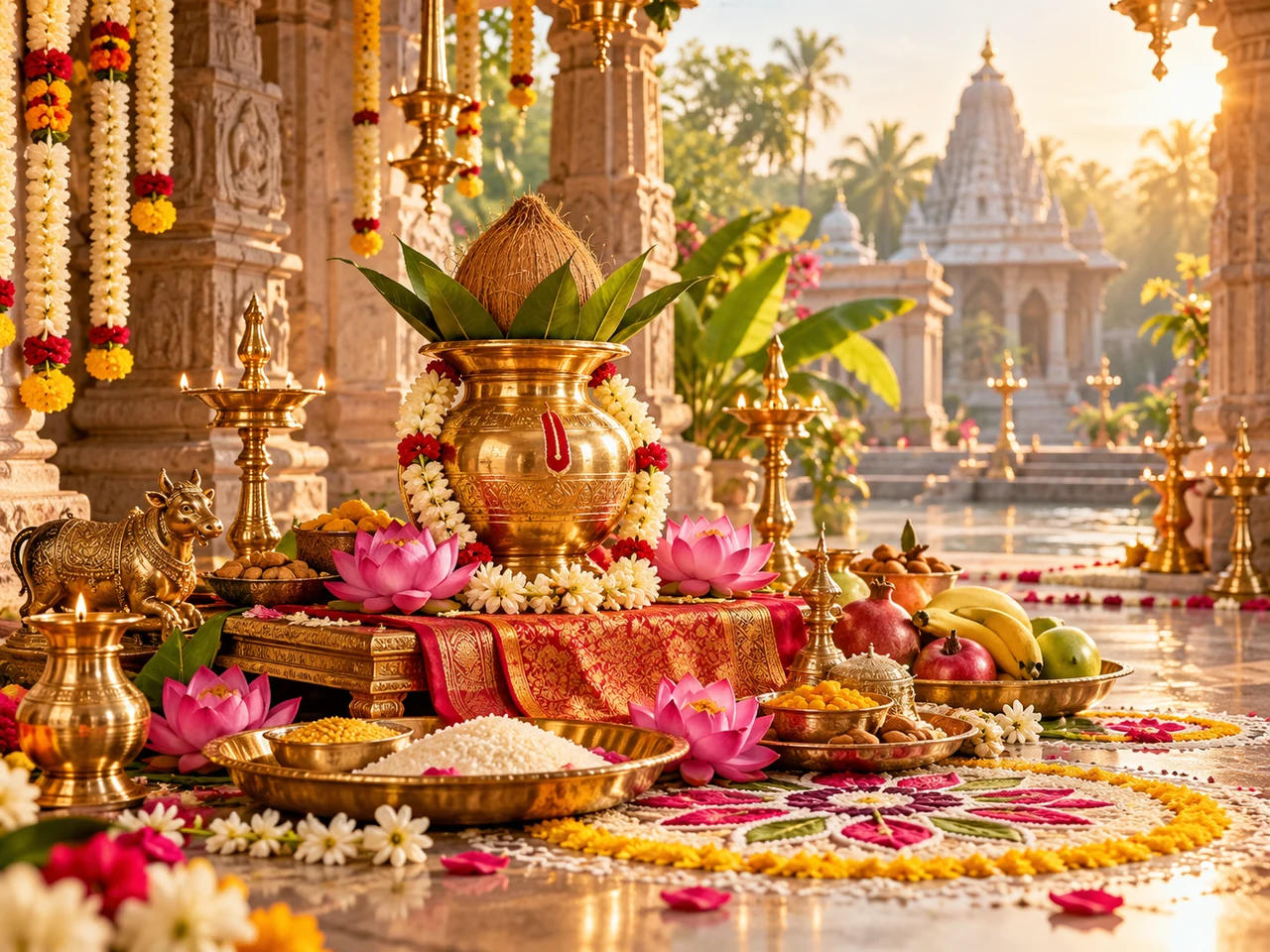
Imagine two preparations for the same festival. In one household, someone sets aside drinking water and food for people enduring the summer heat. In another, a family lights a lamp before Vishnu and Lakshmi and discusses a new beginning. In an Odisha village, farmers prepare a symbolic first handful of paddy seed. All three express aspects of Akshaya Tritiya (अक्षय तृतीया), also called Akha Teej or Akshaya Teej. It is widely associated with auspicious beginnings, gratitude, generosity and the hope that good actions will bear lasting fruit. 1, 4, 5
The festival is frequently advertised as a day to buy gold. That is one familiar modern practice, but it is not the whole festival—and it is not necessary to buy anything to participate. Its older moral vocabulary concerns dāna (giving), worship, service, nourishment and the use of one's resources responsibly. The name itself offers the clue: akṣaya means imperishable, inexhaustible or not subject to diminution; tṛtīyā means the third lunar Tithi. Religious interpretations of inexhaustible merit are matters of faith, not a guarantee of investment returns. 1, 2
When is Akshaya Tritiya celebrated?
Its widely recognised lunar association is Vaishakha Shukla Tritiya, the third Tithi in the waxing fortnight (Shukla Paksha) of Vaishakha. A Tithi is determined by the changing angular separation of Moon and Sun, not by the 24-hour Gregorian date. Its beginning and ending can fall at any local clock time. The observance generally falls during the Indian hot season, but no particular Gregorian date is permanently attached to it. Both Amanta and Purnimanta calendars ordinarily name this bright fortnight Vaishakha; that agreement does not settle every local day-selection or worship-window question. 1, 2
Published almanacs give examples of different categories of timing: the selected festival day, the period during which Tritiya prevails, local worship periods, and separate suggested purchasing windows. These must not be treated as interchangeable. Local sunrise, a tradition's preferred daytime overlap, the Tithi interval and an approved tie-breaking rule all matter. Some adjacent observances—notably Parashurama Jayanti—may select a different civil day when the relevant convention differs. 1, 2
ShivGoraksh calendar status: The next observance and any auspicious local interval should appear only in the separately reviewed Calendar module for a supported city, year and stated convention. Until validated, the correct display is: “Date/timing not yet verified for this city/year.” This article supplies the enduring explanation, not an unreviewed annual date.
Why is this day considered auspicious?
In many Hindu religious calendars Akshaya Tritiya is a particularly favourable occasion for meritorious activity, generosity and undertakings begun with good intent. The significance is less a promise that every transaction succeeds than an invitation to ask, what kind of work would we be glad to see flourish? 1, 2
One may pray for material sufficiency; another may dedicate a day of service to someone in need. A farmer asks for a sustainable harvest, a student begins serious study, and a family may choose to make a long-postponed act of reconciliation. These are ways of interpreting the day's ideal—not a claim that each is an ancient mandated rite.
Vishnu and Lakshmi: preservation, prosperity and responsibility
Worship of Vishnu, including the Lakshminarayana form with Lakshmi, is prominent in widely circulated observance descriptions. Lakshmi represents prosperity and wellbeing in many traditions; Vishnu is associated with sustaining cosmic order. A household may therefore see prosperity and care for others as connected responsibilities. Other regional communities have distinct forms of worship. The festival is not exclusively a Lakshmi festival, nor is every observance a requirement to purchase a precious metal. 1, 2
Charity: why giving often matters more than buying
Traditional acts discussed for this day include gifts of grain, food, water, clothing and other necessities; religious bathing and tarpana for ancestors also occur in some communities. The point of dāna is not simply the value printed on an object. Giving suitable help respectfully, without humiliating its recipient, makes the ethical idea concrete. In warmer regions, providing drinking water, shade or meals has an obvious everyday relevance. Specific recipients and ritual protocols differ between families, temples and lineages. 2
Faith traditions sometimes describe the religious merit of sincere giving as akshaya, or enduring. This is a devotional teaching, not a measurable supernatural or financial claim. Nor should charity become an excuse for wasteful spending.
Stories connected with Akshaya Tritiya: what the sources actually say
A festival can accumulate several memorable stories without all of them appearing in the same ancient text or being explicitly dated to the festival. This distinction is important for readers of scripture.
The inexhaustible vessel in the Mahabharata
In the Mahabharata, Vana Parva, Section III, Yudhishthira worries about feeding guests and followers during exile. Dhaumya directs him toward Surya; after his devotion, the Sun gives him a vessel that sustains the household's duty of hospitality, subject to conditions in the narrative. The episode has become associated in later festival storytelling with the phrase Akshaya Patra, the inexhaustible vessel. The inspected section, however, does not itself establish that this gift occurred on Akshaya Tritiya. That festival-date link must be labelled a later popular association unless an exact text supporting it is identified. 3
The story's central lesson is clearer than any disputed festival date: abundance matters because people must be fed. Its moral centre is the responsibility to share food, not to accumulate possessions indefinitely.
Parashurama Jayanti: a related, not automatically identical, observance
Some Hindu traditions honour Parashurama, regarded within Vaishnava accounts as an incarnation of Vishnu, in this seasonal period. Popular festival guides connect his jayanti with Akshaya Tritiya, but also acknowledge that the calendar-selected dates can differ because selection principles may not be the same. A future ShivGoraksh calendar must model them as separate observance rules if both are supported; one festival's occurrence cannot simply be copied to the other. We do not assign an unsupported exact chapter or verse to a supposed festival-specific birth narrative. 1
Treta Yuga, the Ganga and other cherished associations
Some devotional retellings say that the Treta Yuga began on Akshaya Tritiya. Other popular accounts attach the Ganga's descent, Sudama's visit to Krishna or the beginning of the Mahabharata's writing to the day. Such stories are not all of equal textual standing. The Treta association is recorded here as a traditional belief, not as a historically datable event. We have not verified a specific primary-text passage fixing the other episodes to Vaishakha Shukla Tritiya; they therefore should not be stated as canonical facts. The distinct festival of Ganga Dussehra has its own identity and calendar logic. 1, 3
An attractive story remains meaningful even when its chronology is uncertain. Responsible reading tells a visitor what the story teaches and what the available evidence can actually establish.
How do families observe Akshaya Tritiya?
There is no single compulsory domestic sequence for every Hindu family. Commonly described observances include the following, adapted to household, community and religious guidance. 2
- A clean, peaceful beginning. Families may clean a prayer space, bathe, light a lamp and make time for gratitude rather than treating the day as only a shopping appointment.
- Personal or temple worship. Some offer flowers, water, fruit and food in devotion to Vishnu–Lakshmi or the deity of their family. Formal puja sequences and mantras belong to the family's reviewed tradition; this article is not an authoritative priestly manual.
- Recitation and reflection. Vishnu-related prayers, nama-japa, scripture reading or quiet reflection may be practised according to preference. No unverified mantra prescription is supplied here.
- Charity and hospitality. Giving food or water, helping with education or assisting a local service initiative can make generosity practical. Charity should meet real needs and be undertaken with dignity.
- A responsible beginning. Some select the day for a new notebook, a business milestone, a household purchase or an important family ceremony. Such decisions still require ordinary judgment, affordability, mutual consent and, where relevant, professional advice.
Are fasting and strict ritual rules required?
Some devotees fast or adapt their meals as a personal vrata; many do not. This festival is not a universally mandatory fast with one standard Parana (fast-breaking) rule comparable to the highly structured procedures observed in certain Ekadashi traditions. Observance varies by lineage and family. People with medical, nutritional or other needs should not feel compelled to undertake a fast. A regional priest or a separately reviewed practice guide is the appropriate source for specialised ritual details. 2
Rajasthan and parts of North India: Akha Teej and family occasions
Akha Teej is a particularly familiar name in Rajasthan. The day has longstanding associations with weddings, community gatherings, seasonal hopes and new beginnings. The Ministry of Tourism's festival listing specifically notes Rajasthan's marriage celebrations; traditions range from family worship to larger social events. Not every wedding celebrated in the wider season follows one uniform muhurta rule. 5
An essential modern distinction: the past use of a festival date for some child marriages must not be romanticised. Indian government materials explicitly identify Akshaya Tritiya as a period for child-marriage prevention and enforcement. Religious auspiciousness never overrides consent, adulthood or the law. 9
Gujarat and Maharashtra: giving, household worship and new ventures
In many western Indian households, Akshaya Tritiya is associated with charity, worship, investments or starting practical work. Marathi discussions sometimes place it among particularly auspicious occasions for new undertakings. Specific recipes and ceremonies differ from family to family; neither puran poli nor purchasing jewellery is a universal requirement. The cultural ideal of a good beginning should not be turned into a promise that an asset bought on the day will appreciate. 2
Odisha: Akhi Muthi Anukula and Jagannath's festival cycle
Odisha shows especially clearly how much the festival would lose if it were described only in the language of gold purchases. The practice called Akhi Muthi Anukula marks the symbolic beginning of paddy sowing: a first handful of seed represents labour, rainfall, soil, food and hope. State reporting explicitly documents its ceremonial importance and its connection with the agricultural year. The day is also linked with the start of preparations for Lord Jagannath's Ratha Yatra, including the chariot-making sequence. 4, 10
The Jagannath tradition also has Chandan Yatra / Chandan Jatra, with sandalwood and seasonal temple rituals. Official tourism material describes this larger cycle, but year-specific schedules on separate pages may not map neatly to a single uniform countrywide date. A temple observance and an evergreen festival entry therefore need distinct, reviewed calendar links rather than an assumed one-to-one timetable. 11
Andhra Pradesh: Simhachalam's Chandanotsavam
At Simhachalam near Visakhapatnam, the Varaha Lakshmi Narasimha temple is known for Chandanotsavam. Accounts of the festival describe the removal of the usual sandalwood covering for a special nijarupa darshan and its renewal in the temple's ritual sequence. A government transport department's pilgrimage note and reported temple celebrations identify the practice; the institution's own detailed current ritual schedule would still be needed before publishing visiting instructions. 7, 8
Jain communities: a distinct Akshaya Tritiya meaning
Akshaya Tritiya also holds an important Jain significance; this is a different religious frame and must not be folded into a Hindu story of Vishnu–Lakshmi worship. Jain community explanations connect it with the first Tirthankara Rishabhanatha (Adinatha), with Shreyans Kumar offering sugarcane juice and with the Varshitap tradition of extended austerity, whose completion or parana is marked by the day. JAINA and a Jain educational source document the association. Exact fasting disciplines vary and call for qualified Jain religious guidance; this article does not prescribe them. 6, 12
This neighbouring tradition broadens the day’s cultural landscape while preserving each community's own sources and understanding.
Gold, wealth and the meaning of 'akshaya'
Why do jewellers focus on this festival? A popular belief links acquiring gold and valuables with enduring prosperity. Gold buying can serve a symbolic family or gift-giving role, but nothing in the word 'akshaya' guarantees market appreciation, repayment, fertility, business success or protection from loss. Different households may place greater importance on donation, prayer, a meaningful new undertaking or no purchases at all. 1, 2
If someone chooses to buy, the practical questions remain ordinary ones: affordability, purity, transparent pricing, legal documentation and whether the purchase is needed. A person unable or unwilling to buy gold has not missed the festival's central purpose.
Food, water and symbolic offerings
Food is more than a festive accompaniment here. Grain, rice, seasonal fruit, sweets, cooked meals and drinking water can express the relation between gratitude and giving. The exact food differs between regions and home traditions. In the Mahabharata's inexhaustible-vessel account, the abundance is meaningful precisely because it serves visitors and dependants. Odisha's sowing rites highlight the labour behind a harvest. Jain narratives of sugarcane-juice alms convey a distinct meaning tied to their own religious discipline. 3, 4, 6
A simple glass of water offered with respect may thus convey more of the spirit of the occasion than an expensive object bought out of pressure. This is an ethical reading, not a universal ritual injunction.
Devotion, philosophy and life beyond the shopping season
An 'inexhaustible' life is not one with unlimited possessions. It is a life in which goodwill can keep growing through repeated action: feeding somebody, paying fairly for work, reconciling with a neighbour, supporting a child's study, conserving resources, or practising restraint. Many Hindu devotional traditions speak about wealth together with dharma, the right ordering of conduct and obligation. Reading Akshaya Tritiya in that light does not require a claim that every text uses the same wording.
For ShivGoraksh readers, the day can sit alongside the site's Shiva–Shakti and Nath learning resources without being relabelled a Nath festival. The more accurate connection is a broad ethical interest shared across many traditions: responsibility, generosity and practice. There is no evidence offered here of an exclusive Gorakhnath-specific Akshaya Tritiya rite.
Common questions and misconceptions
The festival is not just a gold-sale season. Akha Teej is not the same as the monsoon Hariyali Teej festival. Parashurama Jayanti is related but not automatically the same calendar occurrence. The Akshaya Patra episode is in the Mahabharata, but the inspected passage does not fix it to this Tithi. Auspicious is a statement about religious and cultural valuation, not a guaranteed financial result. Similarly, a wedding may be considered timely only when all applicable personal, legal and religious requirements are satisfied. 1, 3, 5, 9
1. What is Akshaya Tritiya and why is it celebrated?
It is an annual lunar observance linked with auspicious beginnings, worship, generosity and hopes for enduring wellbeing. Akshaya means inexhaustible, while Tritiya is the third lunar Tithi. Its meanings and practices vary by community. 1, 2
2. Which Hindu calendar date is associated with Akshaya Tritiya?
The commonly stated association is Vaishakha Shukla Tritiya. The local Gregorian date and any relevant worship window must be selected by an approved, location-aware Panchang rule rather than guessed from a fixed date. 1, 2
3. Why do different Panchangs sometimes show different days or timings?
The Tritiya Tithi can span two civil dates. Local sunrise and the selected religious convention may affect the observance choice; worship and purchasing windows are also different data categories. ShivGoraksh will show them only after review. 1
4. Is buying gold compulsory?
No. Buying gold is a popular custom, not an obligation shared by all Hindu or Jain communities. Prayer, charity, service and family observances are equally important parts of the wider cultural picture. 2, 6
5. Does gold bought on this day always gain value?
No. Belief in auspiciousness is not evidence of guaranteed future returns. Any purchase should be assessed by ordinary financial considerations, not a promised supernatural outcome.
6. Which deities are worshipped on Akshaya Tritiya?
Vishnu and Lakshmi in the Lakshminarayana form feature prominently in widely used Hindu observance guides. Individual families and temples may follow other traditions; there is no single worship sequence for everyone. 2
7. What is the connection between Akshaya Tritiya and Parashurama Jayanti?
They are frequently associated, but almanac explanations caution that they can select different civil days. They should not be stored as a single automatically shared calendar event. 1
8. Did the Pandavas receive the Akshaya Patra on Akshaya Tritiya?
The Mahabharata's Vana Parva, Section III recounts Surya giving Yudhishthira an inexhaustible food vessel. The inspected passage does not date that event to Akshaya Tritiya; that additional link needs separate evidence. 3
9. How is the festival observed in Odisha?
Akhi Muthi Anukula symbolises the first sowing of paddy. The festival also connects with the Jagannath temple's chariot-preparation cycle and related local rites. 4, 10
10. What is the festival's significance for Jains?
Jain traditions honour Rishabhanatha and recall Shreyans Kumar's sugarcane-juice offering. For some, it marks the completion of Varshitap, an extended religious austerity, with its own Jain observance rules. 6, 12
11. Is fasting required, and is there one Parana time?
No universally compulsory Hindu fast and single Parana rule can be asserted. Family or lineage fasting differs; Jain Varshitap is a separate practice. Never infer a universal fast-breaking time from this festival article. 2, 12
12. Can a marriage take place on Akha Teej without other considerations?
The day is culturally auspicious for weddings in parts of Rajasthan, but adult consent and all applicable laws remain indispensable. State child-protection material specifically warns against child marriages around Akha Teej. Any personal muhurta question requires separate competent guidance. 5, 9