



Chapter 1
Arjuna Viṣāda Yoga — Arjuna’s DistressArjuna Viṣāda Yoga — Arjuna’s Distress
Reading settings
Jump to verse
Original / source text
धृतराष्ट्र उवाच
धर्मक्षेत्रे कुरुक्षेत्रे समवेता युयुत्सवः । मामकाः पाण्डवाश्चैव किमकुर्वत सञ्जय ॥ १ ॥
ShivGoraksh English Translation
Dhritarashtra said: Sanjaya, when my people and the sons of Pāṇḍu assembled at Kurukṣetra, the field of dharma, intent on fighting, what did they do?Dhṛtarāṣṭra said: Sañjaya, when my people and the sons of Pāṇḍu assembled at Kurukṣetra, the field of dharma, intent on fighting, what did they do?
Roman reading
dharmakshetre kurukshetre samavetaa yuyutsavah | maamakaah paandavaashchaiva kimakurvata sanjaya || 1 ||dharmakṣetre kurukṣetre samavetā yuyutsavaḥ | māmakāḥ pāṇḍavāścaiva kimakurvata sañjaya || 1 ||
Explanation
ShivGoraksh Simple English Explanation
The Gītā opens not with Krishna's teaching but with a question from Dhritarashtra. Kurukṣetra is the battlefield, described here as a “field of dharma.” The king distinguishes “my people” (māmakāḥ) from “the sons of Pāṇḍu,” signalling the two sides of the conflict; the wording by itself does not establish every aspect of his psychology. He asks Sanjaya to report what happened when the armies met. The scene establishes the narrator, setting, and impending struggle. Some commentators also interpret the “field of dharma” symbolically or spiritually. Such readings can enrich an explanation, but they should be identified as interpretive readings rather than substituted for the verse's direct narrative meaning.
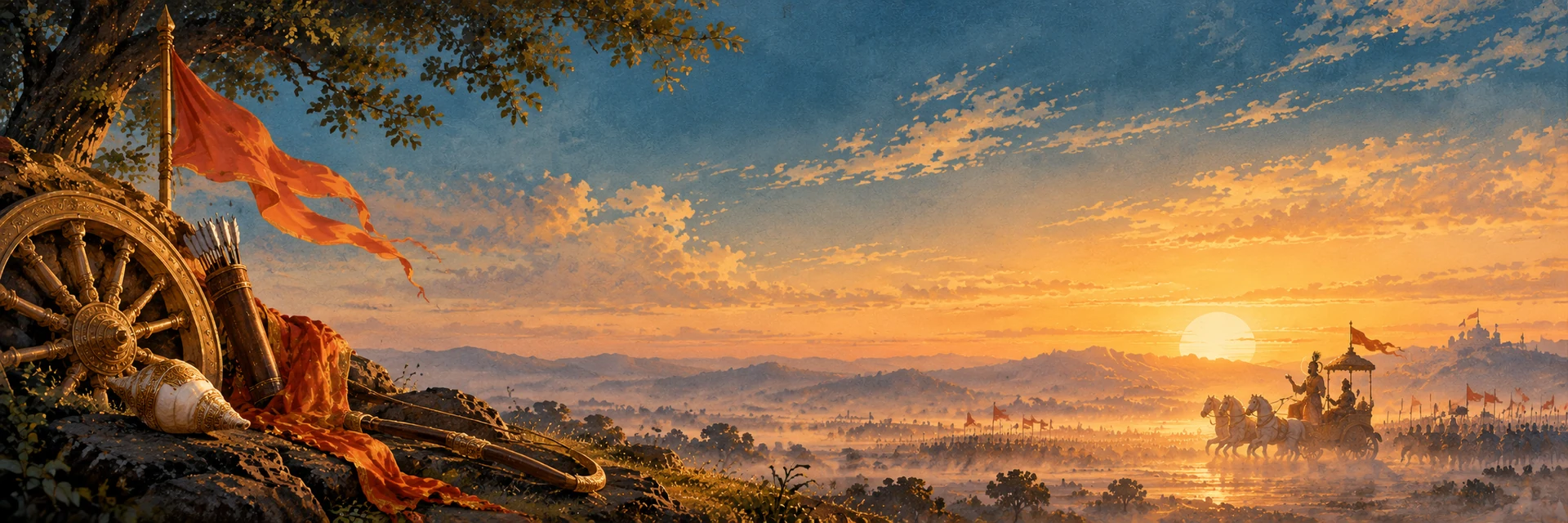
The Gītā opens not with Krishna's teaching but with a question from Dhṛtarāṣṭra. Kurukṣetra is the battlefield, described here as a “field of dharma.” The king distinguishes “my people” (māmakāḥ) from “the sons of Pāṇḍu,” signalling the two sides of the conflict; the wording by itself does not establish every aspect of his psychology. He asks Sañjaya to report what happened when the armies met. The scene establishes the narrator, setting, and impending struggle. Some commentators also interpret the “field of dharma” symbolically or spiritually. Such readings can enrich an explanation, but they should be identified as interpretive readings rather than substituted for the verse's direct narrative meaning.
Other languages and readings
ShivGoraksh Simple Hindi Explanation
ShivGoraksh Simple Hindi Explanation
भगवद्गीता की कथा धृतराष्ट्र के प्रश्न से आरम्भ होती है। कुरुक्षेत्र युद्ध का स्थान है, जिसे यहाँ ‘धर्मक्षेत्र’ भी कहा गया है। धृतराष्ट्र ‘मामकाः’—‘मेरे लोग’—और ‘पाण्डवाः’—‘पाण्डु के पुत्र’—का अलग उल्लेख करते हैं। इससे उनके दृष्टिकोण में दो पक्षों का भेद स्पष्ट होता है; इससे अकेले उनके मन की पूरी स्थिति तय नहीं हो जाती। वे संजय से युद्ध आरम्भ होने पर घटी घटनाएँ पूछ रहे हैं। इस श्लोक में कृष्ण-अर्जुन का उपदेश अभी शुरू नहीं हुआ है; यहाँ पाठक को कथा का स्थान, संघर्ष और कथावाचक की पहचान मिलती है। धर्मक्षेत्र की आध्यात्मिक व्याख्याएँ अलग-अलग भाष्य-परम्पराओं में मिलती हैं, पर वे शाब्दिक कथात्मक अर्थ से पृथक रखनी चाहिए।
Original / source text
सञ्जय उवाच
दृष्ट्वा तु पाण्डवानीकं व्यूढं दुर्योधनस्तदा । आचार्यमुपसङ्गम्य राजा वचनमब्रवीत् ॥ २ ॥
ShivGoraksh English Translation
Sanjaya said: Seeing the Pāṇḍavas' army drawn up in battle formation, King Duryodhana approached his teacher and spoke these words.Sañjaya said: Seeing the Pāṇḍavas' army drawn up in battle formation, King Duryodhana approached his teacher and spoke these words.
Roman reading
drishtvaa tu paandavaaneekam vyoodham duryodhanastadaa | aachaaryamupasangamya raajaa vachanamabraveet || 2 ||dṛṣṭvā tu pāṇḍavānīkaṃ vyūḍhaṃ duryodhanastadā | ācāryamupasaṅgamya rājā vacanamabravīt || 2 ||
Explanation
ShivGoraksh Simple English Explanation
Sanjaya begins describing the battlefield. Duryodhana notices the Pāṇḍava army arranged in a military formation and goes to his teacher, identified in the next verse as Drona. The word vyūḍham points to a deliberate deployment rather than a mere crowd of soldiers. This is also a change in narrative voice: Dhritarashtra's question gives way to Sanjaya's account, which introduces Duryodhana's direct speech. Keeping these levels distinct matters because verses 1.3 onward are Duryodhana's remarks, even though Sanjaya reports them. The verse does not itself establish whether Duryodhana is confident or frightened; those are interpretive possibilities assessed in context.
Sañjaya begins describing the battlefield. Duryodhana notices the Pāṇḍava army arranged in a military formation and goes to his teacher, identified in the next verse as Droṇa. The word vyūḍham points to a deliberate deployment rather than a mere crowd of soldiers. This is also a change in narrative voice: Dhṛtarāṣṭra's question gives way to Sañjaya's account, which introduces Duryodhana's direct speech. Keeping these levels distinct matters because verses 1.3 onward are Duryodhana's remarks, even though Sañjaya reports them. The verse does not itself establish whether Duryodhana is confident or frightened; those are interpretive possibilities assessed in context.
Other languages and readings
ShivGoraksh Simple Hindi Explanation
ShivGoraksh Simple Hindi Explanation
अब संजय युद्धभूमि का वर्णन आरम्भ करते हैं। दुर्योधन शत्रु-पक्ष की व्यवस्थित सेना को देखकर अपने आचार्य के निकट जाता है। अगले श्लोक से स्पष्ट है कि सम्बोधित आचार्य द्रोण हैं। इस श्लोक में ‘व्यूढम्’ सेना के नियोजित युद्ध-विन्यास को दर्शाता है; इसका आशय केवल बड़ी भीड़ से नहीं है। यहाँ एक महत्त्वपूर्ण कथात्मक परिवर्तन भी होता है: धृतराष्ट्र का प्रश्न संजय के प्रत्यक्ष वर्णन में बदलता है, और फिर दुर्योधन की वाणी प्रस्तुत होती है। इसे ध्यान में रखने से अगले अनेक श्लोकों में वक्ता की पहचान सही बनी रहती है।
Original / source text
दुर्योधन (सञ्जय द्वारा उद्धृत कथन)
पश्यैतां पाण्डुपुत्राणामाचार्य महतीं चमूम् । व्यूढां द्रुपदपुत्रेण तव शिष्येण धीमता ॥ ३ ॥
ShivGoraksh English Translation
Teacher, look at this great army of the sons of Pāṇḍu, arrayed by the intelligent son of Drupada, your own pupil.
Roman reading
pashyaitaam paanduputraanaamaachaarya mahateem chamoom | vyoodhaam drupadaputrena tava shishyena dheemataa || 3 ||paśyaitāṃ pāṇḍuputrāṇāmācārya mahatīṃ camūm | vyūḍhāṃ drupadaputreṇa tava śiṣyeṇa dhīmatā || 3 ||
Explanation
ShivGoraksh Simple English Explanation
Duryodhana asks Drona to observe the opposing army, stressing that its arrangement is the work of “the son of Drupada,” who is also Drona's pupil. The wider Mahābhārata identifies this figure as Dhrishtadyumna, although the verse itself names him through his father. The pointed reminder of a teacher–student relationship brings the complexities of loyalty and conflict into view. Commentators may read Duryodhana's choice of words as deliberate pressure on Drona, but the verse does not state such a motive outright. The translation should retain the relational terms; any psychological reconstruction belongs in a qualified explanation. This verse begins a catalogue of notable warriors rather than the Gītā's philosophical instruction.
Duryodhana asks Droṇa to observe the opposing army, stressing that its arrangement is the work of “the son of Drupada,” who is also Droṇa's pupil. The wider Mahābhārata identifies this figure as Dhṛṣṭadyumna, although the verse itself names him through his father. The pointed reminder of a teacher–student relationship brings the complexities of loyalty and conflict into view. Commentators may read Duryodhana's choice of words as deliberate pressure on Droṇa, but the verse does not state such a motive outright. The translation should retain the relational terms; any psychological reconstruction belongs in a qualified explanation. This verse begins a catalogue of notable warriors rather than the Gītā's philosophical instruction.
Other languages and readings
ShivGoraksh Simple Hindi Explanation
ShivGoraksh Simple Hindi Explanation
दुर्योधन अब आचार्य द्रोण का ध्यान पाण्डव-सेना की ओर खींचता है। वह सेनाविन्यास करने वाले व्यक्ति को ‘द्रुपदपुत्र’ और ‘तव शिष्य’ कहता है। महाभारत की व्यापक कथा में यह व्यक्ति धृष्टद्युम्न के रूप में पहचाना जाता है; पर श्लोक के मूल शब्दों में उसका व्यक्तिगत नाम नहीं लिखा है। ‘आपके शिष्य’ का उल्लेख शिक्षण और युद्ध में विरोधी पक्षों से जुड़े सम्बन्धों की जटिलता को उभारता है। क्या दुर्योधन इस सम्बन्ध से द्रोण को सावधान, प्रेरित या असहज करना चाहता है—इस पर भिन्न व्याख्याएँ सम्भव हैं। मूल अनुवाद में केवल वही अर्थ रखना बेहतर है जो शब्दों से स्पष्ट है; सम्भावित मानसिक उद्देश्य व्याख्या में सावधानी से बताया जाए।
Original / source text
दुर्योधन (सञ्जय द्वारा उद्धृत कथन)
अत्र शूरा महेष्वासा भीमार्जुनसमा युधि । युयुधानो विराटश्च द्रुपदश्च महारथः ॥ ४ ॥
ShivGoraksh English Translation
Here stand heroes and great bowmen, comparable in battle to Bhīma and Arjuna: Yuyudhāna, Virāṭa, and Drupada, a great chariot-warrior.
Roman reading
atra shooraa maheshvaasaa bheemaarjunasamaa yudhi | yuyudhaano viraatashcha drupadashcha mahaarathah || 4 ||atra śūrā maheṣvāsā bhīmārjunasamā yudhi | yuyudhāno virāṭaśca drupadaśca mahārathaḥ || 4 ||
Explanation
ShivGoraksh Simple English Explanation
Duryodhana begins listing distinguished fighters on the Pāṇḍava side. He describes them as comparable in combat to Bhīma and Arjuna, signaling his recognition of their capabilities. Maheṣvāsāḥ denotes mighty bowmen, while mahāratha is a high martial designation in epic usage, often associated with accomplished chariot-warriors. The verse names Yuyudhāna, Virāṭa, and Drupada, without pausing to narrate their biographies. The important narrative point is scale: the approaching conflict involves many trained leaders, not only the central cousins. We should not infer from this inventory alone that Duryodhana has either accepted defeat or guaranteed victory; his words contribute to a broader portrayal of the armies.
Other languages and readings
ShivGoraksh Simple Hindi Explanation
ShivGoraksh Simple Hindi Explanation
दुर्योधन पाण्डव पक्ष के विशिष्ट योद्धाओं की गणना शुरू करता है। वह उन्हें ‘भीमार्जुनसमा’ कहकर भीम और अर्जुन के समान युद्ध-कुशल बताता है। इस तुलना से विरोधी सेना की क्षमता का उसका आकलन सामने आता है। ‘महेष्वास’ प्रबल धनुर्धर का विशेषण है, जबकि ‘महारथ’ परम्परागत युद्ध-साहित्य में उच्च श्रेणी के रथी के लिए प्रयुक्त होता है। इस श्लोक में युयुधान, विराट और द्रुपद के नाम आते हैं; नामों के विस्तृत जीवन-वृत्तान्त को मूल अनुवाद में जोड़ना आवश्यक नहीं। पाठक के लिए मुख्य बात यह है कि युद्ध केवल दो व्यक्तियों का द्वन्द्व नहीं, अनेक अनुभवी योद्धाओं के बीच व्यापक संघर्ष है।
Original / source text
दुर्योधन (सञ्जय द्वारा उद्धृत कथन)
धृष्टकेतुश्चेकितानः काशिराजश्च वीर्यवान् । पुरुजित्कुन्तिभोजश्च शैब्यश्च नरपुङ्गवः ॥ ५ ॥
ShivGoraksh English Translation
There are also Dhṛṣṭaketu, Chekitana, the valiant king of Kāśī, Purujit, Kuntibhoja, and Śaibya, outstanding among men.There are also Dhṛṣṭaketu, Cekitāna, the valiant king of Kāśī, Purujit, Kuntibhoja, and Śaibya, outstanding among men.
Roman reading
dhrishtaketushchekitaanah kaashiraajashcha veeryavaan | purujitkuntibhojashcha shaibyashcha narapungavah || 5 ||dhṛṣṭaketuścekitānaḥ kāśirājaśca vīryavān | purujitkuntibhojaśca śaibyaśca narapuṅgavaḥ || 5 ||
Explanation
ShivGoraksh Simple English Explanation
The catalogue of notable Pāṇḍava allies continues. This verse is principally a list of names, with two descriptive epithets: the king of Kāśī is vīryavān, valiant or powerful, and Śaibya is nara-puṅgava, eminent among men. Sanskrit sandhi joins adjacent names, so modern spellings and transliterations sometimes differ. Nothing in the verse calls for imposing a broad metaphysical meaning on each warrior's name. Its immediate purpose is to establish the range of rulers and allies participating in the conflict.
Other languages and readings
ShivGoraksh Simple Hindi Explanation
ShivGoraksh Simple Hindi Explanation
पाण्डवों के प्रमुख सहयोगियों की सूची यहाँ आगे बढ़ती है। यह श्लोक मुख्यतः व्यक्ति-नाम और दो विशेषण देता है: काशिराज को ‘वीर्यवान्’ अर्थात् पराक्रमी, और शैब्य को ‘नरपुङ्गव’ अर्थात् मनुष्यों में श्रेष्ठ कहा गया है। संस्कृत में जुड़े हुए नाम और संधि आधुनिक वर्तनी में थोड़े भिन्न दिख सकते हैं; इसलिए प्रत्येक नाम के मूल पाठ, लिप्यन्तरण और पहचान को अलग सूचीबद्ध करना उपयोगी होगा। इस प्रकार की नामावली में अनावश्यक दार्शनिक अर्थ आरोपित नहीं करना चाहिए। इसका काम पाठक को दिखाना है कि दोनों पक्षों के साथ अनेक कुल, राजा और सहयोगी उपस्थित हैं।
Original / source text
दुर्योधन (सञ्जय द्वारा उद्धृत कथन)
युधामन्युश्च विक्रान्त उत्तमौजाश्च वीर्यवान् । सौभद्रो द्रौपदेयाश्च सर्व एव महारथाः ॥ ६ ॥
ShivGoraksh English Translation
There are the bold Yudhāmanyu, the valiant Uttamaujā, the son of Subhadrā, and the sons of Draupadī; all are great chariot-warriors.
Roman reading
yudhaamanyushcha vikraanta uttamaujaashcha veeryavaan | saubhadro draupadeyaashcha sarva eva mahaarathaah || 6 ||yudhāmanyuśca vikrānta uttamaujāśca vīryavān | saubhadro draupadeyāśca sarva eva mahārathāḥ || 6 ||
Explanation
ShivGoraksh Simple English Explanation
Two additional warriors, Yudhāmanyu and Uttamaujā, are named alongside fighters identified by family relationships. Saubhadra means “son of Subhadrā”; in the wider Mahābhārata narrative he is Abhimanyu. Draupadeyāḥ is plural, referring to Draupadī's sons, not to a single son. The closing phrase, “all are mahārathas,” emphasizes the group's martial standing. These identifications help the reader follow the narrative, but the translation should continue to reflect the verse's actual terms. The family relationships named here become important later in Chapter 1, when Arjuna sees relatives and teachers on both sides and questions the human cost of battle.
Other languages and readings
ShivGoraksh Simple Hindi Explanation
ShivGoraksh Simple Hindi Explanation
इस श्लोक में फिर दो नाम—युधामन्यु और उत्तमौजा—और परिवार के आधार पर पहचाने गए अन्य योद्धा आते हैं। ‘सौभद्र’ का अर्थ सुभद्रा का पुत्र है, जिसे महाभारत की कथा में अभिमन्यु कहा जाता है। ‘द्रौपदेयाः’ द्रौपदी के पुत्रों के लिए सामूहिक शब्द है; इसे केवल एक पुत्र मान लेना गलत होगा। ‘सर्व एव महारथाः’ पूरे उल्लिखित समूह की युद्ध-कुशलता को रेखांकित करता है। ध्यान रहे कि ये परिचय कथा-परम्परा से प्राप्त होते हैं; अनुवाद में मूल पदों को सुरक्षित रखते हुए व्याख्या में ही विस्तार देना चाहिए। आरम्भिक अध्याय का यह विवरण आगे अर्जुन के सामने उपस्थित पारिवारिक सम्बन्धों की पृष्ठभूमि बनाता है।
Original / source text
दुर्योधन (सञ्जय द्वारा उद्धृत कथन)
अस्माकं तु विशिष्टा ये तान्निबोध द्विजोत्तम । नायका मम सैन्यस्य संज्ञार्थं तान्ब्रवीमि ते ॥ ७ ॥
ShivGoraksh English Translation
Now, best of the twice-born, learn who the distinguished leaders on our side are. I shall name the commanders of my army so you may identify them.
Roman reading
asmaakam tu vishishtaa ye taannibodha dvijottama | naayakaa mama sainyasya samjnaartham taanbraveemi te || 7 ||asmākaṃ tu viśiṣṭā ye tānnibodha dvijottama | nāyakā mama sainyasya saṃjñārthaṃ tānbravīmi te || 7 ||
Explanation
ShivGoraksh Simple English Explanation
Duryodhana turns from naming the opposing commanders to introducing his own leaders. He addresses Drona as dvijottama, a traditional honorific meaning “best of the twice-born,” reflecting Drona's status as a Brahmin teacher in the epic's social vocabulary. The wording should be represented accurately without silently converting a historical honorific into a modern social endorsement. Saṃjñārtham conveys the purpose of identification or making the leaders known. The verse thus marks a straightforward structural transition: the Pāṇḍava champions have been listed, and the Kaurava commanders are about to be named. It should not be made to carry an unsupported claim that Duryodhana is certain of victory.
Duryodhana turns from naming the opposing commanders to introducing his own leaders. He addresses Droṇa as dvijottama, a traditional honorific meaning “best of the twice-born,” reflecting Droṇa's status as a Brahmin teacher in the epic's social vocabulary. The wording should be represented accurately without silently converting a historical honorific into a modern social endorsement. Saṃjñārtham conveys the purpose of identification or making the leaders known. The verse thus marks a straightforward structural transition: the Pāṇḍava champions have been listed, and the Kaurava commanders are about to be named. It should not be made to carry an unsupported claim that Duryodhana is certain of victory.
Other languages and readings
ShivGoraksh Simple Hindi Explanation
ShivGoraksh Simple Hindi Explanation
दुर्योधन अब पाण्डव-सेना का वर्णन छोड़कर अपने पक्ष की ओर आता है। वह आचार्य द्रोण को ‘द्विजोत्तम’ कहकर सम्बोधित करता है। यह सम्मानसूचक परम्परागत पद उनके ब्राह्मण-आचार्य होने के सामाजिक और शैक्षिक परिचय से जुड़ा है; इसे आधुनिक सामाजिक मूल्यांकन के रूप में बिना सन्दर्भ के नहीं पढ़ना चाहिए। ‘संज्ञार्थम्’ का आशय पहचान या जानकारी देना है। अगले श्लोक में नाम आने वाले हैं। यह परिवर्तन पाठक के लिए युद्धभूमि का सरल मानचित्र तैयार करता है: पहले विरोधी सेना के प्रमुख योद्धा, फिर दुर्योधन के अपने नेता। वाक्य में अभी किसी व्यक्तिगत योद्धा को विजय का आश्वासन नहीं दिया गया है।
Original / source text
दुर्योधन (सञ्जय द्वारा उद्धृत कथन)
भवान्भीष्मश्च कर्णश्च कृपश्च समितिञ्जयः । अश्वत्थामा विकर्णश्च सौमदत्तिर्जयद्रथः ॥ ८ ॥
ShivGoraksh English Translation
You yourself, Bhishma, Karṇa, Kṛpa—victorious in battle—Aśvatthāman, Vikarṇa, the son of Somadatta, and Jayadratha are among our prominent warriors.You yourself, Bhīṣma, Karṇa, Kṛpa—victorious in battle—Aśvatthāman, Vikarṇa, the son of Somadatta, and Jayadratha are among our prominent warriors.
Roman reading
bhavaanbheeshmashcha karnashcha kripashcha samitinjayah | ashvatthaamaa vikarnashcha saumadattirjayadrathah || 8 ||bhavānbhīṣmaśca karṇaśca kṛpaśca samitiñjayaḥ | aśvatthāmā vikarṇaśca saumadattirjayadrathaḥ || 8 ||
Explanation
ShivGoraksh Simple English Explanation
Duryodhana respectfully addresses Drona as “you” and continues his roll call of leading warriors. Bhishma and Karṇa are named alongside Kṛpa, described with samitiñjayaḥ, “victorious in battle.” Saumadattiḥ means “son of Somadatta,” traditionally identified with Bhūriśravas in the wider epic. The list underscores the prestige and battle experience of Duryodhana’s allies, yet their presence alone does not decide the moral merits of either side. This is Duryodhana’s assessment, long before Krishna begins his teaching.
Duryodhana respectfully addresses Droṇa as “you” and continues his roll call of leading warriors. Bhīṣma and Karṇa are named alongside Kṛpa, described with samitiñjayaḥ, “victorious in battle.” Saumadattiḥ means “son of Somadatta,” traditionally identified with Bhūriśravas in the wider epic. The list underscores the prestige and battle experience of Duryodhana’s allies, yet their presence alone does not decide the moral merits of either side. This is Duryodhana’s assessment, long before Krishna begins his teaching.
Other languages and readings
ShivGoraksh Simple Hindi Explanation
ShivGoraksh Simple Hindi Explanation
दुर्योधन द्रोणाचार्य को सम्मानपूर्वक ‘भवान्’ अर्थात् ‘आप’ कहकर संबोधित करता है और अपनी सेना के प्रसिद्ध योद्धाओं की सूची आगे बढ़ाता है। भीष्म और कर्ण जैसे नामों के साथ ‘समितिञ्जयः’ कृपाचार्य की युद्धकुशलता का विशेषण है। ‘सौमदत्तिः’ का अर्थ सोमदत्त का पुत्र है; महाभारत के व्यापक आख्यान में इस पहचान का संबंध भूरिश्रवा से है। यह सूची अपने पक्ष की शक्ति और वरिष्ठता को उभारती है। लेकिन सम्मानित व्यक्तियों के युद्धभूमि में उपस्थित होने से अपने-आप उनके पक्ष की नैतिक श्रेष्ठता प्रमाणित नहीं होती। युद्ध के मानवीय तनाव का यही एक आरम्भिक संकेत है।
Original / source text
दुर्योधन (सञ्जय द्वारा उद्धृत कथन)
अन्ये च बहवः शूरा मदर्थे त्यक्तजीविताः । नानाशस्त्रप्रहरणाः सर्वे युद्धविशारदाः ॥ ९ ॥
ShivGoraksh English Translation
Many other heroes are also prepared to risk their lives for my sake. They wield many kinds of weapons and are all skilled in warfare.
Roman reading
anye cha bahavah shooraa madarthe tyaktajeevitaah | naanaashastrapraharanaah sarve yuddhavishaaradaah || 9 ||anye ca bahavaḥ śūrā madarthe tyaktajīvitāḥ | nānāśastrapraharaṇāḥ sarve yuddhaviśāradāḥ || 9 ||
Explanation
ShivGoraksh Simple English Explanation
Duryodhana looks beyond the famous commanders to the many other soldiers fighting for his cause. The expression madarthe tyaktajīvitāḥ conveys a readiness to lay down their lives for him; it need not mean that they have already died. Nānā-śastra-praharaṇāḥ points to varied weapons, and yuddha-viśāradāḥ to competence in warfare. The verse presents the army as committed, equipped, and experienced. It also establishes the human stakes of the encounter. Later in the chapter, Arjuna's distress will give a contrasting perspective on what participation in this conflict means for relatives, teachers, and the fighters themselves.
Other languages and readings
ShivGoraksh Simple Hindi Explanation
ShivGoraksh Simple Hindi Explanation
दुर्योधन केवल प्रसिद्ध सेनानायकों का ही नहीं, अन्य अनेक योद्धाओं का भी उल्लेख करता है। ‘मदर्थे त्यक्तजीविताः’ का सन्दर्भ उन सैनिकों की अपने राजा के उद्देश्य के प्रति प्राण-समर्पण की तैयारी है; इसे ऐसा ऐतिहासिक कथन नहीं मानना चाहिए कि सभी की मृत्यु पहले ही हो चुकी थी। ‘नानाशस्त्रप्रहरणाः’ विभिन्न शस्त्रों और युद्ध-साधनों का संकेत देता है, और ‘युद्धविशारदाः’ अभ्यास तथा कौशल को। इस पंक्ति में निष्ठा, सैन्य-संगठन और युद्ध की सम्भावित मानवीय कीमत साथ दिखाई देते हैं। बाद में अर्जुन की प्रतिक्रिया के संदर्भ में यह सूची और अधिक अर्थपूर्ण होती है।
Original / source text
दुर्योधन (सञ्जय द्वारा उद्धृत कथन)
अपर्याप्तं तदस्माकं बलं भीष्माभिरक्षितम् । पर्याप्तं त्विदमेतेषां बलं भीमाभिरक्षितम् ॥ १० ॥
ShivGoraksh English Translation
Our army, guarded by Bhishma, is aparyāpta, whereas theirs, guarded by Bhīma, is paryāpta. The terms are read in two materially different ways: “unbounded/bounded” or “insufficient/sufficient”; the preferred interpretation remains open pending commentary review.Our army, guarded by Bhīṣma, is aparyāpta, whereas theirs, guarded by Bhīma, is paryāpta. The terms are read in two materially different ways: “unbounded/bounded” or “insufficient/sufficient”; the preferred interpretation remains open pending commentary review.
Roman reading
aparyaaptam tadasmaakam balam bheeshmaabhirakshitam | paryaaptam tvidameteshaam balam bheemaabhirakshitam || 10 ||aparyāptaṃ tadasmākaṃ balaṃ bhīṣmābhirakṣitam | paryāptaṃ tvidameteṣāṃ balaṃ bhīmābhirakṣitam || 10 ||
Explanation
ShivGoraksh Simple English Explanation
This verse requires unusual editorial care. Aparyāptam and paryāptam admit two markedly different contextual readings. One makes Duryodhana contrast his own seemingly unlimited forces, under Bhishma, with the Pāṇḍavas' limited forces, under Bhīma. The other makes him describe his forces as insufficient and theirs as sufficient. Traditional interpretive reports associate different preferred senses with commentators such as Śrīdhara and Ānandagiri. It would therefore be misleading to build a psychological explanation solely on one English rendering. The editorial translation deliberately retains the contested terms alongside both alternatives. Reviewers should collate the relevant historical commentary passages before selecting a primary display translation, while preserving the alternative in a textual note.
This verse requires unusual editorial care. Aparyāptam and paryāptam admit two markedly different contextual readings. One makes Duryodhana contrast his own seemingly unlimited forces, under Bhīṣma, with the Pāṇḍavas' limited forces, under Bhīma. The other makes him describe his forces as insufficient and theirs as sufficient. Traditional interpretive reports associate different preferred senses with commentators such as Śrīdhara and Ānandagiri. It would therefore be misleading to build a psychological explanation solely on one English rendering. The editorial translation deliberately retains the contested terms alongside both alternatives. Reviewers should collate the relevant historical commentary passages before selecting a primary display translation, while preserving the alternative in a textual note.
Other languages and readings
ShivGoraksh Simple Hindi Explanation
ShivGoraksh Simple Hindi Explanation
यह अध्याय का महत्त्वपूर्ण पाठ-व्याख्यात्मक स्थान है। संस्कृत में ‘अपर्याप्तम्’ और ‘पर्याप्तम्’ के अर्थ के आधार पर दुर्योधन का कथन बिल्कुल अलग सुनाई दे सकता है। एक व्याख्या में वह अपनी भीष्म-रक्षित सेना को असीम और भीम-रक्षित पाण्डव सेना को सीमित बता रहा है; दूसरी में वह अपनी शक्ति को अपर्याप्त और विरोधियों की शक्ति को पर्याप्त कहता प्रतीत होता है। श्रीधरस्वामी से जुड़ी परम्परा और आनन्दगिरि से जुड़ी व्याख्या में यह अन्तर मिलता है। इसलिए इसे केवल दुर्योधन का आत्मविश्वास या केवल भय बताना अनुचित होगा। शिवगोरक्ष के सम्पादकीय अनुवाद में दोनों अर्थ स्पष्ट दिखाए गए हैं; आगे मूल भाष्यों के सटीक उद्धरणों और स्रोत-पृष्ठों से समीक्षा आवश्यक है।
Original / source text
दुर्योधन (सञ्जय द्वारा उद्धृत कथन)
अयनेषु च सर्वेषु यथाभागमवस्थिताः । भीष्ममेवाभिरक्षन्तु भवन्तः सर्व एव हि ॥ ११ ॥
ShivGoraksh English Translation
All of you, remaining at your assigned positions throughout the army’s approaches, must above all protect Bhishma.All of you, remaining at your assigned positions throughout the army’s approaches, must above all protect Bhīṣma.
Roman reading
ayaneshu cha sarveshu yathaabhaagamavasthitaah | bheeshmamevaabhirakshantu bhavantah sarva eva hi || 11 ||ayaneṣu ca sarveṣu yathābhāgamavasthitāḥ | bhīṣmamevābhirakṣantu bhavantaḥ sarva eva hi || 11 ||
Explanation
ShivGoraksh Simple English Explanation
After his assessment of the two armies, Duryodhana issues a practical instruction to his officers. The expression ayaneṣu can refer to approaches or strategically assigned parts of the formation; his commanders are to remain at their respective posts while making the protection of Bhishma a priority. Bhishma’s importance as the Kaurava leader is thereby brought into focus. This does not mean that the other troops are to abandon their positions or that Bhishma is helpless: the instruction combines deployment discipline with protection of a central commander. Some traditional explanations emphasize the importance of guarding him from all sides. Whether Duryodhana speaks primarily from anxiety or prudence is an inference, not a fact explicitly stated by the verse.
After his assessment of the two armies, Duryodhana issues a practical instruction to his officers. The expression ayaneṣu can refer to approaches or strategically assigned parts of the formation; his commanders are to remain at their respective posts while making the protection of Bhīṣma a priority. Bhīṣma’s importance as the Kaurava leader is thereby brought into focus. This does not mean that the other troops are to abandon their positions or that Bhīṣma is helpless: the instruction combines deployment discipline with protection of a central commander. Some traditional explanations emphasize the importance of guarding him from all sides. Whether Duryodhana speaks primarily from anxiety or prudence is an inference, not a fact explicitly stated by the verse.
Other languages and readings
ShivGoraksh Simple Hindi Explanation
ShivGoraksh Simple Hindi Explanation
पिछले श्लोक में दोनों सेनाओं की शक्ति के बारे में बोलने के बाद दुर्योधन अपने पक्ष के प्रमुख योद्धाओं को निर्देश देता है। ‘अयनेषु’ का आशय युद्ध-व्यूह के मार्गों, मोर्चों अथवा रणनीतिक स्थानों से समझा जाता है। वह चाहता है कि योद्धा अपनी-अपनी जगह बने रहें और भीष्म की रक्षा करें। इससे भीष्म की युद्ध में केंद्रीय भूमिका दिखाई देती है। यह नहीं मानना चाहिए कि शेष सेना अप्रासंगिक है; दुर्योधन सैनिक व्यवस्था को भी बनाए रखना चाहता है। कुछ भाष्य इसे अपने सेनानायक की सुरक्षा पर विशेष जोर बताते हैं। दुर्योधन के मन में केवल भय था या रणनीतिक सावधानी—इसे मूल शब्द स्वयं निश्चित नहीं करते। अगले श्लोक में संजय बताता है कि भीष्म ने कैसी प्रतिक्रिया दी।
Original / source text
(speaker inherited from context)
तस्य संजनयन्हर्षं कुरुवृद्धः पितामहः । सिंहनादं विनद्योच्चैः शङ्खं दध्मौ प्रतापवान् ॥ १२ ॥
ShivGoraksh English Translation
Then the powerful elder and grandfather of the Kurus, Bhishma, seeking to raise his spirits, roared loudly like a lion and blew his conch.Then the powerful elder and grandfather of the Kurus, Bhīṣma, seeking to raise his spirits, roared loudly like a lion and blew his conch.
Roman reading
tasya samjanayanharsham kuruvriddhah pitaamahah | simhanaadam vinadyochchaih shankham dadhmau prataapavaan || 12 ||tasya saṃjanayanharṣaṃ kuruvṛddhaḥ pitāmahaḥ | siṃhanādaṃ vinadyoccaiḥ śaṅkhaṃ dadhmau pratāpavān || 12 ||
Explanation
ShivGoraksh Simple English Explanation
Sanjaya now shifts from Duryodhana’s speech to Bhishma’s response. The phrase tasya ... harṣam indicates the raising of Duryodhana’s spirits in this context. The respected Kuru elder gives a lion-like shout and sounds his conch, actions that mark military resolve and encourage his side. The descriptors “elder,” “grandfather” and “powerful” place Bhishma within the family’s hierarchy as well as the battlefield. The verse does not explain Bhishma’s private thoughts or prove that Duryodhana was already overcome by fear. Commentaries may develop the motivation further, but the direct account is that the senior warrior seeks to rouse his king’s enthusiasm before the wider army joins the sound.
Sañjaya now shifts from Duryodhana’s speech to Bhīṣma’s response. The phrase tasya ... harṣam indicates the raising of Duryodhana’s spirits in this context. The respected Kuru elder gives a lion-like shout and sounds his conch, actions that mark military resolve and encourage his side. The descriptors “elder,” “grandfather” and “powerful” place Bhīṣma within the family’s hierarchy as well as the battlefield. The verse does not explain Bhīṣma’s private thoughts or prove that Duryodhana was already overcome by fear. Commentaries may develop the motivation further, but the direct account is that the senior warrior seeks to rouse his king’s enthusiasm before the wider army joins the sound.
Other languages and readings
ShivGoraksh Simple Hindi Explanation
ShivGoraksh Simple Hindi Explanation
अब संजय दुर्योधन के निर्देश से भीष्म की प्रतिक्रिया की ओर आता है। ‘तस्य’ का संकेत प्रसंग में दुर्योधन की ओर है। भीष्म की सिंह जैसी गर्जना और शंखनाद का उद्देश्य उसका ‘हर्ष’—उत्साह—जगाना बताया गया है। यहाँ शंख युद्धारम्भ से जुड़ा घोष भी है; इसे केवल बाद की पूजा में प्रचलित शंखध्वनि के अर्थ तक सीमित नहीं करना चाहिए। श्लोक भीष्म को ‘कुरुवृद्ध’, ‘पितामह’ और ‘प्रतापवान्’ कहकर उनके वरिष्ठ स्थान और प्रभाव की याद दिलाता है। क्या वे दुर्योधन की घबराहट दूर करना चाहते थे, इसका अधिक विकसित विवरण कुछ भाष्यों में मिलता है; मूल श्लोक केवल उसके उत्साह को जगाने की बात कहता है।
Original / source text
(speaker inherited from context)
ततः शङ्खाश्च भेर्यश्च पणवानकगोमुखाः । सहसैवाभ्यहन्यन्त स शब्दस्तुमुलोऽभवत् ॥ १३ ॥
ShivGoraksh English Translation
Then conches, drums, smaller percussion instruments, large kettledrums and horn-like instruments suddenly sounded together, producing a tremendous uproar.
Roman reading
tatah shankhaashcha bheryashcha panavaanakagomukhaah | sahasaivaabhyahanyanta sa shabdastumulo’bhavat || 13 ||tataḥ śaṅkhāśca bheryaśca paṇavānakagomukhāḥ | sahasaivābhyahanyanta sa śabdastumulo’bhavat || 13 ||
Explanation
ShivGoraksh Simple English Explanation
Bhishma’s individual signal is followed by the wider Kaurava host sounding a range of instruments. The list includes conches and several kinds of drum or horn; precise one-to-one identification with modern instruments is not secure. The adverb sahasā conveys suddenness, while tumula describes the overwhelming collective noise. Narratively, the effect expands from a single commander’s conch to a battlefield-wide announcement of readiness. This is not yet a statement of Krishna’s doctrine or a technical rule for ritual conch blowing. Later devotional associations with the conch may be discussed elsewhere, but this verse first belongs to the unfolding martial setting. The opposite side’s response begins in the next verse.
Bhīṣma’s individual signal is followed by the wider Kaurava host sounding a range of instruments. The list includes conches and several kinds of drum or horn; precise one-to-one identification with modern instruments is not secure. The adverb sahasā conveys suddenness, while tumula describes the overwhelming collective noise. Narratively, the effect expands from a single commander’s conch to a battlefield-wide announcement of readiness. This is not yet a statement of Krishna’s doctrine or a technical rule for ritual conch blowing. Later devotional associations with the conch may be discussed elsewhere, but this verse first belongs to the unfolding martial setting. The opposite side’s response begins in the next verse.
Other languages and readings
ShivGoraksh Simple Hindi Explanation
ShivGoraksh Simple Hindi Explanation
भीष्म के शंखनाद के बाद पूरी कौरव सेना में अनेक प्रकार के युद्ध-वाद्य बजने लगते हैं। श्लोक में शंख, भेरी, पणव, आनक और गोमुख जैसे वाद्यों का उल्लेख है। इन सभी को आधुनिक वाद्यों के बिल्कुल समान बताना उचित नहीं; उनके रूप और उपयोग पर अलग ऐतिहासिक चर्चा हो सकती है। ‘सहसा’ अचानकपन और ‘तुमुल’ बहुत बड़े शोर को प्रकट करता है। यह सैन्य वातावरण का श्रव्य चित्र है—एक व्यक्ति के संकेत से उठकर बड़ी सामूहिक घोषणा तक पहुँचता हुआ। पाठक को ध्यान रखना चाहिए कि अभी कृष्ण और अर्जुन की ओर से कोई उत्तर नहीं आया है; वह अगले श्लोक में शुरू होगा। धार्मिक अनुष्ठानों में शंख के बाद के महत्व को इस प्रसंग के मूल युद्धवर्णन पर आरोपित न किया जाए।
Original / source text
(speaker inherited from context)
ततः श्वेतैर्हयैर्युक्ते महति स्यन्दने स्थितौ । माधवः पाण्डवश्चैव दिव्यौ शङ्खौ प्रदध्मतुः ॥ १४ ॥
ShivGoraksh English Translation
Then Mādhava (Krishna) and the Pāṇḍava (Arjuna), standing in a great chariot drawn by white horses, sounded their two divine conches.
Roman reading
tatah shvetairhayairyukte mahati syandane sthitau | maadhavah paandavashchaiva divyau shankhau pradadhmatuh || 14 ||tataḥ śvetairhayairyukte mahati syandane sthitau | mādhavaḥ pāṇḍavaścaiva divyau śaṅkhau pradadhmatuḥ || 14 ||
Explanation
ShivGoraksh Simple English Explanation
The narration crosses from the Kaurava uproar to Krishna and Arjuna’s chariot. Mādhava names Krishna; Pāṇḍava here refers specifically to Arjuna. They stand in a large chariot drawn by white horses and answer with two conches described as divya, “divine” or “extraordinary.” Their names will be supplied in verse 1.15. The visual contrast between the army’s massed noise and these two figures is a narrative feature, not a license to assert that white horses necessarily symbolize one particular philosophical doctrine. The verse establishes Krishna’s close association with Arjuna on the battlefield well before their famous conversation. The account remains third-person narration by Sanjaya.
The narration crosses from the Kaurava uproar to Krishna and Arjuna’s chariot. Mādhava names Krishna; Pāṇḍava here refers specifically to Arjuna. They stand in a large chariot drawn by white horses and answer with two conches described as divya, “divine” or “extraordinary.” Their names will be supplied in verse 1.15. The visual contrast between the army’s massed noise and these two figures is a narrative feature, not a license to assert that white horses necessarily symbolize one particular philosophical doctrine. The verse establishes Krishna’s close association with Arjuna on the battlefield well before their famous conversation. The account remains third-person narration by Sañjaya.
Other languages and readings
ShivGoraksh Simple Hindi Explanation
ShivGoraksh Simple Hindi Explanation
कौरव सेना की तीव्र ध्वनि के बाद संजय दूसरी ओर का दृश्य दिखाता है। श्वेत अश्वों से जुते रथ में कृष्ण और अर्जुन साथ खड़े हैं और दोनों अपने-अपने शंख बजाते हैं। यहाँ ‘माधव’ कृष्ण का तथा ‘पाण्डव’ अर्जुन का संकेत है; इन्हें अलग अपरिचित पात्र न समझें। ‘दिव्यौ’ शंखों का विशेषण है और कथा में उनकी विशिष्टता दर्शाता है। सफेद घोड़ों और महान रथ का वर्णन दृश्य को प्रभावशाली बनाता है, पर इससे किसी एक अनिवार्य प्रतीकात्मक अर्थ को सिद्ध नहीं किया जा सकता। अगले श्लोक में इन दोनों शंखों के नाम बताए जाएँगे। यह क्रम महत्वपूर्ण है: पहले कृष्ण और अर्जुन की संयुक्त उपस्थिति, फिर शंखों के व्यक्तिगत नाम।
Original / source text
(speaker inherited from context)
पाञ्चजन्यं हृषीकेशो देवदत्तं धनञ्जयः । पौण्ड्रं दध्मौ महाशङ्खं भीमकर्मा वृकोदरः ॥ १५ ॥
ShivGoraksh English Translation
Hṛṣīkeśa (Krishna) sounded Pāñcajanya; Dhanañjaya (Arjuna) sounded Devadatta; and mighty Bhīma, called Vṛkodara, blew his great conch Pauṇḍra.
Roman reading
paanchajanyam hrisheekesho devadattam dhananjayah | paundram dadhmau mahaashankham bheemakarmaa vrikodarah || 15 ||pāñcajanyaṃ hṛṣīkeśo devadattaṃ dhanañjayaḥ | pauṇḍraṃ dadhmau mahāśaṅkhaṃ bhīmakarmā vṛkodaraḥ || 15 ||
Explanation
ShivGoraksh Simple English Explanation
The conches now receive their individual names. Krishna is called Hṛṣīkeśa, Arjuna Dhanañjaya, and Bhīma Vṛkodara; these are epithets, not additional characters. Their conches are Pāñcajanya, Devadatta and Pauṇḍra respectively. The word mahāśaṅkha describes the large conch blown by Bhīma, whose fearsome deeds are suggested by bhīmakarmā. The verse gives names and an action; it does not itself narrate how the conches were acquired. Stories about their origins belong in source-labelled background notes if included at all. Keeping the names mapped correctly matters for reader comprehension, glossary search and Aadesh citations, especially because the passage proceeds as a continuous list across several verses.
Other languages and readings
ShivGoraksh Simple Hindi Explanation
ShivGoraksh Simple Hindi Explanation
इस श्लोक में तीन योद्धाओं और उनके शंखों की पहचान दी गई है। हृषीकेश कृष्ण का, धनञ्जय अर्जुन का तथा वृकोदर भीम का नाम है। उनके शंख क्रमशः पाञ्चजन्य, देवदत्त और पौण्ड्र हैं। ‘भीमकर्मा’ भीम के कठिन और प्रभावशाली कर्मों की ओर संकेत करता है; उसे यहाँ किसी अलग व्यक्ति के रूप में नहीं पढ़ना चाहिए। ‘महाशङ्ख’ विशेष रूप से पौण्ड्र के लिए आता है। शंखों के नाम कथा को व्यक्तिगत पहचान देते हैं, पर मूल श्लोक उनके उत्पत्ति-किस्से नहीं सुनाता। उनके बारे में मिलने वाली परवर्ती पौराणिक कथाएँ प्रमाण सहित अलग टिप्पणी में रखनी चाहिए। यह भी याद रखें कि इन शंखों की आवाज का विस्तृत प्रभाव श्लोक 1.19 में वर्णित है।
Original / source text
(speaker inherited from context)
अनन्तविजयं राजा कुन्तीपुत्रो युधिष्ठिरः । नकुलः सहदेवश्च सुघोषमणिपुष्पकौ ॥ १६ ॥
ShivGoraksh English Translation
King Yudhiṣṭhira, son of Kuntī, sounded Anantavijaya; Nakula and Sahadeva sounded Sughoṣa and Maṇipuṣpaka respectively.
Roman reading
anantavijayam raajaa kunteeputro yudhishthirah | nakulah sahadevashcha sughoshamanipushpakau || 16 ||anantavijayaṃ rājā kuntīputro yudhiṣṭhiraḥ | nakulaḥ sahadevaśca sughoṣamaṇipuṣpakau || 16 ||
Explanation
ShivGoraksh Simple English Explanation
Sanjaya continues the inventory: Yudhiṣṭhira’s conch is Anantavijaya, Nakula’s is Sughoṣa and Sahadeva’s is Maṇipuṣpaka. The order of the two brothers is understood to correspond to the order of the two conch names. The verb “sounded” is carried over from the surrounding construction rather than repeated at every point. This is a good example of why a fluent translation must still respect Sanskrit syntax: treating the two conch names as one instrument, or assigning them in reverse, would misrepresent the passage. Yudhiṣṭhira is identified as both a king and a son of Kuntī. The auspicious conch name should not be treated as proof of a historical outcome independent of the epic narrative.
Sañjaya continues the inventory: Yudhiṣṭhira’s conch is Anantavijaya, Nakula’s is Sughoṣa and Sahadeva’s is Maṇipuṣpaka. The order of the two brothers is understood to correspond to the order of the two conch names. The verb “sounded” is carried over from the surrounding construction rather than repeated at every point. This is a good example of why a fluent translation must still respect Sanskrit syntax: treating the two conch names as one instrument, or assigning them in reverse, would misrepresent the passage. Yudhiṣṭhira is identified as both a king and a son of Kuntī. The auspicious conch name should not be treated as proof of a historical outcome independent of the epic narrative.
Other languages and readings
ShivGoraksh Simple Hindi Explanation
ShivGoraksh Simple Hindi Explanation
यह श्लोक पाण्डव-पक्ष के शंखों की सूची आगे बढ़ाता है। युधिष्ठिर का शंख अनन्तविजय, नकुल का सुघोष और सहदेव का मणिपुष्पक कहा गया है। संस्कृत में ‘नकुलः सहदेवश्च सुघोषमणिपुष्पकौ’ में क्रम से व्यक्ति और शंख का सम्बन्ध समझा जाता है। यहाँ ‘दध्मौ’ जैसी बजाने की क्रिया पिछले तथा अगले वर्णन से अर्थ में जुड़ती है; हर श्लोक में क्रिया का दोहराया जाना आवश्यक नहीं। यह व्याकरण की छोटी बात है, पर सही अनुवाद के लिए उपयोगी है। ‘कुन्तीपुत्र’ से युधिष्ठिर की पारिवारिक पहचान स्पष्ट होती है। उनके शंख के नाम में ‘विजय’ शब्द होना स्वतः किसी ऐतिहासिक युद्ध के परिणाम का प्रमाण नहीं है।
Original / source text
(speaker inherited from context)
काश्यश्च परमेष्वासः शिखण्डी च महारथः । धृष्टद्युम्नो विराटश्च सात्यकिश्चापराजितः ॥ १७ ॥
ShivGoraksh English Translation
The ruler of Kāśī, an excellent bowman, and the great chariot-warrior Śikhaṇḍī, along with Dhrishtadyumna, Virāṭa and the undefeated Sātyaki, also sounded their conches.The ruler of Kāśī, an excellent bowman, and the great chariot-warrior Śikhaṇḍī, along with Dhṛṣṭadyumna, Virāṭa and the undefeated Sātyaki, also sounded their conches.
Roman reading
kaashyashcha parameshvaasah shikhandee cha mahaarathah | dhrishtadyumno viraatashcha saatyakishchaaparaajitah || 17 ||kāśyaśca parameṣvāsaḥ śikhaṇḍī ca mahārathaḥ | dhṛṣṭadyumno virāṭaśca sātyakiścāparājitaḥ || 17 ||
Explanation
ShivGoraksh Simple English Explanation
The roll call expands beyond Krishna and the five Pāṇḍava brothers to their allies. Kāśya indicates the king associated with Kāśī and parameṣvāsa describes exceptional skill with a bow. Śikhaṇḍī is called a mahāratha, while Sātyaki receives the epithet aparājita, “unconquered.” Dhrishtadyumna and Virāṭa also appear. The main verb “sounded their conches” is completed in the following verse, so verses 1.17–1.18 form a continuous description. A glossary can clarify identities, but claims about these warriors’ complete biographies should be linked to separate sources in the Mahābhārata. The text’s immediate purpose is to depict the broad coalition assembled on the Pāṇḍava side.
The roll call expands beyond Krishna and the five Pāṇḍava brothers to their allies. Kāśya indicates the king associated with Kāśī and parameṣvāsa describes exceptional skill with a bow. Śikhaṇḍī is called a mahāratha, while Sātyaki receives the epithet aparājita, “unconquered.” Dhṛṣṭadyumna and Virāṭa also appear. The main verb “sounded their conches” is completed in the following verse, so verses 1.17–1.18 form a continuous description. A glossary can clarify identities, but claims about these warriors’ complete biographies should be linked to separate sources in the Mahābhārata. The text’s immediate purpose is to depict the broad coalition assembled on the Pāṇḍava side.
Other languages and readings
ShivGoraksh Simple Hindi Explanation
ShivGoraksh Simple Hindi Explanation
यहाँ संजय पाण्डवों के अतिरिक्त उनके प्रमुख सहयोगियों का उल्लेख करता है। ‘काश्य’ काशी से जुड़े राजा के लिए है; ‘परमेष्वास’ श्रेष्ठ धनुर्धर का विशेषण है। शिखण्डी को ‘महारथ’ कहा गया है, जबकि सात्यकि ‘अपराजित’ विशेषण के साथ आते हैं। धृष्टद्युम्न और विराट के नाम भी इसी समूह में हैं। शंख बजाने की क्रिया अगले श्लोक के साथ मिलकर पूरी होती है, इसलिए 1.17 को अकेले पढ़ते हुए भी उस वाक्य-संबन्ध को समझना चाहिए। किसी नाम से जुड़ी महाभारत की विस्तृत जीवनकथा स्वतः इस श्लोक का प्रत्यक्ष कथन नहीं बन जाती। इस सूची का मुख्य उद्देश्य यह दिखाना है कि पाण्डव-पक्ष के अनेक सहयोगी युद्ध में उपस्थित और सज्जित हैं।
Original / source text
(speaker inherited from context)
द्रुपदो द्रौपदेयाश्च सर्वशः पृथिवीपते । सौभद्रश्च महाबाहुः शङ्खान्दध्मुः पृथक्पृथक् ॥ १८ ॥
ShivGoraksh English Translation
O ruler of the earth, Drupada, the sons of Draupadī and the mighty son of Subhadrā (Abhimanyu) each sounded their conches separately.
Roman reading
drupado draupadeyaashcha sarvashah prithiveepate | saubhadrashcha mahaabaahuh shankhaandadhmuh prithakprithak || 18 ||drupado draupadeyāśca sarvaśaḥ pṛthivīpate | saubhadraśca mahābāhuḥ śaṅkhāndadhmuḥ pṛthakpṛthak || 18 ||
Explanation
ShivGoraksh Simple English Explanation
Addressing Dhritarashtra as “ruler of the earth,” Sanjaya adds Drupada, Draupadī’s sons (Draupadeyāḥ) and the mighty son of Subhadrā (Saubhadra). In the wider Mahābhārata setting, Saubhadra is Abhimanyu. The phrase pṛthak pṛthak stresses that the warriors blew their conches individually rather than using a single shared instrument. The verse completes the catalogue begun in 1.17. It does not supply the personal names of every son of Draupadī, and it does not recount or predict the later fates of these characters. Those topics require their own correctly sourced passages. The point here is the large and diverse muster on the Pāṇḍava side.
Addressing Dhṛtarāṣṭra as “ruler of the earth,” Sañjaya adds Drupada, Draupadī’s sons (Draupadeyāḥ) and the mighty son of Subhadrā (Saubhadra). In the wider Mahābhārata setting, Saubhadra is Abhimanyu. The phrase pṛthak pṛthak stresses that the warriors blew their conches individually rather than using a single shared instrument. The verse completes the catalogue begun in 1.17. It does not supply the personal names of every son of Draupadī, and it does not recount or predict the later fates of these characters. Those topics require their own correctly sourced passages. The point here is the large and diverse muster on the Pāṇḍava side.
Other languages and readings
ShivGoraksh Simple Hindi Explanation
ShivGoraksh Simple Hindi Explanation
संजय शंख बजाने वाले अन्य योद्धाओं के नाम बताते हुए धृतराष्ट्र को ‘पृथिवीपते’ कहकर संबोधित करता है। द्रुपद, ‘द्रौपदेय’ यानी द्रौपदी के पुत्र, और ‘सौभद्र’ यानी सुभद्रा के पुत्र का उल्लेख है। महाभारत के व्यापक प्रसंग में सौभद्र अभिमन्यु हैं। ‘पृथक्पृथक्’ से स्पष्ट है कि ये सब अपने-अपने शंख अलग बजा रहे थे। ‘सर्वशः’ का अर्थ समूह को समेटने वाला हो सकता है; इससे प्रत्येक व्यक्ति का अलग नाम इस श्लोक में उपलब्ध होने का दावा नहीं बनता। 1.17–1.18 को साथ पढ़ने पर दोनों मिलकर पाण्डव सहयोगियों की विस्तृत युद्ध-घोषणा बनते हैं। अभिमन्यु या द्रौपदी-पुत्रों की आगे की घटनाओं को यहाँ पूर्वघोषित भविष्यवाणी के रूप में नहीं पढ़ना चाहिए।
Original / source text
(speaker inherited from context)
स घोषो धार्तराष्ट्राणां हृदयानि व्यदारयत् । नभश्च पृथिवीं चैव तुमुलो व्यनुनादयन् ॥ १९ ॥
ShivGoraksh English Translation
That mighty uproar, resounding through sky and earth, seemed to pierce the hearts of those on Dhritarashtra’s side.That mighty uproar, resounding through sky and earth, seemed to pierce the hearts of those on Dhṛtarāṣṭra’s side.
Roman reading
sa ghosho dhaartaraashtraanaam hridayaani vyadaarayat | nabhashcha prithiveem chaiva tumulo vyanunaadayan || 19 ||sa ghoṣo dhārtarāṣṭrāṇāṃ hṛdayāni vyadārayat | nabhaśca pṛthivīṃ caiva tumulo vyanunādayan || 19 ||
Explanation
ShivGoraksh Simple English Explanation
“That sound” refers to the Pāṇḍavas’ conch calls described in the preceding verses. Sanjaya portrays their combined force as echoing through sky and earth and piercing the hearts of Dhritarashtra’s supporters. The image of hearts being torn is a vivid literary way to convey dismay or shock, not a physiological claim. The narrative contrasts successive waves of battlefield sound and heightens the sense of impending conflict. Even before weapons clash, morale and fear are part of what the armies confront.
“That sound” refers to the Pāṇḍavas’ conch calls described in the preceding verses. Sañjaya portrays their combined force as echoing through sky and earth and piercing the hearts of Dhṛtarāṣṭra’s supporters. The image of hearts being torn is a vivid literary way to convey dismay or shock, not a physiological claim. The narrative contrasts successive waves of battlefield sound and heightens the sense of impending conflict. Even before weapons clash, morale and fear are part of what the armies confront.
Other languages and readings
ShivGoraksh Simple Hindi Explanation
ShivGoraksh Simple Hindi Explanation
यहाँ ‘स घोषः’ पिछले श्लोकों के पाण्डव-पक्ष के शंखनाद की ओर संकेत करता है। संजय उसका प्रभाव इतना तीव्र बताते हैं कि उसकी गूँज मानो आकाश और पृथ्वी में भर जाती है और धृतराष्ट्र के पक्ष के लोगों के हृदय हिल उठते हैं। ‘हृदय विदीर्ण होना’ एक सशक्त काव्यात्मक अभिव्यक्ति है, वास्तविक शारीरिक चोट का दावा नहीं। पहले कौरव-पक्ष का घोष हुआ था, फिर पाण्डव-पक्ष का उत्तर; दोनों वर्णन युद्ध के निकट आने का वातावरण गहरा करते हैं। कथावाचक की भाषा से हम युद्धभूमि में भय, दबाव और मनोबल के संघर्ष की अनुभूति कर पाते हैं।
Original / source text
सञ्जय उवाच
अथ व्यवस्थितान्दृष्ट्वा धार्तराष्ट्रान्कपिध्वजः । प्रवृत्ते शस्त्रसम्पाते धनुरुद्यम्य पाण्डवः ॥ २० ॥
ShivGoraksh English Translation
O king, the Pāṇḍava whose banner bore a monkey emblem saw the warriors of Dhritarashtra’s side standing in formation. As the clash of weapons was beginning, he lifted his bow.O king, the Pāṇḍava whose banner bore a monkey emblem saw the warriors of Dhṛtarāṣṭra’s side standing in formation. As the clash of weapons was beginning, he lifted his bow.
Roman reading
atha vyavasthitaandrishtvaa dhaartaraashtraankapidhvajah | pravritte shastrasampaate dhanurudyamya paandavah || 20 ||atha vyavasthitāndṛṣṭvā dhārtarāṣṭrānkapidhvajaḥ | pravṛtte śastrasampāte dhanurudyamya pāṇḍavaḥ || 20 ||
Explanation
ShivGoraksh Simple English Explanation
Sanjaya turns the narrative focus from the armies’ conch calls to Arjuna. Kapidhvaja refers to the monkey emblem on his banner, associated with Hanuman in the broader Mahābhārata tradition. Arjuna sees the assembled opponents and raises his bow at the threshold of armed conflict. The Sanskrit temporal phrase does not by itself establish that the entire battle has already been fought. At this moment Arjuna still looks like a warrior prepared for action. What changes the course of the story is his next request to Krishna: to see exactly whom he is expected to fight.
Sañjaya turns the narrative focus from the armies’ conch calls to Arjuna. Kapidhvaja refers to the monkey emblem on his banner, associated with Hanumān in the broader Mahābhārata tradition. Arjuna sees the assembled opponents and raises his bow at the threshold of armed conflict. The Sanskrit temporal phrase does not by itself establish that the entire battle has already been fought. At this moment Arjuna still looks like a warrior prepared for action. What changes the course of the story is his next request to Krishna: to see exactly whom he is expected to fight.
Other languages and readings
ShivGoraksh Simple Hindi Explanation
ShivGoraksh Simple Hindi Explanation
यहाँ कथा की दृष्टि धीरे-धीरे अर्जुन पर टिकती है। ‘कपिध्वज’ उनके रथध्वज पर वानर के चिह्न का संकेत है, जिसे महाभारत-परम्परा हनुमान से जोड़ती है। अर्जुन सामने खड़े कौरव-योद्धाओं को देखकर धनुष उठाते हैं। ‘प्रवृत्ते शस्त्रसम्पाते’ युद्ध-आरम्भ की निकटता का चित्र देता है; इससे यह निष्कर्ष नहीं निकालना चाहिए कि पूरी लड़ाई पहले ही लड़ी जा चुकी थी। इस समय अर्जुन युद्ध के लिए तैयार योद्धा के रूप में दिखाई देते हैं। अगले ही क्षण वे कृष्ण से सेनाओं के बीच रथ ले जाने का अनुरोध करेंगे; उस छोटे निर्णय से पूरी कथा का भाव बदल जाएगा।
Original / source text
सञ्जय कथन → अर्जुन उवाच
हृषीकेशं तदा वाक्यमिदमाह महीपते । सेनयोरुभयोर्मध्ये रथं स्थापय मेऽच्युत ॥ २१ ॥
ShivGoraksh English Translation
O king, Arjuna then spoke these words to Hṛṣīkeśa (Krishna): “O Acyuta, place my chariot between the two armies.”
Roman reading
hrisheekesham tadaa vaakyamidamaaha maheepate | senayorubhayormadhye ratham sthaapaya me’chyuta || 21 ||hṛṣīkeśaṃ tadā vākyamidamāha mahīpate | senayorubhayormadhye rathaṃ sthāpaya me’cyuta || 21 ||
Explanation
ShivGoraksh Simple English Explanation
Sanjaya’s narration gives way to Arjuna’s direct request: place the chariot between the two armies. Arjuna calls Krishna Acyuta, often understood in devotional usage as the unfailing or steadfast one. Arjuna has not yet said that he will refuse to fight; he wants to examine the people assembled for battle. The request opens the way to recognition, as opposing soldiers become teachers, relatives and friends in his sight. A modest action in the story thus becomes the beginning of a profound moral dilemma.
Sañjaya’s narration gives way to Arjuna’s direct request: place the chariot between the two armies. Arjuna calls Krishna Acyuta, often understood in devotional usage as the unfailing or steadfast one. Arjuna has not yet said that he will refuse to fight; he wants to examine the people assembled for battle. The request opens the way to recognition, as opposing soldiers become teachers, relatives and friends in his sight. A modest action in the story thus becomes the beginning of a profound moral dilemma.
Other languages and readings
ShivGoraksh Simple Hindi Explanation
ShivGoraksh Simple Hindi Explanation
संजय के कथन से अर्जुन की सीधी वाणी की ओर कथा बढ़ती है। अर्जुन कृष्ण से दोनों सेनाओं के बीच रथ रोकने के लिए कहते हैं। ‘अच्युत’ कृष्ण का भक्तिपरक संबोधन है, जिसका अर्थ अडिग या अविचल रहने वाला बताया जाता है। अभी अर्जुन युद्ध छोड़ने की बात नहीं करते; वे पहले उन लोगों को देखना चाहते हैं जो लड़ने के लिए आए हैं। सामने बैठे हुए व्यक्तियों को पहचानने पर उनका मन बदल जाएगा। इसी साधारण-से अनुरोध में अगले बड़े दार्शनिक संकट का आरम्भ छिपा है।
Original / source text
अर्जुन उवाच
यावदेतान्निरीक्षेऽहं योद्धुकामानवस्थितान् । कैर्मया सह योद्धव्यमस्मिन् रणसमुद्यमे ॥ २२ ॥
ShivGoraksh English Translation
Let me look closely at these men standing ready and eager for battle, and see with whom I must fight in this undertaking of war.
Roman reading
yaavadetaannireekshe’ham yoddhukaamaanavasthitaan | kairmayaa saha yoddhavyamasmin ranasamudyame || 22 ||yāvadetānnirīkṣe’haṃ yoddhukāmānavasthitān | kairmayā saha yoddhavyamasmin raṇasamudyame || 22 ||
Explanation
ShivGoraksh Simple English Explanation
This verse completes the purpose of Arjuna’s request: he asks that the chariot remain between the formations long enough for him to inspect the warriors and identify those he will face. Yoddhukāmān points to people prepared or willing to fight; nirīkṣe emphasizes attentive observation. The language still belongs to a tactical moment before Arjuna’s change of heart is narrated. It would be premature to read his later refusal into this verse alone. The significance of his request grows when he discovers that the opposing ranks include elders, teachers, friends and relatives whose loss will carry personal and ethical weight.
Other languages and readings
ShivGoraksh Simple Hindi Explanation
ShivGoraksh Simple Hindi Explanation
यह श्लोक पिछले अनुरोध को पूरा करता है: अर्जुन कृष्ण से कहता है कि रथ कुछ समय के लिए बीच में रोकें ताकि वह योद्धाओं को पहचान सके। ‘योद्धुकामान्’ युद्ध की इच्छा अथवा तैयारी दिखाता है, जबकि ‘निरीक्षे’ सावधानी से देखने का संकेत देता है। अभी अर्जुन का उद्देश्य युद्ध-स्थिति का निरीक्षण है। उसके मन में आगे क्या परिवर्तन होगा, यह अगले श्लोकों में स्पष्ट होता है। इस एक वाक्य से यह निष्कर्ष निकालना उचित नहीं कि वह पहले ही अपने कर्तव्य का त्याग कर चुका था। उसके प्रश्न का मानवीय पहलू बाद में सामने आता है, जब वह इन योद्धाओं के साथ अपने पारिवारिक संबंध पहचानता है।
Original / source text
अर्जुन उवाच
योत्स्यमानानवेक्षेऽहं य एतेऽत्र समागताः । धार्तराष्ट्रस्य दुर्बुद्धेर्युद्धे प्रियचिकीर्षवः ॥ २३ ॥
ShivGoraksh English Translation
I wish to look at those assembled here to fight, who seek in this war to do what pleases the misguided son of Dhritarashtra.I wish to look at those assembled here to fight, who seek in this war to do what pleases the misguided son of Dhṛtarāṣṭra.
Roman reading
yotsyamaanaanavekshe’ham ya ete’tra samaagataah | dhaartaraashtrasya durbuddheryuddhe priyachikeershavah || 23 ||yotsyamānānavekṣe’haṃ ya ete’tra samāgatāḥ | dhārtarāṣṭrasya durbuddheryuddhe priyacikīrṣavaḥ || 23 ||
Explanation
ShivGoraksh Simple English Explanation
Arjuna particularly wants to identify those who have joined the battle to support the aims of Dhritarashtra’s son, understood in context as Duryodhana. The adjective durbuddheḥ, “of poor or misguided judgment,” expresses Arjuna’s evaluation of that leader; it is part of a character’s speech, not an independent editorial verdict on everyone present. His language shows that he initially judges the cause of the opposing side critically. Yet, once Krishna places the chariot in position, the same observation will expose Arjuna to a different reality: these are people linked to him by teaching, family and affection. The narrative contrast matters more than assigning uniform motives to every warrior.
Arjuna particularly wants to identify those who have joined the battle to support the aims of Dhṛtarāṣṭra’s son, understood in context as Duryodhana. The adjective durbuddheḥ, “of poor or misguided judgment,” expresses Arjuna’s evaluation of that leader; it is part of a character’s speech, not an independent editorial verdict on everyone present. His language shows that he initially judges the cause of the opposing side critically. Yet, once Krishna places the chariot in position, the same observation will expose Arjuna to a different reality: these are people linked to him by teaching, family and affection. The narrative contrast matters more than assigning uniform motives to every warrior.
Other languages and readings
ShivGoraksh Simple Hindi Explanation
ShivGoraksh Simple Hindi Explanation
अर्जुन अपनी दृष्टि उन योद्धाओं की ओर ले जाता है जो दुर्योधन के पक्ष में आए हैं। ‘धार्तराष्ट्रस्य’ का शाब्दिक संबंध धृतराष्ट्र के पुत्र से है; प्रसंग में दुर्योधन प्रमुख रूप से अभिप्रेत है। ‘दुर्बुद्धेः’ अर्जुन के नैतिक मूल्यांकन को व्यक्त करता है, किसी निष्पक्ष इतिहासकार का निर्णय नहीं। इससे पता चलता है कि आरंभ में अर्जुन विरोधी नेतृत्व की नीति पर आलोचनात्मक दृष्टि रखता है। फिर भी वह यह देखने को उत्सुक है कि किन लोगों ने उसका साथ दिया है। थोड़ी ही देर में यही निरीक्षण उसे दूसरों के प्रति करुणा और अपने निर्णय पर गहरे संदेह तक ले जाएगा।
Original / source text
सञ्जय उवाच
एवमुक्तो हृषीकेशो गुडाकेशेन भारत । सेनयोरुभयोर्मध्ये स्थापयित्वा रथोत्तमम् ॥ २४ ॥
ShivGoraksh English Translation
Sanjaya said: O descendant of Bharata, when Guḍākeśa (Arjuna) spoke in this way, Hṛṣīkeśa (Krishna) placed the excellent chariot between the two armies.Sañjaya said: O descendant of Bharata, when Guḍākeśa (Arjuna) spoke in this way, Hṛṣīkeśa (Krishna) placed the excellent chariot between the two armies.
Roman reading
evamukto hrisheekesho gudaakeshena bhaarata | senayorubhayormadhye sthaapayitvaa rathottamam || 24 ||evamukto hṛṣīkeśo guḍākeśena bhārata | senayorubhayormadhye sthāpayitvā rathottamam || 24 ||
Explanation
ShivGoraksh Simple English Explanation
Sanjaya resumes his narration and addresses Dhritarashtra as “Bhārata,” a reminder that the story is being reported to a member of the same lineage. Arjuna is called Guḍākeśa, often interpreted traditionally as “conqueror of sleep,” while Krishna is Hṛṣīkeśa. These names carry devotional associations, but a particular psychological conclusion cannot be established solely from the epithets. Krishna responds to the request by moving the distinguished chariot into the space between the armies. Grammatically and narratively, the sentence continues into verse 1.25, where Sanjaya specifies the prominent people before whom the chariot stands and reports Krishna’s brief instruction.
Sañjaya resumes his narration and addresses Dhṛtarāṣṭra as “Bhārata,” a reminder that the story is being reported to a member of the same lineage. Arjuna is called Guḍākeśa, often interpreted traditionally as “conqueror of sleep,” while Krishna is Hṛṣīkeśa. These names carry devotional associations, but a particular psychological conclusion cannot be established solely from the epithets. Krishna responds to the request by moving the distinguished chariot into the space between the armies. Grammatically and narratively, the sentence continues into verse 1.25, where Sañjaya specifies the prominent people before whom the chariot stands and reports Krishna’s brief instruction.
Other languages and readings
ShivGoraksh Simple Hindi Explanation
ShivGoraksh Simple Hindi Explanation
अब वक्ता फिर संजय है। ‘भारत’ धृतराष्ट्र के लिए संबोधन है; यह प्रसंग का जीवित संवाद याद दिलाता है। अर्जुन को ‘गुडाकेश’ तथा कृष्ण को ‘हृषीकेश’ कहा गया है। गुडाकेश के अर्थ परंपरा में निद्रा पर विजय जैसे व्याख्यात्मक अर्थ मिलते हैं, पर केवल इस शब्द के आधार पर अर्जुन की मनःस्थिति का मनोवैज्ञानिक निष्कर्ष नहीं निकालना चाहिए। कृष्ण अर्जुन का अनुरोध स्वीकार कर रथ को सेनाओं के मध्य ले जाते हैं। ध्यान देने योग्य बात यह भी है कि वाक्य अगले श्लोक में जारी है: वहाँ बताया जाएगा कि रथ किसके सामने रोका गया और कृष्ण ने अर्जुन से क्या कहा।
Original / source text
(speaker inherited from context)
भीष्मद्रोणप्रमुखतः सर्वेषां च महीक्षिताम् । उवाच पार्थ पश्यैतान्समवेतान्कुरूनिति ॥ २५ ॥
ShivGoraksh English Translation
With the chariot before Bhishma, Drona and the assembled kings, Krishna said, “Pārtha, look at these Kurus gathered here.”With the chariot before Bhīṣma, Droṇa and the assembled kings, Krishna said, “Pārtha, look at these Kurus gathered here.”
Roman reading
bheeshmadronapramukhatah sarveshaam cha maheekshitaam | uvaacha paartha pashyaitaansamavetaankurooniti || 25 ||bhīṣmadroṇapramukhataḥ sarveṣāṃ ca mahīkṣitām | uvāca pārtha paśyaitānsamavetānkurūniti || 25 ||
Explanation
ShivGoraksh Simple English Explanation
The sentence begun in verse 1.24 is completed: Krishna has stopped the chariot facing Bhishma, Drona and the rulers gathered for battle. Bhishma is a revered elder in Arjuna’s family, and Drona is his teacher. The location therefore places the coming violence in a profoundly personal setting rather than an abstract military contest. Krishna’s words are brief: “Pārtha, behold these assembled Kurus.” He has not yet delivered the philosophical teaching for which the Gita is known. The ethical crisis arises as Arjuna looks. Because the term Kurūn belongs to a family context shared across the conflict, its precise scope should be read within the narrative rather than narrowed automatically to one side.
The sentence begun in verse 1.24 is completed: Krishna has stopped the chariot facing Bhīṣma, Droṇa and the rulers gathered for battle. Bhīṣma is a revered elder in Arjuna’s family, and Droṇa is his teacher. The location therefore places the coming violence in a profoundly personal setting rather than an abstract military contest. Krishna’s words are brief: “Pārtha, behold these assembled Kurus.” He has not yet delivered the philosophical teaching for which the Gita is known. The ethical crisis arises as Arjuna looks. Because the term Kurūn belongs to a family context shared across the conflict, its precise scope should be read within the narrative rather than narrowed automatically to one side.
Other languages and readings
ShivGoraksh Simple Hindi Explanation
ShivGoraksh Simple Hindi Explanation
इस श्लोक में पिछले श्लोक का वाक्य पूरा होता है। संजय बताता है कि कृष्ण ने रथ विशेष रूप से भीष्म, द्रोण और राजाओं के सामने रोका। भीष्म अर्जुन के परिवार के वरिष्ठ हैं और द्रोण उसके शिक्षक रहे हैं। इस कारण यह स्थान युद्ध-रणनीति से आगे एक गहरा मानवीय अर्थ ग्रहण करता है। कृष्ण का प्रत्यक्ष कथन संक्षिप्त है—‘पार्थ, इन एकत्र हुए कुरुओं को देखो।’ यहाँ वे अभी कर्मयोग या आत्मा पर कोई दार्शनिक उपदेश नहीं दे रहे। आगे जो संकट उठेगा, वह अर्जुन के देखने से उपजेगा। ‘कुरून्’ शब्द को संदर्भ के बिना केवल दुर्योधन के सैनिकों तक सीमित करना भी सावधानी चाहता है।
Original / source text
सञ्जय उवाच
तत्रापश्यत्स्थितान्पार्थः पितॄनथ पितामहान् । आचार्यान्मातुलान्भ्रातॄन्पुत्रान्पौत्रान्सखींस्तथा । श्वशुरान्सुहृदश्चैव सेनयोरुभयोरपि ॥ २६ ॥
ShivGoraksh English Translation
There Arjuna saw, standing in both armies, fathers or father-figures, grandfathers, teachers, maternal uncles, brothers, sons, grandsons, friends, fathers-in-law and well-wishers.
Roman reading
tatraapashyatsthitaanpaarthah pitreenatha pitaamahaan | aachaaryaanmaatulaanbhraatreenputraanpautraansakheemstathaa | shvashuraansuhridashchaiva senayorubhayorapi || 26 ||tatrāpaśyatsthitānpārthaḥ pitṝnatha pitāmahān | ācāryānmātulānbhrātṝnputrānpautrānsakhīṃstathā | śvaśurānsuhṛdaścaiva senayorubhayorapi || 26 ||
Explanation
ShivGoraksh Simple English Explanation
When the chariot halts, Arjuna’s attention moves from formations and weapons to relationships. Sanjaya lists teachers, elders, kin, friends and well-wishers visible across both armies. Pitṝn may be understood contextually as fatherly elders; it is not a claim that Arjuna’s deceased father is physically standing on the battlefield. Recognizing these faces transforms the armies into a network of personal ties. What had appeared as a contest between opposing sides now becomes a struggle that threatens those to whom Arjuna owes affection, respect and gratitude.
When the chariot halts, Arjuna’s attention moves from formations and weapons to relationships. Sañjaya lists teachers, elders, kin, friends and well-wishers visible across both armies. Pitṝn may be understood contextually as fatherly elders; it is not a claim that Arjuna’s deceased father is physically standing on the battlefield. Recognizing these faces transforms the armies into a network of personal ties. What had appeared as a contest between opposing sides now becomes a struggle that threatens those to whom Arjuna owes affection, respect and gratitude.
Other languages and readings
ShivGoraksh Simple Hindi Explanation
ShivGoraksh Simple Hindi Explanation
कृष्ण के रथ रोकने के बाद अर्जुन योद्धाओं को केवल विरोधी सेना के रूप में नहीं देख पाते; वे उनमें अपने परिवार, शिक्षक, मित्र और हितैषी पहचानते हैं। यह पहचान युद्ध को अचानक व्यक्तिगत और नैतिक रूप से कठिन बना देती है। ‘पितॄन्’ को प्रसंगानुसार पिता-तुल्य वरिष्ठ संबंधियों के अर्थ में भी समझना चाहिए; इससे अर्जुन के दिवंगत पिता की वास्तविक उपस्थिति का दावा नहीं किया जा रहा। परिचित चेहरों से भरी दोनों सेनाओं में अर्जुन के लिए विजय का प्रश्न अब व्यक्तिगत दुःख की संभावना से जुड़ जाता है। यही पहचान अगले श्लोक में उनकी गहरी करुणा और विषाद को जन्म देती है।
Original / source text
सञ्जय उवाच
तान्समीक्ष्य स कौन्तेयः सर्वान्बन्धूनवस्थितान् । कृपया परयाविष्टो विषीदन्निदमब्रवीत् ॥ २७ ॥
ShivGoraksh English Translation
Seeing all his kinspeople standing before him, the son of Kuntī was overcome by profound compassion. Grieving, he spoke as follows.
Roman reading
taansameekshya sa kaunteyah sarvaanbandhoonavasthitaan | kripayaa parayaavishto visheedannidamabraveet || 27 ||tānsamīkṣya sa kaunteyaḥ sarvānbandhūnavasthitān | kṛpayā parayāviṣṭo viṣīdannidamabravīt || 27 ||
Explanation
ShivGoraksh Simple English Explanation
Sanjaya describes Arjuna’s reaction to those he has recognized in the armies. Tān samīkṣya conveys his looking closely at them, while kṛpayā parayāviṣṭaḥ evokes overwhelming compassion. Viṣīdan identifies his sorrow and distress, the emotional condition central to this opening chapter. Sanjaya speaks here; Arjuna’s own words begin in the next verse. The intensity of his response should not be reduced to a simplistic charge of cowardice or treated as the Gītā’s final moral judgment. It brings the human cost of war into focus.
Sañjaya describes Arjuna’s reaction to those he has recognized in the armies. Tān samīkṣya conveys his looking closely at them, while kṛpayā parayāviṣṭaḥ evokes overwhelming compassion. Viṣīdan identifies his sorrow and distress, the emotional condition central to this opening chapter. Sañjaya speaks here; Arjuna’s own words begin in the next verse. The intensity of his response should not be reduced to a simplistic charge of cowardice or treated as the Gītā’s final moral judgment. It brings the human cost of war into focus.
Other languages and readings
ShivGoraksh Simple Hindi Explanation
ShivGoraksh Simple Hindi Explanation
अब संजय केवल यह नहीं बताते कि अर्जुन ने किन्हें देखा, बल्कि उस दृश्य ने उन पर क्या प्रभाव डाला। ‘तान् समीक्ष्य’ उनके पहचान कर देखने का संकेत है और ‘कृपया परया आविष्टः’ उन्हें तीव्र करुणा से भर जाने वाला बताता है। ‘विषीदन्’ उस दु:खपूर्ण मनःस्थिति का शब्द है जिससे पूरे अध्याय का नाम जुड़ता है। यह संजय की कथा है; अर्जुन के अपने शब्द अगले श्लोक से आरम्भ होते हैं। उनकी करुणा को केवल कायरता या कोई अंतिम दार्शनिक निष्कर्ष कहना जल्दबाजी होगी। इस बिंदु पर उनका दुःख युद्ध के मानवीय मूल्य को सामने लाता है।
Original / source text
अर्जुन उवाच
दृष्ट्वेमं स्वजनं कृष्ण युयुत्सुं समुपस्थितम् । सीदन्ति मम गात्राणि मुखं च परिशुष्यति ॥ २८ ॥
ShivGoraksh English Translation
Arjuna said: “Krishna, seeing my own people assembled here, eager to fight, my limbs grow weak and my mouth becomes dry.”
Roman reading
drishtvemam svajanam Krishna yuyutsum samupasthitam | seedanti mama gaatraani mukham cha parishushyati || 28 ||dṛṣṭvemaṃ svajanaṃ kṛṣṇa yuyutsuṃ samupasthitam | sīdanti mama gātrāṇi mukhaṃ ca pariśuṣyati || 28 ||
Explanation
ShivGoraksh Simple English Explanation
The narrative voice changes here: after Sanjaya’s account, Arjuna speaks about what is happening to him. Svajanam, “my own people,” is the crucial term. These are not abstract adversaries but people he recognizes and cares about. He first reports weakening limbs and a drying mouth, responses that convey intense distress in the narrative. Nothing in the verse calls for diagnosing a specific modern condition. The symptoms make clear that Arjuna’s concern is not abstract reasoning alone. His relationships with the people before him affect his body and attention, and this immediate distress soon develops into a question about the value of victory.
The narrative voice changes here: after Sañjaya’s account, Arjuna speaks about what is happening to him. Svajanam, “my own people,” is the crucial term. These are not abstract adversaries but people he recognizes and cares about. He first reports weakening limbs and a drying mouth, responses that convey intense distress in the narrative. Nothing in the verse calls for diagnosing a specific modern condition. The symptoms make clear that Arjuna’s concern is not abstract reasoning alone. His relationships with the people before him affect his body and attention, and this immediate distress soon develops into a question about the value of victory.
Other languages and readings
ShivGoraksh Simple Hindi Explanation
ShivGoraksh Simple Hindi Explanation
यहाँ कथावाचक बदलता है: संजय के विवरण के बाद अर्जुन स्वयं अपने अनुभव की बात करने लगते हैं। ‘स्वजनम्’ उन लोगों को रेखांकित करता है जिनसे उनका निजी संबंध है। योद्धा अब उनके लिए अनाम विरोधी नहीं रह गए हैं। शरीर की शिथिलता और मुँह सूखना उस क्षण की गहरी व्याकुलता के लक्षण हैं; श्लोक से किसी आधुनिक चिकित्सकीय निदान की पुष्टि नहीं होती। ये लक्षण दिखाते हैं कि अर्जुन पर युद्ध का दबाव केवल वैचारिक नहीं, प्रत्यक्ष शारीरिक और भावनात्मक भी है। उनका संकट इसी अनुभव से आगे बढ़कर अपने स्वजनों को मारने के औचित्य का प्रश्न बनेगा।
Original / source text
अर्जुन उवाच
वेपथुश्च शरीरे मे रोमहर्षश्च जायते । गाण्डीवं स्रंसते हस्तात्त्वक्चैव परिदह्यते ॥ २९ ॥
ShivGoraksh English Translation
“My body trembles and my hair stands on end. Gāṇḍīva is slipping from my hand, and my skin seems to burn.”
Roman reading
vepathushcha shareere me romaharshashcha jaayate | gaandeevam sramsate hastaattvakchaiva paridahyate || 29 ||vepathuśca śarīre me romaharṣaśca jāyate | gāṇḍīvaṃ sraṃsate hastāttvakcaiva paridahyate || 29 ||
Explanation
ShivGoraksh Simple English Explanation
Arjuna’s distress becomes more visible. He trembles, the hairs on his body rise, and his famous bow Gāṇḍīva begins slipping from his hand; his skin feels as though it is burning. In context, romaharṣa is part of the physical description of distress, not proof of spiritual ecstasy. The bow slipping is a powerful narrative image precisely because Arjuna is known for archery. The image of the slipping bow is especially affecting: the weapon that normally expresses Arjuna’s skill and confidence now reveals how deeply the prospect of this conflict has unsettled him.
Other languages and readings
ShivGoraksh Simple Hindi Explanation
ShivGoraksh Simple Hindi Explanation
अर्जुन के शारीरिक अनुभव का वर्णन आगे बढ़ता है। ‘वेपथुः’ काँपने और ‘रोमहर्षः’ रोंगटे खड़े होने को दर्शाते हैं। युद्धकौशल का प्रतीक गाण्डीव धनुष हाथ से फिसलना विशेष रूप से मार्मिक है, क्योंकि अर्जुन प्रसिद्ध धनुर्धर हैं। ‘त्वक् परिदह्यते’ में त्वचा जलने जैसी तीव्र अनुभूति व्यक्त होती है। इस प्रसंग में रोमांच को स्वतः आध्यात्मिक आनंद मानना उचित नहीं; श्लोक में यह अर्जुन की व्याकुलता का हिस्सा है। इस दृश्य में वीरता की पहचान रखने वाला धनुष ही अर्जुन के मन के बदल जाने का प्रतीक बन जाता है। जिस योद्धा का हाथ युद्ध में स्थिर रहता था, उसकी पकड़ अब कमजोर हो रही है।
Original / source text
अर्जुन उवाच
न च शक्नोम्यवस्थातुं भ्रमतीव च मे मनः । निमित्तानि च पश्यामि विपरीतानि केशव ॥ ३० ॥
ShivGoraksh English Translation
“I can no longer stand steadily; my mind seems to reel. And, O Keśava, I see signs that appear adverse.”
Roman reading
na cha shaknomyavasthaatum bhramateeva cha me manah | nimittaani cha pashyaami vipareetaani keshava || 30 ||na ca śaknomyavasthātuṃ bhramatīva ca me manaḥ | nimittāni ca paśyāmi viparītāni keśava || 30 ||
Explanation
ShivGoraksh Simple English Explanation
The verse now records Arjuna’s inability to remain steady and the feeling that his mind is reeling. The particle iva in bhramatīva matters: it indicates an appearance or comparison, not an established medical fact. He then reports viparītāni nimittāni, signs that he reads as unfavorable. The passage tells us how he interprets his circumstances; it does not independently confirm a supernatural prediction. His immediate feelings become a way of interpreting the future, although the reader need not accept the signs as supernatural proof. In the following verse he turns from perceived omens to an explicit question of what could count as genuine good.
Other languages and readings
ShivGoraksh Simple Hindi Explanation
ShivGoraksh Simple Hindi Explanation
अर्जुन अब केवल शारीरिक काँपने का वर्णन नहीं करते; वे अपने संतुलन और अनुभूति के बदल जाने की बात भी करते हैं। ‘भ्रमतीव’ में ‘इव’ का अर्थ ‘मानो’ या ‘जैसा लग रहा है’ है, इसलिए इसे वास्तविक बेहोशी या निश्चित बीमारी के रूप में नहीं पढ़ना चाहिए। आगे वे ‘विपरीतानि निमित्तानि’ कहते हैं—ऐसे संकेत जो उन्हें अनिष्टसूचक प्रतीत होते हैं। यह अर्जुन की अपनी व्याख्या है, किसी घटना का स्वतंत्र प्रमाण नहीं। अपनी अस्थिरता को वे आने वाली विपत्ति की आशंका से जोड़ते हैं। अगले श्लोक में यही अनुभव एक स्पष्ट नैतिक प्रश्न बनेगा—स्वजनों का वध कर मिलने वाले फल में क्या कोई वास्तविक हित है?
Original / source text
अर्जुन उवाच
न च श्रेयोऽनुपश्यामि हत्वा स्वजनमाहवे ॥ ३१ ॥
ShivGoraksh English Translation
“I see no good in killing my own people in battle.”
Roman reading
na cha shreyo’nupashyaami hatvaa svajanamaahave || 31 ||na ca śreyo’nupaśyāmi hatvā svajanamāhave || 31 ||
Explanation
ShivGoraksh Simple English Explanation
This unusually short numbered unit shifts from physical symptoms and perceived omens to an explicitly ethical evaluation. Śreyas suggests genuine good or welfare, not merely the reward of victory. Arjuna cannot see how such good could come from killing his own people. It is important to present this as Arjuna’s judgment at this moment, rather than the Gītā’s final instruction. Arjuna measures possible victory against the loss of those to whom he is attached, and the anticipated gain no longer seems worthwhile. This concern opens into the next verses, where he asks what use a kingdom or pleasures would have without loved ones.
Other languages and readings
ShivGoraksh Simple Hindi Explanation
ShivGoraksh Simple Hindi Explanation
यह छोटा-सा श्लोक अर्जुन की पहले व्यक्त हुई व्याकुलता को नैतिक प्रश्न का रूप देता है। उनके सामने युद्ध की सम्भावित जीत है, लेकिन वे पूछ रहे हैं कि अपने स्वजनों को मारकर प्राप्त होने वाला लाभ वास्तव में ‘श्रेयस्’—कल्याण—कैसे बन सकता है। यहाँ वह अपनी तत्काल अनुभूति और निर्णय प्रकट करते हैं; कृष्ण का उत्तर अभी शुरू नहीं हुआ है। अर्जुन की दृष्टि में युद्ध की उपलब्धियाँ उस मानवीय हानि की भरपाई नहीं कर सकतीं जिसे वह सामने देख रहे हैं। यही चिंता अगले श्लोकों में राज्य, सुख और जीवन के मूल्य पर उनके प्रश्नों का आधार बनेगी।
Original / source text
अर्जुन उवाच
न काङ्क्षे विजयं कृष्ण न च राज्यं सुखानि च । किं नो राज्येन गोविन्द किं भोगैर्जीवितेन वा ॥ ३२ ॥
ShivGoraksh English Translation
O Krishna, I do not desire victory, a kingdom or pleasures. O Govinda, what use to us are a kingdom, enjoyments—or even life itself?
Roman reading
na kaankshe vijayam Krishna na cha raajyam sukhaani cha | kim no raajyena govinda kim bhogairjeevitena vaa || 32 ||na kāṅkṣe vijayaṃ kṛṣṇa na ca rājyaṃ sukhāni ca | kiṃ no rājyena govinda kiṃ bhogairjīvitena vā || 32 ||
Explanation
ShivGoraksh Simple English Explanation
Arjuna questions the very rewards for which the battle might be fought: victory, political rule and enjoyment. Na kāṅkṣe states that he no longer wants them in this situation; it does not establish a universal rejection of all responsibility or material well-being. The plural expression no brings his wider group into the question. His reference to life itself intensifies the sense that rewards have lost meaning when those he loves may die. It is the language of grief within a narrative, not an instruction to harm oneself. Verse 1.33 supplies the immediate reason: the people for whose sake such goods mattered are standing in danger before him.
Other languages and readings
ShivGoraksh Simple Hindi Explanation
ShivGoraksh Simple Hindi Explanation
अर्जुन जिन वस्तुओं के लिए युद्ध किया जा सकता है, उन्हीं के मूल्य पर प्रश्न उठाता है। ‘न काङ्क्षे’ का अर्थ है कि इस परिस्थिति में उसकी इच्छा नहीं रह गई है; इससे यह सामान्य नियम नहीं बनता कि गीता हर प्रकार की सामाजिक जिम्मेदारी अथवा समृद्धि को अस्वीकार करती है। ‘नो’ सामूहिक संबोधन है—अर्जुन केवल अपनी निजी सुविधा नहीं, अपने पक्ष के लोगों का भी संदर्भ दे रहा है। ‘जीवितेन वा’ की तीव्र अभिव्यक्ति शोक और निरर्थकता की अनुभूति बताती है, आत्महानि का उपदेश नहीं। अगले श्लोक में वह स्पष्ट करेगा कि राज्य और सुख जिनके लिए वांछित थे, वे ही युद्धभूमि में मृत्यु का सामना कर रहे हैं।
Original / source text
अर्जुन उवाच
येषामर्थे काङ्क्षितं नो राज्यं भोगाः सुखानि च । त इमेऽवस्थिता युद्धे प्राणांस्त्यक्त्वा धनानि च ॥ ३३ ॥
ShivGoraksh English Translation
The very people for whose sake we desired rule, enjoyments and happiness stand here in battle, having put their lives and wealth at stake.
Roman reading
yeshaamarthe kaankshitam no raajyam bhogaah sukhaani cha | ta ime’vasthitaa yuddhe praanaamstyaktvaa dhanaani cha || 33 ||yeṣāmarthe kāṅkṣitaṃ no rājyaṃ bhogāḥ sukhāni ca | ta ime’vasthitā yuddhe prāṇāṃstyaktvā dhanāni ca || 33 ||
Explanation
ShivGoraksh Simple English Explanation
This verse explains the question raised in 1.32: the value of a victory depends partly on the people with whom its benefits could be shared. The phrase prāṇāṃs tyaktvā dhanāni ca presents them as prepared to sacrifice life and wealth; it does not report that they are already dead. Arjuna had desired prosperity in a social world populated by relatives, teachers and friends. If the same people are destroyed in gaining it, the reward seems empty. His reasoning is intelligible as grief and compassion, while the larger Gita will later examine the attachments and responsibilities involved. At this point the text is still presenting Arjuna’s argument, not Krishna’s reply.
Other languages and readings
ShivGoraksh Simple Hindi Explanation
ShivGoraksh Simple Hindi Explanation
यह श्लोक पिछले प्रश्न का उत्तर देता है: किसी उपलब्धि का मूल्य उन लोगों से जुड़ा हो सकता है जिनके साथ उसे साझा करना था। ‘प्राणांस्त्यक्त्वा धनानि च’ का भाव युद्ध में प्राण और संपत्ति के त्याग के लिए तैयार होना है; इसे इस कथन की तरह नहीं पढ़ना चाहिए कि सभी लोग पहले ही मर चुके हैं। अर्जुन जिस जीत की कल्पना कर रहा था, वह परिवार और मित्रों के साथ सुख देने वाली थी। यदि वही लोग युद्ध में नष्ट हो जाएँ, तो जीत उसके लिए खोखली हो जाएगी। इस तर्क में प्रेम और शोक के साथ फल के प्रति आसक्ति का प्रश्न भी निहित है, जिसे गीता आगे अधिक विस्तार से जाँचेगी।
Original / source text
अर्जुन उवाच
आचार्याः पितरः पुत्रास्तथैव च पितामहाः । मातुलाः श्वशुराः पौत्राः श्यालाः संबन्धिनस्तथा ॥ ३४ ॥
ShivGoraksh English Translation
Here stand teachers, fathers or father-figures, sons, grandfathers, maternal uncles, fathers-in-law, grandsons, brothers-in-law and other relatives.
Roman reading
aachaaryaah pitarah putraastathaiva cha pitaamahaah | maatulaah shvashuraah pautraah shyaalaah sambandhinastathaa || 34 ||ācāryāḥ pitaraḥ putrāstathaiva ca pitāmahāḥ | mātulāḥ śvaśurāḥ pautrāḥ śyālāḥ saṃbandhinastathā || 34 ||
Explanation
ShivGoraksh Simple English Explanation
Arjuna now identifies the people to whom he referred in verse 1.33. He names not merely opposing soldiers but teachers and relatives across generations and marital relationships. Pitaraḥ may encompass father-like elders in context; it must not be taken as proof that Arjuna’s deceased father appears on the field. Śyālāḥ generally refers to a wife’s brothers. The expansive enumeration reveals how warfare threatens a network of obligations, memories and affection. This is why Arjuna perceives the prospect of killing as more than military necessity. The list establishes the social scope of his anguish but does not by itself resolve the later ethical debate about what a warrior should do.
Other languages and readings
ShivGoraksh Simple Hindi Explanation
ShivGoraksh Simple Hindi Explanation
पिछले श्लोक के ‘वे लोग’ कौन हैं, इसका उत्तर अर्जुन विस्तृत संबंध-सूची से देता है। केवल सैनिकों या राजाओं की गिनती करने के बजाय वह शिक्षक और परिवार के अनेक स्तरों को पहचानता है। संस्कृत ‘पितरः’ प्रसंगानुसार पिता-तुल्य वरिष्ठों को भी सूचित कर सकता है; इसे अर्जुन के दिवंगत पिता के युद्ध में उपस्थित होने का प्रमाण नहीं मानना चाहिए। ‘श्यालाः’ सामान्यतः पत्नी के भाइयों के लिए आता है। सूची में दोनों पीढ़ियों और वैवाहिक संबंधों का समावेश युद्ध की संभावित सामाजिक क्षति को सामने लाता है। यह श्लोक अपने आप में युद्ध की वैधता का अंतिम निर्णय नहीं देता; वह अर्जुन की चिंता के मानवीय दायरे को विस्तार से दिखाता है।
Original / source text
अर्जुन उवाच
एतान्न हन्तुमिच्छामि घ्नतोऽपि मधुसूदन । अपि त्रैलोक्यराज्यस्य हेतोः किं नु महीकृते ॥ ३५ ॥
ShivGoraksh English Translation
O Madhusūdana, even if these people were to strike me down, I would not wish to kill them—not even to gain sovereignty over the three worlds, much less for rule over this earth.
Roman reading
etaanna hantumichchhaami ghnato’pi madhusoodana | api trailokyaraajyasya hetoh kim nu maheekrite || 35 ||etānna hantumicchāmi ghnato’pi madhusūdana | api trailokyarājyasya hetoḥ kiṃ nu mahīkṛte || 35 ||
Explanation
ShivGoraksh Simple English Explanation
Arjuna states the strength of his reluctance: even if the others were to attack or kill him, he says he would not want to kill them. The conditional force of ghnato ’pi matters; no completed killing is being narrated. Dominion over the “three worlds” is an expansive, almost hyperbolic comparison meant to make ordinary earthly sovereignty seem still less attractive. Madhusūdana, a name associated traditionally with Krishna’s slaying of the demon Madhu, adds a striking address in a speech about violence. This remains Arjuna’s position before instruction begins. It should not be flattened into a universal ruling that all uses of force are necessarily wrong regardless of circumstances.
Other languages and readings
ShivGoraksh Simple Hindi Explanation
ShivGoraksh Simple Hindi Explanation
अर्जुन अपने निषेध को तीव्रतम रूप देता है। ‘घ्नतोऽपि’ का अर्थ है ‘ये मारें भी तो’; इसे वर्तमान में घटी हत्या का विवरण नहीं मानना चाहिए। ‘त्रैलोक्यराज्य’ तीन लोकों की प्रभुता का अतिशयोक्तिपूर्ण उदाहरण है, जिससे पृथ्वी के सीमित राज्य का आकर्षण और छोटा दिखाई देता है। ‘मधुसूदन’ कृष्ण का नाम है, जिसका पारंपरिक संबंध मधु असुर के वध से है; एक हन्ता-रूप संबोधन के सामने अर्जुन अपनी हिंसा-संबंधी हिचक बताता है। इसे सभी परिस्थितियों के लिए सार्वभौमिक अहिंसा का अंतिम सिद्धांत कह देना जल्दबाजी होगी। आगे कृष्ण अर्जुन की क्षात्र-भूमिका और कर्म के विषय में प्रश्न उठाएँगे।
Original / source text
अर्जुन उवाच
निहत्य धार्तराष्ट्रान्नः का प्रीतिः स्याज्जनार्दन । पापमेवाश्रयेदस्मान्हत्वैतानाततायिनः ॥ ३६ ॥
ShivGoraksh English Translation
O Janārdana, what happiness would be ours from killing the sons of Dhritarashtra? Even if we killed these aggressors, Arjuna fears that sin alone would attach to us.O Janārdana, what happiness would be ours from killing the sons of Dhṛtarāṣṭra? Even if we killed these aggressors, Arjuna fears that sin alone would attach to us.
Roman reading
nihatya dhaartaraashtraannah kaa preetih syaajjanaardana | paapamevaashrayedasmaanhatvaitaanaatataayinah || 36 ||nihatya dhārtarāṣṭrānnaḥ kā prītiḥ syājjanārdana | pāpamevāśrayedasmānhatvaitānātatāyinaḥ || 36 ||
Explanation
ShivGoraksh Simple English Explanation
Arjuna speaks in a deliberate tension: he calls the opposing party ātatāyinaḥ, aggressors, yet fears that killing them would still bring pāpa, wrongdoing or moral fault. Indian normative traditions discuss when force against an aggressor may be justified; the verse itself expresses Arjuna’s judgment, not a timeless legal instruction applicable to every confrontation. The adjective should not be generalized to people who merely disagree. His question about happiness reinforces that victory and revenge have ceased to look like goods. The passage is particularly important because later commentators reason differently about aggression, self-defence and the responsibilities of a warrior. Their competing arguments should be attributed, not silently presented as unanimous.
Other languages and readings
ShivGoraksh Simple Hindi Explanation
ShivGoraksh Simple Hindi Explanation
यहाँ अर्जुन दो विचार साथ रखता है: विरोधी ‘आततायी’ अर्थात आक्रमणकारी हैं, फिर भी उन्हें मारना उसके लिए नैतिक संकट है। शास्त्रीय चर्चा में आततायी के विरुद्ध रक्षा की अनुमति पर अनेक तर्क मिलते हैं; इस श्लोक में अर्जुन का अपना निर्णय है कि परिणाम पापमय होगा। इसलिए ‘आततायी’ का अर्थ साधारण विरोधी या हर असहमत व्यक्ति नहीं है, और इस वाक्य को सामान्य विधिक सलाह में नहीं बदलना चाहिए। ‘पापमेव’ अर्जुन के अंतःकरण के भय की तीव्रता दर्शाता है। प्रश्न यह नहीं कि दुर्योधन-पक्ष ने पहले कोई अन्याय नहीं किया, बल्कि यह है कि प्रतिशोध अथवा राज्य-लाभ के लिए परिवार का संहार उचित होगा या नहीं।
Original / source text
अर्जुन उवाच
तस्मान्नार्हा वयं हन्तुं धार्तराष्ट्रान्स्वबान्धवान् । स्वजनं हि कथं हत्वा सुखिनः स्याम माधव ॥ ३७ ॥
ShivGoraksh English Translation
Therefore, we ought not to kill the sons of Dhritarashtra, our own kinspeople. O Mādhava, how could we be happy after killing our own people?Therefore, we ought not to kill the sons of Dhṛtarāṣṭra, our own kinspeople. O Mādhava, how could we be happy after killing our own people?
Roman reading
tasmaannaarhaa vayam hantum dhaartaraashtraansvabaandhavaan | svajanam hi katham hatvaa sukhinah syaama maadhava || 37 ||tasmānnārhā vayaṃ hantuṃ dhārtarāṣṭrānsvabāndhavān | svajanaṃ hi kathaṃ hatvā sukhinaḥ syāma mādhava || 37 ||
Explanation
ShivGoraksh Simple English Explanation
The opening tasmāt marks a conclusion from Arjuna’s preceding argument: if the killing of relatives can yield neither happiness nor moral peace, he believes it should not be undertaken. The plural vayam includes his side in that judgment. Calling the opponents svabāndhavān, their own kinspeople, stresses relationships without establishing that every person involved is innocent of wrongdoing. Mādhava is a traditional name of Krishna. Arjuna’s question is shaped as an appeal in the dialogue, even though his present language sounds firm. In verses 1.38–1.39 he will contrast the greed he attributes to the others with the responsibility he feels to recognize and avoid destructive consequences.
Other languages and readings
ShivGoraksh Simple Hindi Explanation
ShivGoraksh Simple Hindi Explanation
‘तस्मात्’ पिछले तर्क का निष्कर्ष है: जब स्वजन-वध से न सुख मिलेगा और न नैतिक संतोष, तब अर्जुन को ऐसा युद्ध उचित नहीं लगता। वह ‘वयम्’ कहता है और अपने साथियों को भी इस निष्कर्ष में सम्मिलित करता है। ‘स्वबान्धवान्’ परिवार-संबंध का बल देता है; यह शब्द अपने आप में किसी पक्ष को निर्दोष घोषित नहीं करता। ‘माधव’ कृष्ण का एक पारंपरिक संबोधन है। यहाँ अर्जुन कृष्ण से उत्तर पाने के लिए प्रश्न रख रहा है, हालांकि उसने अभी अपनी बात निश्चयात्मक ढंग से कही है। अगले दो श्लोकों में वह दूसरों के लोभ और अपने नैतिक ज्ञान के बीच भेद कर इस तर्क को विस्तृत करता है।
Original / source text
अर्जुन उवाच
यद्यप्येते न पश्यन्ति लोभोपहतचेतसः । कुलक्षयकृतं दोषं मित्रद्रोहे च पातकम् ॥ ३८ ॥
ShivGoraksh English Translation
Although these people, their judgment impaired by greed, do not see the wrong in destroying a family or the fault in betraying friends ...
Roman reading
yadyapyete na pashyanti lobhopahatachetasah | kulakshayakritam dosham mitradrohe cha paatakam || 38 ||yadyapyete na paśyanti lobhopahatacetasaḥ | kulakṣayakṛtaṃ doṣaṃ mitradrohe ca pātakam || 38 ||
Explanation
ShivGoraksh Simple English Explanation
This verse deliberately begins with yady api, “although”; the conclusion is in verse 1.39. Reading 1.38 as an independent closed argument would obscure its logic. Lobhopahata-cetasaḥ is Arjuna’s charge that greed has compromised the other side’s judgment; it is not an externally established psychological diagnosis. He names two feared wrongs: damage caused by the destruction of a family or lineage, and betrayal of friends. His criticism is not simply that opponents have chosen different tactics but that they fail, in his view, to apprehend the harms involved. The next verse turns this accusation into a question of his own moral agency: if we recognize harm, should we not try to avoid it?
Other languages and readings
ShivGoraksh Simple Hindi Explanation
ShivGoraksh Simple Hindi Explanation
यह श्लोक जानबूझकर ‘यद्यपि’ से आरंभ होता है; वाक्य का निष्कर्ष अगले श्लोक 1.39 में मिलेगा। यदि इसे अलग, पूर्ण कथन मानकर पढ़ें तो अर्जुन की तर्क-रचना छूट सकती है। ‘लोभोपहतचेतसः’ दूसरों की बुद्धि पर लोभ के प्रभाव का अर्जुन द्वारा किया गया आरोप है, सर्वसम्मत मनोवैज्ञानिक निदान नहीं। ‘कुलक्षय’ परिवार अथवा वंश की विनाशकारी क्षति, और ‘मित्रद्रोह’ निकट संबंधियों या मित्रों के प्रति विश्वासघात की चिंता को व्यक्त करते हैं। अर्जुन कहता है कि प्रतिपक्ष इन दुष्परिणामों पर ध्यान नहीं दे रहा; लेकिन दूसरों के ऐसा न करने से उसकी अपनी जिम्मेदारी समाप्त नहीं होगी। यही बात अगले श्लोक की मुख्य स्थापना बनेगी।
Original / source text
अर्जुन उवाच
कथं न ज्ञेयमस्माभिः पापादस्मान्निवर्तितुम् । कुलक्षयकृतं दोषं प्रपश्यद्भिर्जनार्दन ॥ ३९ ॥
ShivGoraksh English Translation
O Janārdana, since we clearly perceive the wrong caused by the destruction of a family, how should we fail to understand that we ought to turn away from this wrongdoing?
Roman reading
katham na jneyamasmaabhih paapaadasmaannivartitum | kulakshayakritam dosham prapashyadbhirjanaardana || 39 ||kathaṃ na jñeyamasmābhiḥ pāpādasmānnivartitum | kulakṣayakṛtaṃ doṣaṃ prapaśyadbhirjanārdana || 39 ||
Explanation
ShivGoraksh Simple English Explanation
Verse 1.39 completes the concession introduced by yady api in 1.38: even if others overlook the damage, Arjuna believes that those who recognize it should turn away. Prapaśyadbhiḥ suggests seeing the harm clearly, while nivartitum gives the purpose of withdrawing from wrongdoing. The argument appeals to moral responsibility rather than simple imitation of what others do. Nevertheless, the claimed wrong and the proposed response remain Arjuna’s assessment, voiced before Krishna begins his sustained reply. It is useful to recognize the serious ethical reasoning in his words without prematurely treating it as the final normative resolution of the Gita. Verse 1.40 begins spelling out the kind of social damage he fears.
Other languages and readings
ShivGoraksh Simple Hindi Explanation
ShivGoraksh Simple Hindi Explanation
पिछले श्लोक में अर्जुन ने कहा था कि दूसरे लोग लोभ के कारण दोष नहीं देख रहे। अब वह पूछता है कि जो लोग संभावित हानि पहचानते हैं, वे स्वयं क्यों न रुकें। ‘प्रपश्यद्भिः’ का भाव केवल देखने का नहीं, स्पष्ट रूप से समझने का भी है; फिर भी यह अर्जुन का नैतिक मूल्यांकन है, किसी तटस्थ निर्णायक का अंतिम आदेश नहीं। ‘निवर्तितुम्’ इस पाप से हटने के प्रयोजन को दर्शाता है। अर्जुन के तर्क में अपने कर्म की जिम्मेदारी महत्त्वपूर्ण है: दूसरों की अज्ञानता अपने निर्णय के लिए स्वतः छूट नहीं देती। इस विचार का सम्मान करते हुए भी पूरा शास्त्र पढ़ते समय यह देखना होगा कि कृष्ण बाद में इस निष्कर्ष और उसके आधारों की किस प्रकार परीक्षा करते हैं।
Original / source text
अर्जुन उवाच
कुलक्षये प्रणश्यन्ति कुलधर्माः सनातनाः । धर्मे नष्टे कुलं कृत्स्नमधर्मोऽभिभवत्युत ॥ ४० ॥
ShivGoraksh English Translation
When a family or lineage is destroyed, its long-established customary duties and practices perish. When that sustaining order is lost, wrongdoing comes to prevail over the remaining family.
Roman reading
kulakshaye pranashyanti kuladharmaah sanaatanaah | dharme nashte kulam kritsnamadharmo’bhibhavatyuta || 40 ||kulakṣaye praṇaśyanti kuladharmāḥ sanātanāḥ | dharme naṣṭe kulaṃ kṛtsnamadharmo’bhibhavatyuta || 40 ||
Explanation
ShivGoraksh Simple English Explanation
Arjuna now describes a social consequence he fears from the destruction of kin: the loss of long-established practices, duties and forms of moral continuity. Kuladharmāḥ sanātanāḥ here points to ancestral customs and obligations associated with a family or lineage; the wording does not establish that every inherited custom is universally good or beyond examination. He worries that when elders and keepers of tradition disappear, the surviving social network may lose its guidance and become vulnerable to adharma, harmful or wrongful conduct. This is a historically situated argument within Arjuna’s speech. The following verses develop further social assumptions that deserve accurate translation and careful contextual explanation rather than automatic endorsement in a modern reader.
Other languages and readings
ShivGoraksh Simple Hindi Explanation
ShivGoraksh Simple Hindi Explanation
अब अर्जुन अपने भय का सामाजिक पक्ष समझाता है। ‘कुलधर्माः सनातनाः’ से उसका आशय पीढ़ियों से चले आ रहे परिवार या कुल के आचार, उत्तरदायित्व और अनुष्ठानों से है। ‘सनातन’ शब्द यहाँ परंपरा की दीर्घ निरंतरता दिखाता है; हर प्रचलित रीति को बिना परीक्षा सार्वकालिक नैतिक नियम घोषित करना उचित नहीं होगा। अर्जुन को डर है कि बड़ों और परंपरा-वाहकों की मृत्यु से सामाजिक संबंध तथा नैतिक मार्गदर्शन टूटेंगे और शेष परिवार में अधर्म बढ़ेगा। यह प्राचीन सामाजिक दृष्टिकोण का कथन है, जिसे ऐतिहासिक और परंपरागत संदर्भ सहित पढ़ना चाहिए। अगले श्लोकों में इस तर्क के कुछ ऐसे सामाजिक विचार भी आएँगे जिन्हें आधुनिक पाठक संवेदनशील आलोचनात्मक दृष्टि से पढ़ना चाहेंगे।
Original / source text
अर्जुन उवाच
अधर्माभिभवात्कृष्ण प्रदुष्यन्ति कुलस्त्रियः । स्त्रीषु दुष्टासु वार्ष्णेय जायते वर्णसंकरः ॥ ४१ ॥
ShivGoraksh English Translation
O Krishna, when unrighteousness prevails, the women of the lineage become corrupted, Arjuna says; O descendant of Vṛṣṇi, when women are thus corrupted, a mixing of social classes arises.O Kṛṣṇa, when unrighteousness prevails, the women of the lineage become corrupted, Arjuna says; O descendant of Vṛṣṇi, when women are thus corrupted, a mixing of social classes arises.
Roman reading
adharmaabhibhavaatkrishna pradushyanti kulastriyah | streeshu dushtaasu vaarshneya jaayate varnasamkarah || 41 ||adharmābhibhavātkṛṣṇa praduṣyanti kulastriyaḥ | strīṣu duṣṭāsu vārṣṇeya jāyate varṇasaṃkaraḥ || 41 ||
Explanation
ShivGoraksh Simple English Explanation
Arjuna extends the social fears introduced in 1.40. The verse assumes that when the accepted moral order collapses, women of a lineage become “corrupted” and varna-shankara—mixing of inherited social classifications—follows. These are historically situated assumptions within Arjuna’s speech, not a timeless instruction from Krishna. A responsible translation should retain the difficult terms rather than conceal them, while an explanation should not blame women for social breakdown or present birth-based discrimination as endorsed guidance. The larger setting is Arjuna’s fear that war will fracture households and inherited obligations. Verse 1.42 continues the argument in terms of lineage, ancestral rites and the consequences he believes will follow.
Arjuna extends the social fears introduced in 1.40. The verse assumes that when the accepted moral order collapses, women of a lineage become “corrupted” and varṇa-saṅkara—mixing of inherited social classifications—follows. These are historically situated assumptions within Arjuna’s speech, not a timeless instruction from Kṛṣṇa. A responsible translation should retain the difficult terms rather than conceal them, while an explanation should not blame women for social breakdown or present birth-based discrimination as endorsed guidance. The larger setting is Arjuna’s fear that war will fracture households and inherited obligations. Verse 1.42 continues the argument in terms of lineage, ancestral rites and the consequences he believes will follow.
Other languages and readings
ShivGoraksh Simple Hindi Explanation
ShivGoraksh Simple Hindi Explanation
यह श्लोक अर्जुन के उस भय को आगे बढ़ाता है जो पिछले श्लोक में परिवार की परंपराएँ टूटने से जुड़ा था। यहाँ स्त्रियों की स्थिति और “वर्णसंकर” को लेकर प्राचीन सामाजिक दृष्टिकोण व्यक्त होता है। “प्रदुष्यन्ति” और “वर्णसंकर” जैसे शब्दों का ऐतिहासिक अर्थ सुरक्षित रखना ज़रूरी है, पर इनके आधार पर स्त्रियों को नैतिक संकट का एकमात्र कारण ठहराना या जन्म-आधारित सामाजिक भेदभाव को वर्तमान समय के लिए उचित घोषित करना उचित नहीं होगा। श्लोक अर्जुन की आशंका है, कृष्ण का सार्वकालिक नैतिक निर्णय नहीं। विश्वसनीय व्याख्या को यह भी स्पष्ट करना चाहिए कि युद्ध से परिवारों पर पड़ने वाला संकट सभी सदस्यों को प्रभावित करता है। अगले श्लोक में अर्जुन वंश और पूर्वजों के अनुष्ठानों की निरंतरता की चिंता जोड़ता है।
Original / source text
अर्जुन उवाच
संकरो नरकायैव कुलघ्नानां कुलस्य च । पतन्ति पितरो ह्येषां लुप्तपिण्डोदकक्रियाः ॥ ४२ ॥
ShivGoraksh English Translation
Such mixing, Arjuna fears, leads the destroyers of a lineage and the lineage itself toward hell. Their ancestors too fall, he says, when the rites of offering food-balls and water have ceased.
Roman reading
samkaro narakaayaiva kulaghnaanaam kulasya cha | patanti pitaro hyeshaam luptapindodakakriyaah || 42 ||saṃkaro narakāyaiva kulaghnānāṃ kulasya ca | patanti pitaro hyeṣāṃ luptapiṇḍodakakriyāḥ || 42 ||
Explanation
ShivGoraksh Simple English Explanation
Arjuna invokes the ritual world in which descendants maintain ties to ancestors by performing offerings of piṇḍa (food-balls) and water. If war destroys a household, he fears that those rites will cease and that ancestors, as well as surviving family members, will suffer religious consequences. The verse states a belief held within the narrative and its ritual setting; it is not independent evidence that the afterlife works in a particular measurable way, nor a uniform rule for every Hindu community. The phrase “leads to hell” belongs to Arjuna’s escalating moral alarm. By connecting domestic destruction to ancestral continuity, he turns the battlefield into a question about obligations across generations.
Other languages and readings
ShivGoraksh Simple Hindi Explanation
ShivGoraksh Simple Hindi Explanation
अर्जुन अपने समय की उस धार्मिक मान्यता का उल्लेख कर रहा है जिसमें परिवार की संततियाँ पूर्वजों के लिए पिण्ड और जल अर्पण जैसे कर्म करती थीं। “पिण्डोदकक्रिया” इन्हीं स्मृति और श्राद्ध-संबंधी अनुष्ठानों की ओर संकेत करती है। युद्ध में परिवार टूटने पर अनुष्ठान करने वाले लोगों का अभाव हो सकता है; अर्जुन इसी का परिणाम पूर्वजों के पतन के रूप में देखता है। इसे पाठ की आस्था-आधारित मान्यता के रूप में प्रस्तुत करना चाहिए, किसी सिद्ध वैज्ञानिक तथ्य या हर समुदाय पर लागू नियम के रूप में नहीं। यहाँ “नरक” धार्मिक कल्पना और नैतिक भय का अंग है। यह कथन भी अर्जुन का है, जबकि कृष्ण की शिक्षा का विस्तृत उत्तर अगले अध्यायों में मिलेगा।
Original / source text
अर्जुन उवाच
दोषैरेतैः कुलघ्नानां वर्णसंकरकारकैः । उत्साद्यन्ते जातिधर्माः कुलधर्माश्च शाश्वताः ॥ ४३ ॥
ShivGoraksh English Translation
Through these faults of those who destroy lineages—faults said to produce mixing of social categories—the established duties associated with communities and families are undermined.
Roman reading
doshairetaih kulaghnaanaam varnasamkarakaarakaih | utsaadyante jaatidharmaah kuladharmaashcha shaashvataah || 43 ||doṣairetaiḥ kulaghnānāṃ varṇasaṃkarakārakaiḥ | utsādyante jātidharmāḥ kuladharmāśca śāśvatāḥ || 43 ||
Explanation
ShivGoraksh Simple English Explanation
This verse summarizes the chain of consequences Arjuna has been imagining since 1.40: war destroys lineages, accepted social boundaries lose force, and inherited jāti-dharma and kula-dharma are disrupted. These terms name duties and customs tied to traditional community and family organization; they should not be silently converted into a modern moral mandate. Śāśvatāḥ emphasizes their perceived continuity and durability in Arjuna’s framework, not proof that all historical institutions are beyond criticism. The explanatory task is to report his argument accurately while distinguishing it from later philosophical responses and contemporary equality principles. In 1.44 he appeals to what his community has heard about the religious consequences of such disruption.
Other languages and readings
ShivGoraksh Simple Hindi Explanation
ShivGoraksh Simple Hindi Explanation
यह श्लोक 1.40–1.42 के तर्क का सार है। अर्जुन के अनुसार युद्ध और कुल-विनाश से जो सामाजिक अव्यवस्था उत्पन्न होती है, वह विरासत में मिली “जातिधर्म” और “कुलधर्म” की व्यवस्थाओं को मिटा देती है। ये शब्द प्राचीन सामाजिक-धार्मिक ढाँचे से संबंधित हैं; इन्हें बिना संदर्भ आधुनिक कानूनी, समानतामूलक या नैतिक मानकों का विकल्प नहीं बनाना चाहिए। “शाश्वताः” यहाँ परंपराओं की स्थिर और दीर्घकालीन मानी गई स्थिति को व्यक्त करता है; यह अपने-आप हर ऐतिहासिक प्रथा की नैतिक अनिवार्यता सिद्ध नहीं करता। सही पाठन अर्जुन के डर को समझे, साथ ही स्त्रियों और सामाजिक वर्गों के बारे में उसके कथनों पर आलोचनात्मक दूरी बनाए रखे। अगले श्लोक में वह बताता है कि उसने इन परिणामों के बारे में क्या सुन रखा है।
Original / source text
अर्जुन उवाच
उत्सन्नकुलधर्माणां मनुष्याणां जनार्दन । नरके नियतं वासो भवतीत्यनुशुश्रुम ॥ ४४ ॥
ShivGoraksh English Translation
O Janārdana, we have heard that those whose family duties have been destroyed are destined to dwell in hell.
Roman reading
utsannakuladharmaanaam manushyaanaam janaardana | narake niyatam vaaso bhavateetyanushushruma || 44 ||utsannakuladharmāṇāṃ manuṣyāṇāṃ janārdana | narake niyataṃ vāso bhavatītyanuśuśruma || 44 ||
Explanation
ShivGoraksh Simple English Explanation
Arjuna prefaces this claim with anuśuśruma—“we have heard”—so he is explicitly citing inherited religious teaching. His argument reflects a traditional concern that the collapse of inherited family duties has serious religious consequences. The claim about hell is part of received teaching within Arjuna’s speech, not an independently established description of the afterlife. Readers can understand its role in the epic argument without treating its social assumptions as an unquestionable contemporary rule.
Other languages and readings
ShivGoraksh Simple Hindi Explanation
ShivGoraksh Simple Hindi Explanation
अर्जुन कहते हैं ‘अनुशुश्रुम’—अर्थात् ‘हमने ऐसा सुना है’। वे अपने कथन का आधार परम्परा से मिली धार्मिक शिक्षा को बनाते हैं, न कि किसी प्रत्यक्ष अनुभव को। इस परंपरागत कथन में परिवार और रीति-रिवाज के विनाश को गहरी धार्मिक हानि माना गया है। लेकिन नरक के बारे में दिया गया दावा अर्जुन को मिली शिक्षा और उसके तत्काल तर्क का हिस्सा है। इसे आधुनिक सामाजिक व्यवस्थाओं का अनिवार्य मूल्यांकन या वैज्ञानिक निष्कर्ष समझने के बजाय उस समय की धार्मिक-सामाजिक चिंता के रूप में पढ़ना चाहिए।
Original / source text
अर्जुन उवाच
अहो बत महत्पापं कर्तुं व्यवसिता वयम् । यद्राज्यसुखलोभेन हन्तुं स्वजनमुद्यताः ॥ ४५ ॥
ShivGoraksh English Translation
Alas! We have resolved to commit a great wrong: driven by the desire for royal power and its pleasures, we stand ready to kill our own people.
Roman reading
aho bata mahatpaapam kartum vyavasitaa vayam | yadraajyasukhalobhena hantum svajanamudyataah || 45 ||aho bata mahatpāpaṃ kartuṃ vyavasitā vayam | yadrājyasukhalobhena hantuṃ svajanamudyatāḥ || 45 ||
Explanation
ShivGoraksh Simple English Explanation
The focus shifts from feared social consequences to Arjuna’s own involvement. Aho bata expresses distress or remorse, and vayam (“we”) makes his self-accusation collective rather than a judgment reserved for the enemy. He now sees participation in the planned killing of relatives, motivated by the promise of power and pleasure, as a grave wrong. The intensity of the claim belongs to the dramatic moment before Krishna has given the substantive teaching of the Gita. It should not be flattened into a universal rule about all conflicts, nor dismissed merely as weakness. His speech shows a genuine ethical anguish entangled with attachment, duty and his understanding of violence. Verse 1.46 presses this refusal to its limit.
The focus shifts from feared social consequences to Arjuna’s own involvement. Aho bata expresses distress or remorse, and vayam (“we”) makes his self-accusation collective rather than a judgment reserved for the enemy. He now sees participation in the planned killing of relatives, motivated by the promise of power and pleasure, as a grave wrong. The intensity of the claim belongs to the dramatic moment before Kṛṣṇa has given the substantive teaching of the Gita. It should not be flattened into a universal rule about all conflicts, nor dismissed merely as weakness. His speech shows a genuine ethical anguish entangled with attachment, duty and his understanding of violence. Verse 1.46 presses this refusal to its limit.
Other languages and readings
ShivGoraksh Simple Hindi Explanation
ShivGoraksh Simple Hindi Explanation
अर्जुन अब समाज में होने वाली हानि का वर्णन छोड़कर अपने निर्णय पर लौटता है। “अहो बत” गहरे खेद का सूचक है। “व्यवसिता वयम्” में वह “हम” कहता है; उसके चिंतन में दोष केवल विरोधियों पर नहीं, युद्ध में उतरने वाले अपने पक्ष पर भी पड़ता है। युद्ध में अपने रिश्तेदारों को मारना उसे राज्यसुख-लोभ के कारण किया जाने वाला “महत्पाप” दिखाई देता है। यहाँ पाप का निर्णय अर्जुन की अंतरात्मा और तत्काल स्थिति में है। इसे बिना आगे की गीता पढ़े कृष्ण की अंतिम शिक्षा मानना गलत होगा। पिछले श्लोकों में अर्जुन ने परंपरा के टूटने का डर व्यक्त किया; अब वह युद्ध करने के अपने ही पहले निश्चय पर पछता रहा है। अगले श्लोक में उसका विरोध और भी तीखा हो जाता है।
Original / source text
अर्जुन उवाच
यदि मामप्रतीकारमशस्त्रं शस्त्रपाणयः । धार्तराष्ट्रा रणे हन्युस्तन्मे क्षेमतरं भवेत् ॥ ४६ ॥
ShivGoraksh English Translation
If the armed sons of Dhritarashtra were to kill me in battle while I offered no resistance and bore no weapon, that, I believe, would be better for me.If the armed sons of Dhṛtarāṣṭra were to kill me in battle while I offered no resistance and bore no weapon, that, I believe, would be better for me.
Roman reading
yadi maamaprateekaaramashastram shastrapaanayah | dhaartaraashtraa rane hanyustanme kshemataram bhavet || 46 ||yadi māmapratīkāramaśastraṃ śastrapāṇayaḥ | dhārtarāṣṭrā raṇe hanyustanme kṣemataraṃ bhavet || 46 ||
Explanation
ShivGoraksh Simple English Explanation
Arjuna’s refusal reaches an extreme: rather than strike those he regards as kin, he says he would regard being killed while unarmed and offering no resistance as preferable. Apratīkāram describes non-retaliation, aśastram being without weapons, and kṣemataraṃ what he judges safer or more beneficial in this situation. This is a narrative expression of grief and moral paralysis, not advice to readers to seek harm, abandon safety, or submit to violence. His comparison measures the burden of killing relatives against the fate he is prepared to endure himself. The closing verse reports his immediate action; Krishna’s response begins in the next chapter.
Arjuna’s refusal reaches an extreme: rather than strike those he regards as kin, he says he would regard being killed while unarmed and offering no resistance as preferable. Apratīkāram describes non-retaliation, aśastram being without weapons, and kṣemataraṃ what he judges safer or more beneficial in this situation. This is a narrative expression of grief and moral paralysis, not advice to readers to seek harm, abandon safety, or submit to violence. His comparison measures the burden of killing relatives against the fate he is prepared to endure himself. The closing verse reports his immediate action; Kṛṣṇa’s response begins in the next chapter.
Other languages and readings
ShivGoraksh Simple Hindi Explanation
ShivGoraksh Simple Hindi Explanation
इस श्लोक में अर्जुन अपनी युद्ध-विमुखता की चरम सीमा व्यक्त करता है। “अप्रतीकारम्” का अर्थ है प्रतिरोध न करने वाला और “अशस्त्रम्” का अर्थ है हथियार-विहीन। वह कहता है कि परिजनों पर प्रहार करने की अपेक्षा स्वयं निःशस्त्र होकर मारा जाना उसे अधिक श्रेयस्कर लगेगा। यह युद्धभूमि के भीतर निराशा और नैतिक उलझन से जन्मा कथन है, न कि पाठक के लिए आत्महानि, असुरक्षित समर्पण या अन्याय के आगे बिना सोचे झुकने का निर्देश। “क्षेमतरम्” उसकी वर्तमान दृष्टि में अधिक हितकारी विकल्प को दर्शाता है। इसके बाद संजय बताता है कि अर्जुन ने वास्तव में क्या किया। पाठ अभी तक कृष्ण के उत्तर तक नहीं पहुँचा है।
Original / source text
सञ्जय उवाच
एवमुक्त्वाऽर्जुनः संख्ये रथोपस्थ उपाविशत् । विसृज्य सशरं चापं शोकसंविग्नमानसः ॥ ४७ ॥
ShivGoraksh English Translation
Sanjaya said: Having spoken thus, Arjuna let go of his bow together with its arrows and sat down in the chariot, his mind overwhelmed by grief.Sañjaya said: Having spoken thus, Arjuna let go of his bow together with its arrows and sat down in the chariot, his mind overwhelmed by grief.
Roman reading
evamuktvaa’rjunah samkhye rathopastha upaavishat | visrijya sasharam chaapam shokasamvignamaanasah || 47 ||evamuktvā’rjunaḥ saṃkhye rathopastha upāviśat | visṛjya saśaraṃ cāpaṃ śokasaṃvignamānasaḥ || 47 ||
Explanation
ShivGoraksh Simple English Explanation
Sanjaya returns as narrator at the close of the chapter. Arjuna has expressed his distress; now he puts aside his bow and arrows and sits down in the chariot. Śoka-saṃvigna-mānasaḥ describes a mind deeply shaken by grief. His sitting down makes the emotional crisis visible. The chapter ends with a question still unresolved: how can he act when he fears harm to those he loves? Krishna’s extended response starts in Chapter 2, so this moment is the threshold of the teaching rather than its final message.
Sañjaya returns as narrator at the close of the chapter. Arjuna has expressed his distress; now he puts aside his bow and arrows and sits down in the chariot. Śoka-saṃvigna-mānasaḥ describes a mind deeply shaken by grief. His sitting down makes the emotional crisis visible. The chapter ends with a question still unresolved: how can he act when he fears harm to those he loves? Krishna’s extended response starts in Chapter 2, so this moment is the threshold of the teaching rather than its final message.
Other languages and readings
ShivGoraksh Simple Hindi Explanation
ShivGoraksh Simple Hindi Explanation
पहले अध्याय का समापन संजय के कथन से होता है। अर्जुन अपने मन का संकट व्यक्त करने के बाद धनुष और बाण छोड़ देते हैं और रथ में बैठ जाते हैं। ‘शोकसंविग्नमानसः’ उनके मन की शोकाकुल स्थिति को स्पष्ट करता है; इस क्षण वे युद्ध जारी रखने की स्थिति में नहीं दिखते। अर्जुन का बैठ जाना एक बाहरी दृश्य है जो उनके भीतर के संकट को सामने ला देता है। अभी समाधान नहीं मिला है; कृष्ण के साथ आगे होने वाला संवाद इसी अवस्था से शुरू होगा।
About this edition · Sources & references
Bhagavad Gita · ASS45 (1901) · Initial editorial V1
This is an educational edition; independent textual and specialist review remains incomplete.
Original text, translations and explanations remain separate readings. Shared passages appear once with their complete references.
1.1 — Original / source text
ASS45 (1901)
Supplied chapter/verse numbering; no harmonization
1.1 — ShivGoraksh Hindi Translation
ASS45 (1901)
Supplied chapter/verse numbering; no harmonization
1.1 — ShivGoraksh English Translation
ASS45 (1901)
Supplied chapter/verse numbering; no harmonization
1.1 — ShivGoraksh Simple Hindi Explanation
ASS45 (1901)
Supplied chapter/verse numbering; no harmonization
1.1 — ShivGoraksh Simple English Explanation
ASS45 (1901)
Supplied chapter/verse numbering; no harmonization
1.2 — Original / source text
ASS45 (1901)
Supplied chapter/verse numbering; no harmonization
1.2 — ShivGoraksh Hindi Translation
ASS45 (1901)
Supplied chapter/verse numbering; no harmonization
1.2 — ShivGoraksh English Translation
ASS45 (1901)
Supplied chapter/verse numbering; no harmonization
1.2 — ShivGoraksh Simple Hindi Explanation
ASS45 (1901)
Supplied chapter/verse numbering; no harmonization
1.2 — ShivGoraksh Simple English Explanation
ASS45 (1901)
Supplied chapter/verse numbering; no harmonization
1.3 — Original / source text
ASS45 (1901)
Supplied chapter/verse numbering; no harmonization
1.3 — ShivGoraksh Hindi Translation
ASS45 (1901)
Supplied chapter/verse numbering; no harmonization
1.3 — ShivGoraksh English Translation
ASS45 (1901)
Supplied chapter/verse numbering; no harmonization
1.3 — ShivGoraksh Simple Hindi Explanation
ASS45 (1901)
Supplied chapter/verse numbering; no harmonization
1.3 — ShivGoraksh Simple English Explanation
ASS45 (1901)
Supplied chapter/verse numbering; no harmonization
1.4 — Original / source text
ASS45 (1901)
Supplied chapter/verse numbering; no harmonization
1.4 — ShivGoraksh Hindi Translation
ASS45 (1901)
Supplied chapter/verse numbering; no harmonization
1.4 — ShivGoraksh English Translation
ASS45 (1901)
Supplied chapter/verse numbering; no harmonization
1.4 — ShivGoraksh Simple Hindi Explanation
ASS45 (1901)
Supplied chapter/verse numbering; no harmonization
1.4 — ShivGoraksh Simple English Explanation
ASS45 (1901)
Supplied chapter/verse numbering; no harmonization
1.5 — Original / source text
ASS45 (1901)
Supplied chapter/verse numbering; no harmonization
1.5 — ShivGoraksh Hindi Translation
ASS45 (1901)
Supplied chapter/verse numbering; no harmonization
1.5 — ShivGoraksh English Translation
ASS45 (1901)
Supplied chapter/verse numbering; no harmonization
1.5 — ShivGoraksh Simple Hindi Explanation
ASS45 (1901)
Supplied chapter/verse numbering; no harmonization
1.5 — ShivGoraksh Simple English Explanation
ASS45 (1901)
Supplied chapter/verse numbering; no harmonization
1.6 — Original / source text
ASS45 (1901)
Supplied chapter/verse numbering; no harmonization
1.6 — ShivGoraksh Hindi Translation
ASS45 (1901)
Supplied chapter/verse numbering; no harmonization
1.6 — ShivGoraksh English Translation
ASS45 (1901)
Supplied chapter/verse numbering; no harmonization
1.6 — ShivGoraksh Simple Hindi Explanation
ASS45 (1901)
Supplied chapter/verse numbering; no harmonization
1.6 — ShivGoraksh Simple English Explanation
ASS45 (1901)
Supplied chapter/verse numbering; no harmonization
1.7 — Original / source text
ASS45 (1901)
Supplied chapter/verse numbering; no harmonization
1.7 — ShivGoraksh Hindi Translation
ASS45 (1901)
Supplied chapter/verse numbering; no harmonization
1.7 — ShivGoraksh English Translation
ASS45 (1901)
Supplied chapter/verse numbering; no harmonization
1.7 — ShivGoraksh Simple Hindi Explanation
ASS45 (1901)
Supplied chapter/verse numbering; no harmonization
1.7 — ShivGoraksh Simple English Explanation
ASS45 (1901)
Supplied chapter/verse numbering; no harmonization
1.8 — Original / source text
ASS45 (1901)
Supplied chapter/verse numbering; no harmonization
1.8 — ShivGoraksh Hindi Translation
ASS45 (1901)
Supplied chapter/verse numbering; no harmonization
1.8 — ShivGoraksh English Translation
ASS45 (1901)
Supplied chapter/verse numbering; no harmonization
1.8 — ShivGoraksh Simple Hindi Explanation
ASS45 (1901)
Supplied chapter/verse numbering; no harmonization
1.8 — ShivGoraksh Simple English Explanation
ASS45 (1901)
Supplied chapter/verse numbering; no harmonization
1.9 — Original / source text
ASS45 (1901)
Supplied chapter/verse numbering; no harmonization
1.9 — ShivGoraksh Hindi Translation
ASS45 (1901)
Supplied chapter/verse numbering; no harmonization
1.9 — ShivGoraksh English Translation
ASS45 (1901)
Supplied chapter/verse numbering; no harmonization
1.9 — ShivGoraksh Simple Hindi Explanation
ASS45 (1901)
Supplied chapter/verse numbering; no harmonization
1.9 — ShivGoraksh Simple English Explanation
ASS45 (1901)
Supplied chapter/verse numbering; no harmonization
1.10 — Original / source text
ASS45 (1901)
Supplied chapter/verse numbering; no harmonization
1.10 — ShivGoraksh Hindi Translation
ASS45 (1901)
Supplied chapter/verse numbering; no harmonization
1.10 — ShivGoraksh English Translation
ASS45 (1901)
Supplied chapter/verse numbering; no harmonization
1.10 — ShivGoraksh Simple Hindi Explanation
ASS45 (1901)
Supplied chapter/verse numbering; no harmonization
1.10 — ShivGoraksh Simple English Explanation
ASS45 (1901)
Supplied chapter/verse numbering; no harmonization
1.11 — Original / source text
ASS45 (1901)
Supplied chapter/verse numbering; no harmonization
1.11 — ShivGoraksh Hindi Translation
ASS45 (1901)
Supplied chapter/verse numbering; no harmonization
1.11 — ShivGoraksh English Translation
ASS45 (1901)
Supplied chapter/verse numbering; no harmonization
1.11 — ShivGoraksh Simple Hindi Explanation
ASS45 (1901)
Supplied chapter/verse numbering; no harmonization
1.11 — ShivGoraksh Simple English Explanation
ASS45 (1901)
Supplied chapter/verse numbering; no harmonization
1.12 — Original / source text
ASS45 (1901)
Supplied chapter/verse numbering; no harmonization
1.12 — ShivGoraksh Hindi Translation
ASS45 (1901)
Supplied chapter/verse numbering; no harmonization
1.12 — ShivGoraksh English Translation
ASS45 (1901)
Supplied chapter/verse numbering; no harmonization
1.12 — ShivGoraksh Simple Hindi Explanation
ASS45 (1901)
Supplied chapter/verse numbering; no harmonization
1.12 — ShivGoraksh Simple English Explanation
ASS45 (1901)
Supplied chapter/verse numbering; no harmonization
1.13 — Original / source text
ASS45 (1901)
Supplied chapter/verse numbering; no harmonization
1.13 — ShivGoraksh Hindi Translation
ASS45 (1901)
Supplied chapter/verse numbering; no harmonization
1.13 — ShivGoraksh English Translation
ASS45 (1901)
Supplied chapter/verse numbering; no harmonization
1.13 — ShivGoraksh Simple Hindi Explanation
ASS45 (1901)
Supplied chapter/verse numbering; no harmonization
1.13 — ShivGoraksh Simple English Explanation
ASS45 (1901)
Supplied chapter/verse numbering; no harmonization
1.14 — Original / source text
ASS45 (1901)
Supplied chapter/verse numbering; no harmonization
1.14 — ShivGoraksh Hindi Translation
ASS45 (1901)
Supplied chapter/verse numbering; no harmonization
1.14 — ShivGoraksh English Translation
ASS45 (1901)
Supplied chapter/verse numbering; no harmonization
1.14 — ShivGoraksh Simple Hindi Explanation
ASS45 (1901)
Supplied chapter/verse numbering; no harmonization
1.14 — ShivGoraksh Simple English Explanation
ASS45 (1901)
Supplied chapter/verse numbering; no harmonization
1.15 — Original / source text
ASS45 (1901)
Supplied chapter/verse numbering; no harmonization
1.15 — ShivGoraksh Hindi Translation
ASS45 (1901)
Supplied chapter/verse numbering; no harmonization
1.15 — ShivGoraksh English Translation
ASS45 (1901)
Supplied chapter/verse numbering; no harmonization
1.15 — ShivGoraksh Simple Hindi Explanation
ASS45 (1901)
Supplied chapter/verse numbering; no harmonization
1.15 — ShivGoraksh Simple English Explanation
ASS45 (1901)
Supplied chapter/verse numbering; no harmonization
1.16 — Original / source text
ASS45 (1901)
Supplied chapter/verse numbering; no harmonization
1.16 — ShivGoraksh Hindi Translation
ASS45 (1901)
Supplied chapter/verse numbering; no harmonization
1.16 — ShivGoraksh English Translation
ASS45 (1901)
Supplied chapter/verse numbering; no harmonization
1.16 — ShivGoraksh Simple Hindi Explanation
ASS45 (1901)
Supplied chapter/verse numbering; no harmonization
1.16 — ShivGoraksh Simple English Explanation
ASS45 (1901)
Supplied chapter/verse numbering; no harmonization
1.17 — Original / source text
ASS45 (1901)
Supplied chapter/verse numbering; no harmonization
1.17 — ShivGoraksh Hindi Translation
ASS45 (1901)
Supplied chapter/verse numbering; no harmonization
1.17 — ShivGoraksh English Translation
ASS45 (1901)
Supplied chapter/verse numbering; no harmonization
1.17 — ShivGoraksh Simple Hindi Explanation
ASS45 (1901)
Supplied chapter/verse numbering; no harmonization
1.17 — ShivGoraksh Simple English Explanation
ASS45 (1901)
Supplied chapter/verse numbering; no harmonization
1.18 — Original / source text
ASS45 (1901)
Supplied chapter/verse numbering; no harmonization
1.18 — ShivGoraksh Hindi Translation
ASS45 (1901)
Supplied chapter/verse numbering; no harmonization
1.18 — ShivGoraksh English Translation
ASS45 (1901)
Supplied chapter/verse numbering; no harmonization
1.18 — ShivGoraksh Simple Hindi Explanation
ASS45 (1901)
Supplied chapter/verse numbering; no harmonization
1.18 — ShivGoraksh Simple English Explanation
ASS45 (1901)
Supplied chapter/verse numbering; no harmonization
1.19 — Original / source text
ASS45 (1901)
Supplied chapter/verse numbering; no harmonization
1.19 — ShivGoraksh Hindi Translation
ASS45 (1901)
Supplied chapter/verse numbering; no harmonization
1.19 — ShivGoraksh English Translation
ASS45 (1901)
Supplied chapter/verse numbering; no harmonization
1.19 — ShivGoraksh Simple Hindi Explanation
ASS45 (1901)
Supplied chapter/verse numbering; no harmonization
1.19 — ShivGoraksh Simple English Explanation
ASS45 (1901)
Supplied chapter/verse numbering; no harmonization
1.20 — Original / source text
ASS45 (1901)
Supplied chapter/verse numbering; no harmonization
1.20 — ShivGoraksh Hindi Translation
ASS45 (1901)
Supplied chapter/verse numbering; no harmonization
1.20 — ShivGoraksh English Translation
ASS45 (1901)
Supplied chapter/verse numbering; no harmonization
1.20 — ShivGoraksh Simple Hindi Explanation
ASS45 (1901)
Supplied chapter/verse numbering; no harmonization
1.20 — ShivGoraksh Simple English Explanation
ASS45 (1901)
Supplied chapter/verse numbering; no harmonization
1.21 — Original / source text
ASS45 (1901)
Supplied chapter/verse numbering; no harmonization
1.21 — ShivGoraksh Hindi Translation
ASS45 (1901)
Supplied chapter/verse numbering; no harmonization
1.21 — ShivGoraksh English Translation
ASS45 (1901)
Supplied chapter/verse numbering; no harmonization
1.21 — ShivGoraksh Simple Hindi Explanation
ASS45 (1901)
Supplied chapter/verse numbering; no harmonization
1.21 — ShivGoraksh Simple English Explanation
ASS45 (1901)
Supplied chapter/verse numbering; no harmonization
1.22 — Original / source text
ASS45 (1901)
Supplied chapter/verse numbering; no harmonization
1.22 — ShivGoraksh Hindi Translation
ASS45 (1901)
Supplied chapter/verse numbering; no harmonization
1.22 — ShivGoraksh English Translation
ASS45 (1901)
Supplied chapter/verse numbering; no harmonization
1.22 — ShivGoraksh Simple Hindi Explanation
ASS45 (1901)
Supplied chapter/verse numbering; no harmonization
1.22 — ShivGoraksh Simple English Explanation
ASS45 (1901)
Supplied chapter/verse numbering; no harmonization
1.23 — Original / source text
ASS45 (1901)
Supplied chapter/verse numbering; no harmonization
1.23 — ShivGoraksh Hindi Translation
ASS45 (1901)
Supplied chapter/verse numbering; no harmonization
1.23 — ShivGoraksh English Translation
ASS45 (1901)
Supplied chapter/verse numbering; no harmonization
1.23 — ShivGoraksh Simple Hindi Explanation
ASS45 (1901)
Supplied chapter/verse numbering; no harmonization
1.23 — ShivGoraksh Simple English Explanation
ASS45 (1901)
Supplied chapter/verse numbering; no harmonization
1.24 — Original / source text
ASS45 (1901)
Supplied chapter/verse numbering; no harmonization
1.24 — ShivGoraksh Hindi Translation
ASS45 (1901)
Supplied chapter/verse numbering; no harmonization
1.24 — ShivGoraksh English Translation
ASS45 (1901)
Supplied chapter/verse numbering; no harmonization
1.24 — ShivGoraksh Simple Hindi Explanation
ASS45 (1901)
Supplied chapter/verse numbering; no harmonization
1.24 — ShivGoraksh Simple English Explanation
ASS45 (1901)
Supplied chapter/verse numbering; no harmonization
1.25 — Original / source text
ASS45 (1901)
Supplied chapter/verse numbering; no harmonization
1.25 — ShivGoraksh Hindi Translation
ASS45 (1901)
Supplied chapter/verse numbering; no harmonization
1.25 — ShivGoraksh English Translation
ASS45 (1901)
Supplied chapter/verse numbering; no harmonization
1.25 — ShivGoraksh Simple Hindi Explanation
ASS45 (1901)
Supplied chapter/verse numbering; no harmonization
1.25 — ShivGoraksh Simple English Explanation
ASS45 (1901)
Supplied chapter/verse numbering; no harmonization
1.26 — Original / source text
ASS45 (1901)
Supplied chapter/verse numbering; no harmonization
1.26 — ShivGoraksh Hindi Translation
ASS45 (1901)
Supplied chapter/verse numbering; no harmonization
1.26 — ShivGoraksh English Translation
ASS45 (1901)
Supplied chapter/verse numbering; no harmonization
1.26 — ShivGoraksh Simple Hindi Explanation
ASS45 (1901)
Supplied chapter/verse numbering; no harmonization
1.26 — ShivGoraksh Simple English Explanation
ASS45 (1901)
Supplied chapter/verse numbering; no harmonization
1.27 — Original / source text
ASS45 (1901)
Supplied chapter/verse numbering; no harmonization
1.27 — ShivGoraksh Hindi Translation
ASS45 (1901)
Supplied chapter/verse numbering; no harmonization
1.27 — ShivGoraksh English Translation
ASS45 (1901)
Supplied chapter/verse numbering; no harmonization
1.27 — ShivGoraksh Simple Hindi Explanation
ASS45 (1901)
Supplied chapter/verse numbering; no harmonization
1.27 — ShivGoraksh Simple English Explanation
ASS45 (1901)
Supplied chapter/verse numbering; no harmonization
1.28 — Original / source text
ASS45 (1901)
Supplied chapter/verse numbering; no harmonization
1.28 — ShivGoraksh Hindi Translation
ASS45 (1901)
Supplied chapter/verse numbering; no harmonization
1.28 — ShivGoraksh English Translation
ASS45 (1901)
Supplied chapter/verse numbering; no harmonization
1.28 — ShivGoraksh Simple Hindi Explanation
ASS45 (1901)
Supplied chapter/verse numbering; no harmonization
1.28 — ShivGoraksh Simple English Explanation
ASS45 (1901)
Supplied chapter/verse numbering; no harmonization
1.29 — Original / source text
ASS45 (1901)
Supplied chapter/verse numbering; no harmonization
1.29 — ShivGoraksh Hindi Translation
ASS45 (1901)
Supplied chapter/verse numbering; no harmonization
1.29 — ShivGoraksh English Translation
ASS45 (1901)
Supplied chapter/verse numbering; no harmonization
1.29 — ShivGoraksh Simple Hindi Explanation
ASS45 (1901)
Supplied chapter/verse numbering; no harmonization
1.29 — ShivGoraksh Simple English Explanation
ASS45 (1901)
Supplied chapter/verse numbering; no harmonization
1.30 — Original / source text
ASS45 (1901)
Supplied chapter/verse numbering; no harmonization
1.30 — ShivGoraksh Hindi Translation
ASS45 (1901)
Supplied chapter/verse numbering; no harmonization
1.30 — ShivGoraksh English Translation
ASS45 (1901)
Supplied chapter/verse numbering; no harmonization
1.30 — ShivGoraksh Simple Hindi Explanation
ASS45 (1901)
Supplied chapter/verse numbering; no harmonization
1.30 — ShivGoraksh Simple English Explanation
ASS45 (1901)
Supplied chapter/verse numbering; no harmonization
1.31 — Original / source text
ASS45 (1901)
Supplied chapter/verse numbering; no harmonization
1.31 — ShivGoraksh Hindi Translation
ASS45 (1901)
Supplied chapter/verse numbering; no harmonization
1.31 — ShivGoraksh English Translation
ASS45 (1901)
Supplied chapter/verse numbering; no harmonization
1.31 — ShivGoraksh Simple Hindi Explanation
ASS45 (1901)
Supplied chapter/verse numbering; no harmonization
1.31 — ShivGoraksh Simple English Explanation
ASS45 (1901)
Supplied chapter/verse numbering; no harmonization
1.32 — Original / source text
ASS45 (1901)
Supplied chapter/verse numbering; no harmonization
1.32 — ShivGoraksh Hindi Translation
ASS45 (1901)
Supplied chapter/verse numbering; no harmonization
1.32 — ShivGoraksh English Translation
ASS45 (1901)
Supplied chapter/verse numbering; no harmonization
1.32 — ShivGoraksh Simple Hindi Explanation
ASS45 (1901)
Supplied chapter/verse numbering; no harmonization
1.32 — ShivGoraksh Simple English Explanation
ASS45 (1901)
Supplied chapter/verse numbering; no harmonization
1.33 — Original / source text
ASS45 (1901)
Supplied chapter/verse numbering; no harmonization
1.33 — ShivGoraksh Hindi Translation
ASS45 (1901)
Supplied chapter/verse numbering; no harmonization
1.33 — ShivGoraksh English Translation
ASS45 (1901)
Supplied chapter/verse numbering; no harmonization
1.33 — ShivGoraksh Simple Hindi Explanation
ASS45 (1901)
Supplied chapter/verse numbering; no harmonization
1.33 — ShivGoraksh Simple English Explanation
ASS45 (1901)
Supplied chapter/verse numbering; no harmonization
1.34 — Original / source text
ASS45 (1901)
Supplied chapter/verse numbering; no harmonization
1.34 — ShivGoraksh Hindi Translation
ASS45 (1901)
Supplied chapter/verse numbering; no harmonization
1.34 — ShivGoraksh English Translation
ASS45 (1901)
Supplied chapter/verse numbering; no harmonization
1.34 — ShivGoraksh Simple Hindi Explanation
ASS45 (1901)
Supplied chapter/verse numbering; no harmonization
1.34 — ShivGoraksh Simple English Explanation
ASS45 (1901)
Supplied chapter/verse numbering; no harmonization
1.35 — Original / source text
ASS45 (1901)
Supplied chapter/verse numbering; no harmonization
1.35 — ShivGoraksh Hindi Translation
ASS45 (1901)
Supplied chapter/verse numbering; no harmonization
1.35 — ShivGoraksh English Translation
ASS45 (1901)
Supplied chapter/verse numbering; no harmonization
1.35 — ShivGoraksh Simple Hindi Explanation
ASS45 (1901)
Supplied chapter/verse numbering; no harmonization
1.35 — ShivGoraksh Simple English Explanation
ASS45 (1901)
Supplied chapter/verse numbering; no harmonization
1.36 — Original / source text
ASS45 (1901)
Supplied chapter/verse numbering; no harmonization
1.36 — ShivGoraksh Hindi Translation
ASS45 (1901)
Supplied chapter/verse numbering; no harmonization
1.36 — ShivGoraksh English Translation
ASS45 (1901)
Supplied chapter/verse numbering; no harmonization
1.36 — ShivGoraksh Simple Hindi Explanation
ASS45 (1901)
Supplied chapter/verse numbering; no harmonization
1.36 — ShivGoraksh Simple English Explanation
ASS45 (1901)
Supplied chapter/verse numbering; no harmonization
1.37 — Original / source text
ASS45 (1901)
Supplied chapter/verse numbering; no harmonization
1.37 — ShivGoraksh Hindi Translation
ASS45 (1901)
Supplied chapter/verse numbering; no harmonization
1.37 — ShivGoraksh English Translation
ASS45 (1901)
Supplied chapter/verse numbering; no harmonization
1.37 — ShivGoraksh Simple Hindi Explanation
ASS45 (1901)
Supplied chapter/verse numbering; no harmonization
1.37 — ShivGoraksh Simple English Explanation
ASS45 (1901)
Supplied chapter/verse numbering; no harmonization
1.38 — Original / source text
ASS45 (1901)
Supplied chapter/verse numbering; no harmonization
1.38 — ShivGoraksh Hindi Translation
ASS45 (1901)
Supplied chapter/verse numbering; no harmonization
1.38 — ShivGoraksh English Translation
ASS45 (1901)
Supplied chapter/verse numbering; no harmonization
1.38 — ShivGoraksh Simple Hindi Explanation
ASS45 (1901)
Supplied chapter/verse numbering; no harmonization
1.38 — ShivGoraksh Simple English Explanation
ASS45 (1901)
Supplied chapter/verse numbering; no harmonization
1.39 — Original / source text
ASS45 (1901)
Supplied chapter/verse numbering; no harmonization
1.39 — ShivGoraksh Hindi Translation
ASS45 (1901)
Supplied chapter/verse numbering; no harmonization
1.39 — ShivGoraksh English Translation
ASS45 (1901)
Supplied chapter/verse numbering; no harmonization
1.39 — ShivGoraksh Simple Hindi Explanation
ASS45 (1901)
Supplied chapter/verse numbering; no harmonization
1.39 — ShivGoraksh Simple English Explanation
ASS45 (1901)
Supplied chapter/verse numbering; no harmonization
1.40 — Original / source text
ASS45 (1901)
Supplied chapter/verse numbering; no harmonization
1.40 — ShivGoraksh Hindi Translation
ASS45 (1901)
Supplied chapter/verse numbering; no harmonization
1.40 — ShivGoraksh English Translation
ASS45 (1901)
Supplied chapter/verse numbering; no harmonization
1.40 — ShivGoraksh Simple Hindi Explanation
ASS45 (1901)
Supplied chapter/verse numbering; no harmonization
1.40 — ShivGoraksh Simple English Explanation
ASS45 (1901)
Supplied chapter/verse numbering; no harmonization
1.41 — Original / source text
ASS45 (1901)
Supplied chapter/verse numbering; no harmonization
1.41 — ShivGoraksh Hindi Translation
ASS45 (1901)
Supplied chapter/verse numbering; no harmonization
1.41 — ShivGoraksh English Translation
ASS45 (1901)
Supplied chapter/verse numbering; no harmonization
1.41 — ShivGoraksh Simple Hindi Explanation
ASS45 (1901)
Supplied chapter/verse numbering; no harmonization
1.41 — ShivGoraksh Simple English Explanation
ASS45 (1901)
Supplied chapter/verse numbering; no harmonization
1.42 — Original / source text
ASS45 (1901)
Supplied chapter/verse numbering; no harmonization
1.42 — ShivGoraksh Hindi Translation
ASS45 (1901)
Supplied chapter/verse numbering; no harmonization
1.42 — ShivGoraksh English Translation
ASS45 (1901)
Supplied chapter/verse numbering; no harmonization
1.42 — ShivGoraksh Simple Hindi Explanation
ASS45 (1901)
Supplied chapter/verse numbering; no harmonization
1.42 — ShivGoraksh Simple English Explanation
ASS45 (1901)
Supplied chapter/verse numbering; no harmonization
1.43 — Original / source text
ASS45 (1901)
Supplied chapter/verse numbering; no harmonization
1.43 — ShivGoraksh Hindi Translation
ASS45 (1901)
Supplied chapter/verse numbering; no harmonization
1.43 — ShivGoraksh English Translation
ASS45 (1901)
Supplied chapter/verse numbering; no harmonization
1.43 — ShivGoraksh Simple Hindi Explanation
ASS45 (1901)
Supplied chapter/verse numbering; no harmonization
1.43 — ShivGoraksh Simple English Explanation
ASS45 (1901)
Supplied chapter/verse numbering; no harmonization
1.44 — Original / source text
ASS45 (1901)
Supplied chapter/verse numbering; no harmonization
1.44 — ShivGoraksh Hindi Translation
ASS45 (1901)
Supplied chapter/verse numbering; no harmonization
1.44 — ShivGoraksh English Translation
ASS45 (1901)
Supplied chapter/verse numbering; no harmonization
1.44 — ShivGoraksh Simple Hindi Explanation
ASS45 (1901)
Supplied chapter/verse numbering; no harmonization
1.44 — ShivGoraksh Simple English Explanation
ASS45 (1901)
Supplied chapter/verse numbering; no harmonization
1.45 — Original / source text
ASS45 (1901)
Supplied chapter/verse numbering; no harmonization
1.45 — ShivGoraksh Hindi Translation
ASS45 (1901)
Supplied chapter/verse numbering; no harmonization
1.45 — ShivGoraksh English Translation
ASS45 (1901)
Supplied chapter/verse numbering; no harmonization
1.45 — ShivGoraksh Simple Hindi Explanation
ASS45 (1901)
Supplied chapter/verse numbering; no harmonization
1.45 — ShivGoraksh Simple English Explanation
ASS45 (1901)
Supplied chapter/verse numbering; no harmonization
1.46 — Original / source text
ASS45 (1901)
Supplied chapter/verse numbering; no harmonization
1.46 — ShivGoraksh Hindi Translation
ASS45 (1901)
Supplied chapter/verse numbering; no harmonization
1.46 — ShivGoraksh English Translation
ASS45 (1901)
Supplied chapter/verse numbering; no harmonization
1.46 — ShivGoraksh Simple Hindi Explanation
ASS45 (1901)
Supplied chapter/verse numbering; no harmonization
1.46 — ShivGoraksh Simple English Explanation
ASS45 (1901)
Supplied chapter/verse numbering; no harmonization
1.47 — Original / source text
ASS45 (1901)
Supplied chapter/verse numbering; no harmonization
1.47 — ShivGoraksh Hindi Translation
ASS45 (1901)
Supplied chapter/verse numbering; no harmonization
1.47 — ShivGoraksh English Translation
ASS45 (1901)
Supplied chapter/verse numbering; no harmonization
1.47 — ShivGoraksh Simple Hindi Explanation
ASS45 (1901)
Supplied chapter/verse numbering; no harmonization
1.47 — ShivGoraksh Simple English Explanation
ASS45 (1901)
Supplied chapter/verse numbering; no harmonization