



In everyday Hindi, havan often describes sacred-fire offering and homa is a related Sanskrit ritual term. Yajña has a wider semantic range, including ordered sacrifice, offering, reciprocity and, in many modern interpretations, service to others. Agnihotra can name specific traditional fire rites, including systems with very different timing, mantras and eligibility rules. It is inaccurate to treat every rite carrying one of these names as the same ceremony. Our selected source is the Arya Samaj daily Deva Yajña / Agnihotra, not a universal Vedic ritual, a Tantric deity-homa, a house-warming yajña, or a specialist śrauta offering. The DAV Chennai booklet sets out daily prayers and a series of mantra groups; its scope is more elaborate than a four- or five-offering social-media checklist 1.
Household Havan & Homa
Study Havan traditions, sacred words, preparation and fire-safety boundaries.
On this page
About This Puja
Significance & Tradition
Historical and institutional location
Modern Arya Samaj worship draws on the reform movement associated with Maharshi Dayanand Saraswati. Its institutional literature explains daily Deva Yajña in the setting of household prayer, ethical self-cultivation, Vedic learning and service. The compiler’s choice of verses, order and symbolic explanation must be described as the institutional liturgy, not assumed to be the exact wording of an ancient, uniform domestic paddhati. A 1986 Sarvadeshik Arya Pratinidhi Sabha letter and the Arya Pratinidhi Sabha America leaflet corroborate some overall stage groups but differ in condensation and delivery 62. The historical book Saṃskāravidhi is catalogued under Dayanand, but its actual passages have not been collated for this guide ?.
The meaning of Agni, offering and non-possession
Agni is both the visible fire of the liturgy and a richly layered Vedic image connected with illumination, transformation and communication. As devotional interpretation—not a laboratory claim—the fire can prompt reflection on disciplined effort and self-giving. A frequent conclusion, idam na mama (“this is not mine”), places the act beyond personal ownership 1. The formula svāhā has a specific sacrificial function within a named offering; it is not itself evidence that any invented deity-name-plus-svāhā sentence is a legitimate mantra. The distinct passages printed for fuel, water, morning, evening and conclusion must not be collapsed into one generic line.
Morning and evening are not a single combined ritual
Some prayers in the institutional teaching sequence are associated with morning and others with evening. These are alternative time-specific branches, not sixteen prayers to combine at every session. Other readings belong to a common portion. The step descriptions retain that distinction; this article does not calculate a personal schedule. 1 6
Variations and what not to equate
Arya Samaj daily fire worship differs from Navagraha homa, Ganesha homa, Vedic Shrauta Agnihotra, temple Havan and contemporary sunrise/sunset rice-offering traditions. Their sources, materials, prayers and responsibilities differ. Institutional manuals can also vary in length and sequence; do not combine them into an improvised household fire rite. 1 6
Materials Required
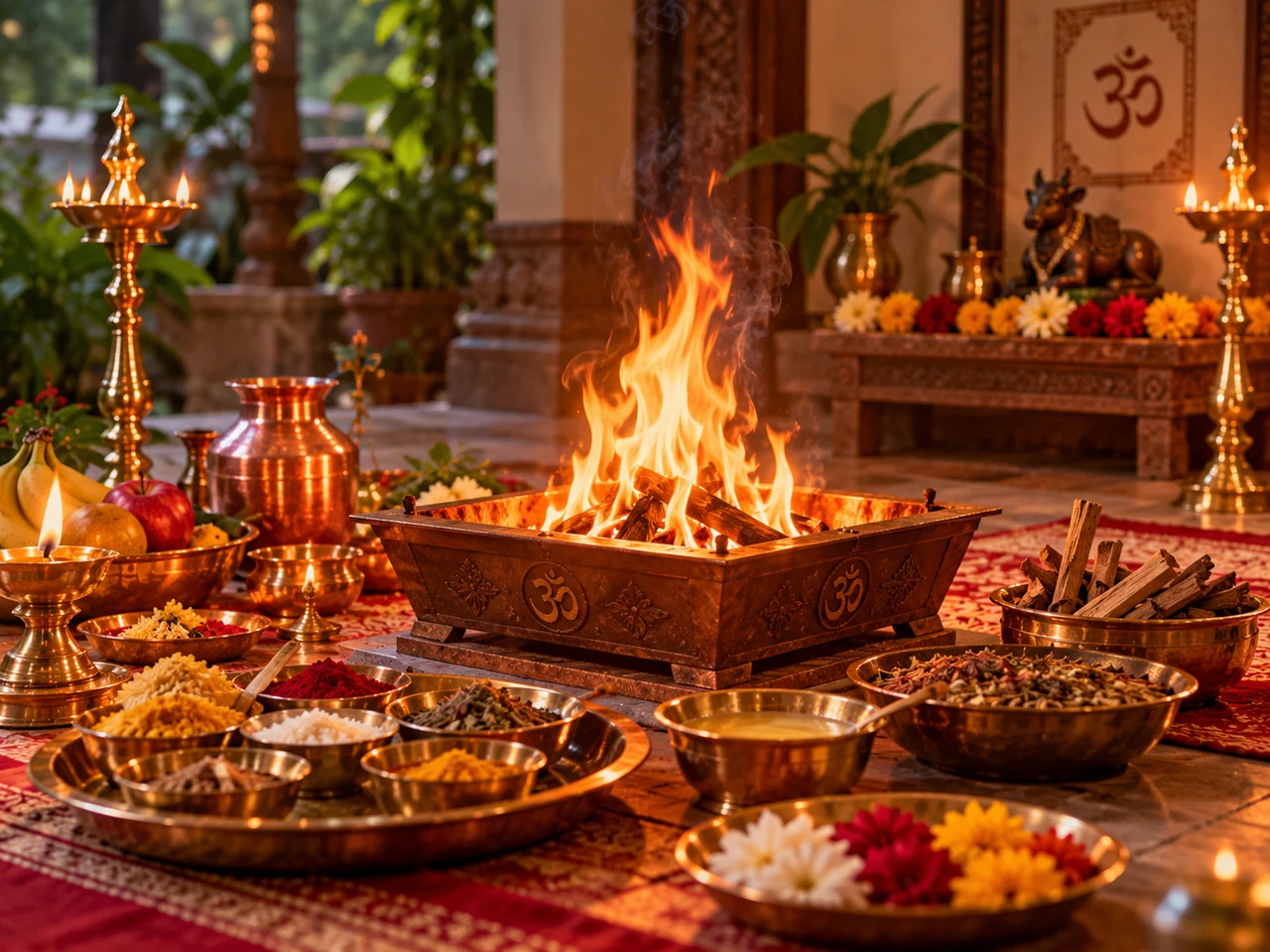
The institutional manual mentions a havan-kuṇḍa, wood or samidhā, ghee, a herb/seed mixture, vessels of water and seating. These illustrate its liturgical setting. They do not constitute a shopping list or permission to burn them in a living room. Fuel quantity, airflow and construction choices cannot be safely specified without site-specific fire expertise. Home shrines, apartments, shared residential buildings, smoke-sensitive rooms and outdoor sites have different risks and restrictions. No type of incense, herb, ghee or wood can be presumed to “clean” indoor air by being burned. The EPA documents fine particulates and combustion byproducts 34.
Before You Begin
Source-specific sequence rather than generic Havan
The DAV text’s presentation broadly moves from intention and preliminary prayers through ācamana, aṅgasparśa, fire-related mantras, fuel and ghee sections, water circumambulation, dedicated ājya prayers, separate solar morning and Agni evening branches, a common portion and a concluding prayer 1. The 1986 organizational letter similarly lists distinct principal divisions 2. this guide records the educational guide and source-recited Sanskrit; it is intentionally not a complete runnable rite. Several of the manual’s eight opening prayers, body formulas and main offerings are identified as untranscribed. None may be silently omitted from a public guided ritual practice merely to meet an appearance of simplicity.
Vedic words and the limits of reader transliteration
The displayed Devanagari follows the checked institutional teaching print only provisionally. It is not a verified edition of the Veda. Vedic svara (accent), sandhi, metrical division and recitation rules are not fully represented in plain modern typography. IAST is a working linguistic aid, not an authorized oral-training substitute. Where the DAV leaflet and the booklet vary (for example, abbreviated versus expanded closing and quoted opening), this edition records the two sources separately. No original Vedic quotation is used to manufacture an unsourced new homa mantra. Formal recitation and officiant competence require a qualified teacher 16?.
How a distinct no-flame devotion works
Without smoke or fire, a person can reflect on generosity, read the meaning of idam na mama and recite a peace prayer. A clean space and a battery-powered light can support reflection. This is a devotional gathering, not a claim that an Agnihotra or Havan has been performed. 1 5
Preparation & Sequential Study
Step 1
Scope and the actual tradition
Arya Samaj daily deva-yajna differs from Smarta and temple deity homa. This guide explains the selected tradition rather than combining these forms into one household rite.
Step 2
Preflight fire and health assessment
Choose surroundings suitable for study and preparation. This guide does not recommend indoor open burning. Actual fire use requires suitable supervision, ventilation, local-rule compliance and site-specific fire precautions.
Step 3
Preparation and meaning of materials
The source mentions a kund, fuel, ghee, water, prayer book and offerings; these are objects of historical study, not a procurement or ignition checklist for a reader.
Context 4
Intention and contemporary sankalpa
Sankalpa expresses the purpose of the observance. Its traditional wording varies by region and family; this guide does not supply a personal gotra, ritual date or muhurta.
Context 5
Opening praise of the Divine
Two of the manual’s eight opening prayers are presented for textual study. They are not a complete preface to a fire ritual.
Original Text
ॐ विश्वानि देव सवितर्दुरितानि परासुव । यद्भद्रं तन्न आ सुव ॥
Roman Transliteration
oṃ vishvaani deva savitarduritaani paraasuva | yadbhadram tanna aa suva ||oṃ viśvāni deva savitar duritāni parā suva | yad bhadraṃ tan na ā suva ||
Meaning
Divine Savitṛ, remove what is harmful and bring what is auspicious.
Related reading & sourceOriginal Text
ॐ अग्ने नय सुपथा राये अस्मान्विश्वानि देव वयुनानि विद्वान् । युयोध्यस्मज्जुहुराणमेनो भूयिष्ठां ते नमउक्तिं विधेम ॥
Roman Transliteration
oṃ agne naya supathaa raaye asmaanvishvaani deva vayunaani vidvaan | yuyodhyasmajjuhuraanameno bhooyishthaam te namauktim vidhema ||oṃ agne naya supathā rāye asmān viśvāni deva vayunāni vidvān | yuyodhy asmaj juhurāṇam eno bhūyiṣṭhāṃ te nama uktiṃ vidhema ||
Meaning
O Agni, knowing the ways, lead us by the good path; remove crooked wrongdoing as we offer our homage.
Related reading & sourceContext 6
Ācamana formulas
Three separate formulas accompany the three ācamana recitations in the DAV source. The source’s ingesting-water gestures are not universal household obligations.
Original Text
ॐ अमृतोपस्तरणमसि स्वाहा ॥
Roman Transliteration
oṃ amritopastaranamasi svāhā ||oṃ amṛtopastaraṇam asi svāhā ||
Meaning
You are an immortal sustaining support; the phrase accompanies the first sipping rite in this edition.
Related reading & sourceOriginal Text
ॐ अमृतापिधानमसि स्वाहा ॥
Roman Transliteration
oṃ amritaapidhaanamasi svāhā ||oṃ amṛtāpidhānam asi svāhā ||
Meaning
You are the immortal covering or protection; second acamana formula.
Related reading & sourceOriginal Text
ॐ सत्यं यशः श्रीर्मयि श्रीः श्रयतां स्वाहा ॥
Roman Transliteration
oṃ satyam yashah shreermayi shreeh shrayataam svāhā ||oṃ satyaṃ yaśaḥ śrīr mayi śrīḥ śrayatāṃ svāhā ||
Meaning
May truth, honorable standing and auspicious well-being abide in me.
Related reading & sourceContext 7
Aṅgasparśa and bodily awareness
The source associates seven lines with bodily awareness. This selection presents only three, not the complete sequence. No therapeutic effect is claimed.
Original Text
ॐ वाङ्म आस्येऽस्तु ॥
Roman Transliteration
oṃ vaanma aasye’stu ||oṃ vāṅ ma āsye ’stu ||
Meaning
May truthful speech abide in my mouth.
Related reading & sourceOriginal Text
ॐ नसोर्मे प्राणोऽस्तु ॥
Roman Transliteration
oṃ nasorme praano’stu ||oṃ nasor me prāṇo ’stu ||
Meaning
May vital breath abide in my nostrils.
Related reading & sourceOriginal Text
ॐ अक्ष्णोर्मे चक्षुरस्तु ॥
Roman Transliteration
oṃ akshnorme chakshurastu ||oṃ akṣṇor me cakṣur astu ||
Meaning
May I have clear sight in my eyes.
Related reading & sourceContext 8
Establishing and awakening Agni
The manual includes prayers for establishing and awakening the fire. They are presented for reading; ignition and fuel-handling techniques are not taught here.
Original Text
ॐ भूर्भुवः स्वः ॥
Roman Transliteration
oṃ bhoorbhuvah svah ||oṃ bhūr bhuvaḥ svaḥ ||
Meaning
An invocation through the three vyāhṛtis in this fire-establishment context.
Related reading & sourceOriginal Text
ॐ उद्बुध्यस्वाग्ने प्रति जागृहि त्वमिष्टापूर्ते सं सृजेथामयं च । अस्मिन्सधस्थे अध्युत्तरस्मिन् विश्वे देवा यजमानश्च सीदत ॥
Roman Transliteration
oṃ udbudhyasvaagne prati jaagrihi tvamishtaapoorte sam srijethaamayam cha | asminsadhasthe adhyuttarasmin vishve devaa yajamaanashcha seedata ||oṃ udbudhyasvāgne prati jāgṛhi tvam iṣṭāpūrte saṃ sṛjethām ayaṃ ca | asmin sadhastha adhyuttarasmin viśve devā yajamānaś ca sīdata ||
Meaning
Awaken, Agni, and support worthy undertakings; may the assembly and sacrificer gather in auspicious fellowship.
Related reading & sourceContext 9
Samidhā offerings
The printed teaching sequence uses distinct verses for three wood-offering positions. These are preserved as textual evidence only; no fuel-placement technique is taught.
Original Text
ॐ अयन्त इध्म आत्मा जातवेदस्तेनेध्यस्व वर्धस्व चेद्ध वर्धय चास्मान् प्रजया पशुभिर्ब्रह्मवर्चसेनान्नाद्येन समेधय स्वाहा । इदमग्नये जातवेदसे इदं न मम ॥
Roman Transliteration
oṃ ayanta idhma aatmaa jaatavedastenedhyasva vardhasva cheddha vardhaya chaasmaan prajayaa pashubhirbrahmavarchasenaannaadyena samedhaya svāhā | idamagnaye jaatavedase idam na mama ||oṃ ayanta idhma ātmā jātavedas tenedhyasva vardhasva ceddha vardhaya cāsmān prajayā paśubhir brahmavarcasenānnādyena samedhaya svāhā | idam agnaye jātavedase idaṃ na mama ||
Meaning
May the sacred fire grow, and may the household flourish through wisdom and sustenance; this offering is not solely mine.
Related reading & sourceOriginal Text
ॐ सुसमिद्धाय शोचिषे घृतं तीव्रं जुहोतन । अग्नये जातवेदसे स्वाहा । इदमग्नये जातवेदसे इदं न मम ॥
Roman Transliteration
oṃ susamiddhaaya shochishe ghritam teevram juhotana | agnaye jaatavedase svāhā | idamagnaye jaatavedase idam na mama ||oṃ susamiddhāya śociṣe ghṛtaṃ tīvraṃ juhotana | agnaye jātavedase svāhā | idam agnaye jātavedase idaṃ na mama ||
Meaning
Offering language addresses the well-kindled fire and asks that its radiance be sustained.
Related reading & sourceOriginal Text
ॐ तं त्वा समिद्भिरङ्गिरो घृतेन वर्धयामसि । बृहच्छोचा यविष्ठ्य स्वाहा । इदमग्नयेऽङ्गिरसे इदं न मम ॥
Roman Transliteration
oṃ tam tvaa samidbhirangiro ghritena vardhayaamasi | brihachchhochaa yavishthya svāhā | idamagnaye’ngirase idam na mama ||oṃ taṃ tvā samidbhir aṅgiro ghṛtena vardhayāmasi | bṛhac chocā yaviṣṭhya svāhā | idam agnaye ’ṅgirase idaṃ na mama ||
Meaning
Agni is addressed as radiant and strengthened by offerings, in the language of the source liturgy.
Related reading & sourceContext 10
Repeated ghṛta prayer
The manual actually repeats the same Jātavedas prayer at a second offering stage. This repetition is source-attested, unlike an invented generic mantra for every action.
Original Text
ॐ अयन्त इध्म आत्मा जातवेदस्तेनेध्यस्व वर्धस्व चेद्ध वर्धय चास्मान् प्रजया पशुभिर्ब्रह्मवर्चसेनान्नाद्येन समेधय स्वाहा । इदमग्नये जातवेदसे इदं न मम ॥
Roman Transliteration
oṃ ayanta idhma aatmaa jaatavedastenedhyasva vardhasva cheddha vardhaya chaasmaan prajayaa pashubhirbrahmavarchasenaannaadyena samedhaya svāhā | idamagnaye jaatavedase idam na mama ||oṃ ayanta idhma ātmā jātavedas tenedhyasva vardhasva ceddha vardhaya cāsmān prajayā paśubhir brahmavarcasenānnādyena samedhaya svāhā | idam agnaye jātavedase idaṃ na mama ||
Meaning
May the sacred fire grow, and may the household flourish through wisdom and sustenance; this offering is not solely mine.
Related reading & sourceOriginal Text
ॐ सुसमिद्धाय शोचिषे घृतं तीव्रं जुहोतन । अग्नये जातवेदसे स्वाहा । इदमग्नये जातवेदसे इदं न मम ॥
Roman Transliteration
oṃ susamiddhaaya shochishe ghritam teevram juhotana | agnaye jaatavedase svāhā | idamagnaye jaatavedase idam na mama ||oṃ susamiddhāya śociṣe ghṛtaṃ tīvraṃ juhotana | agnaye jātavedase svāhā | idam agnaye jātavedase idaṃ na mama ||
Meaning
Offering language addresses the well-kindled fire and asks that its radiance be sustained.
Related reading & sourceOriginal Text
ॐ तं त्वा समिद्भिरङ्गिरो घृतेन वर्धयामसि । बृहच्छोचा यविष्ठ्य स्वाहा । इदमग्नयेऽङ्गिरसे इदं न मम ॥
Roman Transliteration
oṃ tam tvaa samidbhirangiro ghritena vardhayaamasi | brihachchhochaa yavishthya svāhā | idamagnaye’ngirase idam na mama ||oṃ taṃ tvā samidbhir aṅgiro ghṛtena vardhayāmasi | bṛhac chocā yaviṣṭhya svāhā | idam agnaye ’ṅgirase idaṃ na mama ||
Meaning
Agni is addressed as radiant and strengthened by offerings, in the language of the source liturgy.
Related reading & sourceContext 11
Water boundary formulas
The publication lists distinct Aditi, Anumati, Saraswati and Savitṛ recitations. These are not interchangeable with an offering of ghee.
Original Text
ॐ अदितेऽनुमन्यस्व ॥
Roman Transliteration
oṃ adite’numanyasva ||oṃ adite ’numanyasva ||
Meaning
Aditi, grant assent.
Related reading & sourceOriginal Text
ॐ अनुमतेऽनुमन्यस्व ॥
Roman Transliteration
oṃ anumate’numanyasva ||oṃ anumate ’numanyasva ||
Meaning
Anumati, grant assent.
Related reading & sourceOriginal Text
ॐ सरस्वत्यनुमन्यस्व ॥
Roman Transliteration
oṃ sarasvatyanumanyasva ||oṃ sarasvaty anumanyasva ||
Meaning
Saraswati, grant assent.
Related reading & sourceOriginal Text
ॐ देव सवितः प्रसुव यज्ञं प्रसुव यज्ञपतिं भगाय । दिव्यो गन्धर्वः केतपूः केतं नः पुनातु वाचस्पतिर्वाचं नः स्वदतु ॥
Roman Transliteration
oṃ deva savitah prasuva yajnam prasuva yajnapatim bhagaaya | divyo gandharvah ketapooh ketam nah punaatu vaachaspatirvaacham nah svadatu ||oṃ deva savitaḥ prasuva yajñaṃ prasuva yajñapatiṃ bhagāya | divyo gandharvaḥ ketapūḥ ketaṃ naḥ punātu vācaspatir vācaṃ naḥ svadatu ||
Meaning
Divine Savitṛ, inspire the rite; may awareness and speech be purified.
Related reading & sourceContext 12
Ājyabhāga dedications
Four short formulas address Agni, Soma, Prajāpati and Indra respectively; differences matter. They do not authorize physical use by untrained readers.
Original Text
ॐ अग्नये स्वाहा । इदमग्नये इदं न मम ॥
Roman Transliteration
oṃ agnaye svāhā | idamagnaye idam na mama ||oṃ agnaye svāhā | idam agnaye idaṃ na mama ||
Meaning
An offering is dedicated to Agni, not claimed as mine.
Related reading & sourceOriginal Text
ॐ सोमाय स्वाहा । इदं सोमाय इदं न मम ॥
Roman Transliteration
oṃ somaaya svāhā | idam somaaya idam na mama ||oṃ somāya svāhā | idaṃ somāya idaṃ na mama ||
Meaning
The offering is dedicated to Soma without possessiveness.
Related reading & sourceOriginal Text
ॐ प्रजापतये स्वाहा । इदं प्रजापतये इदं न मम ॥
Roman Transliteration
oṃ prajaapataye svāhā | idam prajaapataye idam na mama ||oṃ prajāpataye svāhā | idaṃ prajāpataye idaṃ na mama ||
Meaning
This offering is dedicated to Prajāpati.
Related reading & sourceOriginal Text
ॐ इन्द्राय स्वाहा । इदमिन्द्राय इदं न मम ॥
Roman Transliteration
oṃ indraaya svāhā | idamindraaya idam na mama ||oṃ indrāya svāhā | idam indrāya idaṃ na mama ||
Meaning
This offering is addressed to Indra.
Related reading & sourceContext 13
Morning-specific offerings
The morning branch invokes the solar light through separate readings. It should not be silently blended with the evening branch or assumed to apply at any hour.
Original Text
ॐ सूर्यो ज्योतिर्ज्योतिः सूर्यः स्वाहा ॥
Roman Transliteration
oṃ sooryo jyotirjyotih sooryah svāhā ||oṃ sūryo jyotir jyotiḥ sūryaḥ svāhā ||
Meaning
The Sun is light; light is of the Sun—morning illumination is praised.
Related reading & sourceOriginal Text
ॐ सूर्ये वर्चो ज्योतिर्वर्चः स्वाहा ॥
Roman Transliteration
oṃ soorye varcho jyotirvarchah svāhā ||oṃ sūrye varco jyotir varcaḥ svāhā ||
Meaning
Radiance, luminosity and the Sun are associated in this morning recitation.
Related reading & sourceOriginal Text
ॐ ज्योतिः सूर्यः सूर्यो ज्योतिः स्वाहा ॥
Roman Transliteration
oṃ jyotih sooryah sooryo jyotih svāhā ||oṃ jyotiḥ sūryaḥ sūryo jyotiḥ svāhā ||
Meaning
Light and the Sun are invoked in reciprocal praise.
Related reading & sourceContext 14
Evening alternative
An Agni/light verse identifies the distinct evening branch. It is a different source position, not a second obligatory set in the same morning practice.
Original Text
ॐ अग्निर्ज्योतिर्ज्योतिरग्निः स्वाहा ॥
Roman Transliteration
oṃ agnirjyotirjyotiragnih svāhā ||oṃ agnir jyotir jyotir agniḥ svāhā ||
Meaning
Agni is light; light is Agni, in this distinct evening formula.
Related reading & sourceContext 15
Prāṇa and common offerings
The printed later sequence includes several dedicated mantras; the present three examples are not the whole set. In particular, a Gayatri-plus-svāhā offering differs from private Gayatri japa.
Original Text
ॐ भूर्भुवः स्वः तत्सवितुर्वरेण्यं भर्गो देवस्य धीमहि । धियो यो नः प्रचोदयात् स्वाहा ॥
Roman Transliteration
oṃ bhoorbhuvah svah tatsaviturvarenyam bhargo devasya dheemahi | dhiyo yo nah prachodayaat svāhā ||oṃ bhūr bhuvaḥ svaḥ tat savitur vareṇyaṃ bhargo devasya dhīmahi | dhiyo yo naḥ pracodayāt svāhā ||
Meaning
We contemplate the worthy brilliance of Savitṛ; may that divine radiance inspire our understanding.
Related reading & sourceOriginal Text
ॐ यां मेधां देवगणाः पितरश्चोपासते । तया मामद्य मेधयाग्ने मेधाविनं कुरु स्वाहा ॥
Roman Transliteration
oṃ yaam medhaam devaganaah pitarashchopaasate | tayaa maamadya medhayaagne medhaavinam kuru svāhā ||oṃ yāṃ medhāṃ devagaṇāḥ pitaraś copāsate | tayā mām adya medhayāgne medhāvinaṃ kuru svāhā ||
Meaning
May insight praised by the wise strengthen my discernment.
Related reading & sourceOriginal Text
ॐ विश्वानि देव सवितर्दुरितानि परासुव । यद्भद्रं तन्न आ सुव स्वाहा ॥
Roman Transliteration
oṃ vishvaani deva savitarduritaani paraasuva | yadbhadram tanna aa suva svāhā ||oṃ viśvāni deva savitar duritāni parā suva | yad bhadraṃ tan na ā suva svāhā ||
Meaning
Remove harmful tendencies and bring what is auspicious; the source uses an offering ending here.
Related reading & sourceStep 16
Svāhā and idam na mama
Svāhā marks offerings in the cited liturgy; idam na mama expresses non-appropriation. The syllables do not license a generic formula to replace each attested verse.
Context 17
Completion and pūrṇāhuti
This prayer concludes the selected textual sequence. Institutional repetition customs vary; reading the words alone is not comprehensive training in performing a fire ritual.
Original Text
ॐ सर्वं वै पूर्णं स्वाहा ॥
Roman Transliteration
oṃ sarvam vai poornam svāhā ||oṃ sarvaṃ vai pūrṇaṃ svāhā ||
Meaning
An expression of wholeness marking the formal close of this manual’s offering sequence.
Related reading & sourceContext 18
Optional peace prayer
The printed peace prayer can be studied or recited as a separate, no-flame devotion; its use need not imply a homa occurred.
Original Text
ॐ द्यौः शान्तिरन्तरिक्षं शान्तिः पृथिवी शान्तिरापः शान्तिरोषधयः शान्तिः । वनस्पतयः शान्तिर्विश्वे देवाः शान्तिर्ब्रह्म शान्तिः सर्वं शान्तिः शान्तिरेव शान्तिः सा मा शान्तिरेधि । ॐ शान्तिः शान्तिः शान्तिः ॥
Roman Transliteration
oṃ dyauh shaantirantariksham shaantih prithivee shaantiraapah shaantiroshadhayah shaantih | vanaspatayah shaantirvishve devaah shaantirbrahma shaantih sarvam shaantih shaantireva shaantih saa maa shaantiredhi | oṃ shaantih shaantih shaantih ||oṃ dyauḥ śāntir antarikṣaṃ śāntiḥ pṛthivī śāntir āpaḥ śāntir oṣadhayaḥ śāntiḥ | vanaspatayaḥ śāntir viśve devāḥ śāntir brahma śāntiḥ sarvaṃ śāntiḥ śāntir eva śāntiḥ sā mā śāntir edhi | oṃ śāntiḥ śāntiḥ śāntiḥ ||
Meaning
May peace pervade sky, space, earth, waters, healing plants, trees, all beings and all existence.
Related reading & sourceContext 19
Safe closure and ash handling
Ritual completion and physical cooling are different responsibilities. Follow competent, site-specific fire guidance and never discard hot embers. This article does not teach active-fire management.
Step 20
Non-fire devotional alternative
At a fire-free reading, a family may reflect on truthfulness and generosity and read the separately recorded peace prayer. This is not called a Havan or an equivalent replacement for an authorized Agnihotra.
Original Text
ॐ द्यौः शान्तिरन्तरिक्षं शान्तिः पृथिवी शान्तिरापः शान्तिरोषधयः शान्तिः । वनस्पतयः शान्तिर्विश्वे देवाः शान्तिर्ब्रह्म शान्तिः सर्वं शान्तिः शान्तिरेव शान्तिः सा मा शान्तिरेधि । ॐ शान्तिः शान्तिः शान्तिः ॥
Roman Transliteration
oṃ dyauh shaantirantariksham shaantih prithivee shaantiraapah shaantiroshadhayah shaantih | vanaspatayah shaantirvishve devaah shaantirbrahma shaantih sarvam shaantih shaantireva shaantih saa maa shaantiredhi | oṃ shaantih shaantih shaantih ||oṃ dyauḥ śāntir antarikṣaṃ śāntiḥ pṛthivī śāntir āpaḥ śāntir oṣadhayaḥ śāntiḥ | vanaspatayaḥ śāntir viśve devāḥ śāntir brahma śāntiḥ sarvaṃ śāntiḥ śāntir eva śāntiḥ sā mā śāntir edhi | oṃ śāntiḥ śāntiḥ śāntiḥ ||
Meaning
May peace pervade sky, space, earth, waters, healing plants, trees, all beings and all existence.
Related reading & sourceImportant Precautions
Safety and eligibility before any live flame
A religious text cannot establish that a location is suitable for fire. Local rules, ventilation, smoke exposure, noncombustible surroundings, nearby materials, children, animals, vulnerable people and capable supervision all matter. Combustion can release particulate pollution and carbon monoxide. Avoid indoor wood or charcoal burning and improvised accelerants. Reading prayers does not teach ignition, fuel loading, ember handling or extinguishing. A smaller improvised fire is not a solution to an unsuitable setting. 3 4 5
Respect, environment and obligations
A safe and responsible understanding of yajña includes care for neighbours who may inhale smoke, vulnerable family members, shared building rules and local fire restrictions. Claims that Havan cures disease or that burning any mixture purifies the atmosphere are theological or institutional interpretations unless independently demonstrated; they must not be presented as clinical or environmental findings. Do not expose a child or a smoke-sensitive person merely to reproduce an illustration in a prayer book. Respectful conduct also includes listening to a trained ritualist rather than imitating a photograph as a technical specification 134.
Questions & Further Reading
Can beginners perform an indoor Havan by following this page?
No. This guide explains prayers and background; it is not comprehensive live-fire training. Actual operation requires suitable surroundings, capable supervision and appropriate local and traditional guidance.
Why is the same Jātavedas verse present twice?
The checked institution repeats it at two specified positions. This source-attested reuse is not permission to apply one generic formula to every offering.
Are morning and evening offerings cumulative?
No. The manual distinguishes two branches; mixing them loses their procedural role.
Is the Gayatri mantra always an āhuti formula?
No. The manual shows a svāhā-suffixed offering context; ordinary prayer or japa is a different use.
Does Havan make the air medically clean?
Do not assume so. Smoke and fine particles are recognized respiratory hazards.
What if my family uses a different method?
Treat this as one institutional case study, not a universal substitute. Ask a competent ritual guide and preserve the local tradition.
Can I perform a no-flame version and call it Havan?
No; a prayer session is valuable in its own right, but it is not the fire offering documented here.
Why are some mantras absent despite a detailed guide?
We refuse to manufacture or silently omit required text. The full opening and some later groups need collation; therefore guided ritual practice remains blocked.
Original Roman reading
The Roman reading recorded with this edition, retaining its spelling and word forms before the Easy Roman display conversion.
- Opening praise of the Divine
oṃ viśvāni deva savitar duritāni parā suva | yad bhadraṃ tan na ā suva ||
- Opening praise of the Divine
oṃ agne naya supathā rāye asmān viśvāni deva vayunāni vidvān | yuyodhy asmaj juhurāṇam eno bhūyiṣṭhāṃ te nama uktiṃ vidhema ||
- Ācamana formulas
oṃ amṛtopastaraṇam asi svāhā ||
- Ācamana formulas
oṃ amṛtāpidhānam asi svāhā ||
- Ācamana formulas
oṃ satyaṃ yaśaḥ śrīr mayi śrīḥ śrayatāṃ svāhā ||
- Aṅgasparśa and bodily awareness
oṃ vāṅ ma āsye ’stu ||
- Aṅgasparśa and bodily awareness
oṃ nasor me prāṇo ’stu ||
- Aṅgasparśa and bodily awareness
oṃ akṣṇor me cakṣur astu ||
- Establishing and awakening Agni
oṃ bhūr bhuvaḥ svaḥ ||
- Establishing and awakening Agni
oṃ udbudhyasvāgne prati jāgṛhi tvam iṣṭāpūrte saṃ sṛjethām ayaṃ ca | asmin sadhastha adhyuttarasmin viśve devā yajamānaś ca sīdata ||
- Samidhā offerings
oṃ ayanta idhma ātmā jātavedas tenedhyasva vardhasva ceddha vardhaya cāsmān prajayā paśubhir brahmavarcasenānnādyena samedhaya svāhā | idam agnaye jātavedase idaṃ na mama ||
- Samidhā offerings
oṃ susamiddhāya śociṣe ghṛtaṃ tīvraṃ juhotana | agnaye jātavedase svāhā | idam agnaye jātavedase idaṃ na mama ||
- Samidhā offerings
oṃ taṃ tvā samidbhir aṅgiro ghṛtena vardhayāmasi | bṛhac chocā yaviṣṭhya svāhā | idam agnaye ’ṅgirase idaṃ na mama ||
- Repeated ghṛta prayer
oṃ ayanta idhma ātmā jātavedas tenedhyasva vardhasva ceddha vardhaya cāsmān prajayā paśubhir brahmavarcasenānnādyena samedhaya svāhā | idam agnaye jātavedase idaṃ na mama ||
- Repeated ghṛta prayer
oṃ susamiddhāya śociṣe ghṛtaṃ tīvraṃ juhotana | agnaye jātavedase svāhā | idam agnaye jātavedase idaṃ na mama ||
- Repeated ghṛta prayer
oṃ taṃ tvā samidbhir aṅgiro ghṛtena vardhayāmasi | bṛhac chocā yaviṣṭhya svāhā | idam agnaye ’ṅgirase idaṃ na mama ||
- Water boundary formulas
oṃ adite ’numanyasva ||
- Water boundary formulas
oṃ anumate ’numanyasva ||
- Water boundary formulas
oṃ sarasvaty anumanyasva ||
- Water boundary formulas
oṃ deva savitaḥ prasuva yajñaṃ prasuva yajñapatiṃ bhagāya | divyo gandharvaḥ ketapūḥ ketaṃ naḥ punātu vācaspatir vācaṃ naḥ svadatu ||
- Ājyabhāga dedications
oṃ agnaye svāhā | idam agnaye idaṃ na mama ||
- Ājyabhāga dedications
oṃ somāya svāhā | idaṃ somāya idaṃ na mama ||
- Ājyabhāga dedications
oṃ prajāpataye svāhā | idaṃ prajāpataye idaṃ na mama ||
- Ājyabhāga dedications
oṃ indrāya svāhā | idam indrāya idaṃ na mama ||
- Morning-specific offerings
oṃ sūryo jyotir jyotiḥ sūryaḥ svāhā ||
- Morning-specific offerings
oṃ sūrye varco jyotir varcaḥ svāhā ||
- Morning-specific offerings
oṃ jyotiḥ sūryaḥ sūryo jyotiḥ svāhā ||
- Evening alternative
oṃ agnir jyotir jyotir agniḥ svāhā ||
- Prāṇa and common offerings
oṃ bhūr bhuvaḥ svaḥ tat savitur vareṇyaṃ bhargo devasya dhīmahi | dhiyo yo naḥ pracodayāt svāhā ||
- Prāṇa and common offerings
oṃ yāṃ medhāṃ devagaṇāḥ pitaraś copāsate | tayā mām adya medhayāgne medhāvinaṃ kuru svāhā ||
- Prāṇa and common offerings
oṃ viśvāni deva savitar duritāni parā suva | yad bhadraṃ tan na ā suva svāhā ||
- Completion and pūrṇāhuti
oṃ sarvaṃ vai pūrṇaṃ svāhā ||
- Optional peace prayer
oṃ dyauḥ śāntir antarikṣaṃ śāntiḥ pṛthivī śāntir āpaḥ śāntir oṣadhayaḥ śāntiḥ | vanaspatayaḥ śāntir viśve devāḥ śāntir brahma śāntiḥ sarvaṃ śāntiḥ śāntir eva śāntiḥ sā mā śāntir edhi | oṃ śāntiḥ śāntiḥ śāntiḥ ||
- Non-fire devotional alternative
oṃ dyauḥ śāntir antarikṣaṃ śāntiḥ pṛthivī śāntir āpaḥ śāntir oṣadhayaḥ śāntiḥ | vanaspatayaḥ śāntir viśve devāḥ śāntir brahma śāntiḥ sarvaṃ śāntiḥ śāntir eva śāntiḥ sā mā śāntir edhi | oṃ śāntiḥ śāntiḥ śāntiḥ ||
Reused text credits & licences
Sanskrit comparative witness: ऋग्वेदः सूक्तं ५.८२, Wikisource contributors, https://sa.wikisource.org/w/index.php?oldid=199814. CC BY-SA 4.0; attribution and ShareAlike apply to this adapted reading and aligned meanings. The supplied Om prefix is retained separately; unaccented wording, punctuation and orthographic choices remain as provided. Not independent glyph collation or ritual certification.
LicenceSanskrit comparative witness: ऋग्वेदः सूक्तं १.१८९, Wikisource contributors, https://sa.wikisource.org/w/index.php?oldid=280158. CC BY-SA 4.0; attribution and ShareAlike apply to this adapted reading and aligned meanings. The supplied Om prefix is retained separately; unaccented wording, punctuation and orthographic choices remain as provided. Not independent glyph collation or ritual certification.
LicenceInherited brief salutation or offering formula. Only the short traditional words are used; no modern translation or ritual compilation is reproduced. ShivGoraksh bilingual meanings and explanations are original educational writing.
Inherited brief salutation or offering formula. Only the short traditional words are used; no modern translation or ritual compilation is reproduced. ShivGoraksh bilingual meanings and explanations are original educational writing.
Vedic comparative reading: आश्वलायनगृह्यसूत्रम्/अध्यायः १, Wikisource contributors, https://sa.wikisource.org/w/index.php?oldid=334455. CC BY-SA 4.0; attribution and ShareAlike apply to adapted text and aligned meanings. Selected unaccented reading retained. Om and offering endings remain separate from the Vedic core; accents, sandhi, punctuation and letter variants are not silently replaced.
LicenceInherited brief salutation or offering formula. Only the short traditional words are used; no modern translation or ritual compilation is reproduced. ShivGoraksh bilingual meanings and explanations are original educational writing.
Inherited brief salutation or offering formula. Only the short traditional words are used; no modern translation or ritual compilation is reproduced. ShivGoraksh bilingual meanings and explanations are original educational writing.
Inherited brief salutation or offering formula. Only the short traditional words are used; no modern translation or ritual compilation is reproduced. ShivGoraksh bilingual meanings and explanations are original educational writing.
Sanskrit comparative witness: शुक्लयजुर्वेदः/अध्यायः ३, Wikisource contributors, https://sa.wikisource.org/w/index.php?oldid=415465. CC BY-SA 4.0; attribution and ShareAlike apply to this adapted reading and aligned meanings. The supplied Om prefix is retained separately; unaccented wording, punctuation and orthographic choices remain as provided. Not independent glyph collation or ritual certification.
LicenceVedic comparative reading: शुक्लयजुर्वेदः/अध्यायः १८, Wikisource contributors, https://sa.wikisource.org/w/index.php?oldid=398327. CC BY-SA 4.0; attribution and ShareAlike apply to adapted text and aligned meanings. Selected unaccented reading retained. Om and offering endings remain separate from the Vedic core; accents, sandhi, punctuation and letter variants are not silently replaced.
LicenceTraditional Sanskrit prayer; Inherited fuel prayer, Ashvalayana Grihya Sutra 1.10.12; Jaimini Grihya Sutra 1.3.14 comparative witness, https://hasp.ub.uni-heidelberg.de/journals/ejvs/article/download/22464/21871/45970. The selected word order and offering ending are retained. The modern article, translation and performance instructions are not reproduced. ShivGoraksh meanings are separate educational writing.
Vedic comparative reading: शुक्लयजुर्वेदः/अध्यायः ०३, Wikisource contributors, https://sa.wikisource.org/w/index.php?oldid=415465. CC BY-SA 4.0; attribution and ShareAlike apply to adapted text and aligned meanings. Selected unaccented reading retained. Om and offering endings remain separate from the Vedic core; accents, sandhi, punctuation and letter variants are not silently replaced.
LicenceVedic comparative reading: शुक्लयजुर्वेदः/अध्यायः ०३, Wikisource contributors, https://sa.wikisource.org/w/index.php?oldid=415465. CC BY-SA 4.0; attribution and ShareAlike apply to adapted text and aligned meanings. Selected unaccented reading retained. Om and offering endings remain separate from the Vedic core; accents, sandhi, punctuation and letter variants are not silently replaced.
LicenceInherited brief salutation or offering formula. Only the short traditional words are used; no modern translation or ritual compilation is reproduced. ShivGoraksh bilingual meanings and explanations are original educational writing.
Inherited brief salutation or offering formula. Only the short traditional words are used; no modern translation or ritual compilation is reproduced. ShivGoraksh bilingual meanings and explanations are original educational writing.
Inherited brief salutation or offering formula. Only the short traditional words are used; no modern translation or ritual compilation is reproduced. ShivGoraksh bilingual meanings and explanations are original educational writing.
Vedic comparative reading: शुक्लयजुर्वेदः/अध्यायः ११, Wikisource contributors, https://sa.wikisource.org/w/index.php?oldid=369790. CC BY-SA 4.0; attribution and ShareAlike apply to adapted text and aligned meanings. Selected unaccented reading retained. Om and offering endings remain separate from the Vedic core; accents, sandhi, punctuation and letter variants are not silently replaced.
LicenceInherited brief salutation or offering formula. Only the short traditional words are used; no modern translation or ritual compilation is reproduced. ShivGoraksh bilingual meanings and explanations are original educational writing.
Inherited brief salutation or offering formula. Only the short traditional words are used; no modern translation or ritual compilation is reproduced. ShivGoraksh bilingual meanings and explanations are original educational writing.
Inherited brief salutation or offering formula. Only the short traditional words are used; no modern translation or ritual compilation is reproduced. ShivGoraksh bilingual meanings and explanations are original educational writing.
Inherited brief salutation or offering formula. Only the short traditional words are used; no modern translation or ritual compilation is reproduced. ShivGoraksh bilingual meanings and explanations are original educational writing.
Sanskrit comparative witness: शुक्लयजुर्वेदः/अध्यायः ३, Wikisource contributors, https://sa.wikisource.org/w/index.php?oldid=415465. CC BY-SA 4.0; attribution and ShareAlike apply to this adapted reading and aligned meanings. The supplied Om prefix is retained separately; unaccented wording, punctuation and orthographic choices remain as provided. Not independent glyph collation or ritual certification.
LicenceInherited brief salutation or offering formula. Only the short traditional words are used; no modern translation or ritual compilation is reproduced. ShivGoraksh bilingual meanings and explanations are original educational writing.
Sanskrit comparative witness: शुक्लयजुर्वेदः/अध्यायः ३, Wikisource contributors, https://sa.wikisource.org/w/index.php?oldid=415465. CC BY-SA 4.0; attribution and ShareAlike apply to this adapted reading and aligned meanings. The supplied Om prefix is retained separately; unaccented wording, punctuation and orthographic choices remain as provided. Not independent glyph collation or ritual certification.
LicenceSanskrit comparative witness: शुक्लयजुर्वेदः/अध्यायः ३, Wikisource contributors, https://sa.wikisource.org/w/index.php?oldid=415465. CC BY-SA 4.0; attribution and ShareAlike apply to this adapted reading and aligned meanings. The supplied Om prefix is retained separately; unaccented wording, punctuation and orthographic choices remain as provided. Not independent glyph collation or ritual certification.
LicenceVedic comparative reading: शुक्लयजुर्वेदः/अध्यायः ३६, Wikisource contributors, https://sa.wikisource.org/w/index.php?oldid=310472. CC BY-SA 4.0; attribution and ShareAlike apply to adapted text and aligned meanings. Selected unaccented reading retained. Om and offering endings remain separate from the Vedic core; accents, sandhi, punctuation and letter variants are not silently replaced.
LicenceVedic comparative reading: शुक्लयजुर्वेदः/अध्यायः ३२, Wikisource contributors, https://sa.wikisource.org/w/index.php?oldid=401215. CC BY-SA 4.0; attribution and ShareAlike apply to adapted text and aligned meanings. Selected unaccented reading retained. Om and offering endings remain separate from the Vedic core; accents, sandhi, punctuation and letter variants are not silently replaced.
LicenceVedic comparative reading: शुक्लयजुर्वेदः/अध्यायः ३०, Wikisource contributors, https://sa.wikisource.org/w/index.php?oldid=321120. CC BY-SA 4.0; attribution and ShareAlike apply to adapted text and aligned meanings. Selected unaccented reading retained. Om and offering endings remain separate from the Vedic core; accents, sandhi, punctuation and letter variants are not silently replaced.
LicenceInherited brief salutation or offering formula. Only the short traditional words are used; no modern translation or ritual compilation is reproduced. ShivGoraksh bilingual meanings and explanations are original educational writing.
Vedic comparative reading: शुक्लयजुर्वेदः/अध्यायः ३६, Wikisource contributors, https://sa.wikisource.org/w/index.php?oldid=310472. CC BY-SA 4.0; attribution and ShareAlike apply to adapted text and aligned meanings. Selected unaccented reading retained. Om and offering endings remain separate from the Vedic core; accents, sandhi, punctuation and letter variants are not silently replaced.
LicenceReferences & Sources (10)
This bibliography accompanies the article. Source links do not establish independent textual verification or permission to reuse material.
- Agnihotra Book Final: Agnihotra (daily worship manual)
- Agnihotra Broucher — Daily Havan / Dainik Dev-Yajnya
- Letter on the order of Dainik Havan
- Havan Mantras
- Sources of Indoor Particulate Matter (PM)
- Smoke from Residential Wood Burning
- Candle Fire Safety
- Havan Format & Sequence
- Sanskar Vidhi (Saṃskāravidhi)
- Candle Safety
About this article
Founder-reviewed educational edition, without a claim of independent scholarly certification. The references above identify source-specific variants and reuse conditions.
Editorial policy