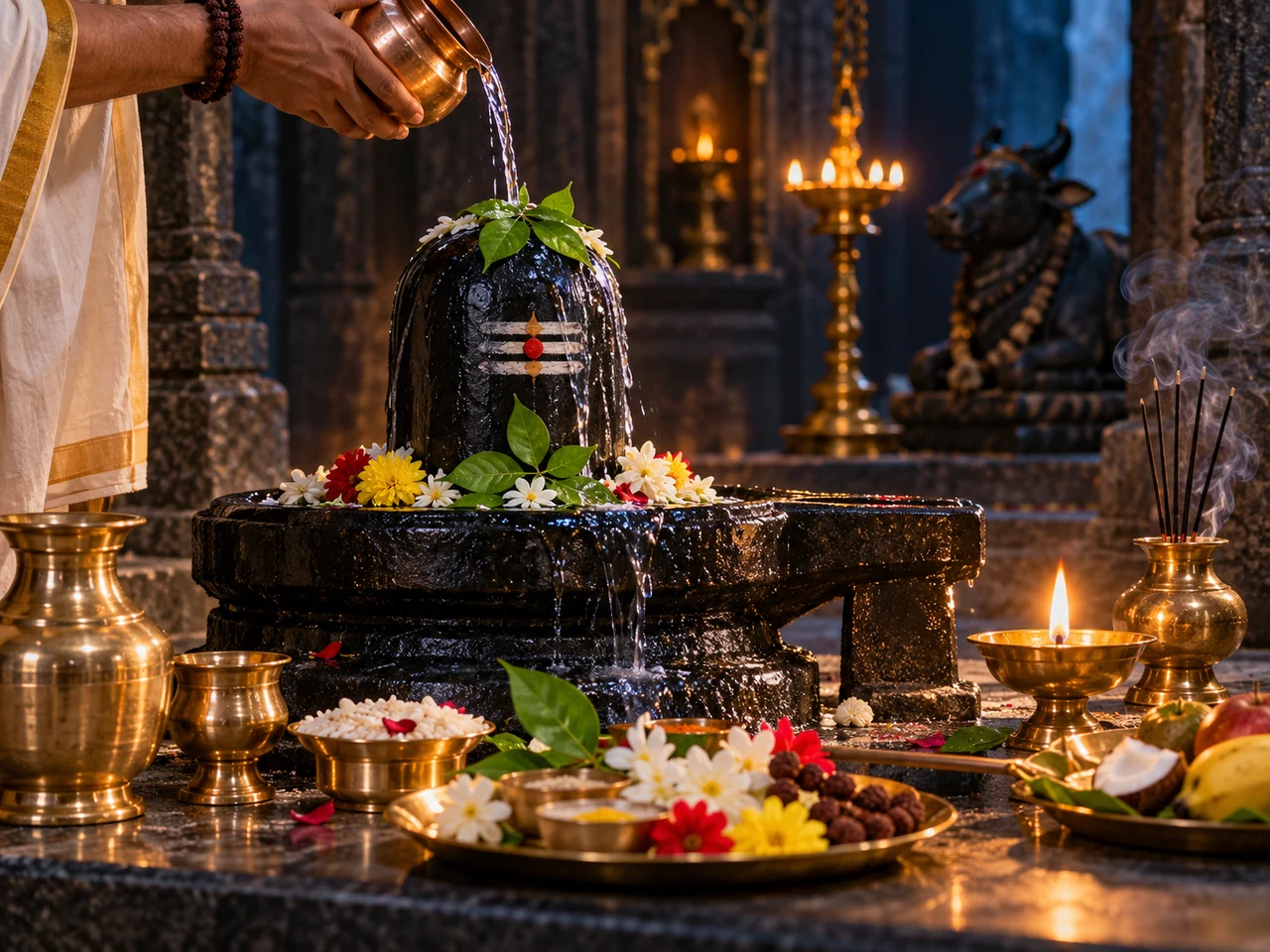
Household Worship: Steps & Context
Step 1 · Optional
Prepare the space, supplies and safety
Clean a small personal shrine; set a tray under a washable home linga. Place clean drinking water in a separate vessel from runoff; assemble offerings; keep paths clear. Do not touch temple installations without staff permission.Clean a small personal shrine; set a tray under a washable home liṅga. Place clean drinking water in a separate vessel from runoff; assemble offerings; keep paths clear. Do not touch temple installations without staff permission.
The source methods prescribe ordinary cleanliness but not an additional standalone mantra for washing the room. No mantra has been invented.
Step 2 · Optional
Optional Ganesha remembrance
Before Shiva meditation, optionally recall Ganesha for a clear beginning. This is a documented add-on, NOT in the numbered Shiva Drik Panchang sequence.
An auspicious opening and request to proceed without obstacles.
Original Text
वक्रतुण्ड महाकाय सूर्यकोटिसमप्रभ ।
निर्विघ्नं कुरु मे देव सर्वकार्येषु सर्वदा ॥
Roman Transliteration
vakratunda mahaakaaya sooryakotisamaprabha |
nirvighnam kuru me deva sarvakaaryeshu sarvadaa ||vakratuṇḍa mahākāya sūryakoṭisamaprabha |
nirvighnaṃ kuru me deva sarvakāryeṣu sarvadā ||
Meaning
An auspicious opening and request to proceed without obstacles.
Explanation
Optional independent prayer, not required by the chosen Shiva source.
Related reading & sourceStep 3 · Optional
Optional Guru remembrance
Offer reverence to teachers and the transmission of sacred knowledge before the named puja sequence; no initiation is implied.
Honours knowledge and the teacher as a guide, not a substitute for skilled ritual authorization.
Original Text
गुरुर्ब्रह्मा गुरुर्विष्णुर्गुरुर्देवो महेश्वरः ।
गुरुः साक्षात् परं ब्रह्म तस्मै श्रीगुरवे नमः ॥
Roman Transliteration
gururbrahmaa gururvishnurgururdevo maheshvarah |
guruh saakshaat param brahma tasmai shreegurave namah ||gurur brahmā gurur viṣṇur gurur devo maheśvaraḥ |
guruḥ sākṣāt paraṃ brahma tasmai śrīgurave namaḥ ||
Meaning
Honours knowledge and the teacher as a guide, not a substitute for skilled ritual authorization.
Explanation
Optional independent prayer, not required by the chosen Shiva source.
Related reading & sourceStep 4
Meditate on Shiva
Sit calmly before a personal shrine and contemplate Shiva as an auspicious, compassionate presence. No mudrā, yogic breathing, or initiated visualization is required.
The opening situates the rest of the offerings in awareness rather than mechanical handling.
Original Text
ध्यायेन्नित्यं महेशं रजतगिरिनिभं चारुचन्द्रावतंसं
रत्नाकल्पोज्ज्वलाङ्गं परशुमृगवराभीतिहस्तं प्रसन्नम्।
पद्मासीनं समन्तात् स्तुतममरगणैर्व्याघ्रकृत्तिं वसानं
विश्वाद्यं विश्वबीजं निखिलभयहरं पञ्चवक्त्रं त्रिनेत्रम्॥
बन्धूकसन्निभं देवं त्रिनेत्रं चन्द्रशेखरम्।
त्रिशूलधारिणं वन्दे चारुहासं सुनिर्मलम्॥
कपालधारिणं देवं वरदाभयहस्तकम्।
उमया सहितं शम्भुं ध्यायेत् सोमेश्वरं सदा॥
Roman Transliteration
dhyaayennityam mahesham rajatagirinibham chaaruchandraavatamsam
ratnaakalpojjvalaangam parashumrigavaraabheetihastam prasannam|
padmaaseenam samantaat stutamamaraganairvyaaghrakrittim vasaanam
vishvaadyam vishvabeejam nikhilabhayaharam panchavaktram trinetram||
bandhookasannibham devam trinetram chandrashekharam|
trishooladhaarinam vande chaaruhaasam sunirmalam||
kapaaladhaarinam devam varadaabhayahastakam|
umayaa sahitam shambhum dhyaayet someshvaram sadaa||dhyāyennityaṃ maheśaṃ rajatagirinibhaṃ cārucandrāvataṃsaṃ
ratnākalpojjvalāṅgaṃ paraśumṛgavarābhītihastaṃ prasannam |
padmāsīnaṃ samantāt stutamamaragaṇairvyāghrakṛttiṃ vasānaṃ
viśvādyaṃ viśvabījaṃ nikhilabhayaharaṃ pañcavaktraṃ trinetram ||
bandhūkasannibhaṃ devaṃ trinetraṃ candraśekharam |
triśūladhāriṇaṃ vande cāruhāsaṃ sunirmalam ||
kapāladhāriṇaṃ devaṃ varadābhayahastakam |
umayā sahitaṃ śambhuṃ dhyāyet someśvaraṃ sadā ||
Meaning
Contemplate Mahesha, radiant like a silver mountain, crowned with the beautiful crescent moon; shining with ornaments, holding the axe and deer, granting fearlessness and blessings. Seated on a lotus, praised by divine beings and clothed in a tiger skin, he is described as the source of the universe, five-faced and three-eyed. The following lines salute the moon-crested, trident-bearing, gracious Shiva, united with Uma.
Explanation
The opening situates the rest of the offerings in awareness rather than mechanical handling. The prayer accompanies this offering.
Related reading & sourceContext 5
Invocation
Invocation greets the presence already venerated at an established household shrine. It should not be confused with prana-pratishtha, a consecration rite with its own tradition-specific requirements.
Different traditions handle permanent and temporary installations differently.
Original Text
आगच्छ भगवन्देव स्थाने चात्र स्थिरो भव।
यावत्पूजां करिष्यामि तावत्त्वं सन्निधौ भव॥
Roman Transliteration
aagachchha bhagavandeva sthaane chaatra sthiro bhava|
yaavatpoojaam karishyaami taavattvam sannidhau bhava||āgaccha bhagavandeva sthāne cātra sthiro bhava |
yāvatpūjāṃ kariṣyāmi tāvattvaṃ sannidhau bhava ||
Meaning
Lord, graciously come and remain present here throughout the worship I am about to offer.
Explanation
Different traditions handle permanent and temporary installations differently. The prayer accompanies this offering.
Related reading & sourceStep 6
Offer water for the feet
Place a small spoonful of clean water in the offering vessel; no need to pour it over an immovable temple image.
This is the hospitality of receiving an honoured guest.
Original Text
महादेव महेशान महादेव परात्पर।
पाद्यं गृहाण मद्दतं पार्वतीसहितेश्वर॥
Roman Transliteration
Mahadeva maheshaana Mahadeva paraatpara|
paadyam grihaana maddatam paarvateesahiteshvara||mahādeva maheśāna mahādeva parātpara |
pādyaṃ gṛhāṇa maddataṃ pārvatīsahiteśvara ||
Meaning
Great Lord, transcendent Mahadeva, together with Parvati, please receive the water offered for your feet.
Explanation
This is the hospitality of receiving an honoured guest. The prayer accompanies this offering.
Related reading & sourceStep 7
Offer arghya water
Offer a little water separately from pādya. Some Shiva manuals direct it toward the head; do not treat that temple instruction as authorization to touch a protected linga.Offer a little water separately from pādya. Some Shiva manuals direct it toward the head; do not treat that temple instruction as authorization to touch a protected liṅga.
Pādya, arghya and ācamaniya are distinct acts in the cited fuller manual.
Original Text
त्र्यम्बकेश सदाचार जगदादिविधायक।
अर्घ्यं गृहाण देवेश साम्बसर्वार्थदायक॥
Roman Transliteration
tryambakesha sadaachaara jagadaadividhaayaka|
arghyam grihaana devesha saambasarvaarthadaayaka||tryambakeśa sadācāra jagadādividhāyaka |
arghyaṃ gṛhāṇa deveśa sāmbasarvārthadāyaka ||
Meaning
O three-eyed Lord, guide of the world and divine giver, please receive this honoured water-offering.
Explanation
Pādya, arghya and ācamaniya are distinct acts in the cited fuller manual. The prayer accompanies this offering.
Related reading & sourceStep 8
Offer water for ācamana
Offer clean water in a small designated bowl. This is water offered to the deity; it is not an instruction for the reader to perform priestly ācamana.
Do not confuse deity ācamaniya with the participant’s own purification rite.
Original Text
त्रिपुरान्तक दीनार्तिनाश श्रीकण्ठशाश्वत।
गृहाणाचमनीयं च पवित्रोदककल्पितम्॥
Roman Transliteration
tripuraantaka deenaartinaasha shreekanthashaashvata|
grihaanaachamaneeyam cha pavitrodakakalpitam||tripurāntaka dīnārtināśa śrīkaṇṭhaśāśvata |
gṛhāṇācamanīyaṃ ca pavitrodakakalpitam ||
Meaning
Protector who ended Tripura, reliever of the distressed, eternal blue-throated Lord: receive this clean water for ceremonial sipping.
Explanation
Do not confuse deity ācamaniya with the participant’s own purification rite. The prayer accompanies this offering.
Related reading & sourceStep 9 · Optional
Optional milk bathing
The cited longer method lists a milk bath; it is not required in the selected household approach. Do not use milk where hygiene, materials, accessibility or shrine policy make it unsuitable.
Water-only bathing is simpler and avoids dairy waste.
Original Text
मधुरं गोपयः पुण्यं पटपूतं पुरस्कृतम्।
स्नानार्थं देव देवेश गृहाण परमेश्वर॥
Roman Transliteration
madhuram gopayah punyam patapootam puraskritam|
snaanaartham deva devesha grihaana parameshvara||madhuraṃ gopayaḥ puṇyaṃ paṭapūtaṃ puraskṛtam |
snānārthaṃ deva deveśa gṛhāṇa parameśvara ||
Meaning
Lord of gods, please accept this sweet, strained and respectfully presented cow’s milk for bathing.
Explanation
Water-only bathing is simpler and avoids dairy waste. The prayer accompanies this offering.
Related reading & sourceStep 10 · Optional
Optional curd bathing
Recorded in the extended sequence, but omitted in a everyday household selection; do not mix ingredients unless the selected rite specifically calls for them.
Not interchangeable with the later pure-water rinse.
Original Text
दुर्लभं दिवि सुस्वादु दधि सर्वप्रियं परम्।
पुष्टिदं पार्वतीनाथ स्नानाय प्रतिगृह्यताम्॥
Roman Transliteration
durlabham divi susvaadu dadhi sarvapriyam param|
pushtidam paarvateenaatha snaanaaya pratigrihyataam||durlabhaṃ divi susvādu dadhi sarvapriyaṃ param |
puṣṭidaṃ pārvatīnātha snānāya pratigṛhyatām ||
Meaning
Lord of Parvati, receive this pleasing, nourishing curd offered for your bath.
Explanation
Not interchangeable with the later pure-water rinse. The prayer accompanies this offering.
Related reading & sourceStep 11 · Optional
Optional ghee bathing
The named source includes this in a richer ritual; it is unnecessary for the water-only household approach, and slippery residues are a practical concern.
The custom can be understood without wasteful or unsafe use of materials.
Original Text
घृतं गव्यं शुचि स्निग्धं सुसेव्यं पुष्टिमिच्छताम्।
गृहाण गिरिजानाथ स्नानाय चन्द्रशेखर॥
Roman Transliteration
ghritam gavyam shuchi snigdham susevyam pushtimichchhataam|
grihaana girijaanaatha snaanaaya chandrashekhara||ghṛtaṃ gavyaṃ śuci snigdhaṃ susevyaṃ puṣṭimicchatām |
gṛhāṇa girijānātha snānāya candraśekhara ||
Meaning
Girinatha, moon-crested Lord, receive this pure, smooth cow’s ghee offered as a bathing substance.
Explanation
The custom can be understood without wasteful or unsafe use of materials. The prayer accompanies this offering.
Related reading & sourceStep 12 · Optional
Optional honey bathing
A separate optional part of the source’s five-ingredient bathing sequence; avoid sticky residue, insects and sanitation problems.
Honey is not a requirement for receiving Shiva’s grace.
Original Text
मधुरं मृदु मोहघ्नं स्वरभङ्गविनाशनम्।
महादेवेदमुत्सृष्टं तव स्नानाय शङ्कर॥
Roman Transliteration
madhuram mridu mohaghnam svarabhangavinaashanam|
mahaadevedamutsrishtam tava snaanaaya Shankara||madhuraṃ mṛdu mohaghnaṃ svarabhaṅgavināśanam |
mahādevedamutsṛṣṭaṃ tava snānāya śaṅkara ||
Meaning
Great Shiva, this sweet and gentle honey—traditionally praised for its qualities—is offered for your bath. The verse’s medicinal-sounding descriptors are ritual praise, not a healthcare claim.
Explanation
Honey is not a requirement for receiving Shiva’s grace. The prayer accompanies this offering.
Related reading & sourceStep 13 · Optional
Optional sugar bathing
The published fuller procedure ends its ingredient baths with sugar before a water rinse. This remains outside the selected household approach.
An optional ingredient rite is not part of the minimum public observance.
Original Text
तापशान्तिकरी शीता मधुरास्वादसंयुता।
स्नानार्थं देवदेवेश शर्करेयं प्रदीयते॥
Roman Transliteration
taapashaantikaree sheetaa madhuraasvaadasamyutaa|
snaanaartham devadevesha sharkareyam pradeeyate||tāpaśāntikarī śītā madhurāsvādasaṃyutā |
snānārthaṃ devadeveśa śarkareyaṃ pradīyate ||
Meaning
Lord of gods, this cool, sweet sugar is presented for the bathing offering.
Explanation
An optional ingredient rite is not part of the minimum public observance. The prayer accompanies this offering.
Related reading & sourceStep 14
Offer clean water / abhiṣeka
For a movable personal linga that can safely be washed, let a modest amount of clean, room-temperature water flow gently into a collection vessel. For a fixed or delicate shrine, use symbolic water in a separate bowl.For a movable personal liṅga that can safely be washed, let a modest amount of clean, room-temperature water flow gently into a collection vessel. For a fixed or delicate shrine, use symbolic water in a separate bowl.
This is the central water/abhiṣeka action. Here the source prints its own short formula; longer bathing hymns are optional elsewhere.
Original Text
गङ्गा गोदावरी रेवा पयोष्णी यमुना तथा।
सरस्वत्यादितीर्थानि स्नानार्थं प्रतिगृह्यताम्॥
Roman Transliteration
gangaa godaavaree revaa payoshnee yamunaa tathaa|
sarasvatyaaditeerthaani snaanaartham pratigrihyataam||gaṅgā godāvarī revā payoṣṇī yamunā tathā |
sarasvatyāditīrthāni snānārthaṃ pratigṛhyatām ||
Meaning
May you accept this bathing water, reverently associated with Ganga, Godavari, Reva, Payoshni, Yamuna, Saraswati and other sacred waters. The prayer is symbolic; ordinary water is not claimed to be sourced from those rivers.
Explanation
This is the central water/abhiṣeka action. Here the source prints its own short formula; longer bathing hymns are optional elsewhere. The prayer accompanies this offering.
Related reading & sourceStep 15 · Optional
Optional symbolic cloth
Only if an appropriate clean cloth can be placed without damaging the linga; otherwise keep it beside the altar symbolically.Only if an appropriate clean cloth can be placed without damaging the liṅga; otherwise keep it beside the altar symbolically.
The shape and established status of a linga affect feasible offerings.The shape and established status of a liṅga affect feasible offerings.
Original Text
सर्वभूषाधिके सौम्ये लोकलज्जानिवारणे।
मयोपपादिते देव गृह्यतां वाससी शुभे॥
Roman Transliteration
sarvabhooshaadhike saumye lokalajjaanivaarane|
mayopapaadite deva grihyataam vaasasee shubhe||sarvabhūṣādhike saumye lokalajjānivāraṇe |
mayopapādite deva gṛhyatāṃ vāsasī śubhe ||
Meaning
Please accept the auspicious garment respectfully prepared as an adornment and covering.
Explanation
The shape and established status of a linga affect feasible offerings. The prayer accompanies this offering.The shape and established status of a liṅga affect feasible offerings. The prayer accompanies this offering.
Related reading & sourceContext 16
Optional sacred-thread offering
The source includes this treatment, but it is tradition-dependent and should not be imposed on all household shrines.
Symbolic offering must not be used to make caste or eligibility claims.
Original Text
नवभिस्तन्तुभिर्युक्तं त्रिगुणं देवतामयम्।
उपवीतं चोत्तरीयं गृहाण पार्वतीपते॥
Roman Transliteration
navabhistantubhiryuktam trigunam devataamayam|
upaveetam chottareeyam grihaana paarvateepate||navabhistantubhiryuktaṃ triguṇaṃ devatāmayam |
upavītaṃ cottarīyaṃ gṛhāṇa pārvatīpate ||
Meaning
Lord of Parvati, accept the sacred thread, described as comprising nine strands and threefold construction, as an offering.
Explanation
Symbolic offering must not be used to make caste or eligibility claims. The prayer accompanies this offering.
Related reading & sourceStep 17
Apply sandalwood fragrance
Offer a small amount of suitable sandal paste on an allowed surface, or in a small dish when direct application is unsuitable.
Gandha conveys care and hospitality, not a guarantee of material reward.
Original Text
श्रीखण्डं चन्दनं दिव्यं गन्धाढ्यं सुमनोहरम्।
विलेपनं सुरश्रेष्ठ चन्दनं प्रतिगृह्यताम्॥
Roman Transliteration
shreekhandam chandanam divyam gandhaadhyam sumanoharam|
vilepanam surashreshtha chandanam pratigrihyataam||śrīkhaṇḍaṃ candanaṃ divyaṃ gandhāḍhyaṃ sumanoharam |
vilepanaṃ suraśreṣṭha candanaṃ pratigṛhyatām ||
Meaning
Lord among gods, receive this fine, pleasing, fragrant sandalwood paste for anointing.
Explanation
Gandha conveys care and hospitality, not a guarantee of material reward. The prayer accompanies this offering.
Related reading & sourceStep 18 · Optional
Optional unbroken rice
The Shiva source includes akṣata; local Shaiva norms can vary. Use symbolic offering or omit if the temple or household tradition avoids rice on the linga.The Shiva source includes akṣata; local Shaiva norms can vary. Use symbolic offering or omit if the temple or household tradition avoids rice on the liṅga.
Flower and grain conventions differ among traditions.
Original Text
अक्षताश्च सुरश्रेष्ठ शुभ्रा धूताश्च निर्मलाः।
मया निवेदिता भक्त्या गृहाण परमेश्वर॥
Roman Transliteration
akshataashcha surashreshtha shubhraa dhootaashcha nirmalaah|
mayaa niveditaa bhaktyaa grihaana parameshvara||akṣatāśca suraśreṣṭha śubhrā dhūtāśca nirmalāḥ |
mayā niveditā bhaktyā gṛhāṇa parameśvara ||
Meaning
Supreme Lord, accept these clean, unbroken grains, offered with devotion.
Explanation
Flower and grain conventions differ among traditions. The prayer accompanies this offering.
Related reading & sourceStep 19
Offer fresh flowers
Place a clean flower or a few petals gently at the permitted place. Do not pluck protected plants, use thorns, or obstruct the water outlet.
Flowers symbolize care, beauty and the impermanence of outward form.
Original Text
माल्यादीनि सुगन्धीनि मालत्यादीनि वै प्रभो।
मयाऽऽनीतानि पुष्पाणि गृहाण परमेश्वर॥
Roman Transliteration
maalyaadeeni sugandheeni maalatyaadeeni vai prabho|
mayaa’’neetaani pushpaani grihaana parameshvara||mālyādīni sugandhīni mālatyādīni vai prabho |
mayā''nītāni puṣpāṇi gṛhāṇa parameśvara ||
Meaning
Lord, please receive these fragrant flowers and garlands that I have brought for your worship.
Explanation
Flowers symbolize care, beauty and the impermanence of outward form. The prayer accompanies this offering.
Related reading & sourceStep 20
Offer bilva leaves
Select clean, suitable leaves where available and permitted. Place them gently; no universal claim is made about leaf orientation or a fixed leaf count.
Bilva is distinctive in many Shaiva traditions; a separate bilva-stotra belongs to another Devotion work, not this offering utterance.
Original Text
बिल्वपत्रं सुवर्णेन त्रिशूलाकारमेव च।
मयाऽर्पितं महादेव बिल्वपत्रं गृहाण मे॥
Roman Transliteration
bilvapatram suvarnena trishoolaakaarameva cha|
mayaa’rpitam Mahadeva bilvapatram grihaana me||bilvapatraṃ suvarṇena triśūlākārameva ca |
mayā'rpitaṃ mahādeva bilvapatraṃ gṛhāṇa me ||
Meaning
Great Shiva, accept the bilva leaf that I offer; its three-part form is likened in the verse to a trident. The unusual wording “suvarṇena” requires further grammatical and historical review.
Explanation
Bilva is distinctive in many Shaiva traditions; a separate bilva-stotra belongs to another Devotion work, not this offering utterance. The prayer accompanies this offering.
Related reading & sourceContext 21 · Optional
Present incense
If smoke is safe for everyone present, show a small amount of incense in a stable holder; otherwise omit actual smoke and do not describe an unsourced substitute as an identical ritual.
Incense is not appropriate around respiratory sensitivity, smoke alarms or restricted sites.
Original Text
वनस्पतिरसोद्भूतो गन्धाढ्यो गन्ध उत्तमः।
आघ्रेयः सर्वदेवानां धूपोऽयं प्रतिगृह्यताम्॥
Roman Transliteration
vanaspatirasodbhooto gandhaadhyo gandha uttamah|
aaghreyah sarvadevaanaam dhoopo’yam pratigrihyataam||vanaspatirasodbhūto gandhāḍhyo gandha uttamaḥ |
āghreyaḥ sarvadevānāṃ dhūpo'yaṃ pratigṛhyatām ||
Meaning
Accept this fragrant incense made from aromatic plant substances and traditionally presented as pleasing to the gods.
Explanation
Incense is not appropriate around respiratory sensitivity, smoke alarms or restricted sites. The prayer accompanies this offering.
Related reading & sourceContext 22 · Optional
Show the lamp
Use a stable lamp only when safe and supervised; otherwise omit the flame. Electric light is a safety alternative, not necessarily the same traditional lamp rite.
An open flame needs suitable surroundings and continuous supervision.
Original Text
साज्यं च वर्तिसंयुक्तं वह्निना योजितं मया।
दीपं गृहाण देवेश त्रैलोक्यतिमिरापहम्॥
Roman Transliteration
saajyam cha vartisamyuktam vahninaa yojitam mayaa|
deepam grihaana devesha trailokyatimiraapaham||sājyaṃ ca vartisaṃyuktaṃ vahninā yojitaṃ mayā |
dīpaṃ gṛhāṇa deveśa trailokyatimirāpaham ||
Meaning
Lord of gods, accept this wick-fed lamp offered with flame; its light is celebrated as dispelling the darkness of the three worlds.
Explanation
An open flame needs suitable surroundings and continuous supervision. The prayer accompanies this offering.
Related reading & sourceStep 23
Offer food
Set aside clean fruit or suitable food before eating it; protect it from smoke or contaminants. The quoted source mentions sweets, but that does not mean sugar is compulsory.
Offering food expresses gratitude and later responsibility for prasāda hygiene.
Original Text
शर्कराघृतसंयुक्तं मधुरं स्वादु चोत्तमम्।
उपहारसमायुक्तं नैवेद्यं प्रतिगृह्यताम्॥
Roman Transliteration
sharkaraaghritasamyuktam madhuram svaadu chottamam|
upahaarasamaayuktam naivedyam pratigrihyataam||śarkarāghṛtasaṃyuktaṃ madhuraṃ svādu cottamam |
upahārasamāyuktaṃ naivedyaṃ pratigṛhyatām ||
Meaning
Please receive this pleasant, sweet food offering, described in this selected verse as prepared with sugar, ghee and other gifts. For a fruit-only household selection, the wording may not literally fit; that adaptation is not authorized here.
Explanation
Offering food expresses gratitude and later responsibility for prasāda hygiene. The prayer accompanies this offering.
Related reading & sourceStep 24
Offer water after food
Place a separate portion of clean water, as in the cited post-food hospitality sequence. Do not reuse contaminated abhiṣeka runoff for drinking.
The same short words occur twice but refer to different points in the hospitality sequence.
Original Text
एलोशीर-लवङ्गादि-कर्पूर-परिवासितम्।
प्राशनार्थं कृतं तोयं गृहाण गिरिजापते॥
Roman Transliteration
elosheera-lavangaadi-karpoora-parivaasitam|
praashanaartham kritam toyam grihaana girijaapate||elośīra-lavaṅgādi-karpūra-parivāsitam |
prāśanārthaṃ kṛtaṃ toyaṃ gṛhāṇa girijāpate ||
Meaning
Lord of Girija, accept the water for ceremonial drinking, described in this verse as perfumed with cardamom, fragrant roots, cloves and camphor. Such ingredients are descriptive of the printed source, not required for household use.
Explanation
The same short words occur twice but refer to different points in the hospitality sequence. The prayer accompanies this offering.
Related reading & sourceStep 25 · Optional
Optional tāmbūla
Betel materials occur in some offering traditions; they are not compulsory for everyone. Avoid unsuitable ingredients and do not treat an offering as advice to chew or consume areca nut.
Not an obligation to chew or consume areca nut.
Original Text
पूगीफलं महद्दिव्यं नागवल्लीदलैर्युतम्।
ऐलाचूर्णादिसंयुक्तं ताम्बूलं प्रतिगृह्यताम्॥
Roman Transliteration
poogeephalam mahaddivyam naagavalleedalairyutam|
ailaachoornaadisamyuktam taamboolam pratigrihyataam||pūgīphalaṃ mahaddivyaṃ nāgavallīdalairyutam |
ailācūrṇādisaṃyuktaṃ tāmbūlaṃ pratigṛhyatām ||
Meaning
Accept this traditional tāmbūla offering of areca nut, betel leaf and aromatic ingredients. This is a historical offering description, not dietary advice.
Explanation
Not an obligation to chew or consume areca nut. The prayer accompanies this offering.
Related reading & sourceStep 26 · Optional
Optional gift / dakṣiṇā
In a home this may be an optional symbolic charitable intention; the cited ritual’s monetary step must not be represented as a required payment.
Puja is not invalidated by inability to spend money.
Original Text
हिरण्यगर्भगर्भस्थं हेमबीजं विभावसोः।
अनन्तपुण्यफलदमतः शान्तिं प्रयच्छ मे॥
Roman Transliteration
hiranyagarbhagarbhastham hemabeejam vibhaavasoh|
anantapunyaphaladamatah shaantim prayachchha me||hiraṇyagarbhagarbhasthaṃ hemabījaṃ vibhāvasoḥ |
anantapuṇyaphaladamataḥ śāntiṃ prayaccha me ||
Meaning
The verse presents a gold-associated offering with a prayer for peace, using the imagery of Hiraṇyagarbha; its specialized compounds need expert review.
Explanation
Puja is not invalidated by inability to spend money. The prayer accompanies this offering.
Related reading & sourceContext 27 · Optional
Offer ārati / light-honouring
Camphor aarti involves an open flame. Do not light camphor for an unsupervised indoor demonstration; a devotional song can be read without performing the flame rite.
The selected source gives a distinct camphor-light ārati prayer; it is not the complete popular song “Om Jai Shiv Omkara”. Avoid flame or smoke where conditions are unsuitable.
Original Text
कदलीगर्भसम्भूतं कर्पूरं च प्रदीपितम्।
आरार्तिक्यमहं कुर्वे पश्य मे वरदो भव॥
Roman Transliteration
kadaleegarbhasambhootam karpooram cha pradeepitam|
aaraartikyamaham kurve pashya me varado bhava||kadalīgarbhasambhūtaṃ karpūraṃ ca pradīpitam |
ārārtikyamahaṃ kurve paśya me varado bhava ||
Meaning
I present a ceremonial light using kindled camphor and ask the benevolent Lord to receive this ārati. This is an offering verse, not the full text of a separate sung hymn.
Explanation
Here ārati is the ritual offering formula; it is not the full song “Om Jai Shiv Omkara.” The prayer accompanies this offering.
Related reading & sourceContext 28
Circumambulation or respectful bow
The cited Shiva guide mentions half-circumambulation. Local temple rules vary near the water channel; a respectful bow without moving is the safer alternative when route or eligibility is uncertain.
Circumambulation customs vary; limited mobility does not prevent respectful prayer.
Original Text
यानि कानि च पापानि जन्मान्तरकृतानि वै।
तानि सर्वाणि नश्यन्तु प्रदक्षिणां पदे पदे॥
Roman Transliteration
yaani kaani cha paapaani janmaantarakritaani vai|
taani sarvaani nashyantu pradakshinaam pade pade||yāni kāni ca pāpāni janmāntarakṛtāni vai |
tāni sarvāṇi naśyantu pradakṣiṇāṃ pade pade ||
Meaning
May faults accumulated through many lives diminish with every step of this reverential circumambulation. This is a devotional petition, not a verifiable guarantee.
Explanation
Circumambulation customs vary; limited mobility does not prevent respectful prayer.
Related reading & sourceStep 29
Concluding handful of flowers
Place a small, clean flower as final homage; the source lists a specific concluding mantra-puṣpāñjali step after the circumambulation.
Do not substitute a long Vedic mantra-puṣpam without training or source.
This edition uses the Someshvara flower prayer from the 1923 Puja Samuccaya.
Original Text
हर विश्वाखिलाधार निराधार निराश्रय ।
पुष्पाञ्जलिं गृहाणेश सोमेश्वर नमोऽस्तु ते ॥
Roman Transliteration
hara vishvaakhilaadhaara niraadhaara niraashraya |
pushpaanjalim grihaanesha someshvara namo’stu te ||hara viśvākhilādhāra nirādhāra nirāśraya |
puṣpāñjaliṃ gṛhāṇeśa someśvara namo’stu te ||
Meaning
O Hara, support of the whole world, who needs no support or refuge: accept this offering of flowers. Salutations to you, Someshvara.
Explanation
This edition uses the Someshvara flower-offering prayer from Puja Samuccaya. Its language expresses reverence and hospitality; it does not make a particular flower mandatory.
Related reading & sourceStep 30
Ask forgiveness and bow
Bow and read the brief forgiveness prayer shown here. Acknowledge human limitations with humility, without claiming ritual expertise or fearing an inevitable supernatural punishment.
The closing directs attention to humility instead of anxiety over perfect performance.
This edition uses the brief forgiveness prayer.
Original Text
मन्त्रहीनं क्रियाहीनं भक्तिहीनं सुरेश्वर ।
यत्पूजितं मया देव परिपूर्णं तदस्तु मे ॥
Roman Transliteration
mantraheenam kriyaaheenam bhaktiheenam sureshvara |
yatpoojitam mayaa deva paripoornam tadastu me ||mantrahīnaṃ kriyāhīnaṃ bhaktihīnaṃ sureśvara |
yatpūjitaṃ mayā deva paripūrṇaṃ tadastu me ||
Meaning
O Lord of the gods, may the worship I have offered, lacking in mantra, action or devotion, be made complete.
Explanation
The brief forgiveness prayer acknowledges the limits of outward performance. It is a humble prayer, not a promise that mistakes or harmful conduct have no consequences.
Related reading & sourceStep 31 · Optional
Optional Shiva name-recitation
As a separate devotional adjunct after the sourced sequence, recite slowly with understanding if appropriate to your tradition; no invented mandatory count, mālā rule, or special initiation is implied.
The source calls this Shiva’s well-known short mantra. Other Vedic or tantric japa traditions may require qualified instruction.
Original Text
ॐ नमः शिवाय।
Roman Transliteration
oṃ namah Shivaya|oṃ namaḥ śivāya
Meaning
Reverence to Shiva; I bow to Shiva.
Explanation
A separate optional nāma-japa for reflection; never used as a substitute for undocumented upacāra mantras.
Related reading & sourceStep 32
प्रसाद तथा सम्मानपूर्वक समापन
After checking food safety, share suitable prasāda. Extinguish supervised flame safely, let holders cool, clear stale flowers, and dispose water with regard to hygiene and local rules; do not pour milk or ghee into natural waterways.
This is practical care, not another Sanskrit rite; no separate mantra was verified or invented.
Reused text credits & licences
Reading & sourceMIT License
Copyright (c) 2026 Ishank Gupta and contributors to hindu-devotional-texts
Permission is hereby granted, free of charge, to any person obtaining a copy
of this software and associated documentation files (the "Software"), to deal
in the Software without restriction, including without limitation the rights
to use, copy, modify, merge, publish, distribute, sublicense, and/or sell
copies of the Software, and to permit persons to whom the Software is
furnished to do so, subject to the following conditions:
The above copyright notice and this permission notice shall be included in all
copies or substantial portions of the Software.
THE SOFTWARE IS PROVIDED "AS IS", WITHOUT WARRANTY OF ANY KIND, EXPRESS OR
IMPLIED, INCLUDING BUT NOT LIMITED TO THE WARRANTIES OF MERCHANTABILITY,
FITNESS FOR A PARTICULAR PURPOSE AND NONINFRINGEMENT. IN NO EVENT SHALL THE
AUTHORS OR COPYRIGHT HOLDERS BE LIABLE FOR ANY CLAIM, DAMAGES OR OTHER
LIABILITY, WHETHER IN AN ACTION OF CONTRACT, TORT OR OTHERWISE, ARISING FROM,
OUT OF OR IN CONNECTION WITH THE SOFTWARE OR THE USE OR OTHER DEALINGS IN THE
SOFTWARE.
LicenceReading & sourceInherited traditional wording; selected witness cited below. Romanization, meanings and explanations prepared for ShivGoraksh. No modern source translation, page layout or recording reproduced.
The quoted passage is used for textual study, without conferring ritual authority.
Reading & sourceTraditional prayer; comparative witness: Puja Samuccaya, Nirnaya Sagar Press, Bombay, 1923, https://sanskritdocuments.org/~sanskrit/doc_trial/fortransfer/Shankara/pUjAsamucchaya.pdf. The 1923 printed edition is used for inherited text, not modern website commentary, translations or arrangement. Traditional offering verse; the selected wording is retained, including sandhi, spelling and devotional-address variants. Comparative witness is not claimed identical.
Reading & sourceTraditional prayer; comparative witness: Puja Samuccaya, Nirnaya Sagar Press, Bombay, 1923, https://sanskritdocuments.org/~sanskrit/doc_trial/fortransfer/Shankara/pUjAsamucchaya.pdf. The 1923 printed edition is used for inherited text, not modern website commentary, translations or arrangement. Traditional offering verse; the selected wording is retained, including sandhi, spelling and devotional-address variants. Comparative witness is not claimed identical.
Reading & sourceTraditional prayer; comparative witness: Puja Samuccaya, Nirnaya Sagar Press, Bombay, 1923, https://sanskritdocuments.org/~sanskrit/doc_trial/fortransfer/Shankara/pUjAsamucchaya.pdf. The 1923 printed edition is used for inherited text, not modern website commentary, translations or arrangement. Traditional offering verse; the selected wording is retained, including sandhi, spelling and devotional-address variants. Comparative witness is not claimed identical.
Reading & sourceTraditional prayer; comparative witness: Puja Samuccaya, Nirnaya Sagar Press, Bombay, 1923, https://sanskritdocuments.org/~sanskrit/doc_trial/fortransfer/Shankara/pUjAsamucchaya.pdf. The 1923 printed edition is used for inherited text, not modern website commentary, translations or arrangement. Traditional offering verse; the selected wording is retained, including sandhi, spelling and devotional-address variants. Comparative witness is not claimed identical.
Reading & sourceTraditional prayer; comparative witness: Puja Samuccaya, Nirnaya Sagar Press, Bombay, 1923, https://sanskritdocuments.org/~sanskrit/doc_trial/fortransfer/Shankara/pUjAsamucchaya.pdf. The 1923 printed edition is used for inherited text, not modern website commentary, translations or arrangement. Traditional offering verse; the selected wording is retained, including sandhi, spelling and devotional-address variants. Comparative witness is not claimed identical.
Reading & sourceTraditional prayer; comparative witness: Puja Samuccaya, Nirnaya Sagar Press, Bombay, 1923, https://sanskritdocuments.org/~sanskrit/doc_trial/fortransfer/Shankara/pUjAsamucchaya.pdf. The 1923 printed edition is used for inherited text, not modern website commentary, translations or arrangement. Traditional offering verse; the selected wording is retained, including sandhi, spelling and devotional-address variants. Comparative witness is not claimed identical.
Reading & sourceTraditional prayer; comparative witness: Puja Samuccaya, Nirnaya Sagar Press, Bombay, 1923, https://sanskritdocuments.org/~sanskrit/doc_trial/fortransfer/Shankara/pUjAsamucchaya.pdf. The 1923 printed edition is used for inherited text, not modern website commentary, translations or arrangement. Traditional offering verse; the selected wording is retained, including sandhi, spelling and devotional-address variants. Comparative witness is not claimed identical.
Reading & sourceTraditional prayer; comparative witness: Puja Samuccaya, Nirnaya Sagar Press, Bombay, 1923, https://sanskritdocuments.org/~sanskrit/doc_trial/fortransfer/Shankara/pUjAsamucchaya.pdf. The 1923 printed edition is used for inherited text, not modern website commentary, translations or arrangement. Traditional offering verse; the selected wording is retained, including sandhi, spelling and devotional-address variants. Comparative witness is not claimed identical.
Reading & sourceTraditional prayer; comparative witness: Puja Samuccaya, Nirnaya Sagar Press, Bombay, 1923, https://sanskritdocuments.org/~sanskrit/doc_trial/fortransfer/Shankara/pUjAsamucchaya.pdf. The 1923 printed edition is used for inherited text, not modern website commentary, translations or arrangement. Traditional offering verse; the selected wording is retained, including sandhi, spelling and devotional-address variants. Comparative witness is not claimed identical.
Reading & sourceTraditional prayer; comparative witness: Puja Samuccaya, Nirnaya Sagar Press, Bombay, 1923, https://sanskritdocuments.org/~sanskrit/doc_trial/fortransfer/Shankara/pUjAsamucchaya.pdf. The 1923 printed edition is used for inherited text, not modern website commentary, translations or arrangement. Traditional offering verse; the selected wording is retained, including sandhi, spelling and devotional-address variants. Comparative witness is not claimed identical.
Reading & sourceTraditional prayer; comparative witness: Puja Samuccaya, Nirnaya Sagar Press, Bombay, 1923, https://sanskritdocuments.org/~sanskrit/doc_trial/fortransfer/Shankara/pUjAsamucchaya.pdf. The 1923 printed edition is used for inherited text, not modern website commentary, translations or arrangement. Traditional offering verse; the selected wording is retained, including sandhi, spelling and devotional-address variants. Comparative witness is not claimed identical.
Reading & sourceTraditional prayer; comparative witness: Puja Samuccaya, Nirnaya Sagar Press, Bombay, 1923, https://sanskritdocuments.org/~sanskrit/doc_trial/fortransfer/Shankara/pUjAsamucchaya.pdf. The 1923 printed edition is used for inherited text, not modern website commentary, translations or arrangement. Traditional offering verse; the selected wording is retained, including sandhi, spelling and devotional-address variants. Comparative witness is not claimed identical.
Reading & sourceTraditional prayer; comparative witness: Puja Samuccaya, Nirnaya Sagar Press, Bombay, 1923, https://sanskritdocuments.org/~sanskrit/doc_trial/fortransfer/Shankara/pUjAsamucchaya.pdf. The 1923 printed edition is used for inherited text, not modern website commentary, translations or arrangement. Traditional offering verse; the selected wording is retained, including sandhi, spelling and devotional-address variants. Comparative witness is not claimed identical.
Reading & sourceTraditional prayer; comparative witness: Puja Samuccaya, Nirnaya Sagar Press, Bombay, 1923, https://sanskritdocuments.org/~sanskrit/doc_trial/fortransfer/Shankara/pUjAsamucchaya.pdf. The 1923 printed edition is used for inherited text, not modern website commentary, translations or arrangement. Traditional offering verse; the selected wording is retained, including sandhi, spelling and devotional-address variants. Comparative witness is not claimed identical.
Reading & sourceTraditional prayer; comparative witness: Puja Samuccaya, Nirnaya Sagar Press, Bombay, 1923, https://sanskritdocuments.org/~sanskrit/doc_trial/fortransfer/Shankara/pUjAsamucchaya.pdf. The 1923 printed edition is used for inherited text, not modern website commentary, translations or arrangement. Traditional offering verse; the selected wording is retained, including sandhi, spelling and devotional-address variants. Comparative witness is not claimed identical.
Reading & sourceTraditional prayer; comparative witness: Puja Samuccaya, Nirnaya Sagar Press, Bombay, 1923, https://sanskritdocuments.org/~sanskrit/doc_trial/fortransfer/Shankara/pUjAsamucchaya.pdf. The 1923 printed edition is used for inherited text, not modern website commentary, translations or arrangement. Traditional offering verse; the selected wording is retained, including sandhi, spelling and devotional-address variants. Comparative witness is not claimed identical.
Reading & sourceTraditional prayer; comparative witness: Puja Samuccaya, Nirnaya Sagar Press, Bombay, 1923, https://sanskritdocuments.org/~sanskrit/doc_trial/fortransfer/Shankara/pUjAsamucchaya.pdf. The 1923 printed edition is used for inherited text, not modern website commentary, translations or arrangement. Traditional offering verse; the selected wording is retained, including sandhi, spelling and devotional-address variants. Comparative witness is not claimed identical.
Reading & sourceTraditional prayer; comparative witness: Puja Samuccaya, Nirnaya Sagar Press, Bombay, 1923, https://sanskritdocuments.org/~sanskrit/doc_trial/fortransfer/Shankara/pUjAsamucchaya.pdf. The 1923 printed edition is used for inherited text, not modern website commentary, translations or arrangement. Traditional offering verse; the selected wording is retained, including sandhi, spelling and devotional-address variants. Comparative witness is not claimed identical.
Reading & sourceTraditional prayer; comparative witness: Puja Samuccaya, Nirnaya Sagar Press, Bombay, 1923, https://sanskritdocuments.org/~sanskrit/doc_trial/fortransfer/Shankara/pUjAsamucchaya.pdf. The 1923 printed edition is used for inherited text, not modern website commentary, translations or arrangement. Traditional offering verse; the selected wording is retained, including sandhi, spelling and devotional-address variants. Comparative witness is not claimed identical.
Reading & sourceTraditional prayer; comparative witness: Puja Samuccaya, Nirnaya Sagar Press, Bombay, 1923, https://sanskritdocuments.org/~sanskrit/doc_trial/fortransfer/Shankara/pUjAsamucchaya.pdf. The 1923 printed edition is used for inherited text, not modern website commentary, translations or arrangement. Traditional offering verse; the selected wording is retained, including sandhi, spelling and devotional-address variants. Comparative witness is not claimed identical.
Reading & sourceTraditional prayer; comparative witness: Puja Samuccaya, Nirnaya Sagar Press, Bombay, 1923, https://sanskritdocuments.org/~sanskrit/doc_trial/fortransfer/Shankara/pUjAsamucchaya.pdf. The 1923 printed edition is used for inherited text, not modern website commentary, translations or arrangement. Traditional offering verse; the selected wording is retained, including sandhi, spelling and devotional-address variants. Comparative witness is not claimed identical.
Reading & sourceTraditional prayer; comparative witness: Puja Samuccaya, Nirnaya Sagar Press, Bombay, 1923, https://sanskritdocuments.org/~sanskrit/doc_trial/fortransfer/Shankara/pUjAsamucchaya.pdf. The 1923 printed edition is used for inherited text, not modern website commentary, translations or arrangement. Traditional offering verse; the selected wording is retained, including sandhi, spelling and devotional-address variants. Comparative witness is not claimed identical.
Reading & sourceTraditional prayer; comparative witness: Puja Samuccaya, Nirnaya Sagar Press, Bombay, 1923, https://sanskritdocuments.org/~sanskrit/doc_trial/fortransfer/Shankara/pUjAsamucchaya.pdf. The 1923 printed edition is used for inherited text, not modern website commentary, translations or arrangement. Traditional offering verse; the selected wording is retained, including sandhi, spelling and devotional-address variants. Comparative witness is not claimed identical.
Reading & sourceMIT License
Copyright (c) 2026 Ishank Gupta and contributors to hindu-devotional-texts
Permission is hereby granted, free of charge, to any person obtaining a copy
of this software and associated documentation files (the "Software"), to deal
in the Software without restriction, including without limitation the rights
to use, copy, modify, merge, publish, distribute, sublicense, and/or sell
copies of the Software, and to permit persons to whom the Software is
furnished to do so, subject to the following conditions:
The above copyright notice and this permission notice shall be included in all
copies or substantial portions of the Software.
THE SOFTWARE IS PROVIDED "AS IS", WITHOUT WARRANTY OF ANY KIND, EXPRESS OR
IMPLIED, INCLUDING BUT NOT LIMITED TO THE WARRANTIES OF MERCHANTABILITY,
FITNESS FOR A PARTICULAR PURPOSE AND NONINFRINGEMENT. IN NO EVENT SHALL THE
AUTHORS OR COPYRIGHT HOLDERS BE LIABLE FOR ANY CLAIM, DAMAGES OR OTHER
LIABILITY, WHETHER IN AN ACTION OF CONTRACT, TORT OR OTHERWISE, ARISING FROM,
OUT OF OR IN CONNECTION WITH THE SOFTWARE OR THE USE OR OTHER DEALINGS IN THE
SOFTWARE.
LicenceReading & sourcePuja Samuccaya, Nirnaya Sagar Press, Bombay, 1923. https://sanskritdocuments.org/~sanskrit/doc_trial/fortransfer/Shankara/pUjAsamucchaya.pdf. Inherited Sanskrit offering text, distinguished from modern translations, explanations and arrangements. The historical/institutional comparison is not a claim that every spelling or deity-address is identical. Selected traditional orthography and devotional-address variants are retained.
Reading & sourceMaharshi Sandipani Rashtriya Veda Vidya Pratishthan, Purohit Kanishtha Sahayak. https://msrvvp.ac.in/skill_course/textbook/Purohit_Kanishtha_Sahayak_1_07_24.pdf. Inherited Sanskrit offering text, distinguished from modern translations, explanations and arrangements. The historical/institutional comparison is not a claim that every spelling or deity-address is identical. Selected traditional orthography and devotional-address variants are retained.
Reading & sourcePuja Samuccaya, Nirnaya Sagar Press, Bombay, 1923. https://sanskritdocuments.org/~sanskrit/doc_trial/fortransfer/Shankara/pUjAsamucchaya.pdf. Inherited Sanskrit offering text, distinguished from modern translations, explanations and arrangements. The historical/institutional comparison is not a claim that every spelling or deity-address is identical. This edition uses a separately attributed alternative; other devotional sequences use different prayers.
Reading & sourcehindu-devotional-texts 0.8.0, Ishank Gupta and contributors. https://www.npmjs.com/package/hindu-devotional-texts/v/0.8.0. Selected reading adapted or quoted under MIT. MIT License
Copyright (c) 2026 Ishank Gupta and contributors to hindu-devotional-texts
Permission is hereby granted, free of charge, to any person obtaining a copy
of this software and associated documentation files (the "Software"), to deal
in the Software without restriction, including without limitation the rights
to use, copy, modify, merge, publish, distribute, sublicense, and/or sell
copies of the Software, and to permit persons to whom the Software is
furnished to do so, subject to the following conditions:
The above copyright notice and this permission notice shall be included in all
copies or substantial portions of the Software.
THE SOFTWARE IS PROVIDED "AS IS", WITHOUT WARRANTY OF ANY KIND, EXPRESS OR
IMPLIED, INCLUDING BUT NOT LIMITED TO THE WARRANTIES OF MERCHANTABILITY,
FITNESS FOR A PARTICULAR PURPOSE AND NONINFRINGEMENT. IN NO EVENT SHALL THE
AUTHORS OR COPYRIGHT HOLDERS BE LIABLE FOR ANY CLAIM, DAMAGES OR OTHER
LIABILITY, WHETHER IN AN ACTION OF CONTRACT, TORT OR OTHERWISE, ARISING FROM,
OUT OF OR IN CONNECTION WITH THE SOFTWARE OR THE USE OR OTHER DEALINGS IN THE
SOFTWARE. This edition uses a separately attributed alternative; other devotional sequences use different prayers.
Licence