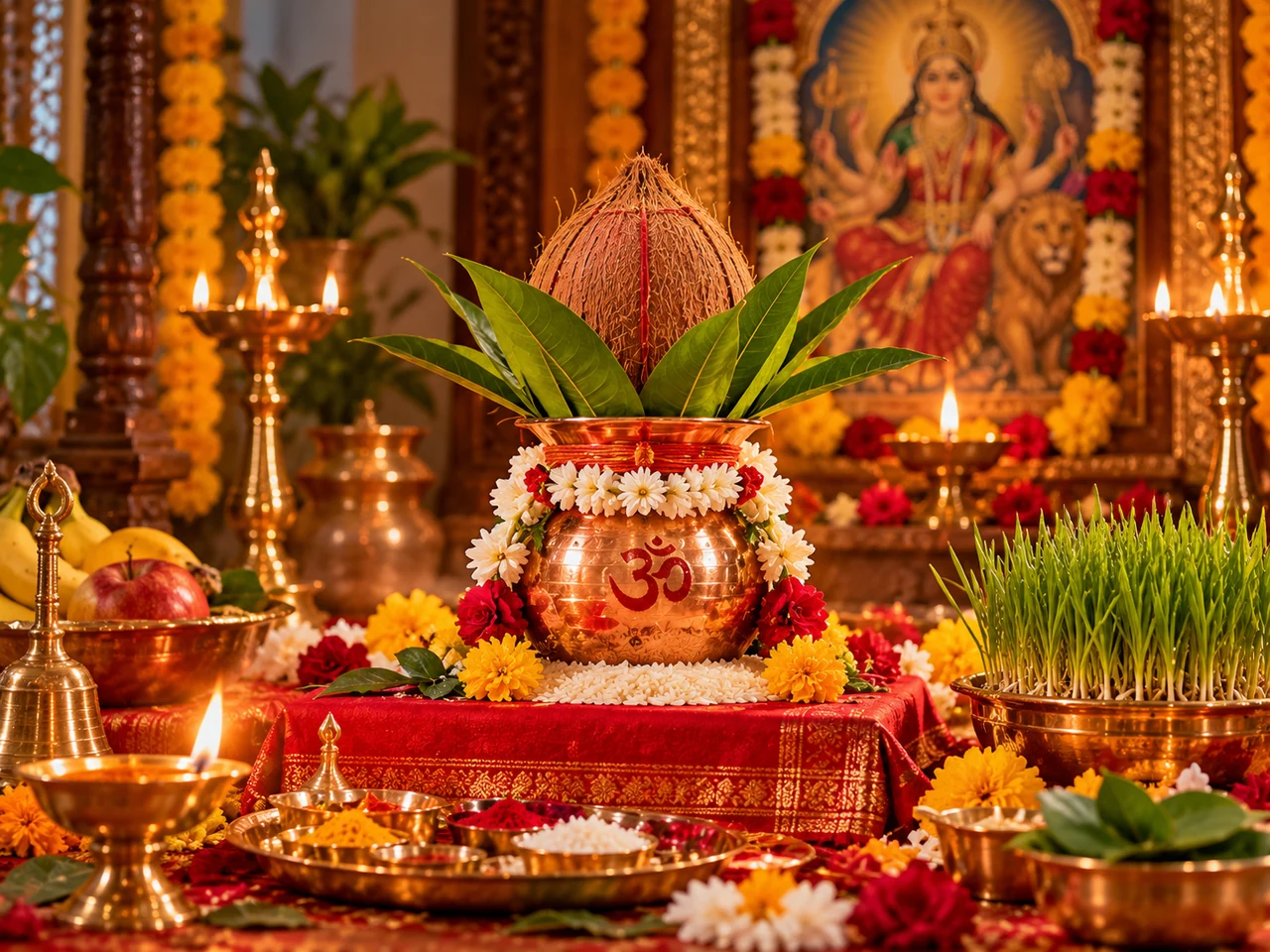
Preparation & Sequential Study
Step 1 · Optional
Identify the method, shrine and timing
Choose whether studying general Varuna–Kalasha worship or a Navratri Ghatasthapana example. Confirm family tradition; do not assume a posted date/muhūrta applies locally.
Step 2 · Optional
Clean hands and arrange materials
Arrange a stable non-spill vessel, clean water, soil/grain where selected, flowers and a safe platform. Avoid heating or fire near cloth. No universal cleaning Sanskrit is supplied in the witness.
Step 3 · Optional
Ganesha and Guru remembrance (optional context)
Some families begin with a Ganesha prayer or a remembrance of the Guru. This is an optional opening, not a single compulsory text for every Kalash tradition.
Step 4 · Optional
Purpose and festival context
Sankalpa expresses the purpose of an observance. A simple personal resolve can be stated in your own language. Formal forms vary; do not guess a gotra, ritual date or muhurta.
Context 5 · Optional
Touch the earth / support
Fuller Kalash manuals begin by acknowledging the earth that supports the vessel. This passage explains that symbolism rather than supplying a complete Vedic recitation.
Original Text
ॐ भूरसि भूमिरस्यदितिरसि विश्वधाया विश्वस्य भुवनस्य धर्त्री। पृथिवीं यच्छ पृथिवीं दृंह पृथिवीं मा हिंसीः॥
Roman Transliteration
oṃ bhoorasi bhoomirasyaditirasi vishvadhaayaa vishvasya bhuvanasya dhartree| prithiveem yachchha prithiveem drimha prithiveem maa himseeh||oṃ bhūrasi bhūmirasyaditirasi viśvadhāyā viśvasya bhuvanasya dhartrī | pṛthivīṃ yaccha pṛthivīṃ dṛṃha pṛthivīṃ mā hiṃsīḥ ||
Meaning
You are earth and sustaining ground; may the earth be firm and unharmed.
Explanation
This is attached to this precise action in an identified ritual witness; a verse may have wider Vedic meaning, not merely an instruction.
Related reading & sourceContext 6 · Optional
Place soil and grains / barley
Some Kalash manuals associate a grain prayer with the supporting grain. The selected passage is shorter than the longer Vedic sequence; it should not be treated as the complete recitation for every tradition.
Original Text
ॐ धान्यमसि धिनुहि देवान् प्राणाय त्वोदानाय त्वा व्यानाय त्वा।
Roman Transliteration
oṃ dhaanyamasi dhinuhi devaan praanaaya tvodaanaaya tvaa vyaanaaya tvaa|oṃ dhānyamasi dhinuhi devān prāṇāya tvodānāya tvā vyānāya tvā |
Meaning
You are grain, the sustenance offered in relation to divine powers and to the life-breaths.
Explanation
This is attached to this precise action in an identified ritual witness; a verse may have wider Vedic meaning, not merely an instruction.
Related reading & sourceContext 7 · Optional
Set down the Kalasha vessel
The vessel is positioned on the prepared support with a distinct Kalasha-placing verse. This is the source-specific placement action, not merely a deity name repeated over it.
Original Text
ॐ आ जिघ्र कलशं मह्या त्वा विशन्त्विन्दवः। पुनरूर्जा निवर्तस्व सा नः सहस्रं धुक्ष्वोरुधारा पयस्वती पुनर्मा विशताद्रयिः॥
Roman Transliteration
oṃ aa jighra kalasham mahyaa tvaa vishantvindavah| punaroorjaa nivartasva saa nah sahasram dhukshvorudhaaraa payasvatee punarmaa vishataadrayih||oṃ ā jighra kalaśaṃ mahyā tvā viśantvindavaḥ | punarūrjā nivartasva sā naḥ sahasraṃ dhukṣvorudhārā payasvatī punarmā viśatādrayiḥ ||
Meaning
May nourishing drops enter the vessel; may nourishment, abundance and renewed sustenance return to us.
Explanation
This is attached to this precise action in an identified ritual witness; a verse may have wider Vedic meaning, not merely an instruction.
Related reading & sourceContext 8 · Optional
Fill the Kalasha with clean water
The selected Varuṇa formula accompanies pouring water into the vessel; the historical accent and variant collation are incomplete. Use water that is clean and safe; water need not be drawn from any particular river.
Original Text
ॐ वरुणस्योत्तम्भनमसि वरुणस्य स्कम्भसर्जनी स्थो वरुणस्य ऋतसदन्यसि वरुणस्य ऋतसदनमसि वरुणस्य ऋतसदनमासीद॥
Roman Transliteration
oṃ varunasyottambhanamasi varunasya skambhasarjanee stho varunasya ritasadanyasi varunasya ritasadanamasi varunasya ritasadanamaaseeda||oṃ varuṇasyottambhanamasi varuṇasya skambhasarjanī stho varuṇasya ṛtasadanyasi varuṇasya ṛtasadanamasi varuṇasya ṛtasadanamāsīda ||
Meaning
The vessel is ritually associated with Varuṇa and with the order (ṛta) upheld by him.
Explanation
This is attached to this precise action in an identified ritual witness; a verse may have wider Vedic meaning, not merely an instruction.
Related reading & sourceContext 9 · Optional
Tie the thread / cloth around vessel
Cloth and covering prayers differ among ritual manuals. Their wording and ritual positions should not be treated as interchangeable.
Original Text
ॐ सुजातो ज्योतिषा सह शर्म वरूथमासदत्स्वः। वासो अग्ने विश्वरूपं सं व्ययस्व विभावसो॥
Roman Transliteration
oṃ sujaato jyotishaa saha sharma varoothamaasadatsvah| vaaso agne vishvaroopam sam vyayasva vibhaavaso||oṃ sujāto jyotiṣā saha śarma varūthamāsadatsvaḥ | vāso agne viśvarūpaṃ saṃ vyayasva vibhāvaso ||
Meaning
A prayer of auspicious radiance, protection and covering; the source associates the verse with cloth wrapping.
Explanation
This is attached to this precise action in an identified ritual witness; a verse may have wider Vedic meaning, not merely an instruction.
Related reading & sourceContext 10 · Optional
Optional fragrance / sandalwood
Where the expanded source adds sandalwood or fragrance, the cited botanical verse is distinct; it is not proof that every home must put perfume in drinking water.
Original Text
ॐ त्वां गन्धर्वा अखनंस्त्वामिन्द्रस्त्वां बृहस्पतिः। त्वामोषधे सोमो राजा विद्वान्यक्ष्मादमुच्यत॥
Roman Transliteration
oṃ tvaam gandharvaa akhanamstvaamindrastvaam brihaspatih| tvaamoshadhe somo raajaa vidvaanyakshmaadamuchyata||oṃ tvāṃ gandharvā akhanaṃstvāmindrastvāṃ bṛhaspatiḥ | tvāmoṣadhe somo rājā vidvānyakṣmādamucyata ||
Meaning
A plant-associated Vedic prayer recalling divine powers and release from affliction; not a medical treatment claim.
Explanation
This is attached to this precise action in an identified ritual witness; a verse may have wider Vedic meaning, not merely an instruction.
Related reading & sourceContext 11 · Optional
Optional ritual herbs (blocked)
Some traditions place a selection of herbs in the vessel. The complete ingredient list and its corresponding prayer are not established in this guide; do not improvise plant identification or ingredients.
Context 12 · Optional
Place betel nut (optional)
In a detailed witness a plant verse accompanies the betel nut. That same verse can also accompany coconut in a different source; this overlap is explicitly recorded.
Original Text
ॐ याः फलिनीर्या अफला अपुष्पा याश्च पुष्पिणीः। बृहस्पतिप्रसूतास्ता नो मुञ्चन्त्वंहसः॥
Roman Transliteration
oṃ yaah phalineeryaa aphalaa apushpaa yaashcha pushpineeh| brihaspatiprasootaastaa no munchantvamhasah||oṃ yāḥ phalinīryā aphalā apuṣpā yāśca puṣpiṇīḥ | bṛhaspatiprasūtāstā no muñcantvaṃhasaḥ ||
Meaning
May the fruit-bearing, fruitless, flowerless and flowering plants associated with Bṛhaspati free us from distress.
Explanation
This is attached to this precise action in an identified ritual witness; a verse may have wider Vedic meaning, not merely an instruction.
Related reading & sourceContext 13 · Optional
Add a coin, if this custom is followed
The Hiraṇyagarbha verse is assigned to placing a coin/value offering in some manuals; the verse is a cosmic hymn, not a promise of financial gain.
Original Text
ॐ हिरण्यगर्भः समवर्तताग्रे भूतस्य जातः पतिरेक आसीत्। स दाधार पृथिवीं द्यामुतेमां कस्मै देवाय हविषा विधेम॥
Roman Transliteration
oṃ hiranyagarbhah samavartataagre bhootasya jaatah patireka aaseet| sa daadhaara prithiveem dyaamutemaam kasmai devaaya havishaa vidhema||oṃ hiraṇyagarbhaḥ samavartatāgre bhūtasya jātaḥ patireka āsīt | sa dādhāra pṛthivīṃ dyāmutemāṃ kasmai devāya haviṣā vidhema ||
Meaning
At the beginning arose Hiraṇyagarbha, lord of beings; he sustained earth and heaven—what deity shall we honour with offering?
Explanation
This is attached to this precise action in an identified ritual witness; a verse may have wider Vedic meaning, not merely an instruction.
Related reading & sourceContext 14 · Optional
Add dūrvā grass, if applicable
A distinct dūrvā plant verse is printed for placing shoots. It describes growth from joint to joint; no fixed number of blades is inferred.
Original Text
ॐ काण्डात्काण्डात्प्ररोहन्ती परुषः परुषस्परि। एवा नो दूर्वे प्रतनु सहस्रेण शतेन च॥
Roman Transliteration
oṃ kaandaatkaandaatprarohantee parushah parushaspari| evaa no doorve pratanu sahasrena shatena cha||oṃ kāṇḍātkāṇḍātprarohantī paruṣaḥ paruṣaspari | evā no dūrve pratanu sahasreṇa śatena ca ||
Meaning
O dūrvā, growing again from each joint, spread for us in hundreds and thousands.
Explanation
This is attached to this precise action in an identified ritual witness; a verse may have wider Vedic meaning, not merely an instruction.
Related reading & sourceContext 15 · Optional
Place the selected leaves
Some families use mango or ashoka leaves, while other traditions use a different group of five leaves. Plant names and recitations vary; use only safely identified materials appropriate to your household tradition.
Original Text
ॐ अश्वत्थे वो निषदनं पर्णे वो वसतिष्कृता। गोभाज इत्किलासथ यत्सनवथ पूरुषम्॥
Roman Transliteration
oṃ ashvatthe vo nishadanam parne vo vasatishkritaa| gobhaaja itkilaasatha yatsanavatha poorusham||oṃ aśvatthe vo niṣadanaṃ parṇe vo vasatiṣkṛtā | gobhāja itkilāsatha yatsanavatha pūruṣam ||
Meaning
The verse refers to dwelling on the sacred fig and among leaves; the remainder requires philological review.
Explanation
This is attached to this precise action in an identified ritual witness; a verse may have wider Vedic meaning, not merely an instruction.
Related reading & sourceContext 16 · Optional
Optional kuśa / sacred grass (blocked)
Longer Vedic manuals include kusha grass and a specific recitation. This guide explains that distinction without supplying the complete accent-bearing recitation or presenting it as a household instruction.
Context 17 · Optional
Put the filled plate / lid above the vessel
The source-specific pūrṇapātra verse accompanies an upper plate/lid holding rice or grain. Distinguish a loose cover from another vessel.
Original Text
ॐ पूर्णा दर्वि परापत सुपूर्णा पुनरापत। वस्नेव विक्रीणावहा इषमूर्जं शतक्रतो॥
Roman Transliteration
oṃ poornaa darvi paraapata supoornaa punaraapata| vasneva vikreenaavahaa ishamoorjam shatakrato||oṃ pūrṇā darvi parāpata supūrṇā punarāpata | vasneva vikrīṇāvahā iṣamūrjaṃ śatakrato ||
Meaning
May fullness return and nourishment be brought in abundance; a verse applied to the filled covering vessel.
Explanation
This is attached to this precise action in an identified ritual witness; a verse may have wider Vedic meaning, not merely an instruction.
Related reading & sourceContext 18 · Optional
Place coconut over filled cover
The university text attaches the same “yāḥ phalinīḥ” verse to coconut that another manual attaches to betel nut. A distinct Śrīśca-te verse appears in other manuals but is not silently inserted into this witness.
Original Text
ॐ याः फलिनीर्या अफला अपुष्पा याश्च पुष्पिणीः। बृहस्पतिप्रसूतास्ता नो मुञ्चन्त्वंहसः॥
Roman Transliteration
oṃ yaah phalineeryaa aphalaa apushpaa yaashcha pushpineeh| brihaspatiprasootaastaa no munchantvamhasah||oṃ yāḥ phalinīryā aphalā apuṣpā yāśca puṣpiṇīḥ | bṛhaspatiprasūtāstā no muñcantvaṃhasaḥ ||
Meaning
May all sorts of fruiting and flowering plants be a means of release from adversity.
Explanation
This is attached to this precise action in an identified ritual witness; a verse may have wider Vedic meaning, not merely an instruction.
Related reading & sourceContext 19 · Optional
Invite Varuṇa into the vessel
Kalash invitation prayers and Vedic Varuna hymns are distinct textual forms. The existence of a hymn does not determine its place in every installation tradition.
Original Text
ॐ भूर्भुवः स्वः। वरुण इहागच्छ, इह तिष्ठ, मम पूजां गृहाण।
Roman Transliteration
oṃ bhoorbhuvah svah| varuna ihaagachchha, iha tishtha, mama poojaam grihaana|oṃ bhūrbhuvaḥ svaḥ | varuṇa ihāgaccha, iha tiṣṭha, mama pūjāṃ gṛhāṇa |
Meaning
O Varuṇa, please be present here, remain here and receive this worship.
Explanation
This is attached to this precise action in an identified ritual witness; a verse may have wider Vedic meaning, not merely an instruction.
Related reading & sourceContext 20 · Optional
Optional invocation of sacred rivers
A separate river-name prayer is documented in ritual manuals; the verse personifies sacred geography rather than changing the chemical safety of the water.
Original Text
गङ्गे च यमुने चैव गोदावरि सरस्वति। नर्मदे सिन्धु कावेरि जलेऽस्मिन् सन्निधिं कुरु॥
Roman Transliteration
gange cha yamune chaiva godaavari sarasvati| narmade sindhu kaaveri jale’smin sannidhim kuru||gaṅge ca yamune caiva godāvari sarasvati | narmade sindhu kāveri jale’smin sannidhiṃ kuru ||
Meaning
O Gaṅgā, Yamunā, Godāvarī, Saraswati, Narmadā, Sindhu and Kāverī, be present in this water.O Gaṅgā, Yamunā, Godāvarī, Sarasvatī, Narmadā, Sindhu and Kāverī, be present in this water.
Explanation
This is attached to this precise action in an identified ritual witness; a verse may have wider Vedic meaning, not merely an instruction.
Related reading & sourceContext 21 · Optional
Offer a flower to Varuṇa
The source uses a short action-specific upacāra formula rather than a unique long Vedic hymn. A flower offering in a different Devi-first ceremony cannot be presumed identical.
Original Text
ॐ वरुणाय नमः पुष्पं समर्पयामि।
Roman Transliteration
oṃ varunaaya namah pushpam samarpayaami|oṃ varuṇāya namaḥ puṣpaṃ samarpayāmi |
Meaning
Salutations to Varuṇa; I offer a flower.
Explanation
This is attached to this precise action in an identified ritual witness; a verse may have wider Vedic meaning, not merely an instruction.
Related reading & sourceContext 22 · Optional
Offer incense only where safe
The source gives its own incense-offering utterance. Avoid smoky incense with infants, vulnerable persons or poor ventilation; omission is not a fabricated ritual fault.
Original Text
ॐ वरुणाय नमः धूपं घ्रापयामि।
Roman Transliteration
oṃ varunaaya namah dhoopam ghraapayaami|oṃ varuṇāya namaḥ dhūpaṃ ghrāpayāmi |
Meaning
Salutations to Varuṇa; I offer incense fragrance.
Explanation
This is attached to this precise action in an identified ritual witness; a verse may have wider Vedic meaning, not merely an instruction.
Related reading & sourceContext 23 · Optional
Show lamp only where safe
The source has a separate light formula. Never leave a flame unattended; avoid flame near leaves, cotton and cloth.
Original Text
ॐ वरुणाय नमः दीपं दर्शयामि।
Roman Transliteration
oṃ varunaaya namah deepam darshayaami|oṃ varuṇāya namaḥ dīpaṃ darśayāmi |
Meaning
Salutations to Varuṇa; I show the light of the lamp.
Explanation
This is attached to this precise action in an identified ritual witness; a verse may have wider Vedic meaning, not merely an instruction.
Related reading & sourceContext 24 · Optional
Offer clean fruit or food
The short naivedya formula explicitly names food. Do not reuse the incense or flower formula; ensure offerings do not spoil.
Original Text
ॐ वरुणाय नमः नैवेद्यं समर्पयामि।
Roman Transliteration
oṃ varunaaya namah naivedyam samarpayaami|oṃ varuṇāya namaḥ naivedyaṃ samarpayāmi |
Meaning
Salutations to Varuṇa; I offer food.
Explanation
This is attached to this precise action in an identified ritual witness; a verse may have wider Vedic meaning, not merely an instruction.
Related reading & sourceContext 25 · Optional
Contemplate the divine Kalasha
One traditional verse identifies Vishnu, Rudra, Brahma and the Mothers with parts of the vessel. It belongs to a longer hymn; this single stanza is not misrepresented as the whole hymn.One traditional verse identifies Viṣṇu, Rudra, Brahmā and the Mothers with parts of the vessel. It belongs to a longer hymn; this single stanza is not misrepresented as the whole hymn.
Original Text
कलशस्य मुखे विष्णुः कण्ठे रुद्रः समाश्रितः। मूले तस्य स्थितो ब्रह्मा मध्ये मातृगणाः स्मृताः॥
Roman Transliteration
kalashasya mukhe vishnuh kanthe rudrah samaashritah| moole tasya sthito Brahma madhye maatriganaah smritaah||kalaśasya mukhe viṣṇuḥ kaṇṭhe rudraḥ samāśritaḥ | mūle tasya sthito brahmā madhye mātṛgaṇāḥ smṛtāḥ ||
Meaning
Vishnu is revered at the vessel’s mouth, Rudra at its neck, Brahma at its base and the Mothers in its middle.
Explanation
This is attached to this precise action in an identified ritual witness; a verse may have wider Vedic meaning, not merely an instruction.
Related reading & sourceContext 26 · Optional
Navratri-specific invitation to Durga
Navratri traditions invite Durga to remain in the Kalasha during the nine days. The particular fixed Sanskrit words are not supplied here; a Varuna invocation should not be converted into a Durga mantra by changing a name.
Context 27 · Optional
Observe the vessel during the festival
The installation is not a perpetual shrine object. Families vary: offer daily flowers/prayer, monitor grains hygienically and avoid unattended akhaṇḍ jyoti. No single daily-maintenance mantra sequence is confirmed for this composite method.
Context 28 · Optional
Festival conclusion and respectful aftercare
At the end of a family observance, follow local custom for respectful farewell and distribution. Do not put plastics, metal, cloth or food waste into rivers; reuse the vessel and handle water and plant matter responsibly.
Reused text credits & licences
Reading & sourceVedic comparative reading: शुक्लयजुर्वेदः/अध्यायः १३, Wikisource contributors, https://sa.wikisource.org/w/index.php?oldid=369793. CC BY-SA 4.0; attribution and ShareAlike apply to adapted text and aligned meanings. Selected unaccented reading retained. Om and offering endings remain separate from the Vedic core; accents, sandhi, punctuation and letter variants are not silently replaced.
LicenceReading & sourceVedic comparative reading: शुक्लयजुर्वेदः/अध्यायः ०१, Wikisource contributors, https://sa.wikisource.org/w/index.php?oldid=401551. CC BY-SA 4.0; attribution and ShareAlike apply to adapted text and aligned meanings. Selected unaccented reading retained. Om and offering endings remain separate from the Vedic core; accents, sandhi, punctuation and letter variants are not silently replaced.
LicenceReading & sourceVedic comparative reading: शुक्लयजुर्वेदः/अध्यायः ०८, Wikisource contributors, https://sa.wikisource.org/w/index.php?oldid=330337. CC BY-SA 4.0; attribution and ShareAlike apply to adapted text and aligned meanings. Selected unaccented reading retained. Om and offering endings remain separate from the Vedic core; accents, sandhi, punctuation and letter variants are not silently replaced.
LicenceReading & sourceVedic comparative reading: शुक्लयजुर्वेदः/अध्यायः ०४, Wikisource contributors, https://sa.wikisource.org/w/index.php?oldid=333477. CC BY-SA 4.0; attribution and ShareAlike apply to adapted text and aligned meanings. Selected unaccented reading retained. Om and offering endings remain separate from the Vedic core; accents, sandhi, punctuation and letter variants are not silently replaced.
LicenceReading & sourceVedic comparative reading: शुक्लयजुर्वेदः/अध्यायः ११, Wikisource contributors, https://sa.wikisource.org/w/index.php?oldid=369790. CC BY-SA 4.0; attribution and ShareAlike apply to adapted text and aligned meanings. Selected unaccented reading retained. Om and offering endings remain separate from the Vedic core; accents, sandhi, punctuation and letter variants are not silently replaced.
LicenceReading & sourceVedic comparative reading: शुक्लयजुर्वेदः/अध्यायः १२, Wikisource contributors, https://sa.wikisource.org/w/index.php?oldid=369832. CC BY-SA 4.0; attribution and ShareAlike apply to adapted text and aligned meanings. Selected unaccented reading retained. Om and offering endings remain separate from the Vedic core; accents, sandhi, punctuation and letter variants are not silently replaced.
LicenceReading & sourceSanskrit comparative witness: ऋग्वेदः सूक्तं १०.९७, Wikisource contributors, https://sa.wikisource.org/w/index.php?oldid=317292. CC BY-SA 4.0; attribution and ShareAlike apply to this adapted reading and aligned meanings. The supplied Om prefix is retained separately; unaccented wording, punctuation and orthographic choices remain as provided. Not independent glyph collation or ritual certification.
LicenceReading & sourceSanskrit comparative witness: ऋग्वेदः सूक्तं १०.१२१, Wikisource contributors, https://sa.wikisource.org/w/index.php?oldid=400427. CC BY-SA 4.0; attribution and ShareAlike apply to this adapted reading and aligned meanings. The supplied Om prefix is retained separately; unaccented wording, punctuation and orthographic choices remain as provided. Not independent glyph collation or ritual certification.
LicenceReading & sourceSanskrit comparative witness: शुक्लयजुर्वेदः/अध्यायः १३, Wikisource contributors, https://sa.wikisource.org/w/index.php?oldid=369793. CC BY-SA 4.0; attribution and ShareAlike apply to this adapted reading and aligned meanings. The supplied Om prefix is retained separately; unaccented wording, punctuation and orthographic choices remain as provided. Not independent glyph collation or ritual certification.
LicenceReading & sourceSanskrit comparative witness: ऋग्वेदः सूक्तं १०.९७, Wikisource contributors, https://sa.wikisource.org/w/index.php?oldid=317292. CC BY-SA 4.0; attribution and ShareAlike apply to this adapted reading and aligned meanings. The supplied Om prefix is retained separately; unaccented wording, punctuation and orthographic choices remain as provided. Not independent glyph collation or ritual certification.
LicenceReading & sourceVedic comparative reading: शुक्लयजुर्वेदः/अध्यायः ०३, Wikisource contributors, https://sa.wikisource.org/w/index.php?oldid=415465. CC BY-SA 4.0; attribution and ShareAlike apply to adapted text and aligned meanings. Selected unaccented reading retained. Om and offering endings remain separate from the Vedic core; accents, sandhi, punctuation and letter variants are not silently replaced.
LicenceReading & sourceInherited brief salutation or offering formula. Only the short traditional words are used; no modern translation or ritual compilation is reproduced. ShivGoraksh bilingual meanings and explanations are original educational writing.
Reading & sourceMIT License
Copyright (c) 2026 Ishank Gupta and contributors to hindu-devotional-texts
Permission is hereby granted, free of charge, to any person obtaining a copy
of this software and associated documentation files (the "Software"), to deal
in the Software without restriction, including without limitation the rights
to use, copy, modify, merge, publish, distribute, sublicense, and/or sell
copies of the Software, and to permit persons to whom the Software is
furnished to do so, subject to the following conditions:
The above copyright notice and this permission notice shall be included in all
copies or substantial portions of the Software.
THE SOFTWARE IS PROVIDED "AS IS", WITHOUT WARRANTY OF ANY KIND, EXPRESS OR
IMPLIED, INCLUDING BUT NOT LIMITED TO THE WARRANTIES OF MERCHANTABILITY,
FITNESS FOR A PARTICULAR PURPOSE AND NONINFRINGEMENT. IN NO EVENT SHALL THE
AUTHORS OR COPYRIGHT HOLDERS BE LIABLE FOR ANY CLAIM, DAMAGES OR OTHER
LIABILITY, WHETHER IN AN ACTION OF CONTRACT, TORT OR OTHERWISE, ARISING FROM,
OUT OF OR IN CONNECTION WITH THE SOFTWARE OR THE USE OR OTHER DEALINGS IN THE
SOFTWARE.
LicenceReading & sourceShort inherited Varuna invocation/offering formula. No modern commentary, translation or ritual arrangement is copied. Original ShivGoraksh bilingual explanation; no specialist or ritual authorization asserted.
Reading & sourceShort inherited Varuna invocation/offering formula. No modern commentary, translation or ritual arrangement is copied. Original ShivGoraksh bilingual explanation; no specialist or ritual authorization asserted.
Reading & sourceShort inherited Varuna invocation/offering formula. No modern commentary, translation or ritual arrangement is copied. Original ShivGoraksh bilingual explanation; no specialist or ritual authorization asserted.
Reading & sourceShort inherited Varuna invocation/offering formula. No modern commentary, translation or ritual arrangement is copied. Original ShivGoraksh bilingual explanation; no specialist or ritual authorization asserted.
Reading & sourceTraditional prayer; comparative witness: Puja Samuccaya, Nirnaya Sagar Press, Bombay, 1923, https://sanskritdocuments.org/~sanskrit/doc_trial/fortransfer/Shankara/pUjAsamucchaya.pdf. The 1923 printed edition is used for inherited text, not modern website commentary, translations or arrangement. Traditional offering verse; the selected wording is retained, including sandhi, spelling and devotional-address variants. Comparative witness is not claimed identical.