



At a glance
Krishna Janmashtami (श्रीकृष्ण जन्माष्टमी), also called Janmashtami, Krishna Jayanti, Gokulashtami and, in some southern settings, Ashtami Rohini, is the annual celebration of the birth or divine appearance of Shri Krishna. Krishna is worshipped as an incarnation of Vishnu in many Hindu traditions; in several Krishna-centred Vaishnava sampradayas he is revered as the Supreme Lord himself. Devotees commemorate him as the child of Devaki and Vasudeva, the beloved Gopala raised by Yashoda and Nanda, and the teacher of the Bhagavad Gita. 1, 2, 3
The festival's familiar calendar marker is Krishna Paksha Ashtami: the eighth lunar Tithi of the waning fortnight, commonly designated Bhadrapada Krishna Ashtami in the North Indian Purnimanta system and Shravana Krishna Ashtami in the Amanta system. Celebrations centre on a birth observance at night, but not every family, temple or lineage selects exactly the same civil day. Ashtami, the Rohini nakshatra, the traditional Nishita interval, locality and named Smarta/Vaishnava observance rules matter. This is an annual festival, not the monthly occurrence of every Krishna Ashtami. 4
Imagine a small cradle in a home, a song rising in a temple courtyard, or a crowd waiting for midnight. In one place a family quietly reads Krishna's story; in another, teams gather around a suspended clay pot. The joy is shared, but Janmashtami has never had just one local expression. 5, 7, 8
What do its many names mean?
Janma means birth and Ashtami is the eighth Tithi; hence Janmashtami points to the birth commemoration associated with that lunar day. Shri Krishna Janmotsav emphasizes the celebration itself. Gokulashtami brings to mind Gokula, the setting of Krishna's childhood stories. Nandotsav/Nandotsava refers to the joy and welcome at Nanda's house after Krishna's arrival there; it is related to, but not simply another name for, every midnight birth ceremony. In Kerala Ashtami Rohini is an established regional name, reflecting the festival's association with the Rohini asterism. These names overlap without meaning that every regional timing rule is identical. 1, 2, 4, 10
The story: from Mathura's prison to the joy of Gokula
One of the festival's main scriptural anchors is the Bhagavata Purana, Book 10, Chapter 3. Within this sacred narrative, Kamsa, the ruler of Mathura, fears the child foretold to end his power. He imprisons his sister Devaki and her husband Vasudeva; Devaki's earlier children are killed. Krishna's birth therefore takes place against a background of danger, not a peaceful royal ceremony. The plot is religious narrative, not a modern independently established report of the date and circumstances of a birth. 1, 6
The Bhagavata describes Krishna's appearance in the darkness of night with a resplendent four-armed divine form. Devaki and Vasudeva recognise his extraordinary nature; at their request, the child assumes the form of an ordinary infant. Vasudeva carries him away to the household of Nanda and Yashoda in Gokula. Yogamaya, who appears as a daughter in that household, is integral to the narrative and the exchange that protects the child. It is misleading to omit her or to make Yashoda irrelevant because Devaki gave birth in the Mathura account. Both mothers occupy treasured but different places in Krishna-bhakti. 1
The adjoining Bhagavata Purana 10.5 tells what happens when the story becomes communal: Nanda celebrates the child's arrival, neighbours come, musicians play, blessings are offered and gifts are shared. This helps explain why a festival associated with a dangerous prison birth is remembered with such warmth. From darkness and fear the narrative moves towards welcome, kinship and protection. Some Vaishnava commentaries interpret Krishna's relationship to Yashoda in more theologically elaborate ways; one account should not be declared the sole interpretation of all Krishna traditions. 2
What is the meaning of Yogamaya?
In the consulted Bhagavata account, Yogamaya is a divine power active in Krishna's birth story. Shakta, Vaishnava and other interpretations of divine power are not interchangeable; a reader may notice a Shiva–Shakti resonance in the importance of the Goddess, but Janmashtami is fundamentally a Krishna-centred celebration, not a substitute for a Devi festival. Specialised interpretations of Yogamaya and the identity of the Goddess require the relevant text and sampradaya to be named rather than guessed. 1
What does Krishna's appearance mean to devotees?
For many worshippers Krishna is simultaneously the playful child, compassionate companion, enchanting flute-player, guardian of the vulnerable and teacher of dharma. The Bhagavad Gita 4.7–4.8 connects divine manifestation with a decline in dharma and the protection of the good. These verses provide a theological way to understand divine appearance, but they do not tell an editor which civil date a future Janmashtami should use. 3
There is another meaning close to daily life. Devaki and Vasudeva evoke parental fear and courage; Yashoda and Nanda evoke affectionate care; the child Krishna evokes the possibility that joy can arise in troubled circumstances. In many bhakti traditions vatsalya bhava describes approaching the divine with a parent's tender affection. The cradle, lullaby and small footprint are devotional symbols of that relationship; their effects are matters of faith and experience, not scientific claims. 1, 2, 5
Krishna is also the speaker of the Gita to Arjuna. Families who reflect on its teaching may discuss responsibility, ethical difficulty and selfless action during Janmashtami. The larger philosophical conversation belongs to the Mahabharata and the Gita; it should not be presented as a scene that occurred on the night of Krishna's birth. 3
When is Janmashtami celebrated—and why can dates differ?
The general basis is annual Krishna Paksha Ashtami in the relevant late-monsoon lunar month. A Tithi tracks the changing angular separation of Sun and Moon; it may start or end at any clock time. A calendar day, a traditional lunar day and a festival's chosen worship night are therefore related but different things. The Purnimanta month may be labelled Bhadrapada while an Amanta calendar uses Shravana for the corresponding Krishna fortnight. This is a naming convention, not evidence for two separate Krishna births. 4
Nishita is a tradition-defined late-night or midnight interval used in birth-commemoration selection; Rohini is a nakshatra or lunar asterism. In the consulted almanac's presentation, Smarta rules give important weight to Ashtami during Nishita and additional Rohini conditions, while Vaishnava/ISKCON-labelled rules employ different preferences. The relationship is more complex than “take whichever date has Ashtami at sunrise.” An Ashtami that touches two nights, one that misses a relevant Nishita interval, or Rohini that overlaps only one candidate can alter a traditionally selected day. Smarta and Vaishnava are broad labels with internal lineage differences, not universal two-button settings. 4
Someone may therefore encounter one date on a household calendar and another at a nearby temple without either being a typographical error. A valid festival listing must say for which place, convention and institution it was prepared. Historical religious guides such as the Dharma Sindhu and Nirnaya Sindhu are named by the almanac, but their underlying passages have not been collated here; they cannot be claimed as independently verified algorithms. No Gregorian observance day, fasting-end time, local Nishita, or Rohini interval is approved by this draft. ShivGoraksh's Calendar module must show a reviewed local occurrence or explicitly say that the date is not yet verified. 4
How do people observe the day and night?
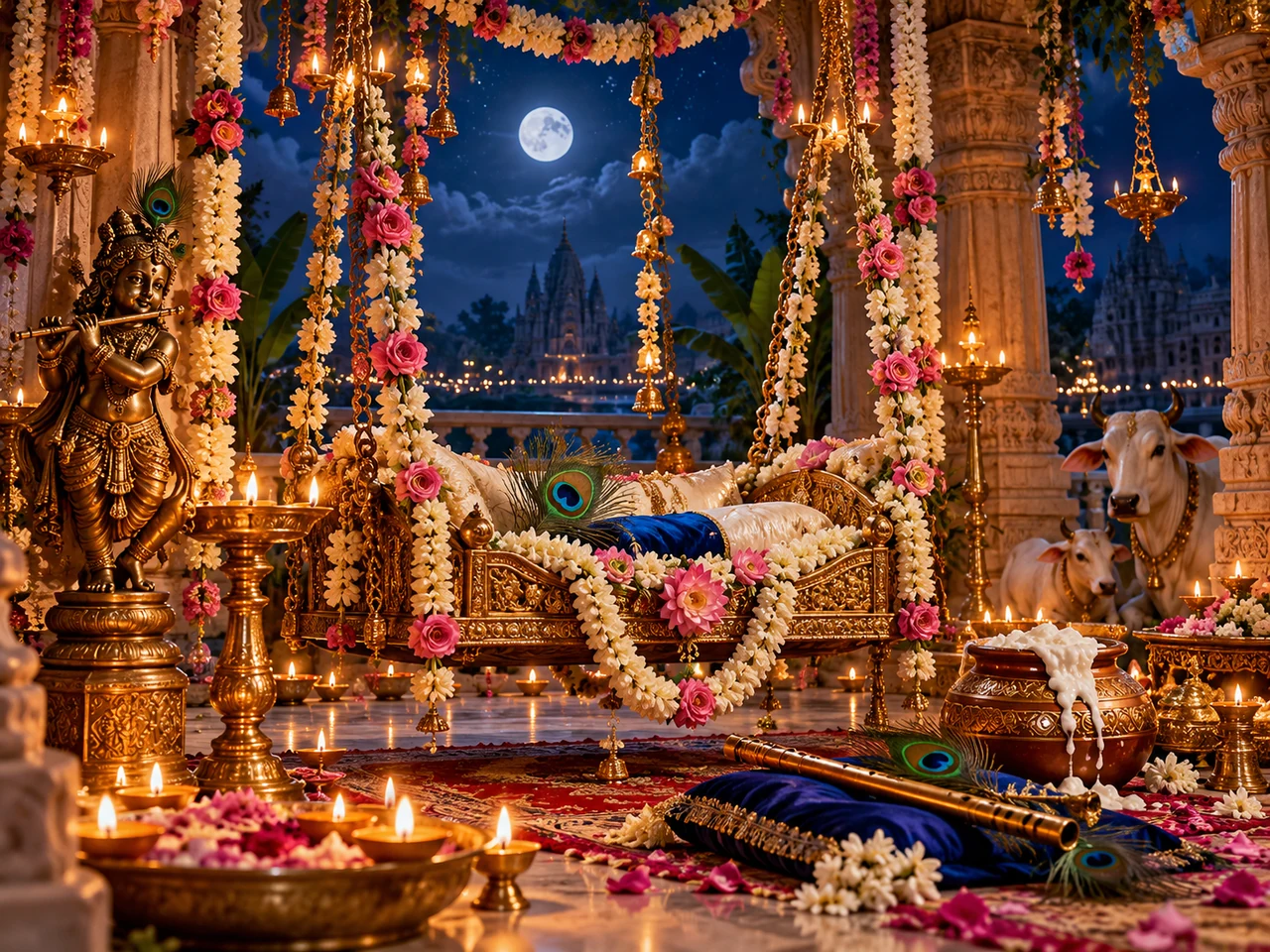
Households may decorate a clean worship space with flowers, lamps, a portrait of Krishna or a child-Krishna image, and a small cradle (jhula). Some draw symbolic tiny footprints leading into the home; others set out a simple flower or fruit offering. These are descriptions of public devotional customs rather than a compulsory procedure. No visitor needs expensive ornaments or a perfectly staged tableau to read the story, sing a bhajan or celebrate with family. 5, 7
Bhajan means devotional song and kirtan commonly refers to sung, often communal praise. Temples may hold scripture readings, public congregational singing, abhisheka conducted by authorised priests, or a symbolic birth welcome around the selected midnight interval. There are many styles of Krishna worship. A detailed abhisheka, initiatory mantra, deity consecration or community-specific vow is not supplied here as a self-perform ritual. Learn it, if desired, from a trusted temple or appropriate lineage. 5, 7
Does everyone fast?
No. Some devotees keep a Janmashtami vrata—a voluntary religious observance that may involve fasting, prayer, restraint and charitable giving. Others follow a temple community's food practice, make a simple offering, or do not fast. Some traditions conclude a fast in relation to midnight worship; other rules take account of the next day, Rohini or parana conventions. There is no single fast-ending clock time that this article can responsibly prescribe. Anyone with medical or dietary needs should not treat a festival description as a requirement to abstain from food or water. 4, 5
What happens afterwards: Nandotsav
The festival's story does not end when midnight passes. In the Bhagavata, Nanda's celebration centres on congratulations, hospitality, music and generosity. Many communities observe a related Nandotsav or local continuation after the birth-night commemoration. Its placement and scope vary; a second-day celebration is not automatically the same as the fasting date, nor should a website hardcode “next day” without a reviewed locality/profile. The literary Nanda ceremony and contemporary community programmes have connected meanings but are not identical historical events. 2, 5
Mathura, Vrindavan and the wider Braj region
Mathura is the city of Krishna's birth in the devotional account and the location of the Krishna Janmasthan pilgrimage site. Vrindavan, Gokul, Nandgaon and Govardhan form part of a larger Braj sacred geography associated with different episodes of his life. Uttar Pradesh's tourism material describes illuminated temples, midnight worship, jhankis (narrative tableaux), song, raslila performances and public gatherings. A jhanki is a visual depiction of an episode, not evidence that the depicted episode happened in a specific modern building. 5, 6
Dwarka, Gujarat
Dwarka's Krishna devotion remembers a different phase of his story: the king and guardian associated with the western city. Government tourism material describes decorated spaces, midnight aarti, devotional singing and festival gatherings at the Dwarkadhish Temple. The experience differs from Braj's childhood emphasis even though both honour Krishna. The temple's own yearly schedule must be checked separately; a tourism description is not a perpetual guarantee of worship times or unrestricted access. 7
Maharashtra: Dahi Handi and the Govinda teams
Dahi Handi brings Krishna's playful butter-and-curd stories into a public physical celebration. Groups sometimes form human pyramids to reach an elevated pot, accompanied by cheering and community participation. Maharashtra Tourism documents this as a popular Janmashtami-related custom, not a requirement observed uniformly by every Hindu family. The activity carries obvious risks from height, falls and crowding, so this article does not provide competitive techniques or encourage unprotected participation; organisers must follow applicable safety rules. The playful symbolism is meaningful even to someone who never climbs a pyramid. 8
Udupi and coastal Karnataka
Udupi's Shri Krishna Temple is associated with Vitla Pindi, also called Mosaru Kudike. Karnataka Tourism documents pot-breaking festivities linked to Krishna's childhood play. Its distinct setting, vocabulary and local temple traditions should not be flattened into a claim that the event is precisely the same as every Maharashtra Dahi Handi programme. Dates of temple rites and public events require site-specific verification. 9
Kerala: Ashtami Rohini
At Guruvayur, Krishna devotion is deeply embedded in regional temple life; the national tourism description lists Ashtami Rohini among the temple's festivals. Kerala Tourism also documents Uriyadi, a suspended-pot game played in connection with Shri Krishna Jayanti and other local occasions. These examples show why a southern festival calendar may not be adequately described with only a North Indian month label or a nationwide date copied from a poster. Local festival calendars and temple announcements deserve their own checks. 10, 11
Butter, cradles, flutes and prasad: what do they signify?
Krishna's childhood narratives make butter and curd especially recognizable: food becomes a playful reminder of the intimacy between a child and his community. A cradle recalls welcome and parental affection; a flute refers to later Braj devotion and the music-loving Krishna, rather than to a documented event at his birth. Peacock feathers and yellow garments are familiar devotional iconography, not an instruction that all festival images must use one historical costume. Footprints invite Krishna's presence into a family's home in symbolic language. 1, 2, 5, 8
In Braj settings, sweets such as Mathura peda, makhan-mishri and other milk-based preparations often appear in festival descriptions. In homes elsewhere, offerings might be fruit, milk, butter, homemade sweets or local vegetarian preparations. The choice depends on household custom, regional ingredients and temple rules. Prasad is an offering shared after worship in many traditions; a costly feast is not its defining feature. Do not assume every Krishna temple offers the same foods or that a named dish is scripturally compulsory. 5, 7, 10
Scripture, worship and the boundary of what we can responsibly teach
For the birth and the escape to Gokula, read Bhagavata Purana 10.3; for Nanda's celebration, 10.5. For the teaching on divine appearance and dharma, see Bhagavad Gita 4.7–4.8. They are different parts of Krishna literature with different narrative functions. The online editions inspected here are modern tradition-specific presentations. Their English commentary and translation are not licensed for wholesale reuse merely because they are accessible; this article gives original explanations rather than reproducing them. 1, 2, 3
Families may also read selected Krishna stories, hear Bhagavata-katha, sing locally favoured bhajans or participate in the public recitation of divine names. A festival overview can introduce such practices without handing out unverified Sanskrit mantras, asserting a single obligatory puja vidhi, or trespassing into initiation-dependent ritual. Readers following a particular Vaishnava, Smarta or regional temple tradition should follow its qualified guidance. 1, 4, 5
Common confusions worth clearing up
Janmashtami is not every monthly Ashtami. The annual celebration identifies Krishna's birth observance within a named lunar-season convention. Rohini is not interchangeable with Ashtami: one is a nakshatra, the other a Tithi; some date rules weigh both. A public Dahi Handi programme is not the same thing as a temple's midnight birth worship. Nandotsav is related, but not always the same date and programme as Janmashtami. A festival date cannot be safely copied across cities and religious profiles, particularly in boundary cases. 2, 4, 8
Most importantly, scriptural narrative, later devotional expression and a verified calendar occurrence answer different questions. All are worth understanding, but none should be used as a shortcut for the others.
1. What is Krishna Janmashtami?
An annual Hindu celebration of Shri Krishna's birth or divine appearance, particularly important in Krishna-bhakti and many Vaishnava traditions. The sacred birth narrative is recounted in Bhagavata Purana 10.3. 1
2. Why is Janmashtami celebrated at midnight?
Krishna's appearance is described as occurring in the darkness of night, and many observances focus on a traditional Nishita or birth-night interval. Its precise local definition needs the relevant community's calendar rule. 1, 4
3. Is Janmashtami in Shravana or Bhadrapada?
For the relevant Krishna fortnight, the Amanta and Purnimanta month systems use different names—commonly Shravana and Bhadrapada respectively. Specify the convention rather than calling one name a mistake. 4
4. Why do Smarta and Vaishnava dates sometimes differ?
Traditions weigh Ashtami, the local Nishita interval and Rohini according to different selection rules. A date intended for one tradition or place cannot automatically stand for all others. 4
5. Is Rohini nakshatra always present on the chosen day?
Not necessarily. Rohini and Ashtami are distinct astronomical-calendar markers; their intervals may not align, and their treatment differs by profile. 4
6. Is a full fast compulsory?
No. Fasting customs vary by family, sect and capacity; devotion may also take the form of prayer, song, scripture reading or service. No universal food rule or fast-breaking hour is supplied here. 4, 5
7. Who are Krishna's parents—Devaki and Vasudeva or Yashoda and Nanda?
The consulted Bhagavata narrates Krishna's appearance to Devaki and Vasudeva and his upbringing in the house of Yashoda and Nanda; both relationships are cherished in the devotional story. 1, 2
8. What is Nandotsav?
A celebration associated with Nanda's rejoicing at Krishna's arrival. Its scriptural scene is in Bhagavata Purana 10.5; present-day timing and form vary. 2
9. Is Dahi Handi part of every Janmashtami?
No. It is particularly prominent in Maharashtra and has related but distinctive forms elsewhere. Temple worship and home celebration may occur without it. 8, 9
10. Where are major Janmashtami celebrations held?
Documented locations include Mathura–Braj, Dwarka, Udupi and Guruvayur. Their rites, audiences, festival names and local programme dates are not interchangeable. 5, 7, 9, 10
11. What can children learn from Janmashtami?
Age-appropriate storytelling can explore caring for others, courage in difficulty, friendship, generosity and the difference between playful symbolism and actual dangerous stunts. The approach should remain respectful of family belief. 1, 2, 8
12. Where can I find Janmashtami's date for my city?
Use an approved local calendar occurrence stating the city, year and tradition profile. Until ShivGoraksh's reviewed Calendar layer supplies one, its honest answer is “Date/timing not yet verified for this city/year.” 4