



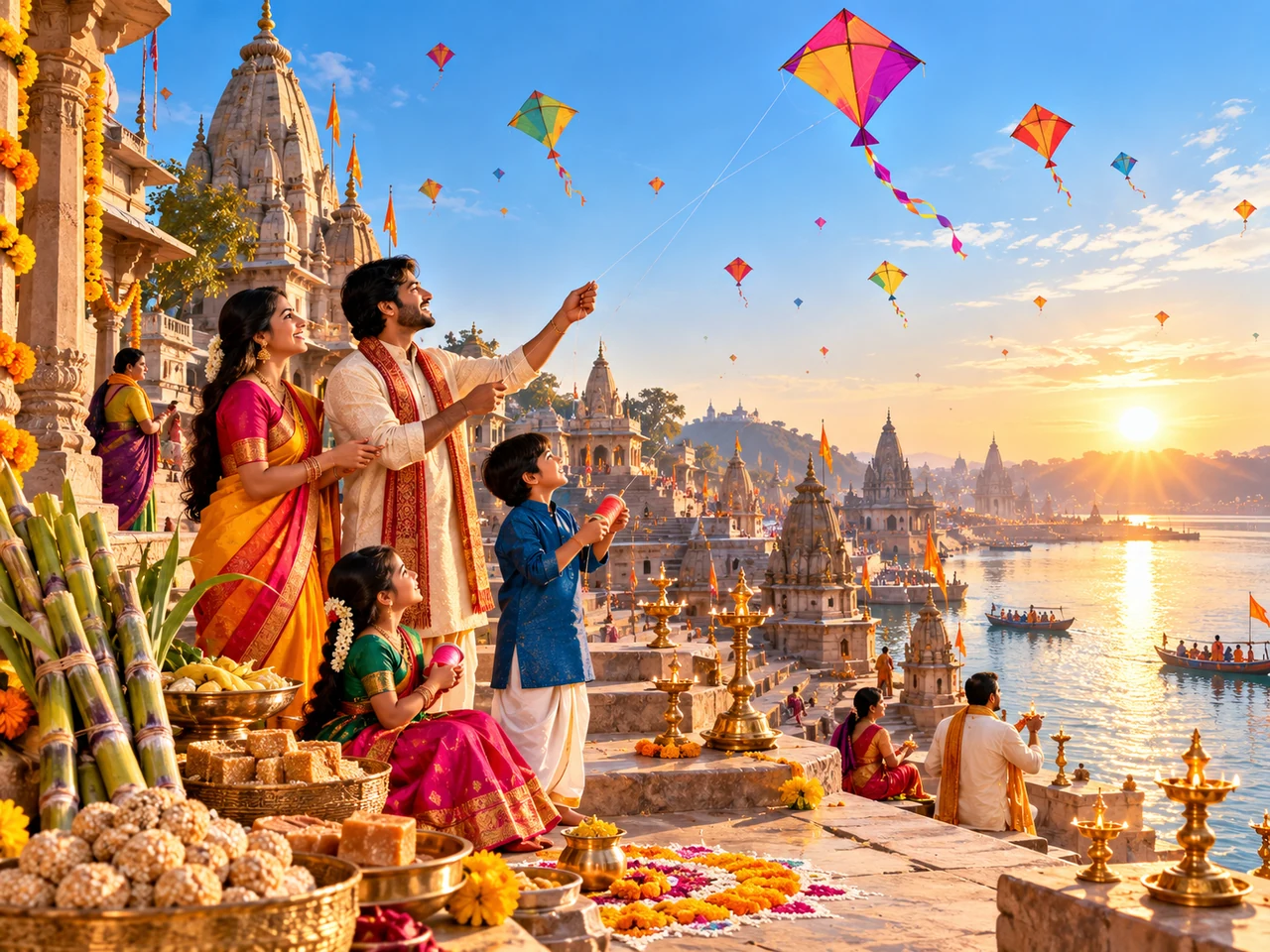
An offering of sesame and jaggery, a pot of new rice bubbling over, a roof full of kites, and a bowl of khichdi carried reverently to a temple: these can all belong to the festival season around Makar Sankranti. What connects such different scenes is an awareness of the Sun, the agricultural year and the relationships through which a community sustains itself. Yet they are not all identical rituals, nor do all regions celebrate in precisely the same way. 3, 5, 6, 10
Makar Sankranti (Makara Saṅkrānti, मकर संक्रांति) marks the traditional solar passage into Makara rashi, the sidereal zodiacal sign associated with Capricorn. It differs from most well-known Hindu festivals because its calendar anchor is a solar ingress, not a lunar tithi such as Ashtami or Purnima. The occasion is especially associated with Surya (the Sun in Hindu worship), charity, sacred bathing, shared food and expressions of gratitude for agricultural abundance. Across India and Nepal, related seasonal celebrations preserve distinctive local names, histories and meanings. 1, 10, 12
What does “Sankranti” mean?
Saṅkrānti means a transition or entry. In a Hindu solar-calendar context, it refers to the Sun's passage from one zodiacal sign into the next. There are multiple solar transitions during a year; this page concerns the entry into Makara. The astronomical instant of ingress and the socially observed festival day are separate concepts: the instant can occur at night, while prescribed observances may be assigned to a daylight interval according to a tradition's calendar rules. 1, 11, 12
The Rashtriya Panchang, produced under the India Meteorological Department's Positional Astronomy Centre, distinguishes nirayana (sidereal) positions and lists solar transits. Calendar calculations use a stated reference frame and ayanamsa rather than inferring a Makar Sankranti date from a fixed civil-calendar number. 12
Makar Sankranti and Uttarayana: closely related, not astronomically identical
In religious speech, Makar Sankranti is widely linked with Uttarayana, the Sun's northward course. There is an important technical distinction. The Sun's apparent northward turning—in terms of its seasonal declination—begins at the December solstice. The traditional nirayana Makara ingress is defined against a sidereal zodiacal frame and occurs later. The gradual separation between season-based and star-referenced divisions is associated with the precession of the equinoxes. Thus the festival's cultural language about Uttarayana should be honoured without teaching that the actual winter solstice takes place on Makar Sankranti. 2, 12
Similarly, Makara rashi is a calendrical zodiac division; it must not be confused with the modern boundaries of the visible astronomical constellation Capricornus. Nothing in this distinction diminishes the festival's religious meaning: it simply separates observational astronomy, calendar convention and symbolic tradition.
When is Makar Sankranti celebrated?
It is observed once in the solar cycle around the middle of the Gregorian month of January, but no single fixed Gregorian date or pan-Indian worship time should be assumed for every year. A consulted almanac illustrates why a calculated ingress instant and the associated public worship day may differ; its timings are explicitly city-dependent. 1, 11
The key terms are:
- Makara ingress: the instant at which the Sun reaches the selected sidereal Makara boundary.
- Punya Kala: a tradition-defined meritorious interval for bathing, offerings and charity; the exact treatment of after-sunset ingress requires review.
- Maha Punya Kala: a narrower, tradition-specific preferred interval in some almanac systems, not a universal clock time.
- Local sunrise and sunset: relevant to deciding when daytime practices may occur and to assigning an ingress to an observance day.
A widely used published almanac describes a Punya Kala after ingress and special handling when ingress occurs after sunset. That is a documented almanac convention, not yet an approved ShivGoraksh calculation rule. The site should eventually display dates and intervals from a verified, city-aware Calendar service; where none is approved, it should say that the date or timing is not yet verified. 1, 11
Unlike lunar festivals, Makar Sankranti is not selected by Shukla/Krishna Paksha or a tithi at sunrise. A lunar tithi may coexist with the day, but it does not define the primary annual event.
Sunlight, gratitude and Surya devotion
The Sun is both an everyday physical necessity and an object of sacred regard in many Hindu traditions. Homes and temples may offer water or prayer to Surya, thanking the divine source of light, vitality and the seasonal order. Devotional language calls this auspicious or purifying; those are matters of belief, not verified promises of health, wealth or freedom from misfortune. 10, 13
An agricultural festival does not have to mean every region harvests the same crop on the same day. Rather, communities use the turning of a seasonal cycle to acknowledge the labour of cultivators, animals, soil, rain and shared resources. Official cultural statements describe this cluster of winter festivals as occasions of gratitude to farmers and nature. 10
Giving before receiving
Many households make dāna—gifts of grain, food, sesame, blankets or other useful items according to local custom and ability. Others organise meals, visit elders or share seasonal sweets. These gestures express reciprocity: the festival is not only about enjoying the harvest, but also about recognizing those who need a share of it. Bathing in a river or other water body is a devotional custom in several pilgrimage settings, not a requirement for every person. 7, 10
A festival of togetherness, not one uniform ceremony
Some celebrations centre on a temple; others on fields, kitchens, rooftops or community bonfires. The traditions have overlapping themes of season, gratitude and family, but their regional names do not make them exact synonyms or prove that each originated from one historical ceremony. It is more accurate to see a connected seasonal cluster than to flatten India's diversity into a single ritual.
Stories and religious interpretations
Popular retellings sometimes connect this season to Bhishma waiting for an auspicious northern course before his death, to Surya and Shani, or to other Puranic figures. Such stories circulate in devotional literature and regional storytelling, but they are not all equivalent to a directly verified primary-text explanation of the festival's origins. This article does not claim a specific chapter, Sanskrit line or historical date for those retellings without edition-level verification. The core festival can be understood without treating any one legend as a compulsory belief.
The relation to the Mahabharata is especially worth keeping precise. Traditions about Bhishma and Uttarayana belong to epic religious interpretation; a solar ingress calendar rule cannot be proven merely by repeating an epic story. Likewise, Surya is honoured across Hindu traditions in different ways; Makar Sankranti is not exclusively a Shaiva, Vaishnava or Shakta festival.
How families commonly observe the festival
There is no universal household ritual checklist. Depending on family and region, a day might include bathing, cleaning a prayer space, lighting a lamp, offering water or flowers to Surya, remembering ancestors, visiting a temple, giving food and preparing a shared meal. Some people undertake a personal fast or follow a priest-guided observance; others do not. A reader should not infer that all these practices are obligatory. 1, 10
A simple, inclusive way to participate is to learn how the day is observed locally, offer thanks for food and livelihood, share a meal, and give in a way that genuinely helps another person. Formal sankranti-puja, offerings and timings may depend on community and temple procedures; specialized practice should not be improvised from a general-interest article.
Bathing in open water has ordinary physical hazards, and kite flying with abrasive or hazardous string can injure people and birds. Public celebrations are best enjoyed with local safety guidance, reusable decorations and wildlife-safe practices. Fasting is optional in this descriptive account; individuals with medical needs should not feel religiously compelled to abstain from food or water.
North India: khichdi, sesame and charity
In parts of Uttar Pradesh, Bihar and neighbouring Hindi-speaking areas, Khichdi is a familiar name for the occasion. Rice and lentils appear in family meals and offerings; sesame (til) and jaggery (gur) appear in sweets. People may make donations and visit riverbank or temple gatherings. This is a description of living custom, not a claim that every household observes the same rule. 6, 10
Gorakhpur: the Khichdi Mela and the Nath tradition
A particularly important ShivGoraksh connection is Shri Gorakhnath Temple in Gorakhpur. The Gorakhpur district administration identifies the temple as a central Nath institution and describes a Khichdi Mela held around Makar Sankranti. Its cultural-history account also describes devotees offering khichdi to Guru Gorakhnath, including visitors from surrounding areas and Nepal. 6
This is a specific Nath-associated pilgrimage and offering tradition, not proof that all Nath lineages conduct an identical ceremony or that Makar Sankranti began as a Nath festival. The visible temple culture adds a meaningful local story to a much wider Indian seasonal observance. Spiritual benefits ascribed to darshan or offerings belong to devotees' faith; no result is guaranteed here.
Gujarat: Uttarayan and the skies full of kites
In Gujarat, especially Ahmedabad, Uttarayan brings family gatherings on terraces and remarkable communal kite flying. Gujarat Tourism documents the strong association with paper kites, local kite markets and festive foods such as undhiyu. The modern International Kite Festival is an organized public cultural event within this wider tradition; it is not the origin of all Uttarayan observance. 3
Kite flying can be a joyful public activity without dangerous glass-coated line, litter or harm to birds. Details of any annual public event require a separate current official announcement.
Maharashtra: tilgul and social greetings
In many Maharashtrian settings, tilgul—sesame-and-jaggery sweets—accompanies visits and wishes for warm speech and good relations. Some communities organize haldi-kumkum gatherings. These are regional social customs, not requirements for all Hindus; the exact form and participants differ across families. The broader festival's shared themes of gifting and harvest are documented institutionally, while specific household phrases and rites deserve further ethnographic review before they are presented as universal. 10
Tamil Nadu: the distinct Pongal festival
Pongal is a major Tamil harvest celebration associated with the beginning of the Tamil month Thai. An official Indian-heritage resource in Singapore describes the multi-day sequence of Bhogi, Thai/Surya Pongal, Mattu Pongal, and Kaanum Pongal. At the centre is rice cooked until it rises over the pot—a public expression of abundance and thankfulness. Mattu Pongal honours cattle and their contribution to farming. 5
Pongal belongs to the same broad seasonal moment as Makara Sankranti, but it has its own Tamil calendar setting and multi-day social structure. The calendar should not automatically assign every Pongal-related event to the single Makara ingress day or assume that all Tamil families observe all four days in exactly the same manner.
Andhra Pradesh and Telangana: Bhogi, Sankranti and Kanuma
The Telugu-speaking region preserves a linked sequence that can include Bhogi, Sankranti and Kanuma. Seasonal food, decorative muggu or rangoli, family visits and respect for cattle are visible features in many communities. Government greetings specifically distinguish the names within the regional cycle. They are associated observances, not interchangeable names for a single moment of astronomical ingress. 13
Assam: Magh or Bhogali Bihu
In Assam, Magh Bihu, also called Bhogali Bihu, celebrates the harvest season through feasts and communal life. Assam Tourism describes an evening of food, the making of meji bonfires, their ceremonial lighting, and festive pitha. The broader Bihu tradition has other seasonal observances, including Bohag and Kati Bihu: only Magh/Bhogali belongs to this winter setting. 4
Odisha, Bengal and pilgrimage gatherings
Odisha Tourism describes Makar Sankranti as a festival of solar transition, donation, harvest foods and local religious practice. In West Bengal, Gangasagar Mela is associated with sacred bathing at the meeting of the Ganga's waters and the Bay of Bengal. The Indian tourism ministry describes its importance as a pilgrimage gathering. Actual crowd arrangements and bathing permissions, of course, are location- and year-specific. 8, 7
Nepal: Maghe Sankranti
Nepal's Maghe Sankranti, tied to the opening of the Bikram Sambat month Magh, features family gatherings and winter foods including sesame sweets, chaku, ghee and roots such as yam. Nepal Tourism Board describes related traditions among different communities, including Maghi celebrations. It is connected to the wider seasonal family, not reducible to an Indian regional label. 9
What about Lohri and Baisakhi?
Lohri in Punjab and parts of North India is an adjacent winter celebration associated with bonfires and community, but it has its own identity. Baisakhi/Vaisakhi belongs to a different seasonal period and should not be listed as another January name for Makar Sankranti. Government greetings often mention several neighbouring festivals together precisely because they are related but distinguishable. 10
Festival foods and what they convey
Sesame and jaggery sweets, rice-and-lentil khichdi, newly cooked rice, pitha, undhiyu, and pongal express the agricultural diversity of the season. No one menu is compulsory. Some foods are offered devotionally; others are shared as gifts or enjoyed at family tables. Local recipes, ingredients and traditions should be understood in their own context rather than advertised as medicinal cures. 3, 4, 5, 6, 9
The pattern of cooking and sharing makes this festival especially approachable: the central teaching is not a secret technique but a public act of thankfulness and mutual care.
What makes Makar Sankranti different from other Hindu observances?
The crucial distinction is solar versus lunar selection. Many festivals follow a lunar month and tithi, sometimes with midnight, sunrise or twilight priorities. Makar Sankranti's defining anchor is a named solar sign ingress. A trustworthy calendar must compute that event from an explicitly chosen astronomical convention and only then apply a separately approved local observance-day rule. 1, 12
The distinction matters for common questions: why a festival occurs in mid-January, why a prayer interval may be announced for a city rather than for all of India, and why a culturally related festival like Pongal may have a longer sequence of days. If a calendar offers an unverified date, readers deserve an honest unavailable message rather than a confident guess.
1. Is Makar Sankranti a harvest festival or a religious festival?
Both descriptions are useful. It has solar and devotional significance, while regional celebrations also thank farmers, livestock and nature for food and livelihood. 10
2. Why is it called Makar Sankranti?
Because its key calendar event is the Sun's traditional entry into Makara, a sidereal zodiacal sign. Sankranti means transition. 12
3. Does it always fall on the same Gregorian date?
No universal date should be hardcoded. The ingress instant and locally observed day require an approved solar-calendar rule; conventions can produce an adjacent-day observance. 1
4. Is Makar Sankranti the exact winter solstice?
No. The modern astronomical December solstice and the traditional nirayana Makara ingress are distinct. Religious language often associates the festival with Uttarayana. 2, 12
5. What is Punya Kala?
It is a tradition-defined meritorious interval used in some almanacs for worship, bathing and charity. Its bounds depend on the calendar convention and local solar times. 1
6. Is it compulsory to fast?
No universal fasting obligation is asserted here. Practices vary by family, region and tradition; health needs take precedence over a general article's description.
7. Why is khichdi offered at Gorakhnath Temple?
The local Nath tradition connects a khichdi offering and the Khichdi Mela with devotion to Guru Gorakhnath. Gorakhpur district documentation records this practice. 6
8. Are Makar Sankranti and Pongal exactly the same festival?
They share a seasonal setting, but Pongal has its own Tamil identity, new-rice rites and multi-day sequence. 5
9. What is the link with kite flying?
Uttarayan in Gujarat is famous for public and family kite flying, especially around Ahmedabad. That custom is not mandatory everywhere. 3
10. What is Magh Bihu?
It is Assam's winter harvest celebration, also called Bhogali Bihu, associated with shared feasts, mejis and pitha. 4
11. Why do people give til and gur?
Sesame and jaggery are familiar seasonal festive foods and gifts in several communities. The gifts communicate warmth and goodwill; individual interpretations vary. 6, 10
12. Where can I find a trustworthy date and auspicious time for my city?
Use an independently reviewed calendar with the chosen city, time zone, sidereal reference and named observance convention. ShivGoraksh should show a date only after its calendar review; until then, no city-specific time is asserted. 1, 12