



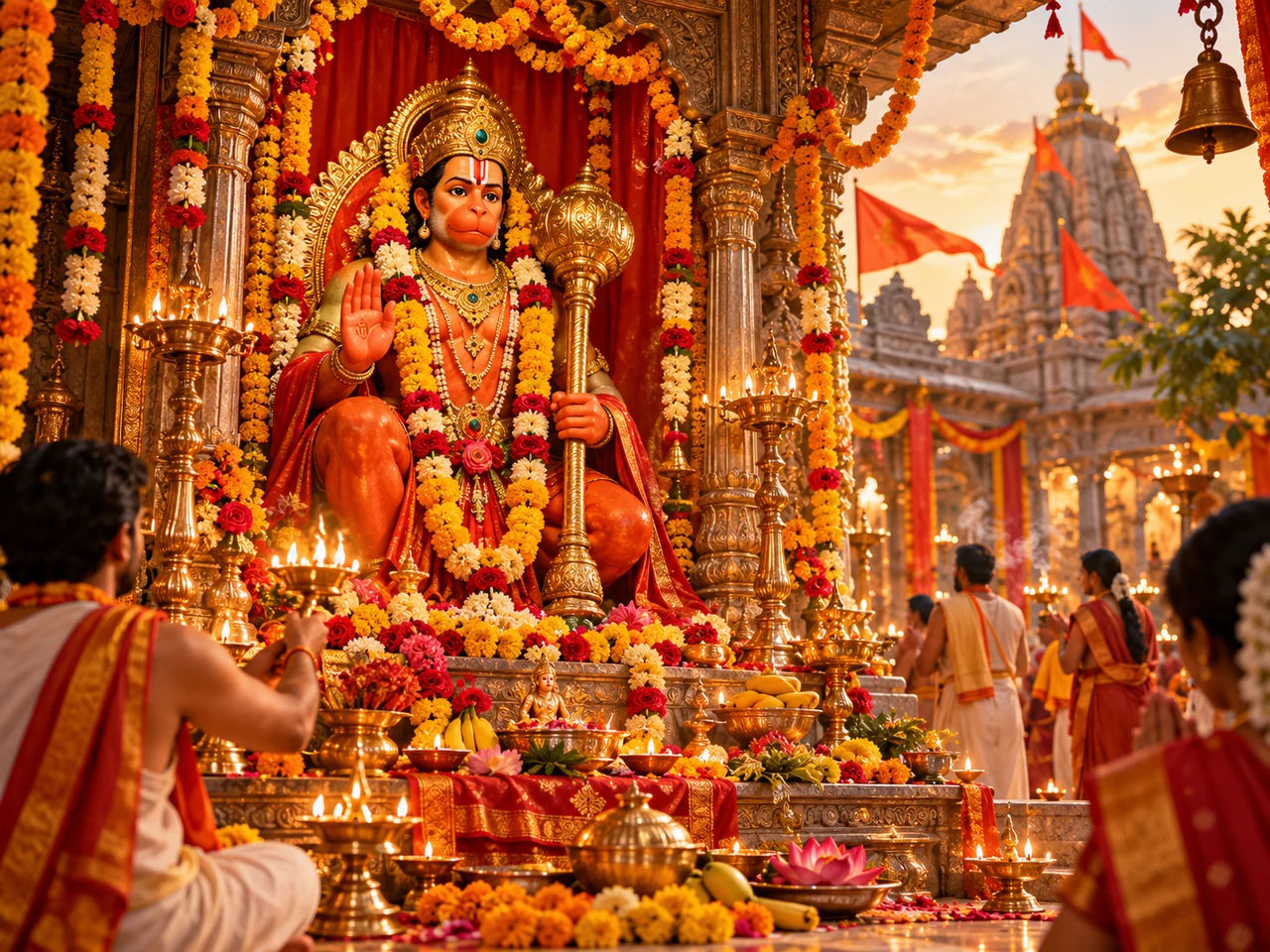
At a Hanuman shrine, a devotee may come with a garland and a small box of sweets; another brings the Ramayana to read; a child knows Hanuman first as the heroic figure who crossed the sea. The heart of Hanuman Jayanti, also called Hanuman Janmotsav, is broader than a celebration of extraordinary strength. It remembers a hero whose greatest gift, in the devotional imagination, was his willingness to place that strength in the service of Rama and Sita. 2, 3, 4
The festival honours Hanuman—Anjaneya, Maruti, Pavanputra, Bajrangbali, Mahavir and Rama-bhakta—yet there is no single universally observed Hanuman Jayanti date across India. Chaitra Purnima is common in North India and parts of western India; other Hindu communities honour Hanuman on notably different lunar or solar occasions. Understanding that variety is essential both to celebrating thoughtfully and to reading a Hindu calendar correctly. 6, 7
What is Hanuman Jayanti, and why is it celebrated?
The word jayanti is widely used for an anniversary of sacred birth; janmotsav directly means a celebration of birth. Devotees remember the appearance of Hanuman, traditionally described as born to Anjana and associated with Kesari and Vayu, the wind deity. Both names for the festival are current. A preference for janmotsav in some communities reflects the belief that Hanuman is chiranjeevi—ever-living—not a reason to reject the familiar name Hanuman Jayanti. 1, 6
The celebration invites devotees to contemplate four qualities together: bala, the capacity to act; buddhi, discernment and skill; bhakti, devotion; and seva, service. These meanings emerge from Hanuman's conduct in the Ramayana. He knows when to speak with delicacy, when to take a courageous risk, and when to put another person's well-being before his own reputation. The festival therefore concerns moral purpose as much as physical prowess. 2, 3, 4
For many worshippers, prayer to Hanuman is an expression of confidence and humility during difficulty. Traditional hymns speak of protection from fear and obstacles, but these are statements of faith, not guarantees of medical cures, exam success, financial results or supernatural intervention. Keeping that distinction makes room for devotion without turning it into a transaction.
Anjana, Kesari and Vayu
In Valmiki Ramayana, Kishkindha Kanda, sarga 66, the elder Jambavan urges Hanuman to remember his exceptional strength before the leap to Lanka. In that address he recounts Anjana's background, her connection with Kesari, and the role of the wind deity in Hanuman's birth. The same scene portrays a crucial transformation: the hero already possesses the ability, but encouragement awakens his determination to use it. 1
Different retellings describe Anjana's penance, the blessings of divine beings and Hanuman's arrival in different ways. It is more accurate to speak of a family of sacred birth narratives than to present every detail of one retelling as the sole story accepted by all Hindu traditions. Pavanputra (son of the Wind) and Anjaneya (son of Anjana) preserve two of the most familiar associations.
The child who reached toward the Sun
A beloved narrative tells of young Hanuman taking the rising Sun for a fruit and rushing toward it. The story appears in textual and devotional retellings; the Shiva Purana, in the inspected Shatarudra Samhita, chapter 20, also presents this childhood episode. It is told to convey youthful energy, divine protection and the beginning of Hanuman's remarkable learning, not to describe a historical astronomical event. 5
Is Hanuman an incarnation of Shiva?
In some Shaiva and related devotional traditions Hanuman is revered as a manifestation or amsha of Shiva/Rudra. This is not merely an unsourced modern slogan: the Shiva Purana, Shatarudra Samhita 20, explicitly tells Hanuman's story in a Shiva-incarnation framework and connects it with help offered to Rama. The Valmiki Ramayana passages inspected for this article tell the Anjana–Vayu story without requiring that identical theological framing. Readers may encounter both, and neither should be silently imposed on every community. 1, 5
For ShivGoraksh, this is a meaningful link between Shaiva reverence and devotion to Rama: the traditions can meet in selfless service, without pretending that Hanuman Jayanti is universally a Shiva festival. The familiar name Shankar refers to Shiva in many contexts; it does not establish another distinct deity for this narrative.
An intelligent envoy, not only a powerful warrior
Hanuman first approaches Rama and Lakshmana as Sugriva's representative in Kishkindha Kanda 3. His words are careful and his purpose is diplomatic. This chapter is important because it portrays Hanuman as a discerning messenger before the famous heroic exploits begin. His greatness includes listening, judgment and the ability to build trust. 2
The leap across the sea
In Sundara Kanda 1, Hanuman sets out in search of Sita and crosses the ocean toward Lanka. Obstacles test his resolve and ingenuity. The narrative's great leap has become a symbol of going beyond fear in the service of a just task. It also explains why the Sundara Kanda is especially important to Hanuman devotees: the book gives extended attention to his efforts, decisions and encounter with Sita. 3
Bringing assurance to Sita
Finding Sita is not simply a feat of speed. Hanuman must convince a woman held captive in a hostile place that he truly comes from Rama. Sundara Kanda 36 describes the ring he brings as a sign of recognition and reassurance. His purpose is not to announce his own glory but to deliver hope faithfully and carefully. 4
In later devotional teaching, Hanuman is consequently remembered as the ideal dasya-bhakta—one whose devotion finds expression in devoted service. Stories of carrying healing herbs for Lakshmana, protecting Rama's companions and returning with good news deepen that portrait. The precise telling of each episode differs across editions and retellings; not every popular image should be presented as a word-for-word quotation from Valmiki.
When is Hanuman Jayanti celebrated?
There is no one India-wide rule. The best-known North Indian profile is Chaitra Shukla Purnima—the full-moon Tithi of Chaitra. This is also observed in several Maharashtra and other western Indian communities. But the same deity is honoured under other regional traditions, some tied to a different lunar month and another tied to a solar transition. 6, 7, 8
| Region or tradition | Commonly described annual observance | Essential qualification |
|---|---|---|
| North India and many Maharashtra communities | Chaitra Purnima | Local Tithi and sunrise conventions must be reviewed; a pan-Indian fixed civil date is invalid. |
| Andhra Pradesh and Telangana | Vaishakha Krishna Dashami in a tradition associated with a period of Hanuman Deeksha beginning at Chaitra Purnima | The often-described 41-day span belongs to a particular observance convention, not every household. |
| Karnataka | Margashirsha Shukla Trayodashi, often called Hanuman Vratam | Temple, regional and household practice may vary; do not force this on every Karnataka community. |
| Tamil Nadu | Margazhi / Margashirsha Amavasya, commonly associated in tradition with Mula Nakshatra | Tamil solar-month naming, new-moon Tithi and nakshatra must be handled as separate inputs. |
| Odisha | Pana Sankranti / Maha Vishuba Sankranti, at the traditional Mesha solar ingress | This is a solar New Year festival with Hanuman's birth observance, not Chaitra Purnima under another label. |
| Some Ayodhya or Diwali-linked traditions | A Hanuman celebration around Kartik Krishna Chaturdashi, associated with the Diwali cycle | Requires separate temple/tradition verification; do not replace the Chaitra profile automatically. |
These distinctions are reported by a contemporary Panchang reference, while Odisha Tourism independently confirms that Pana Sankranti is locally celebrated as Hanuman's birth anniversary. The listed rules are editorial descriptions, not approved code or published occurrence dates. 6, 7, 8
A Tithi is a lunar day based on the changing angular separation of Sun and Moon. It does not begin at a fixed civil midnight. In the North Indian profile, a particular sunrise may be relevant; in Tamil Nadu an Amavasya associated with a named solar month raises different questions; Odisha needs an ingress time. Therefore the right display is “Hanuman Jayanti under [named regional profile] for [selected city]”, generated from independently reviewed calendar rules. Until then, ShivGoraksh must show: “Date/timing not yet verified for this city/year.”
What about a belief that Hanuman was born at sunrise on a Tuesday? Such details circulate in religious calendar literature, sometimes with Chitra Nakshatra and Mesha Lagna. They are devotional calendrical claims, not an authenticated historical timestamp and not sufficient to calculate the festival. No universal sunrise, birth-hour or Muhurta should be invented. 6
At home: devotion without unnecessary complication
One ordinary household pattern is to clean a worship space, place an image of Hanuman or the Rama family there, light a lamp safely, offer flowers or fruit, and remember Hanuman's service to Rama. Some households read or listen to the Hanuman Chalisa, portions of the Sundara Kanda, or episodes of the Ramayana. Others make time for simple acts of service or charity. These are examples, not a universal mandatory rite. 6, 9
Offerings can include boondi or besan laddus, jaggery and gram, bananas, flowers or other vegetarian food according to family custom. In many temples, sindoor and oil are part of the adornment called chola. The well-known explanation that Hanuman covered himself in sindoor out of love for Rama is a devotional popular story; the article does not attribute that episode to the inspected Valmiki Ramayana passages. Not every image, temple or tradition invites devotees to apply substances directly to a murti; follow local instructions. 9
The practice of chanting “Ram” or a familiar Hanuman prayer emphasises attention and remembrance. The Hanuman Chalisa, traditionally attributed to Tulsidas, belongs to later vernacular devotional literature; it is not a chapter of the Sanskrit Valmiki Ramayana. Likewise a Sundara Kanda recitation should be identified by the actual Ramayana version used—Valmiki's and Tulsidas's tellings should not be silently conflated. 3, 9
In temples and community celebrations
Temples may arrange special puja, arati, readings, bhajan singing and prasada distribution. Some communities undertake processions, collective readings or food service. The rhythm can be lively, with drums and gatherings, or quiet, with the emphasis on prayer. Temple programmes, attire, permitted offerings, crowds and schedules vary widely and must never be guessed from a national festival description. 6, 9
Voluntary fasting is observed by some devotees, but its food rules, duration and the time of ending it vary by family and tradition. Fasting is not an eligibility test for devotion, and this article does not prescribe dehydration or a strict fast for children, pregnant people, people who are ill or anyone for whom fasting may be unsafe. Ask a trusted family or temple authority for community-specific practice, and qualified medical guidance for health concerns.
Why Tuesdays and Saturdays are often associated with Hanuman
Hanuman worship on Tuesday and Saturday is common in many regions outside the annual festival. These weekly customs can involve Chalisa recitation, temple visits and particular offerings. They are regular devotional practices, not alternative formulas for generating the annual Hanuman Jayanti date. Folk explanations involving Mangala or Shani belong to the devotional and astrological tradition, not empirically established effects. 9
North India: Hanuman Janmotsav and Rama devotion
In Uttar Pradesh, Bihar, Rajasthan, Haryana, Delhi and other northern settings, the festival is widely associated with Chaitra Purnima. An image of Hanuman beside Rama, Sita and Lakshmana makes its central message readily visible: force directed by loyalty and compassion. Families visit temples, read the Chalisa or Sundara Kanda and share prasada. Local variations in puja time and community celebrations matter more than assuming one standard procedure. 6
Ayodhya deserves its own note. Published Panchang guidance also reports a prominent Kartik Krishna Chaturdashi-linked Hanuman Janmotsav tradition at Hanumangarhi around Diwali. That local calendar practice should remain a separate named observance profile or related temple event, rather than be erased by the national Chaitra article or mechanically duplicated as an approved date. The temple's current practice and exact event naming require direct verification. 8
Maharashtra and the wider west
Many Maharashtra communities keep Hanuman Jayanti on Chaitra Purnima; worship may be associated with early-day offerings and community readings. Do not assume the ritual's exact hour is uniform throughout the state. Different local temples and family lineages preserve their own forms, and travellers should consult a temple's published schedule rather than a static article. 6, 9
Andhra Pradesh and Telangana: Hanuman Deeksha
In important Telugu observance patterns, devotees undertake a Deeksha period beginning at Chaitra Purnima and culminating at Vaishakha Krishna Dashami. Contemporary festival guides often describe this as a forty-one-day cycle. Such vows can involve special clothing, disciplined living and prayer according to a teacher or temple's rules. It would be misleading to turn this tradition-specific vow into a compulsory public-facing step-by-step instruction or to conclude that every Telugu Hanuman shrine uses an identical date. 6
Karnataka: Hanuman Vratam
A prominently described Kannada calendar profile places Hanuman Vratam at Margashirsha Shukla Trayodashi, rather than Chaitra Purnima. Its local devotional life includes Anjaneya worship and readings, but the lunar rule and temple practice require explicit Karnataka-profile verification. A person should not be shown the North Indian date merely because an app defaulted to a generic “India” calendar. 6
Tamil Nadu: Hanumath Jayanthi
Many Tamil observances celebrate Hanumath Jayanthi in Margazhi, associated with Amavasya and, in some accounts, Mula Nakshatra. The emphasis on Tamil solar-month context means that “Margashirsha Amavasya” is an imperfect shortcut unless the chosen almanac convention is made explicit. In these communities Hanuman is often called Anjaneyar. The article does not assign a universal date to Kerala or other neighbouring regions solely by analogy. 6, 10
Odisha: Hanuman devotion at Pana Sankranti
Odisha's practice is especially distinctive. Pana Sankranti, or Maha Vishuba Sankranti, ushers in the Odia New Year and is associated with the Sun's traditional entry into Mesha. The Odisha Tourism department identifies it also as a celebration of Hanuman's birth, with Hanuman worship among several temple traditions. The sharing of bela pana, a seasonal drink, belongs to the wider festival culture. It would be a calendar error to relabel this solar observance as the Chaitra full moon. 7
What do Hanuman's familiar symbols mean?
- Gada (mace): an image of disciplined capability; strength matters because it protects and serves.
- Folded hands before Rama and Sita: devotion without a claim to personal supremacy.
- The mountain of healing herbs: a widely loved episode of determination to help Lakshmana; details vary between tellings.
- The long leap and the small messenger's form: knowing when to be bold and when to be unobtrusive.
- Sindoor-coloured icons: associated with well-established practices of temple adornment; the explanatory legend is devotional, not a universal textual rule. 3, 4, 5, 9
Hanuman is often called Sankat Mochan—one who relieves distress—in prayer and poetry. The term expresses trust in divine help; it need not erase ordinary duties to seek help, care for others and act responsibly.
Hanuman Jayanti and the wider ShivGoraksh learning journey
Hanuman's story connects naturally with Rama Navami and the devotional Ramayana tradition. It also links, in the specific Shiva Purana tradition, with Shiva/Rudra. But these relationships have different meanings: Rama Navami is Rama's birth festival; Hanuman Jayanti honours Hanuman, and neither should inherit the other's calendar rule. Chaitra Purnima also has its own recurring Purnima observance, which must not be treated as synonymous with Hanuman Jayanti. 5, 6
The important spiritual question at the close of this festival is simple: Where can I put my courage, attention and ability to genuinely good use? Hanuman's example suggests that greatness does not end in force or applause. It matures in judgment, loyalty, kindness and service.