



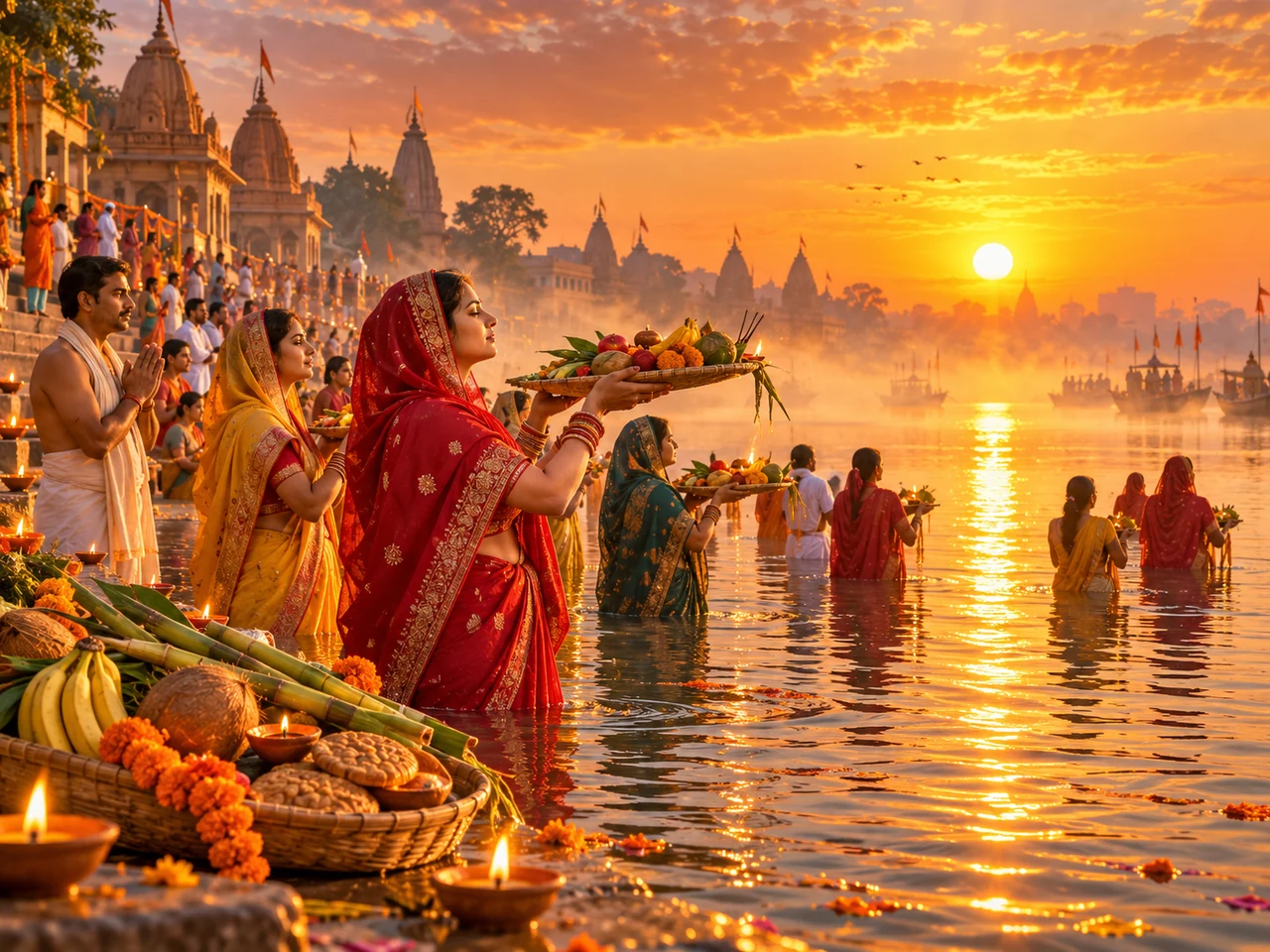
Chhath Puja (छठ पूजा), or Surya Shashthi, is a festival of gratitude, discipline, family cooperation and devotion closely associated with Bihar, eastern Uttar Pradesh, Jharkhand and the Mithila–Terai cultural region. Its most recognizable moment is an offering to the setting sun, followed the next morning by an offering to the rising sun. 1 2 3
When people return to a riverbank carrying bamboo trays of fruit and handmade sweets, the ceremony expresses more than a wish for good fortune. The water, the seasonal harvest, the waiting at dusk, and the gathering again at dawn form a language of devotion learned within families. The person keeping the vow—often called a vrati or parvaitin—stands at the centre of an effort supported by relatives, neighbours and friends. Not every household performs every part identically; the shared commitment is to a worshipful, carefully prepared offering to Surya and Chhathi Maiya. 1 6
Chhath at a glance
| Question | Short answer |
|---|---|
| What is celebrated? | Devotion to Surya (the Sun deity) and Chhathi Maiya, a maternal protective figure in regional worship. |
| What does Chhath mean? | A name associated with shashthi, the sixth lunar Tithi. |
| When does the principal festival recur? | Around Kartika Shukla Shashthi, in the bright fortnight after Diwali; a second observance, Chaiti Chhath, occurs around Chaitra Shukla Shashthi. |
| How long does it last? | The customary major framework has four days, leading from preparations to two main arghyas. |
| What makes the public worship distinctive? | Arghya—an offering of water and devotion—is made near sunset and again at the following sunrise. |
| Where is it prominent? | Bihar, eastern Uttar Pradesh, Jharkhand, Nepal's Madhesh/Terai region, and migrant communities elsewhere. |
The table describes an educational pattern, not a calculation of this year's dates. A city-specific, reviewed Panchang must establish each observance day and the local solar-event times. 1 2 3
What the names mean
Chhath, Chhathi, and Shashthi all draw attention to the sixth lunar day. Surya Shashthi highlights devotion to Surya; Chhath Mahaparv reflects the occasion's extraordinary importance in many Bihari households. The term Kartik Chhath generally identifies the widely observed autumn festival; Chaiti Chhath refers to its spring counterpart. In Nepali contexts, Chhat Parva is also encountered. Spellings reflect Bhojpuri, Maithili, Magahi, Hindi, Nepali and other regional languages rather than separate competing religious systems. 2 3 6
Chhathi Maiya is not simply a decorative alternate name for the physical sun. She is invoked in living family worship as a compassionate maternal presence associated with children's and household well-being. Some practitioners connect her with Shashthi Devi, while others use the language of Surya's sister or the dawn's divine power. These are devotional identifications that vary in telling; they should not be collapsed into one textually established genealogy. Likewise, Usha and Pratyusha appear in explanations of dawn and dusk, but identifying them unconditionally with Chhathi Maiya goes beyond what the sources inspected here establish. 6 7
Why people observe Chhath
Surya is visible to everyone: daylight shapes farming, time, seasons and everyday life. For devotees, worship of Surya gives a religious expression to gratitude for the conditions that sustain life. The Vedic tradition contains praise of Surya—for example Rigveda 1.50, a hymn whose text directly addresses the Sun. That hymn provides genuine evidence of an old devotional vocabulary of solar worship; it does not, by itself, prescribe the present-day four-day Chhath festival. 4 5
Many households pray for the welfare of children and relatives, the fulfilment of vows, or simply the opportunity to express thanks. Such wishes are statements of religious hope, not medically or scientifically established results of performing a particular rite. The attention to cleanliness and preparation is equally meaningful: before the community gathers at the water, kitchens, ingredients, vessels and spaces are readied with care. 1 6
The celebration also teaches that devotion is shared work. A vrati's observance may require time, cooking, carrying baskets and accompanying relatives to the ghat. Those who do not fast still participate meaningfully. In many families, women are prominent ritual leaders, but the vow and supporting roles are not restricted to one gender. Ghat means a riverside or waterside set of steps or access point; a safe designated pond or other water setting may serve a comparable social role. 1 3
The four-day sequence
The following is the widely described Bihar–Purvanchal framework. Ritual language, household offerings and the way days are counted differ. These are explanations of customary practice, not instructions requiring anyone to undertake a demanding fast. 1 2 6
Day 1 — Nahay Khay (नहाय-खाय)
Nahay means bathing and khay means eating. The first day is marked by bathing or cleaning, attention to the home and cooking space, and a simple meal prepared under the family's customary purity rules. In parts of Bihar, people associate this meal with plain rice, seasonal vegetables such as bottle gourd, and uncomplicated food. The important idea is preparing the household—not purchasing impressive ingredients or performing a public spectacle. The ritual bath may take place at a natural waterbody where appropriate; access and safety conditions vary. 1 6
Day 2 — Kharna or Lohanda (खरना / लोहंडा)
On Kharna, the vrati commonly observes a daytime fast and, after the household evening worship, takes a modest offering such as jaggery-based rice kheer, sometimes with roti or fruit according to family practice. Prasad is shared with those who have gathered. In a number of traditions this meal precedes a further prolonged period of abstinence extending across both arghya ceremonies. Public descriptions often mention a waterless fast, but they are reporting a demanding custom, not a requirement suitable for every person's health or circumstances. 1 2 6
Day 3 — Sandhya Arghya (संध्या अर्घ्य)
Preparation reaches its most visible point. Families arrange soop (bamboo winnowing trays) and daura (baskets) with produce, thekua and other offerings. People proceed to a river, pond or designated ghat and wait for the setting sun. Water offered with folded hands or a vessel is part of the act of arghya. The community's songs, patient waiting and the careful arrangement of prasad are as memorable as the brief solar moment itself. In some households, a Kosi Bharna or similar observance involves sugarcane supports and lamps at night; this is a particular custom, not a compulsory fifth stage. 1 2
The sunset here is the local astronomical event, not an hour that can be copied between Patna, Delhi and Janakpur. The festival's lunar Tithi and the solar-event boundary raise separate questions for the Calendar team. Their resolution belongs in the reviewed rule and occurrence record, not in an evergreen article.
Day 4 — Usha Arghya and Parana (उषा अर्घ्य एवं पारण)
Before sunrise, families gather again with offerings. They greet the rising sun and complete the morning arghya; the customary vow concludes with parana—breaking the fast—and distribution of prasad. After intense preparation, the return home is a moment of relief, generosity and reunion. The sequence's arc from dusk to dawn is often read as a reminder that gratitude belongs to endings as well as beginnings. 1 2
When is Chhath in the Hindu calendar?
The main observance is linked with Kartika Shukla Shashthi, the sixth Tithi of the bright fortnight in the lunar month Kartika. The larger four-day sequence is customarily described from Shukla Chaturthi through Shukla Saptami: preparatory day, Kharna, evening arghya, then morning arghya. Chaiti Chhath follows a corresponding observance in Chaitra Shukla Paksha. The latter receives less public attention in some places, but it is a real and continuing religious observance rather than an invented alternative date for Kartik Chhath. 2
A Tithi is a lunar phase interval and does not necessarily begin or end at a civil midnight. Consequently, a regional almanac may show two adjacent civil dates touched by Shashthi, while the sunset arghya and following sunrise remain distinct moments. There is no safe shortcut such as selecting a festival solely because Shashthi appears at sunrise. A verified calculation must consider the applicable ritual-day profile, locally computed Tithi boundaries, sunset for the evening rite, next-day sunrise for the morning rite, and documented exceptions. We do not endorse a universal tie-break here.
In both Purnimanta and Amanta month systems the bright-fortnight month naming frequently aligns, but Nepalese calendar usage and local observance decisions still require explicit profiling rather than inference. The Kartik and Chaiti seasonal observances have separate calendar contexts; neither has a universally fixed Gregorian date.
Chhathi Maiya, Surya and the stories families tell
The festival's devotional world includes songs and stories told around the household fire or while preparing prasad. Some recount Karna, who is associated with Surya in the Mahabharata; others connect the observance with Draupadi, Sita, or a story of King Priyavrata and Shashthi Devi. These associations illustrate how communities relate their own vows to familiar sacred characters. They should be introduced as popular or later devotional accounts, not as proof that the extant epic contains today's four-stage Chhath instructions. this edition has not established a reliable precise primary-text passage for those complete festival-origin claims, so none is supplied. 5
A historical distinction follows. Vedic praise of Surya is old; the precise antiquity of the present Chhath complex is a different question. Cultural geographer Rana P. B. Singh discusses Chhath as a regional festival whose wider reach has grown with migration and warns against assuming an uncomplicated direct line from ancient solar worship to today's form. That scholarship is useful context, not a definitive date of origin. 5
Where Chhath is celebrated
Bihar: The festival is woven into family memory and public life in the Bhojpuri, Maithili and Magahi cultural regions. River and pond ghats, neighbourhood contributions, the making of soop and daura, and collective preparations all matter. Bihar's tourism department documents Kharna, the two arghyas, folk songs and the optional Kosi custom. 1
Eastern Uttar Pradesh and Jharkhand: Many communities share related Chhath practices and local vernacular songs. In the eastern Gangetic region the festival is not simply a copy of a metropolitan public event; household ritual commitments and neighbourhood cooperation remain central. State-level government descriptions and public reporting support its presence across this larger region. 2 6 8
Nepal's Madhesh/Terai and Kathmandu: The Nepal Tourism Board describes celebrations in Janakpur and gatherings along the Bagmati in Kathmandu. Its public overview counts the most visible preparation-and-arghya sequence as three days, unlike the common Indian four-day framework. That difference is a useful warning: a tourist summary's number of days need not describe every family's entire vow. Nepali terminology, water sites and household practices deserve their own reviewed regional treatment. 3
Beyond the home region: Families who moved for work or education have carried Chhath into Indian cities. Published geographical research specifically notes celebrations involving migrant communities in Delhi and Mumbai. A community's access to a safe, permitted site may shape the arrangements, but the essential intent of sunset and sunrise gratitude remains recognizable. 5
Offerings, foods and the meaning of simple materials
Thekua, a sturdy sweet commonly prepared from wheat flour with jaggery or sugar, is among the best-known Chhath offerings. Families may also prepare kasar or rice-based sweets and Kharna's jaggery kheer. Seasonal bananas, coconut, sugarcane, citrus and other fruits appear in baskets, with choices influenced by locality and household custom. Do not treat any one inventory as universally mandatory. 2 6
Bamboo trays and baskets are practical objects transformed by careful preparation. Earthen lamps offer light, and sugarcane canopies appear in particular Kosi observances. Such materials connect the rite to work, cultivation and everyday life. Chhath is sometimes described as environmentally attentive because its imagery features sunlight, water and unelaborate offerings. That ethical interpretation does not make every real-world gathering automatically low-impact: safe paths, clean water, responsible disposal and respect for other users of a riverbank are still important. 1
Music, family responsibility and respectful participation
Chhath songs in Bhojpuri, Maithili, Magahi and other languages accompany travel to the ghat and work at home. Through a song, an older family member may explain a vow or remember someone absent; through food preparation, children learn who contributed what. A participant need not know every lyric or imitate another community's customs to show respect. The festival is best understood as a living regional heritage, not a standardized performance. 1 5
Many worshippers undertake severe dietary austerities, but there is no reason to present deprivation as a test of moral worth. Children, older adults, pregnant people and anyone whose health or medication makes fasting risky should not be pressured into a waterless observance. Watching from a safe place, helping carry supplies, keeping a ghat clean, or sharing food can also be meaningful participation. At sunrise or sunset, do not stare at the Sun; use common-sense precautions near deep or polluted water. These are safety principles, not new religious rules.
Spiritual meaning: honouring both dusk and dawn
In everyday life, people celebrate what is arriving and sometimes overlook what is ending. Chhath's pairing of setting and rising sun offers a gentle contrast: gratitude need not depend on the moment looking like a beginning. For some devotees, it is also a lesson in keeping promises, sharing labour, and approaching the divine without elaborate display. For others, the central emphasis is Chhathi Maiya's maternal care or Surya's life-sustaining presence.
Although ShivGoraksh places special attention on Shiva–Shakti and Nath traditions, it should not recast Chhath as a primarily Nath or Shaiva observance. Its regional Surya–Chhathi Maiya character deserves to remain intact. Where practitioners understand Chhathi Maiya within broader Shakti devotion, that may be discussed as a devotional connection, not a claim that all households share one sectarian theology.
Common confusions to avoid
- Chhath is not the same as Makar Sankranti: both involve the Sun, but Sankranti is associated with a solar ingress; Chhath is organized around a lunar Shashthi and two local solar events.
- Kartik Chhath and Chaiti Chhath are not one annual date: they are distinct seasonal occurrences.
- A Vedic Surya hymn is not proof of a four-day Vedic Chhath liturgy: the text and the living festival have different evidentiary histories.
- A fixed sunset time is not transferable between cities: even two nearby ghats may have different usable horizons and public arrangements.
- Not everyone performs the same fast, Kosi custom or priestly service: variations are normal and deserve precise attribution.