



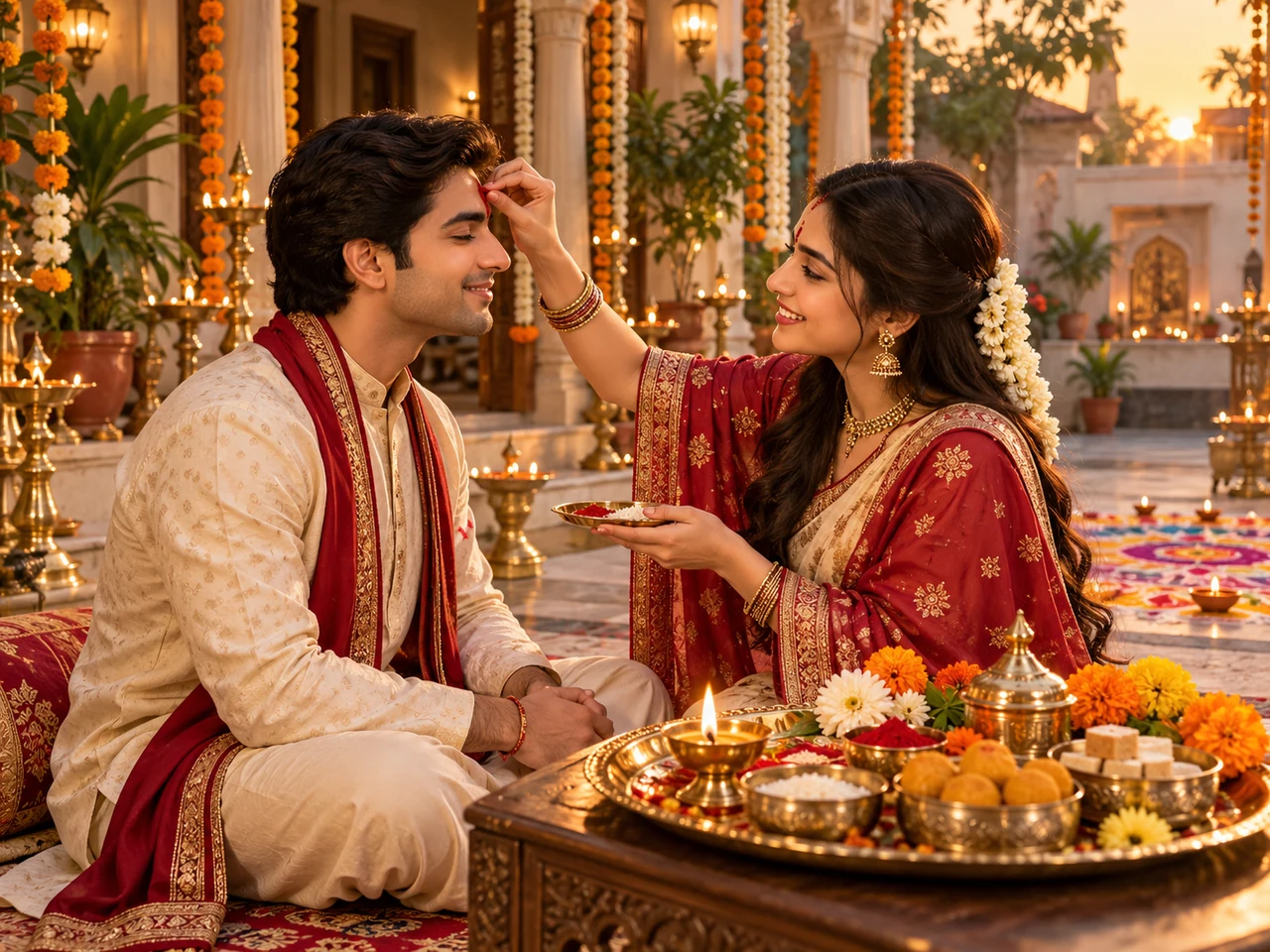
A sister welcomes her brother, marks his forehead, and sets a favourite meal before him. What looks like a small family gesture carries a large idea: relationships need time, hospitality and mutual care. Bhai Dooj, also called Bhaiya Dooj, Bhratri Dwitiya or Yama Dwitiya, is the annual sibling festival associated with Kartika Shukla Dwitiya in the Diwali cycle. 1 7
A family may gather around a carefully decorated plate; another may share sweets after a long journey. In Bengal the mark is a phonta; in Maharashtra the visit is called Bhau Beej; in Nepal the final day of Tihar becomes Bhai Tika. Their ceremonies are not interchangeable in every detail, but each asks siblings to recognise one another with affection and respect. 2 3 5
Bhai Dooj at a glance
| Question | Explanation |
|---|---|
| What is Bhai Dooj? | A festival of sibling affection, blessings and hospitality, often marked by a sister's tilak for a brother. |
| When is it observed? | Generally Kartika Shukla Dwitiya, after the Diwali new moon; the selected civil day depends on the local Panchang and tradition. |
| Other names | Bhaiya Dooj, Bhratri Dwitiya, Yama Dwitiya, Bhau Beej, Bhai Phonta/Phota and Bhai Tika, within relevant regions. |
| Principal narrative | Yama visits his sister Yamuna and accepts the meal she prepares. |
| Common activities | Welcome, tilak or phonta, prayers, affectionate conversation, festive food and reciprocal gifts. |
| Are the rituals universal? | No. Timing, materials, songs, food and family roles differ. |
| Where is my festival date? | The future reviewed Calendar module must provide a location-and-profile-specific occurrence; this article publishes none. |
What does the name mean?
Bhai means brother in several north Indian languages, while dooj is a vernacular name for dvitiya, the second lunar Tithi. Bhratri Dwitiya means the Dwitiya concerned with a brother; Yama Dwitiya links the day with the deity Yama. The festival's name points to both a calendar position and a relationship. The word tilak refers to a ceremonial forehead mark; Bengali phonta similarly refers to the mark central to Bhai Phonta. 1 5
A Tithi is determined by the changing angular separation of Moon and Sun. It does not always start at midnight or occupy one entire calendar date. Even though a family may say the festival is “two days after Diwali,” that is a conversational description of the cycle, not a reliable calculation rule for every location or exceptional year. 4
When is Bhai Dooj celebrated?
The usual Hindu calendar designation is Kartika Shukla Dwitiya, the second Tithi of the waxing fortnight following Diwali Amavasya. The chapter devoted to Yama Dwitiya in the Skanda Purana explicitly identifies this lunar occasion. In North India and in many other calendars the month is called Kartika; the festival is not assigned a fixed Gregorian day. 1
For the sibling-tilak observance, some contemporary Panchangs give special importance to Aparahna, the afternoon portion of local daytime. That is a relevant lead for calendar research, not a validated ShivGoraksh algorithm. The relevant Dwitiya interval may straddle two civil dates; local sunrise and sunset and reviewed convention rules are essential. Sunrise-Tithi alone must not be used to settle every disputed case. 4
Bengali panjika practice deserves its own profile. Accounts of Bhai Phonta discuss households that use Pratipad for a mark or use Dwitiya, with different ways of organising the meal. Nepal's Bhai Tika belongs to the Tihar sequence and may be accompanied by an officially advised local auspicious time. Neither tradition should silently inherit a North Indian Aparahna choice. 5 8 9
The exact festival date and any recommended tilak interval must be supplied separately by an approved, location-specific Calendar occurrence. If one is unavailable, the page should say that its timing has not yet been verified, rather than offering a guessed date.
The Yama and Yamuna story: a text that can be located
Yama, also known as Dharmaraja, is associated with death and the ethical consequences of action. Yamuna is venerated as a river goddess. In the festival narrative, the siblings' meeting changes the mood from fear of death to the warmth of welcome. Although later retellings use many details, the core story is not merely an uncited modern invention. 1
A directly inspected passage occurs in the Skanda Purana, Vaishnava Khanda, Karttikamasa Mahatmya, Chapter 11, a chapter dedicated to Yamadvitiya. Verses 19 and 31–36 recall Yama being honoured and fed by Yamuna. Verses 41–53 tell the fuller story: Yamuna repeatedly asks her busy brother to visit; he finally arrives, receives food and hospitality, offers a boon, and hears her wish that brothers and sisters share happiness on this day. The chapter's teaching also places unusual emphasis on the brother honouring the sister and eating in her home. 1
This is a Puranic devotional account, not historical documentation of a datable event. Promised freedom from fear of death or the consequences of sin belongs to its religious discourse. Such promises can be explained respectfully without being presented as outcomes anyone can guarantee.
An instructive detail is sometimes lost in short social-media versions: the text is not only about receiving a mark on the forehead. It dwells on food offered by the sister, affection reciprocated by the brother, and respect shown to female relatives. That makes hospitality and reciprocity central to understanding the festival rather than treating the sister as a person who simply performs a service.
Why does Yamuna's hospitality matter?
A shared meal requires an invitation, an arrival and attention. In the Yama–Yamuna episode, those ordinary acts become spiritually meaningful. The river goddess does not defeat death through a military battle; she receives her brother as a guest and asks for the welfare of others. The deity who normally embodies a difficult reality appears here as a member of a family. 1
People may draw different lessons from the scene. For a devotee, it expresses a blessing sought from Yama and Yamuna. For a family, it is a reminder to visit rather than assume that kinship maintains itself. For children it offers a simple story about remembering people who care for us. None of these interpretations requires claiming that every regional rite descends without change from the same text.
Is Krishna and Subhadra's story also connected?
Another widely recounted story says that Subhadra welcomed her brother Krishna, offered him sweets or a tilak, and rejoiced after his victory over Narakasura. Cultural retellings associate this episode with Bhai Dooj. It can be included as a popular devotional explanation, but a specific early passage establishing this complete festival episode has not been independently located for this edition. 5
It would therefore be misleading to quote a precise verse from the Mahabharata or the Bhagavata Purana as though it had been verified. The Krishna–Subhadra retelling and the chapter of the Skanda Purana about Yama–Yamuna are distinct layers of festival narration. The first should remain qualified until a matching textual witness is identified.
What is the spiritual meaning of Bhai Dooj?
The obvious answer is affection between a sister and brother, but the festival's symbolism is wider. A forehead mark becomes a visible wish for well-being; a meal becomes an act of honour; a visit renews responsibility. The sister is not depicted as less worthy of blessing: the Puranic passage includes the brother honouring her in return. 1
Many families pray for ayu (long life), arogya (good health) or mangal (welfare). These are aspirations expressed through faith. They should not be confused with measurable assurances against illness or death. A thoughtful reading emphasises goodwill and continuing care after the festive day has passed.
In homes where inheritance, marriage, work or travel has created distance, the festival can also remind relatives that siblings should not be defined solely by property, duties or expectations. Respectful conversation, genuine consent and the freedom to celebrate simply are more valuable than an expensive display.
How is Bhai Dooj celebrated at home?
The following is a description of common, public household customs, not a mandatory vidhi or a priestly ruling. Exact materials and the sequence vary across families and regional traditions. 1 2 7
- Family members arrange a welcoming space, sometimes with rangoli, flowers, a lamp or a small ritual plate.
- Siblings greet one another; in households where the custom is followed, the sister applies tilak, tika or phonta to her brother's forehead.
- Some families wave an aarti lamp, offer akshata (uncooked rice grains), sweets, flowers or locally customary blessings.
- The brother may receive a meal prepared in the sister's home or share a festive meal with the family. The importance of hospitality is especially clear in the Yamadvitiya textual account.
- The siblings exchange gifts, blessings or expressions of gratitude. In many households, elder members bless younger relatives as well.
The essential character of the gathering does not require an elaborate shrine, an expensive gift or a particular number of ceremonial items. Where a family follows a hereditary liturgy, that practice deserves respectful description, but a general web article should not claim to replace its teacher or priest.
The tilak, the meal and the gift: three small gestures
A tilak can be made with customary materials such as roli, sandalwood or other locally accepted substances. Bengali phonta may use combinations that are different from a north Indian tilak. There is no evidence from the sources in this edition for prescribing a universal colour, finger, number of dots or direction of seating. 5
The meal carries deeper significance than the sweets alone. In the Skanda Purana account, receiving food from a sister is itself foregrounded. Today the meal can be simple, adjusted to dietary needs and shared with relatives without making anyone uncomfortable. 1
Gifts are reciprocal rather than commercial obligations. A book, homemade food, a message or help with a responsibility may be meaningful. The festival is enriched when siblings ask each other how life is actually going, not simply whether a ritual was performed correctly.
Bhai Dooj in North India: Bhaiya Dooj and Yama Dwitiya
In much of Uttar Pradesh, Haryana, Rajasthan and neighbouring regions the festival is familiar as Bhai Dooj or Bhaiya Dooj. Many households focus on a sister's welcome, a forehead mark and food shared after Diwali. The broad shape is widely recognised, but even nearby families differ over small offerings and songs. 7
The region around Mathura adds a particularly striking connection to Yamuna. Reports from Vishram Ghat describe brothers and sisters visiting the Yamuna together on Yama Dwitiya and worshipping near the temple associated with Yama/Dharmaraja. This is a documented local pilgrimage tradition, not a requirement for every household and not a reason to advise unsupervised bathing in a river. 6
The Yama–Yamuna narrative thus has two lives: in domestic conversation around a meal and in a location-specific sacred-river observance. The article can explain both without assuming that the latter is universally followed.
Maharashtra: Bhau Beej and the end of the Diwali sequence
The Maharashtra tourism department identifies Bhau Beej as a sibling-focused occasion near the close of its Diwali sequence. Households may exchange visits, offer refreshments and express affection between sisters and brothers. The festival is closely connected to the broader atmosphere of faral—Diwali savouries and sweets—in Maharashtrian family gatherings. 2
The regional sequence may begin with Vasubaras and include Dhantrayodashi, Naraka Chaturdashi, Lakshmi Pujan and Balipratipada/Padwa. Descriptions of “the five days of Diwali” are helpful summaries, but they should not be treated as a rigid, identical itinerary across all Indian states. Bhau Beej is not the same occasion as the new-moon Lakshmi Puja. 2
West Bengal: Bhai Phonta and its spoken blessings
In Bengal the ceremony is often called Bhai Phonta or Bhai Phota (ভাইফোঁটা). A sister marks her brother's forehead while wishing for his welfare; families may gather for food and sweets, with blessings expressed in Bengali verse or rhyme. Reported ingredients and methods vary by locality and household. 5
The rhymes reveal a living tradition: words inherited from elders change across districts and family histories. Cultural reporting records different versions and discusses the distinction between folk verse and formal Sanskrit mantra. The absence of a single fixed wording is not evidence that one family has celebrated improperly. 5
Some Bengali families observe a mark on Pratipad and a meal on Dwitiya; others keep the ceremony on Dwitiya under a chosen panjika. This issue requires a distinct Bengali calendar profile and independent almanac verification rather than a blanket claim that a local custom overrules Kartika Shukla Dwitiya everywhere. 5 8
Nepal: Bhai Tika on the final day of Tihar
Nepal's Bhai Tika is a major part of Tihar, the festival period that also includes observances associated with crows, dogs, cows, Lakshmi and oxen. The Nepal Tourism Board places the sibling ceremony at the culmination of the sequence. Sisters place tika on brothers, exchange blessings, and relatives share food and gifts. It also notes that some communities exchange tika reciprocally. 3
Colourful tika and flower garlands are strongly associated with many Nepali celebrations, but ingredients and sequences are not identical among all communities. The Newar community's Mha Puja is a distinct observance within the wider Tihar period, not another name for Bhai Tika. 3
The Nepal Tourism Board additionally notes that families may seek auspicious hours for Bhai Tika through local astrological traditions. A Nepal-specific Calendar profile must not simply display a city-in-India Aparahna period or a copied date from a tourism article. 9
And what about other regional names?
Public reporting also mentions names such as Bhratri Dwitiya and Bhagini Hasta Bhojanam in particular eastern and southern contexts. Such labels point back to the sibling visit and shared food, but a list of names is not proof that every place uses identical fasting and tilak procedures. 5 7
Across communities, linguistic and family variations matter: some households welcome cousins who are treated as siblings, and others use the occasion for a broader reunion. The Skanda Purana itself discusses alternatives among female relatives where a man's sister is absent, showing that hospitality—not merely a fixed household composition—is meaningful within that textual setting. That passage is not a command to force participation today. 1
Is Bhai Dooj the same as Raksha Bandhan?
No. Both are widely associated with sibling affection, but Raksha Bandhan ordinarily centres on the tying of a rakhi during the Shravana Purnima period, while Bhai Dooj centres on a visit, tilak/phonta/tika and hospitality near Kartika Shukla Dwitiya. The traditions have distinct calendar requirements, material practices and local interpretations.
Nor is Bhai Dooj another name for Diwali Amavasya. Diwali's main Lakshmi Puja, Dhanteras, Govardhan Puja or Balipratipada and the sibling day form a related but regionally varied festival cycle. Treating them as separate calendar records preserves that cultural meaning. 2
What if siblings live far apart or a family has no brother or sister?
The historic custom often centres a sister blessing a brother, yet modern households can honour its underlying purpose without manufacturing a relationship or making anyone feel excluded. Some exchange calls, photos, letters or greetings. Some honour cousins or people who have held a sibling-like place in their lives. For others, remembering a loved one quietly may be the most respectful observance.
These are contemporary social adaptations, not claims that a particular ritual manual mandates a video call or that every community agrees on who may exchange tilak. The most enduring principle is mutual dignity, not policing family structure. A sister's well-being deserves attention alongside her brother's.
Must sisters fast? Must brothers bring expensive gifts?
No single uniform fast emerges from the regional cultural evidence examined here. Some families maintain household fasting customs; many describe a meal and blessing rather than a strict fast. Practices cannot be safely generalised into a compulsory prescription, and no health-related promise should be attached to fasting. 1 5
Similarly, presents may be exchanged as affection allows. A festival concerned with care becomes poorer if a person borrows money to purchase a ceremonial gift. Hospitality can be warm and economical. Individual observance, particularly where dietary, accessibility or family constraints matter, should remain considerate.
Why Bhai Dooj still matters
The festival offers an annual invitation to revisit a relationship that daily responsibilities can push to the margins. Its strongest images are not of grandeur but of recognition: somebody comes home, someone prepares a place, and both leave with the knowledge that they matter to each other.
The Yama–Yamuna narrative adds an unexpectedly moving turn: even the deity linked with death is welcomed as a brother. When translated into daily conduct, the festival's message becomes practical—stay in contact, make room at the table, listen generously, and support one another beyond the day itself. 1
1. What is Bhai Dooj?
An annual sibling celebration involving affection, wishes for well-being, tilak or phonta in many homes, and a shared meal. 1 7
2. Why is it called Yama Dwitiya?
The festival is linked to a Puranic narrative in which Yama receives hospitality from his sister Yamuna on Kartika Shukla Dwitiya. 1
3. Which Hindu Tithi is associated with it?
Kartika Shukla Dwitiya is the standard designation. A verified calendar must separately select the local civil date and any observance window. 1 4
4. Does Bhai Dooj have a fixed Gregorian date?
No. A lunar Tithi and local convention determine the occurrence; do not reuse a date from an unrelated city or year. 4
5. Is Aparahna important for the tilak?
Some present-day Panchangs consider local Aparahna, but exact overlap and tie-break rules need a reviewed, named convention profile. 4
6. Is Bhai Dooj different from Raksha Bandhan?
Yes. Raksha Bandhan commonly involves a rakhi in Shravana; Bhai Dooj focuses on a sibling visit, mark and meal near Kartika Dwitiya.
7. Is Bhau Beej another name for Bhai Dooj?
Yes, in Maharashtra and related communities. Its place in the Diwali sequence is described by Maharashtra Tourism. 2
8. What is Bhai Phonta?
It is the Bengali form, centred on a forehead phonta, blessings, rhymes and family hospitality. Ritual details and local Panjika practices vary. 5 8
9. What is Bhai Tika in Nepal?
It is the sibling-focused final part of the Tihar sequence, with tika, blessings, food and gifts; practices may differ by community. 3
10. Does the Krishna–Subhadra story come from a verified verse?
this edition treats it as a popular narrative. A specific primary-text passage for the full Bhai Dooj episode has not been independently verified. 5
11. Are fasting and expensive gifts compulsory?
No universal rule was established by the inspected sources. Family practices differ, and affection need not be measured through fasting or spending.
12. Where is the verified Bhai Dooj date for my city?
It must come from the separately reviewed ShivGoraksh calendar occurrence. Until approved, the appropriate display is “Date/timing not yet verified for this city/year.”